
Translated material
Life on loan. How Russia goes into debt to continue the war and what consequences this will have
The war and the high budget costs associated with it are forcing Russia to borrow more and more. The government plans to cover almost the entire budget deficit for next year by borrowing from the domestic market. This week, the government increased the government debt allocation plan for the last quarter of 2025 by 2.3 trillion rubles. Officials often say that Russia can borrow on the market without any problems, since the country still has a very low level of public debt by world standards. But servicing this is becoming more and more expensive, the purchase of OFZ by state banks can contribute to inflation, and the appetite of the state can make borrowed funds more expensive for business.
More and more debts
The war has become costly for the Russian budget: in 2025, the authorities had to adjust budget parameters twice. In the latest amendments introduced to the State Duma, it amounted to 5.7 trillion (2.6% of GDP) instead of the planned 1.17 trillion (0.5%). In absolute terms, this is the largest gap between budget revenues and expenditures in the entire history of modern Russia. In relative terms, things were worse only in the pandemic year of 2020, when the deficit was 3.8% of GDP.
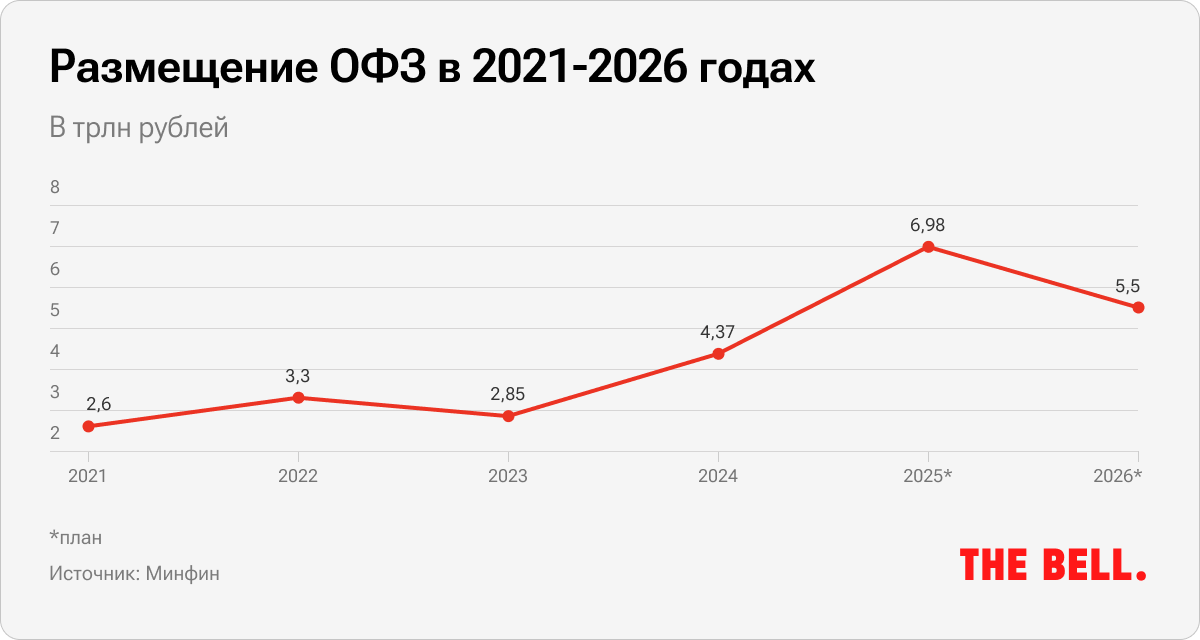
The authorities want to finance the increased deficit through new borrowings on the domestic debt market. When the state borrows money, part of it always goes to pay off old obligations. Three months before the end of 2025, the Ministry of Finance decided to increase ( .doc ) the annual volume of OFZ placement by 2.2 trillion rubles - this is almost half of the entire originally planned volume of borrowings for 2025 (4.781 trillion rubles). In total, therefore, in 2025 the state will borrow 6.981 trillion rubles, of which 1.416 trillion rubles will be used to pay off old obligations.
To prevent this situation from repeating in 2026, the government decided to raise taxes again. But this will not be enough - the deficit for next year is already planned at 3.786 trillion rubles or 1.6% of GDP. The main source of covering it will again be government borrowing, as follows from the draft budget. In 2026, the Ministry of Finance plans ( .doc ) to attract 5.509 trillion rubles in the domestic market. Of these, 1.337 trillion will be used to pay off old debt, and 3.98 trillion rubles will be used to finance the 2026 deficit. The other two sources of covering the budget deficit—the National Welfare Fund (NWF) and profits from privatization—will provide incomparably less: 38.5 billion and 3.2 billion rubles, respectively.
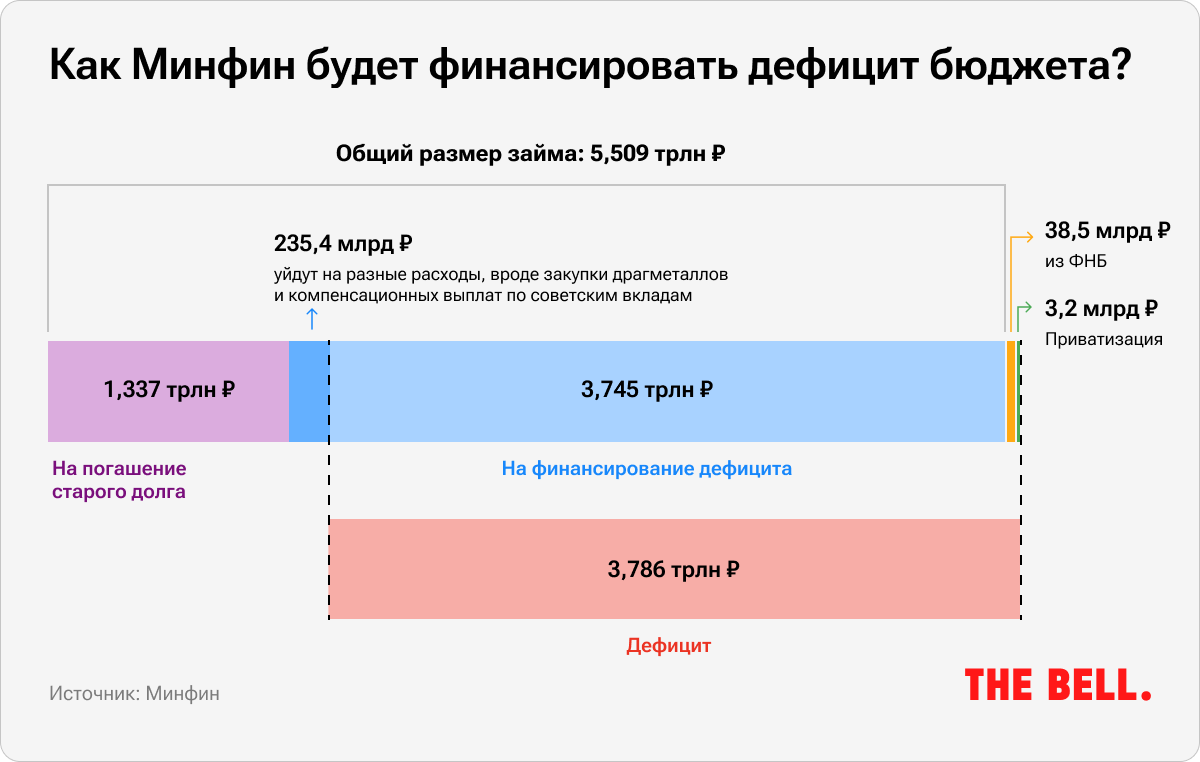
This means that the authorities, in fact, completely refuse to finance the deficit with money from the oil and gas box. The decision that the liquid part of the fund would no longer be used to finance the budget deficit was made at a summer economic meeting with Putin, who does not like the idea of zeroing out the National Welfare Fund for this purpose, The Bell wrote in August.
Over the course of three and a half years of war, the government has already spent more than half of the liquid part of the National Welfare Fund reserves, covering the budget deficit from it. As of September 1, 2025, the National Welfare Fund had 3.93 trillion rubles, or $48.9 billion in liquid funds. As of February 1, 2022, this figure was 8.779 trillion rubles, or $112.698 billion. Such a bold pace of spending national reserves in conditions of low oil prices could lead to a rapid depletion of the fund’s funds.
How much can you borrow?
The sanctions introduced in 2022 completely cut off Russia from the international capital market, so loans are now taken only on the domestic market - and there are no problems with the placement of government bonds there. Already at the end of September, the Ministry of Finance exceeded the federal loan plan for the third quarter, placing 1.5 trillion rubles. And this week he announced that he was increasing the OFZ placement plan for the next, fourth quarter, more than doubling - from 1.5 trillion to 3.8 trillion. The level of demand for Russian government securities, which allowed the Ministry of Finance to break the historical record for placement volume on November 12, leaves no doubt that this ambitious plan will be fulfilled.
The largest buyers of government securities are state banks, which in general are the largest investors in Russia in terms of assets and capital, states Natalya Milchakova, leading analyst at Freedom Finance Global. For banks, OFZ is an attractive, liquid and risk-free (if we do not consider apocalyptic scenarios) asset, the presence of which on the balance sheet helps the bank to easily comply with Central Bank regulations. And the rush demand at the last auction for the placement of OFZs was explained by the fact that the Ministry of Finance for the first time in 11 months sold floaters - bonds with a variable coupon, the interest rate on which is tied to the Central Bank rate. Such securities remove from banks (and transfer to the budget) the risk of losses in the event of rising rates.
Where do state banks get trillions to buy OFZ? By and large, the state prints them itself. Of course, the process of “printing money” is not so simple (we described exactly how here ). In fact, money emission occurs at the moment when the state decides to spend more than it can earn through taxes and duties - that is, it approves a budget with a deficit. But financing this deficit by placing OFZs is the most direct emission mechanism.
The very fact of selling OFZ to a bank is an exchange of assets (money is exchanged for securities). An increase in money in the monetary system occurs at the moment when this money “goes out” from the Central Bank to commercial banks. It works like this. Suppose a bank buys OFZ for 100 million rubles, this money goes to the account of the Ministry of Finance at the Central Bank. The same bank pledges securities to the Central Bank and receives liquidity, which becomes loans to the real sector. At the same time, the Ministry of Finance is spending 100 million rubles received for OFZs. As a result, the amount of money in the monetary system increases by those same 100 million.
Unpleasant consequences
The placement of public debt is the most pro-inflationary mechanism for financing the budget deficit. That is why Elvira Nabiullina welcomed the September decision to increase VAT, even despite the fact that the increase in this tax would spur inflation by 1 percentage point. The alternative would be to increase the budget deficit through borrowing - and this would be “a source of persistent inflationary pressure,” she explained. “Increasing VAT is much less pro-inflationary than financing the deficit by increasing public debt,” Nabiullina repeated at the end of October, speaking in the Federation Council.
True, another economist working in Russia notes that the pro-inflationary effect of growing public debt cannot be assessed in isolation from other economic factors. “Purchasing debt will automatically increase the amount of money in circulation, but it is still difficult to predict what consequences this will lead to; everything will depend on how much demand grows, what happens with the overheating of the economy, and so on,” he says.
Another problem that an increase in borrowing can lead to is the government pulling over free resources in the financial market, the Central Bank pointed out . By actively borrowing money on the domestic market, it competes with companies for bank loans and investments and, being a much more reliable borrower, wins this competition.
Active and massive placement of the Ministry of Finance can generate increased premiums for placement, and this translates into higher rates on corporate debt, says the chief economist of a large Russian broker. As a result, it becomes more expensive for companies to borrow in the market. The Ministry of Finance's large placement overhang was one of the reasons for the very high spreads between government and corporate bonds in the fourth quarter of 2024. Thus, spreads among second-tier issuers were almost four times higher than a year earlier.
How much can you borrow?
The low current level of Russian public debt is often cited as an argument in favor of the fact that Russia can easily finance the budget deficit for a long time by issuing OFZs. “You will say: “Well, what’s wrong, let’s do 20–25%.” Yes, we can go further, as many countries do,” Finance Minister Anton Siluanov flaunted in September.
By world standards, Russian government debt is now really low. At the end of 2025, it should amount to 38.553 trillion rubles (17.7% of GDP), and in 2026 it should grow to 43.668 trillion rubles or 18.6% of GDP. For comparison, in the eurozone the average level of public debt is 81.8% of GDP.
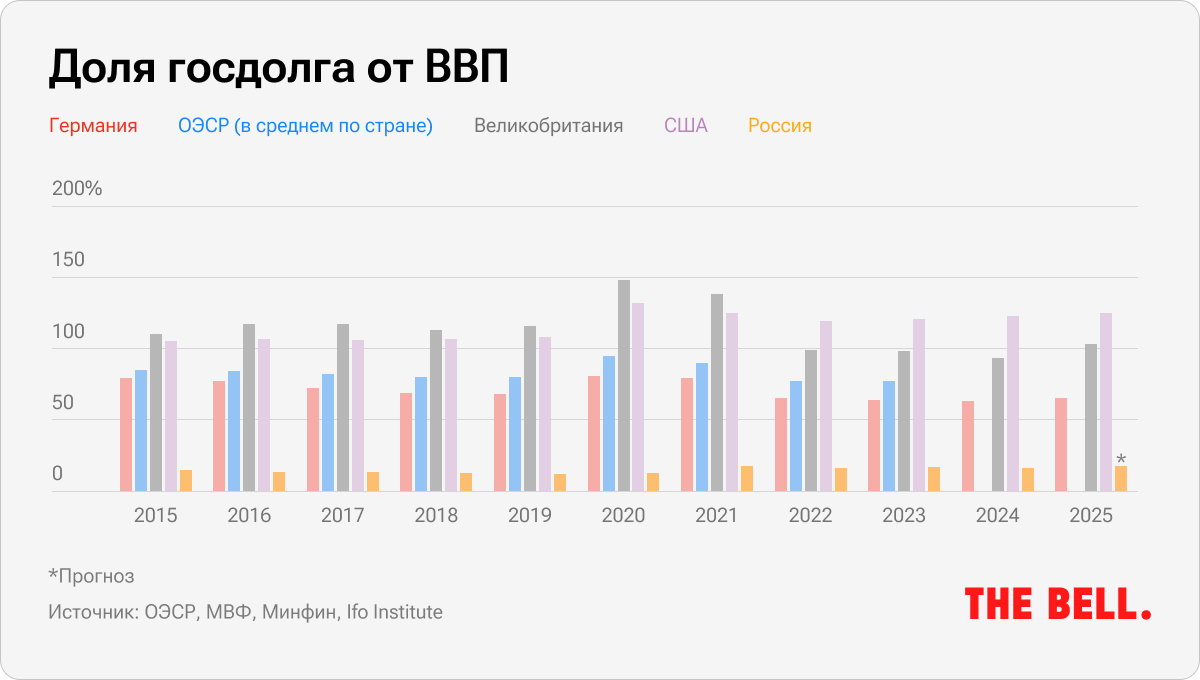
Such a low debt is largely a consequence of the 1998 default, when Russia, amid falling energy prices and the Asian financial crisis, was unable to repay investors who had invested in Russian government short-term bonds. The level of public debt in 1999 was 92.1% of GDP, unthinkable for the country today. For Vladimir Putin, who just took office as president, paying off this debt and reducing inflation have become fundamental priorities. The conservative monetary policy pursued for this purpose in the 2000-2010s became possible thanks to rising oil prices and high economic growth rates.
But there are also arguments against a rapid increase in the level of public debt, Siluanov admitted in the same speech. Among the main obstacles, he named the low capacity of the financial market compared to developed economies, the lack of external investors and the high cost of servicing. “Perhaps the most important thing is that the more we borrow, the less opportunity the Central Bank will have to reduce the interest rate,” Siluanov said.
There are other reasons, pointed out Yuri Danilov, leading researcher at the Department of Macroeconomic Policy and Strategic Management of Moscow State University. Firstly, the ruble has lost its status as a freely convertible currency after 2022, and secondly, there is no long-term money in Russia, that is, funds used for long-term investments (the largest long-term money was the money of non-residents). Therefore, it would be correct to compare the amount of public debt with those countries where similar restrictions exist - for example, with Indonesia, Romania or Saudi Arabia. The ratio of public debt to GDP in these countries is 27%, 20% and 16% respectively.
Is it expensive to pay interest?
Now it’s very expensive. Almost the entire government debt is ruble borrowing (in 2026, the share of the ruble in the government debt will be 85.7%, and by 2028 - already 88.2%). Servicing ruble debt in the context of a double-digit key rate of the Central Bank is not cheap and is becoming more expensive every year - and the prospect of a rapid reduction in the rate is becoming increasingly vague: the July forecast of the Central Bank provides for an average rate for 2025 of 18.8-19.6%, for 2026 - 12-13%.
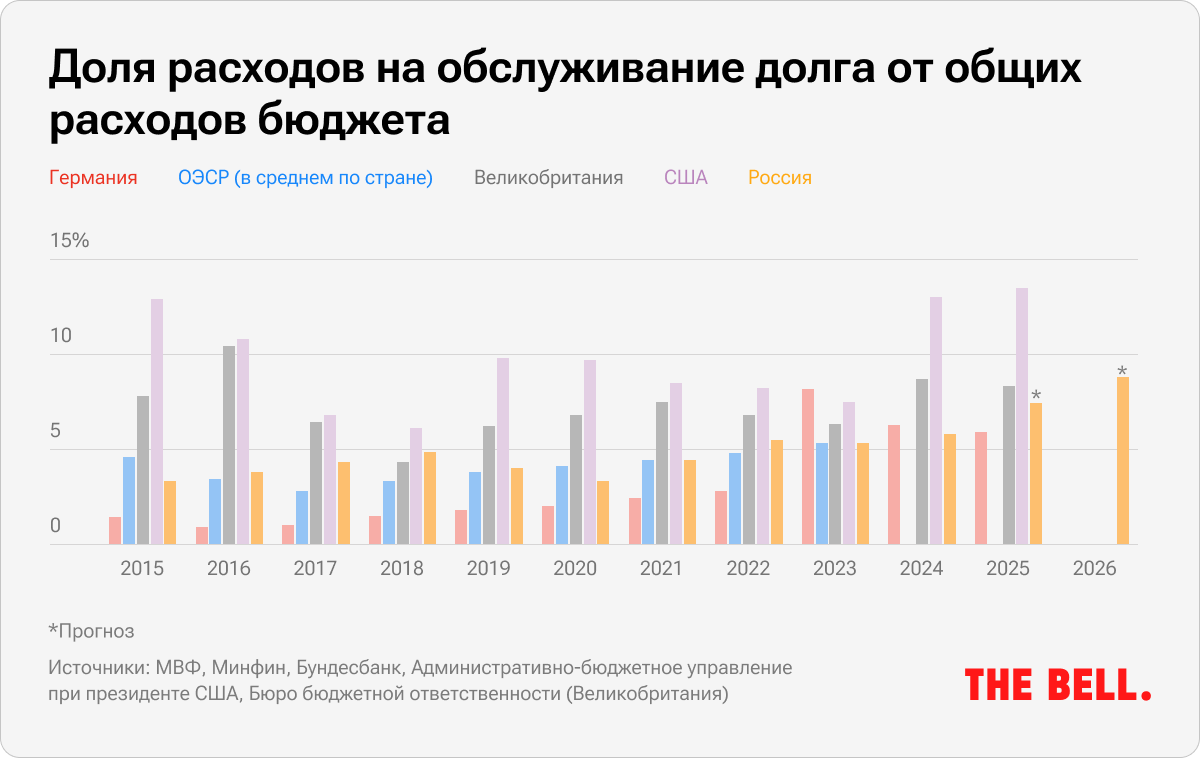
In 2025, expenses for servicing the national debt should amount to 3.181 trillion rubles (1.46% of GDP), in 2026 - already 3.9 trillion rubles (1.7% of GDP). This is more than budget expenditures on education and healthcare combined (3.62 trillion rubles in 2026). Before the war, the budget spent half as much on servicing the national debt - in 2019-2020, approximately 0.7% of GDP, in 2021 - 0.8% of GDP.
What's next
As can be seen from the speeches of Nabiullina and Siluanov, in the economic bloc, governments are aware of the restrictions and arguments against increasing the volume of borrowing. Vladimir Putin, who considers Russia's low public debt an important personal achievement, should be able to listen to these arguments. This is also why in the fall the government took a difficult and unpopular measure - for the second year in a row (after the introduction of a progressive personal income tax scale and an increase in income tax in 2024) it increased taxes .
After this, in 2026 the state is unlikely to go for a third tax increase in a row, suggests Natalya Milchakova from Freedom Finance Global. But she does not rule out introducing some kind of one-time taxes for individual companies or industries. In conditions of budgetary austerity, the government simply has no other options. For example, there is no more money to finance import substitution in electronics, and instead, from 2026, electronics manufacturers and importers will now have to pay a special “technological fee” on each unit of goods produced or imported.
However, by raising taxes, the authorities risk facing a new problem - falling into a tax spiral, that is, when the state introduces new taxes, trying to compensate for the poor collection of those already introduced, says the chief economist of a large Russian broker. In 2025, taxes were already raised in Russia: the authorities introduced a progressive personal income tax scale, according to which tax rates for high-income Russians increased, and also increased the income tax rate from 20% to 25%. But tax collection in the context of slowing economic growth and cooling demand leaves much to be desired, which the Ministry of Finance itself admitted . Therefore, the draft amendments to the budget law for 2025 provide ( .doc ) for reducing the forecast for non-oil and gas revenues - from 30.2 trillion rubles to 27.9 trillion rubles.
“Having learned to avoid the debt spiral, it's almost like we're now worried about getting into a tax spiral. When everything is tight, taxes have increased, everything else has not decreased, and the Central Bank’s policy has not softened. And so, it turns out, we are heading for the second or third round of tax increases,” the economist adds.
What's in it for me?
If a government systematically spends more than it earns, it has no good solutions left. In order for the budget to remain balanced, it is necessary to either reduce expenses (but 40% of expenses go to the military and security forces, and no one will reduce these expenses during or immediately after the war), or increase taxes (but this has already been done twice in the last two years). Financing the budget deficit through the growth of public debt is a tool with very limited possibilities, even taking into account the low level of Russian public debt.