Azerbaijan demanded to rewrite the document on partnership between Armenia and the EU. Baku acts in the interests of Turkey, ignoring the EU - political scientist • The Insider • RIMA — Russian Independent Media Archive
Azerbaijan demanded to rewrite the document on partnership between Armenia and the EU. Baku acts in the interests of Turkey, ignoring the EU - political scientist
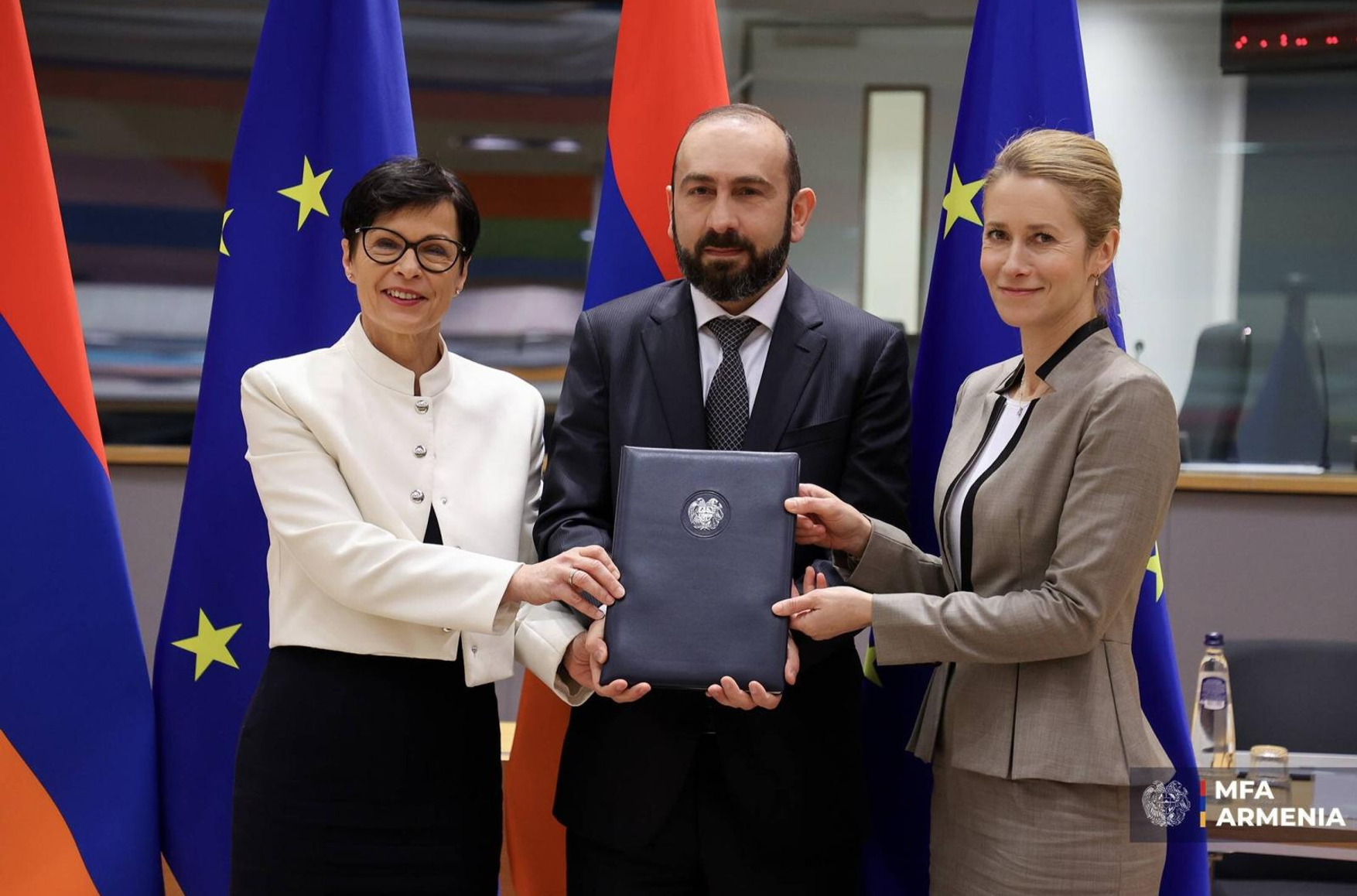
Ararat Mirzoyan and Kaya Kallas (right) at the signing of the Strategic Agenda for Partnership between Armenia and the EU. Photo: Ministry of Foreign Affairs of Armenia
Armenia and the European Union signed a Strategic Partnership Agenda in early December. The entire text of the document was published on the website of the Armenian Foreign Ministry. After some time, the Azerbaijani Foreign Ministry protested, saying that the mention of certain topics in the document “contradicts the peace agenda between Azerbaijan and Armenia,” and also accusing the EU of interfering in bilateral relations between neighboring countries.
Baku was displeased by the mention of refugees from Nagorno-Karabakh. The Azerbaijani authorities continue to insist that the Armenian population, who fled the region amid hostilities launched by the Azerbaijani army, left their homes “voluntarily” <The European Parliament in its resolutionequatedthe forced displacement of Karabakh Armenians to ethnic cleansing - The Insider> . “Also, defining this issue as one of the priorities of the partnership between the EU and Armenia and designating this category of people as refugees is an obvious manifestation of bias against Azerbaijan,” the Foreign Ministry said in a statement.
The Azerbaijani side further states that “calling prisoners of Armenian origin accused and convicted of crimes against humanity and war crimes, as well as defining their release as a separate priority, is a serious distortion of reality and is unacceptable.” <The European Parliament in its resolutioncallsArmenian prisoners held in Baku hostages, and their trials are a fiction - The Insider> .
In addition, Baku was dissatisfied with the “provision supporting the full, immediate and effective implementation of all relevant decisions of the International Court of Justice, [which] clearly implies the claims brought by Armenia against Azerbaijan”, as well as the lack of mention of the “Trump Route” ( TRIPP ). “We expect Armenia and the EU to take concrete steps to eliminate these undesirable provisions that do not reflect existing realities,” concluded the Azerbaijani Foreign Ministry.
The Armenian Foreign Ministry responded to these claims that cooperation between Yerevan and Brussels “contributes to efforts aimed at further strengthening peace in the region.”
As Narek Sukiasyan, a researcher at the Center for Civilizational and Cultural Studies, candidate of political sciences, said in an interview with The Insider,Baku is apparently looking for a reason to delay the peace process and blame Yerevan for this:
“Azerbaijan follows a strategy of absolute regional dominance, according to which all key policies must clearly correspond to its own national interests, even if they are not a priority. The country views any independent actions by Armenia that could bring tangible benefits to Yerevan as a threat. While Azerbaijan may even be interested in signing and concluding a peace agreement with Armenia, it will do so only after it is satisfied that any Armenian subjectivity it perceives as a potential distant threat will be eliminated. The agreement between the EU and Armenia is also viewed in this light.
It is hard not to notice the lack of sincerity in the peace commitments contained in the Azerbaijani Foreign Ministry statement, as if it is looking for an excuse to blame Armenia and abandon the process, while simultaneously looking for opportunities for escalation. Such a reaction could also be an adjustment to tensions between the US and the EU, and with the US as the main mediator in the process, Baku may be trying to win over Washington. In addition, Baku is interested in attracting post-conflict assistance and benefits from the EU, despite the fact that it is a source of aggression and demonstrates negative dynamics in the field of democracy and human rights. Baku may exert pressure on Brussels in the hope of gaining benefits for itself in other areas and issues.”
Political scientist, economist, senior researcher at the Caucasus Institute (Yerevan) Grant Mikaelyan believes that Baku will express its opinion on all strategic documents that Yerevan signs, while promoting the interests of Turkey:
“The problems that exist between Armenia and Azerbaijan cannot be resolved within the framework of diplomacy, because pan-Turkism does not presuppose the existence of Armenia. And this process is controlled not by Baku, but by Ankara. Baku is now a proxy force that takes upon itself to carry out some radical actions. Therefore, Baku makes speeches against the EU, Russia, Armenia, and so on, and Ankara simply regulates them. The problem is that first Russia and then the EU tried to resolve the conflict, ignoring this context. Nothing worked out for Russia, and now the EU finds itself at the same point.
Moscow, Brussels and Washington think that geopolitics in the region is determined either by Moscow or Brussels, and they see their task as seizing the initiative and adjusting everything to themselves. In reality, Türkiye is formatting the region for itself, and Russia’s departure does not mean the automatic arrival of the West.
The Azerbaijani Foreign Ministry expressed protest [against the Strategic Agenda for Partnership between Armenia and the EU]. How does this document relate to Azerbaijan? Everything is clear here: Azerbaijan wants to deprive Armenia of its sovereignty and make all its external relations controlled. Accordingly, Azerbaijan will have its own opinion on all strategic documents that Armenia will sign.
Can we say that Baku wants to disrupt the signing of the peace treaty and is looking for reasons for this? This is more than obvious. Pashinyan hoped for a peace treaty to be signed in 2021. Since the fall of 2021, negotiations began to move under the auspices of Brussels and Washington, and Pashinyan had great hope that he would finally make peace and everything would end. Baku constantly demanded new concessions, Pashinyan agreed to them, and Brussels and Washington pushed him towards this.
Now Baku wants to implement the corridor , and on its own terms, namely, without the Americans. If the Americans come, it will be on such terms that they can be pushed aside later. Turkey and Azerbaijan need communications that no one will control: neither Armenia, nor the United States, nor Russia or Iran.”
One of the key topics of negotiations between Armenia, Azerbaijan and Western countries remains the unblocking of communications in the South Caucasus (the Armenian-Azerbaijani border has been closed since the 1990s). There are three projects.
The so-called “Zangezur Corridor” promoted by Azerbaijan. Baku wants to receive a corridor with extraterritorial status (that is, without control by the Armenian authorities) to the exclave of Nakhichevan and through it to Turkey.
“Crossroads of the World” is a project presented by the Prime Minister of Armenia in 2023 and repeatedly mentioned in the Strategic Partnership Agenda. Within the framework of the project, it is proposed to create a wide network of communications in the South Caucasus that will connect Armenia, Georgia, Iran, Turkey, Azerbaijan and other countries.
Trump Route for International Peace and Prosperity (TRIPP). The project was first mentioned in the declaration that Ilham Aliyev and Nikol Pashinyan signed in August in Washington. The plan assumes that the United States will receive exclusive rights to develop a strategic transit corridor through the South Caucasus for a period of 99 years.
The document was signed in Brussels by Armenian Foreign Minister Ararat Mirzoyan and EU High Representative for Foreign Affairs and Security Policy Kaya Kallas.
The so-called “Zangezur Corridor”. Azerbaijan wants to receive a corridor with extraterritorial status to Nakhchivan, bordering Turkey, through the south of Armenia.