
Translated material
Fake by Dmitry Kiselev: Europe is beginning to understand that Putin is right
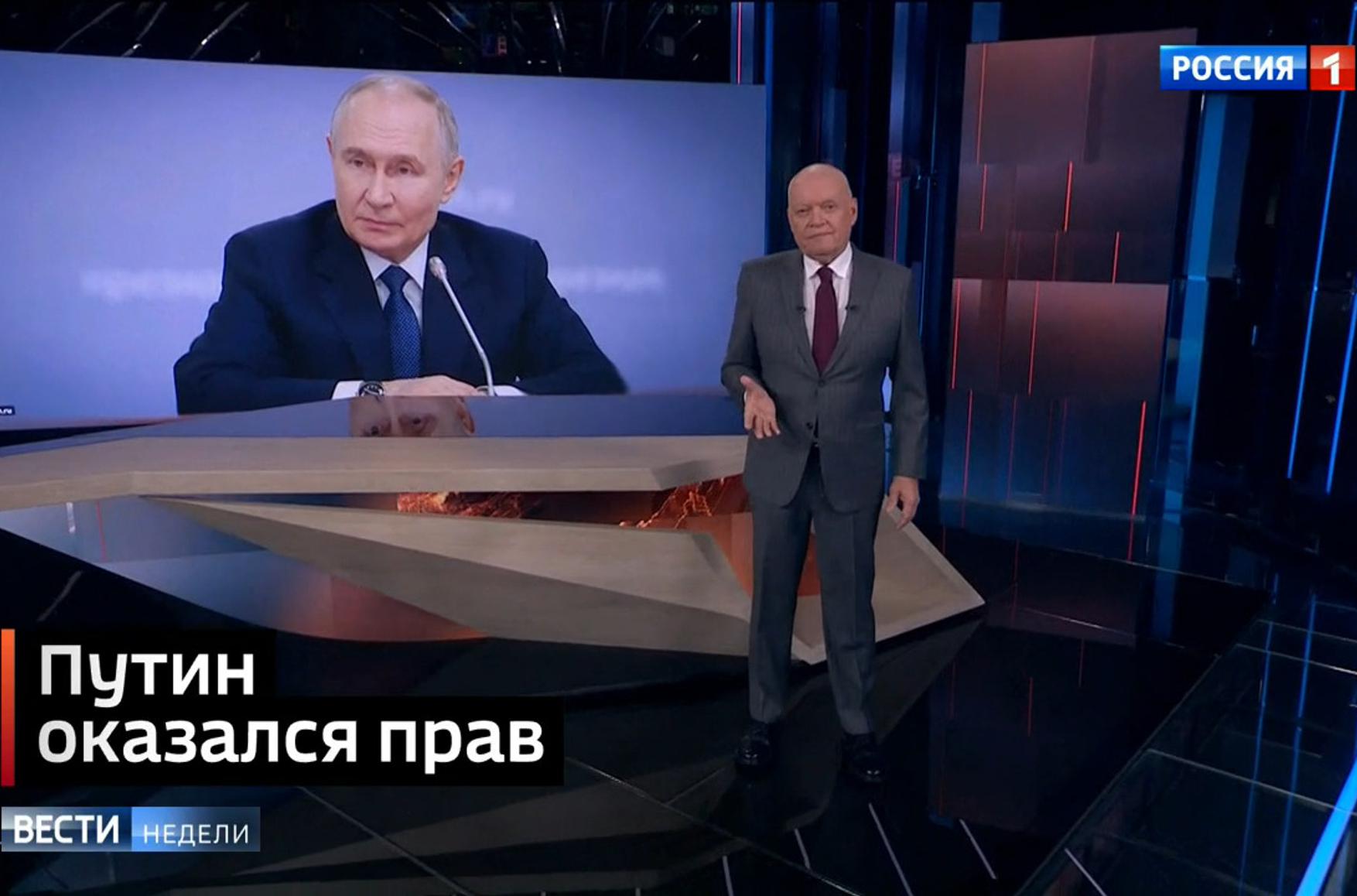
Fake by Dmitry Kiselev: Europe is beginning to understand that Putin is right
The Insider 19 January 2026One of Dmitry Kselev’s monologues in Vesti Nedeli is entitled “Europe has begun to realize that Putin is right.” The Kremlin chief propagandist says :
“But what makes the news less often are phenomena. It seems like there is no incident, nothing special happened, but suddenly the realization comes that something is different. It accumulated little by little, and then - bam. Phenomenon. That's how it is now. The phenomenon we want to draw your attention to is the awareness that Russia is right. An awareness that Russian President Putin fights for year after year, never tired of explaining both in a good way and in a different way. Today we will look at the signs of a new awareness that is making its way in the West. How do you like, for example, the Chancellor of Germany, who is already declaring that Russia is Europe? Something new, isn't it?
"Russia is a European country. If we manage to find a long-term balance with Russia, if there is peace, if freedom is guaranteed, if we achieve all this, ladies and gentlemen, then this European Union, then we, the Federal Republic of Germany, will pass another test, and then we can look with great confidence to the future after 2026. I wish this for us. I am confident that we will succeed."
To see “something new” here, you need to try really hard. Firstly, Merz here merely stated a well-known fact from the field of geography: Russia occupies about 40% of the territory of Europe and, therefore, is the largest European country. If this is “new” for Kiselev, it characterizes him, not Mertz. Secondly, he shortened the quote somewhat. In fact, a fragment of a speech at the New Year's reception of the Chamber of Commerce and Industry in Halle (Saxony-Anhalt) is translated as follows:
“And if we manage to ensure the return of peace and freedom to Europe, if we finally find a compromise with our largest European neighbor, namely Russia... And I’m not saying this because I’m here in the East. I say this anywhere else in Germany. Russia is a European country. If we manage to find a common language with Russia again in the long term, if peace reigns, if freedom is guaranteed, if we succeed in all this, ladies and gentlemen, then the European Union, and with it the Federal Republic of Germany, will pass another test, and then we will be able to look to the future with great confidence, even beyond 2026. I wish this for us. I'm sure we will succeed. Contribute to this."
That is, Merz is talking about the long term, about a future in which it will be possible to restore peace and freedom in Europe - in other words, about restoring relations with Russia in a post-war world in which, most importantly, freedom will be guaranteed; one must understand that he also means the freedom of Ukraine. In Kiselev's translation, the long-term perspective somehow miraculously turned into a long-term balance sheet. And it’s not clear what’s new in Mertz’s words, except that on New Year’s days he thought about the distant future.
But Kiselev continues:
“Chancellor Merz is wonderful here. “Long-term balance with Russia” - the freedom of peoples to live their own cultural way of life without oppression. This is exactly what Russia has been defending for decades. For Merz and Germany this is a “test”, but he is ready to call on the European Union to overcome it, which will ultimately give “confidence in the future.”
Putin has spoken about “balance” and “freedom” countless times. From a speech in the Bundestag in 2001 to Munich in 2007 and now very specifically - 5 years ago, in the summer of 2021 - about what the Nazis are doing to the Russians in Ukraine in general and in the Donbass in particular:
"We are talking about a forced change of identity. And the most disgusting thing is that Russians in Ukraine are forced not only to renounce their roots, from the generations of their ancestors, but also to believe that Russia is their enemy. It will not be an exaggeration to say that the course towards forced assimilation, towards the formation of an ethnically pure Ukrainian state, aggressive towards Russia, in its consequences is comparable to the use of weapons of mass destruction against us. As a result of such a crude, artificial separation of Russians and Ukrainians collectively, the Russian people may decrease by hundreds of thousands, or even millions.”
As a result, Russia was left with no choice but to act. And now Putin, on that memorable day of February 24, 2022, gave a televised address to the people, where he explained the motives for the start of the SVO:
"It is impossible to look at what is happening there without compassion. It was simply impossible to tolerate all of this. It was necessary to immediately stop this nightmare - genocide against the millions of people living there who rely only on Russia, hope only on you and me."
That is, according to Kiselev, Putin started the “SVO” for the sake of the freedom of peoples. As if he wasn’t the one who argued that the Ukrainian people do not exist at all, that they are part of the Russian people. Meanwhile, the Russian language in Ukraine until 2018 retained its regional status in a number of areas; Russian-language schools, theaters, TV channels, and radio stations operated in the country. The law “On ensuring the functioning of the Ukrainian language as a state language,” which abolished the official status of regional languages, was adopted only in 2019, 5 years after the start of Russia’s hybrid war against Ukraine. In essence, it was Russia’s aggressive anti-Ukrainian policy that led to the fact that the Russian language in Ukraine began to lose ground, and after the outbreak of a full-scale war it was almost completely forced out of the public sphere.
With other manifestations of the European “awareness that Putin is right,” Kiselev somehow did not work out very well. He quotes statements from Viktor Orbán and Robert Fico, who have always expressed themselves in a pro-Russian spirit. He also cites statements from Macron and Meloni:
“French President Macron loves to excite the public. Working for himself, in the new fashion, he is ready to rely on Putin: “I think that it will again be useful to talk with Vladimir Putin.”
He is echoed by Italian Prime Minister Giorgia Meloni: “I think that Macron is right in this: the moment has come when Europe should begin a dialogue with Russia.”
To see in the words of the leaders of states who continue to support Ukraine some kind of recognition of Putin’s rightness, a remarkable creative imagination is needed.
With this, Kiselyov’s list of government leaders who “understand Putin” is exhausted, and he moves on to private individuals:
“Even some foreign agents who, blinded, left their homeland, are already serving the cause of realizing that Russia is right. Now, being cut off from American funding after the closure of USAID, the reality is perceived more clearly.
Foreign agent Yulia Latynina: "I always laughed when they told us that America was behind all this. But I listen to the tape in which Nuland in 2014 discusses who to put in charge of Ukraine, and I have the feeling that I was massively screwed. And not even from the age of 14, but earlier. And I understand that the whole picture with which we joyfully came to the year 22 was painted with fake paints on a holey canvas. And that many of Putin’s theses were much more in line with reality. And I understand that they lied to me.”
Fact checker, founder of the Verified.media publication Ilya Ber examined Latynina’s arguments on the Breakfast Show; they are based on fakes - from the fact that journalist Pavel Kanygin was kidnapped by the Ukrainian side, that in 2014 they shot at protesters on the Maidan from a building controlled by the opposition, and that trees there were cut down specifically to hide the traces of bullets.
In addition, in his monologue, Kiselev also talks about Tucker Carlson, who, however, has no direct connection to Europe at all:
“And if we talk about the current awareness of our rightness, then the assessments of probably the most popular journalist in America, Tucker Carlson, are typical.
"As soon as you openly say: 'We're taking Venezuela because we're angry that they're selling our oil to the Chinese, our rivals,' once you just say it out loud (and honesty is good), it becomes very difficult to further assert, for example, that Russia supposedly has no interest in what's happening in eastern Ukraine. It's hard to blame Putin now for entering Ukraine. Here's a great power that's being threatened right outside its borders - and it takes actions to protect itself. How can it be considered wrong that a great power like Russia defends itself according to the rules by which we now operate - this is not at all wrong.”
That is, Kiselev, following Carlson, recognizes the right of the strong to take what he needs, regardless of whose property it is (about “our” oil, Carlson actually says that it is oil from “our hemisphere,” apparently believing that the entire Western Hemisphere belongs to the United States). But as for the supply of Venezuelan oil to China, he is clearly mistaken. TASS on January 18, in a material about Venezuela’s trade with China, noted :
“China directly imports oil from Venezuela, but in relatively small volumes: thus, according to the GTU, in 2024, China purchased 1.49 million tons of this energy carrier from this state (for comparison, Russia’s supplies for the same period to the Chinese side reached 108.4 million tons). In January – November 2025, Venezuelan oil exports to China amounted to only 341 thousand tons - this is 34th place among more than 40 oil exporters to China, after Mongolia and Cameroon.”
As Sergei Vakulenko, an expert at the Berlin Carnegie Center and former head of the department of strategy and innovation at Gazprom Neft, explains , although Venezuela has the world’s largest proven oil reserves, it is mainly heavy oil, difficult to extract, relatively cheap and requiring significant processing costs, so Carlson’s version does not look very convincing, as does his statement about the alleged threat to Russia from Ukraine.
We really need your help
Sign up for regular donations