
Translated material
Five nuclear-powered Titanics in one bay
Floating nuclear power plants, climate crisis and a new energy adventure in the Russian Arctic
Russia plans to power the infrastructure of the Baimsky mining and processing plant through several small floating nuclear power plants. Even land-based nuclear power plants carry risks and vulnerabilities, which are only intensified by the climate crisis. And floating stations may face additional problems. How reasonable is it to launch new floating nuclear power plants in the rapidly changing climate of the Arctic?
This is the second in a series of materials about the impact of large infrastructure projects in the Russian Arctic on nature and climate. The previous one was devoted to how sailing along the Northern Sea Route in an era of climate crisis can turn into an environmental disaster.
Imagine that there are as many as five floating nuclear power plants near your city. This is exactly the situation the residents of Pevek will soon find themselves in. The only floating nuclear power plant in the world is already located in the port, and soon four more will be brought to Chaun Bay. Less than five thousand people live in the city, and the stations are being transported to build and supply a mining plant with electricity.
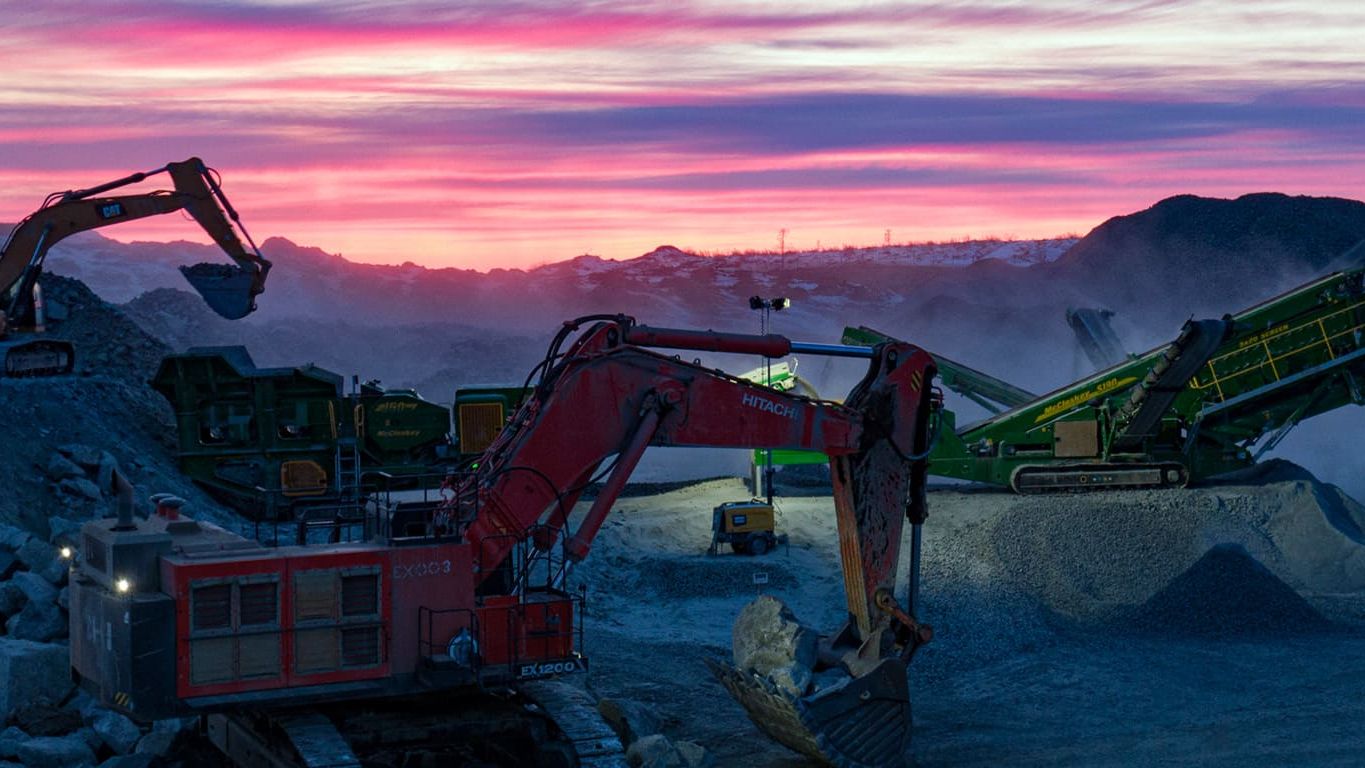
The Baimskoye deposit is one of the largest undeveloped deposits in the world, containing deposits of copper ore, as well as gold and silver. It is unique in that it is located in a sparsely populated, hard-to-reach area in Chukotka. To develop the subsoil, Russia is building the Baimsky mining and processing plant. This is a large-scale infrastructure project, which involves not only the construction of the plant itself, but also all the associated infrastructure. To power the project, Rosatom is building four small floating nuclear power plants, which they promise to launch before 2029 in a new port at Cape Nagluingyn.
Even land-based nuclear power plants carry risks that are only intensified by the climate crisis. The operation of floating stations implies additional vulnerabilities.
Data over the past year shows an unprecedented pace of climate change in the Arctic.
In 2025, record high temperatures were recorded in the last 125 years. Warming entails a whole chain of negative effects: the water becomes warmer and saltier, storms become stronger, the likelihood of destructive storms and abnormal precipitation increases, which lead to floods and landslides, which is especially dangerous in permafrost areas.
Nevertheless, Russia does not abandon the construction of floating nuclear power plants. Moreover, they are concentrated on the coast of Chukotka - the largest floating nuclear power plant, Akademik Lomonosov, is already located in the port of Pevek, and soon several more floating nuclear power plants will be located not far from it.
What could the use of high-risk energy in an equally high-risk region lead to, and are there alternatives?
Academician Lomonosov: man and floating nuclear power plant
Around the world, only Russia is building floating nuclear power plants.
The first such project is “Academician Lomonosov”. It was on this basis that MPEBs were designed for the Baimsky Mining and Processing Plant.
The station looks like a large barge 144 meters long and cannot move on its own. It houses two KLT-40S type reactor installations and residential buildings for employees. To get to the northernmost city of Russia, Pevek, the Akademik was towed along the Northern Sea Route along with a whole complex of coastal structures, and upon arrival, the entire brought complex was assembled on site and connected to the network.
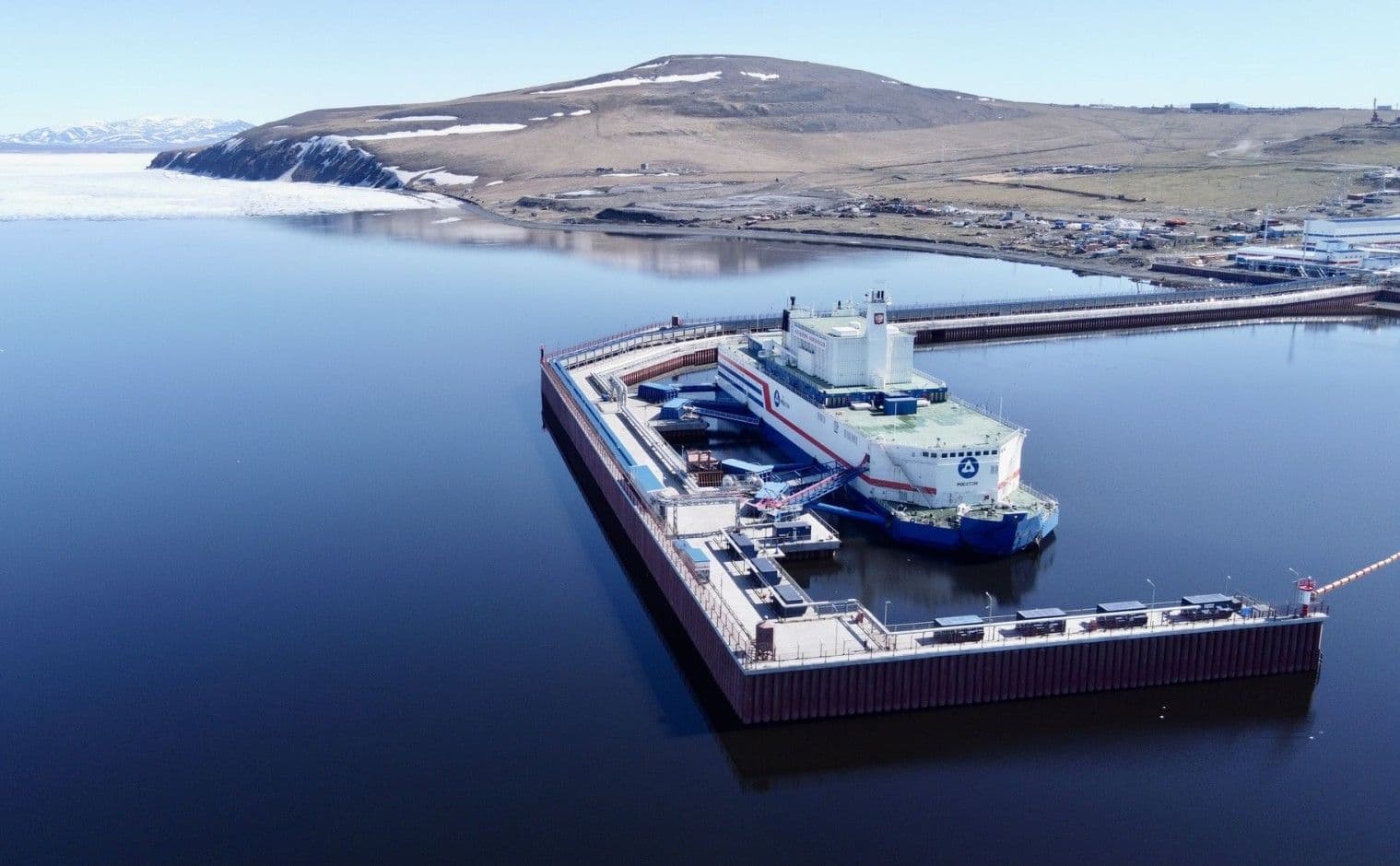
The station was built based on the experience of using nuclear energy on icebreakers to provide heat and electricity to remote industrial enterprises, ports and offshore oil production stations in the Arctic and Far East. Now the station is located in Chukotka in the port of Pevek and is considered the northernmost nuclear power plant in the world.
Rosatom launched the floating nuclear power plant construction project back in 2007. And only 13 years later the station was put into operation. It produces not only 70 MW of electricity, but also 50 Gcal/h of heat, and can power a city with 100 thousand inhabitants. Moreover, after launch, it provides energy to Pevek, where less than five thousand people lived in 2024, and gave the rest to the regional energy system.
Since the entire Chukotka Autonomous Okrug, according to Rosstat, has a population of less than 50 thousand people, both nuclear power plants were built, among other things, to provide energy to industrial capacities in the region - mining companies. It was planned that Akademik Lomonosov would help power the Baimsky GOK project. However, in the design documentation, the main energy sources for it will be four small floating nuclear power plants, which are currently being built in China.
Why does such a sparsely populated region need so much energy? For the development of the Baimsk ore zone.
“We need a lot of energy, about 300 megawatts. All the energy that the Bilibino Nuclear Power Plant and Academician Lomonosov will produce will go to gold and copper deposits in Chukotka. This is a new industrial Chukotka, we are reshaping the entire energy system.”
Source: TV channel “St. Petersburg”
On the unrest of the Neva
“Akademik Lomonosov” was built in St. Petersburg at the Baltic Shipyard and was first launched back in 2010. The construction site was located near the historical center of the city, where work on modernization and installation of generators took place. Also, even before both power units were fully loaded with nuclear fuel, experiments were carried out with starting generators. All this is two kilometers from the Hermitage, although the city has had a ban on carrying out nuclear hazardous work since the 90s.
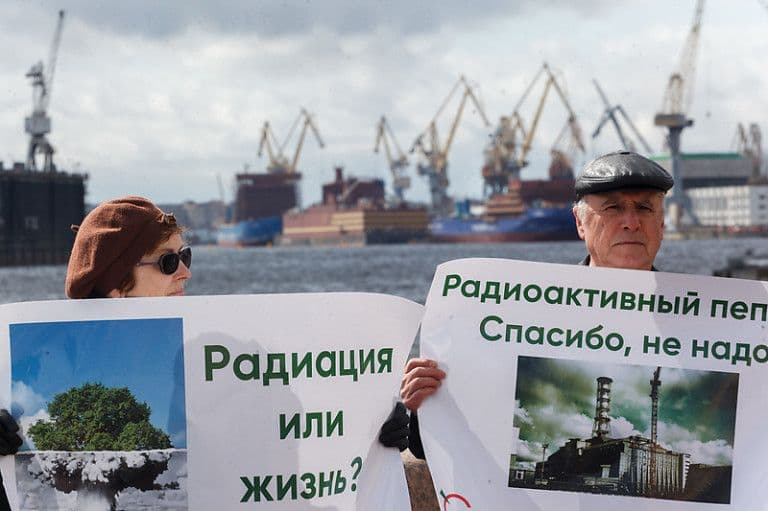
The novelty of the project, proximity to a multimillion-dollar city and reports of accidents at the floating nuclear power plant caused tension and unrest among residents, as well as criticism and protests from experts and environmentalists.
Since the Akademik Lomonosov, standing at the Baltic Plant, was a nuclear facility, before construction began it was necessary to at least conduct an environmental assessment and public hearings. In addition, the city plan should have included the site in energy and evacuation plans in case of an emergency. But none of this, according to experts, was done. This is also why news about the loading of fuel on the floating nuclear power plant caused unrest.
During the construction period in general there were many “oddities”. Anti-nuclear public expert Rashid Alimov then emphasized that they do not have a license to operate, and they, like any nuclear power plant, must obtain several licenses, including for construction in St. Petersburg.
Anti-nuclear experts also criticized the FNPP project as a whole. The main arguments can be described in three words: expensive, unsafe, unecological.
In 2020, Rosenergoatom proposed increasing the generation cost for floating nuclear power plants to seven million rubles per MW. The cost of energy generated at the Bilibino Nuclear Power Plant is almost twice as high - about 13 million per MW. Experts emphasize that in 2021 this is up to five times more expensive than the cost of the same volume of energy from renewable sources in terms of cost on the wholesale market. Of course, the cost of energy also depends on where the electricity is distributed - to households or businesses. But the price of the generated energy still raises the question: could it be possible to use a less expensive source of energy or even concentrate on renewable energy?
The reason for the increase in energy costs in the Chukotka Autonomous Okrug was the launch of the floating nuclear power plant at the end of 2019, as it was necessary to find money to maintain the operation of the new station. Thus, the amount of the surcharge on the cost of energy in 2020 amounted to 8.6 billion rubles, which is 3.6 billion more than before the launch of the floating nuclear power plant. This difference in cost is the cost of maintaining the Akademik Lomonosov.
Due to the high cost of electricity, the government launched a mechanism to regulate prices in the energy system of the Far Eastern Federal District, which includes energy facilities in Chukotka. The price of reducing tariffs for citizens there is an increase in energy costs for residents of other regions of the European part of Russia, the Urals and Siberia. In 2020, they paid more than 37 billion rubles.
“Rosatom does not count money because it has almost unlimited access to the budget and special treatment from the president. Risks also do not scare them, especially in a situation where it is so far away that independent experts are unlikely to get there, and information about accidents is easy to hide, because state censorship controls the Russian media. The nuclear industry has a specific mandate from President Putin to increase dependence on Russian technology and supplies, and then that dependence leads to increased political influence. For this purpose, many billions are allocated from the Russian budget to pay for the construction of nuclear power plants in different countries. The export of floating nuclear power plants opens up new opportunities - in poor countries where there are no suitable networks and there is no point in building large nuclear power plants, a small plant project may well be suitable, and if there is a coastline, then a floating one. In such cases, the risks increase because poor countries have a disproportionately low safety culture,” comments Vladimir Slivyak*, co-chairman of the Ecodefense! group.
Taking into account the multibillion-dollar costs of constructing a floating station and the high cost of generation, experts and environmentalists believe that the task pursued by Rosatom was to build and launch a demonstration project in order to show it to potential technology buyers. This is necessary to expand exports and influence of the Russian nuclear industry. And, although such construction is not currently underway, this plan can be called successful to some extent - investors from China and Latin American countries are interested in the technology.
Construction in China
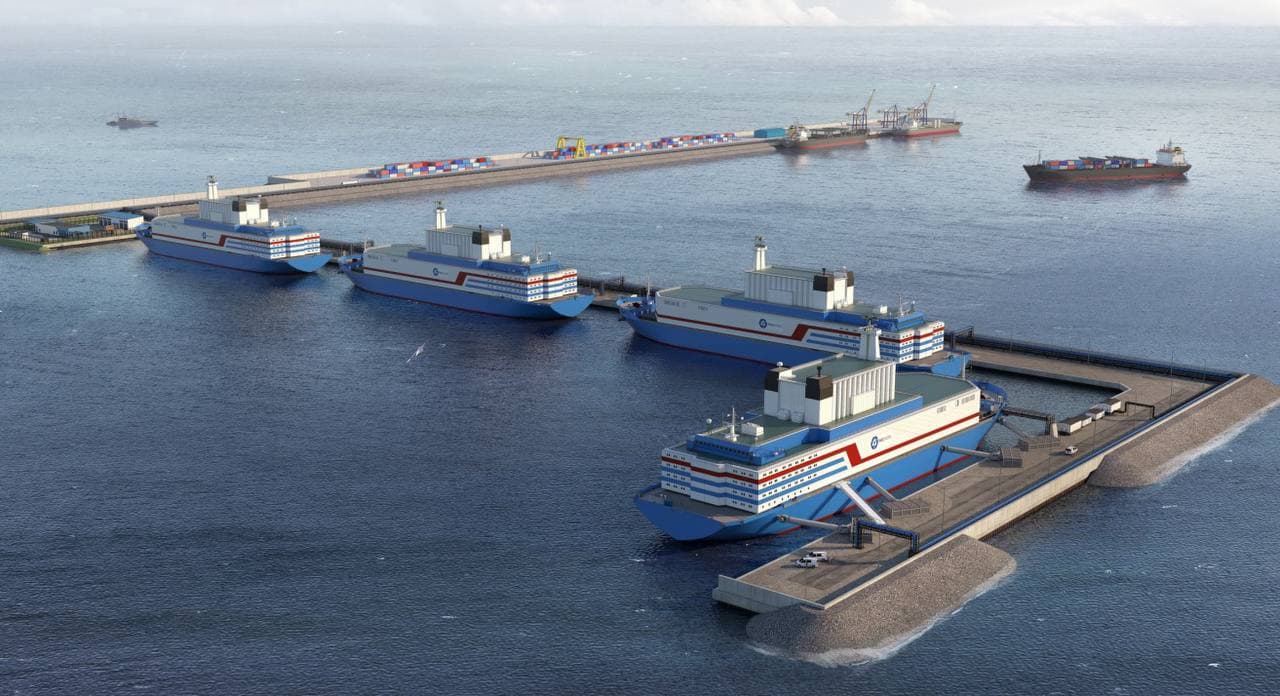
To power the giant Baimsky mining and processing plant, Rosatom has developed a project for modernized floating power units (MPPU). These stations became the development of the Akademik Lomonosov floating nuclear power plant project. Soon, as many as four new floating nuclear power plants will stand off the coast of the East Siberian Sea near the first floating station. The geographical center of the project will be Cape Nagleinyn in Chaunskaya Bay; it was there that they decided to expand the port in Pevek and moor all the new power units to power the Baimsky Mining and Processing Plant.
The design of the MPEB was based on the operating experience of the Akademik Lomonosov, but the KLT-40S reactors were replaced with more powerful RITM-200. This will increase the installed capacity of each unit to 106 MW (the reactor at the floating nuclear power plant produces about 70 MW).
The cost of construction of four power units is estimated at more than 140 billion rubles (in 2020 prices excluding VAT), and the total investment in the energy supply of Baimka exceeds 190 billion rubles.
Initially, Rosatom planned to launch the first units at Cape Naglyunin by January 2027. And the stations themselves will be built following the example of “Akademik” at the same Baltic Shipyard in St. Petersburg. However, the high load of the Baltic Plant forced the state corporation to move the construction of buildings abroad. In 2021, they signed a contract with the Chinese shipyard Wison (Nantong) Heavy Industry. By 2023, it became known that at least three buildings out of four planned were being built in China.
In parallel with the difficulties of shipbuilding, the deadlines for the implementation of the mining and processing plant itself were also adjusted. At EEF 2024, Rosatom General Director Alexey Likhachev clarified: delivery of the first MPEBs is expected in 2028–2029. And the installation and launch of four units (three main and one reserve) should be completed by 2031.
Nuclear fuel: there and back
The Northern Sea Route will be used to collect spent nuclear fuel and supply new nuclear fuel to floating nuclear power plants. This is exactly what they did with fuel reloading for the Akademik Lomonosov.
“The nuclear waste generated by a floating nuclear power plant is stored there. In the event of an accident resulting from, for example, a tsunami, there is a possibility of damage to both the station and waste containers. Difficult or extreme natural conditions can cause an accident, which could result in radiation contamination, as well as the release of nuclear materials into the marine ecosystem.”
Nuclear fuel was transported to Pevek for the first time in 2023 - from Elektrostal near Moscow, where Rosatom’s subsidiary for the production of fuel for nuclear power plants, Mashinostroitelny Zavod JSC, is located. And nuclear fuel made its second journey along the Northern Sea Route in 2024.
Sailing along the NSR is a dangerous adventure. Unstable ice conditions, risks of getting caught in a storm or getting stuck in ice, and increasing extreme weather events create a huge number of risks. Traveling along the NSR with radioactive fuel becomes a critically dangerous mission, since any failure along the way threatens large-scale radiation contamination. According to Arktida estimates, 15 vessels encountered accidents in the Arctic in 2024 alone.
There are always risks of accidents, and in conditions of the climate crisis they are even higher
Any emergency situation associated with a leak of a radioactive substance poses risks to human life and the integrity of the ecosystem. These risks especially grow in the harsh climatic conditions of the Arctic, which is seriously affected by the negative consequences of the climate crisis, which are described above.
“The sea coast is characterized by highly specialized and vulnerable biodiversity. Any accident with the release of radiation and an extremely limited ability to eliminate the consequences will cause great damage to all living things.”
The Arctic is warming almost four times faster than the rest of the planet, triggering a cascade of negative consequences that create additional vulnerabilities for infrastructure. Due to the thawing of permafrost , up to 45% of infrastructure in the Arctic region has now been damaged .
And, judging by the observed trends, the trend towards melting of the upper permafrost cover will only worsen, which can lead to catastrophic consequences and will increase the accident rate at industrial enterprises. Due to increased precipitation, the risk of landslides increases, especially in coastal areas - this is an additional danger to the port infrastructure.
Another consequence of the climate crisis, which is relevant not only for the Arctic, but also for all coastal areas where there is a winter period of freezing (for example, the Baltic Sea and in particular the Gulf of Finland) is a reduction in ice volume . Due to the lack of strong ice cover in the coastal zone of the seas, the frequency and strength of storms in Chaun Bay is increasing. They erode the coastline and can cause landslides in coastal areas, which creates an additional danger for coastal infrastructure.
Storms threaten not only the destruction of coastline infrastructure. Since floating plants involve taking and desalinating water to cool the reactors directly from the bay, water quality could be a potential problem. Storms bring sediment and silt to the surface, which can clog water intakes. Without cooling, the reactor will quickly overheat, which will lead to a critical emergency.
In addition, rising temperatures also lead to unpredictability of the ice cover - the likelihood of a collision between the station and large ice masses increases. And this will presumably require constant monitoring of the situation and the operation of icebreakers to prevent such collisions.
In the case of high-risk nuclear facilities located on the coast (namely, these include floating nuclear power plants), the combination of the consequences of climate change can lead to an increase in emergency situations. This increases the risk of accidents at stations, which can lead to catastrophic consequences. And if we take into account that within five years there will be not one floating nuclear power plant on the coastline near Pevek, but a total of five nuclear power units , the consequences of a possible accident will only get worse.
“There are no completely safe nuclear power plants. Radiation accidents have occurred not only at large nuclear power plants, but also on nuclear submarines and icebreakers. The location in the Arctic creates additional risks, for example, strong storms or tsunamis can seriously damage such a facility. Considering that nuclear waste is also stored there for a long time next to the reactors, the risk doubles. In the event of an accident, it will be extremely difficult, if not impossible, to organize work to eliminate radioactive contamination. In this case, the vulnerable Arctic nature will suffer significantly more than an accident, for example, in the European part. In the event of an accident at such a nuclear power plant, there is always a risk of radioactive contamination of the marine ecosystem,” comments Slivyak*.
Three mistakes in the abbreviation NPP
Despite the stability of energy generation, nuclear power plants pose serious risks in the event of emergencies amid the unpredictable climate crisis in the region.
As an alternative, you can consider a mix of renewable energy sources (RES).
The use of renewable energy sources immediately eliminates the risks of nuclear pollution; they are also more flexible to the negative consequences of the climate crisis.
The coast of Chukotka is one of the windiest regions of Russia. Среднегодовые скорости ветра здесь могут достигать 9–12 м/с — мировой рекорд для береговых зон. Район мыса Наглёйнгын и побережье Чаунской губы подходят для размещения крупных ветропарков .
Чтобы покрыть энергетическую потребность для запитки Баимского ГОКа только с помощью ВИЭ, необходимо будет построить крупный ветропарк с более чем сотней турбин. Тем не менее, стоимость строительства будет не выше стоимости атомных станций, в которые уже вложили около 140 миллиардов рублей. А в качестве вспомогательных возобновляемых мощностей можно было бы установить солнечные станции и приливные турбины.
Та же цена, но без риска атомной катастрофы.
«Атомная энергетика — наиболее дорогая, опасная и грязная из всех возможных, если рассматривать полный топливный цикл. Более того, в последние годы из-за возрастающих рисков, в том числе и климатических, и военных, стоимость строительства АЭС продолжает расти, в то время, как стоимость остальных источников энергии — продолжает снижаться. Но руководство госкорпорации Росатом умеет выбивать госфинансирование.
Плавучие АЭС и реакторы малой мощности — это модный тренд в индустрии, но базовые технологии и проблемы остаются старыми и нерешёнными за десятилетия существования отрасли, перекладывая проблемы ядерных отходов на плечи будущих поколений.
В год 40-й годовщины Чернобыльской катастрофы полезно вспомнить, как наше государство не справилось с той аварией, в прошлом году государство не предотвратило даже нефтяную катастрофу в южном море. Что же можно ждать от возможной ядерной аварии в Арктике?» — пояснил Виталий Серветник из Эколого-кризисной группы.
* Минюст РФ считает эколога Владимира Сливяка «иностранным агентом»
Фото обложки: Правительство России