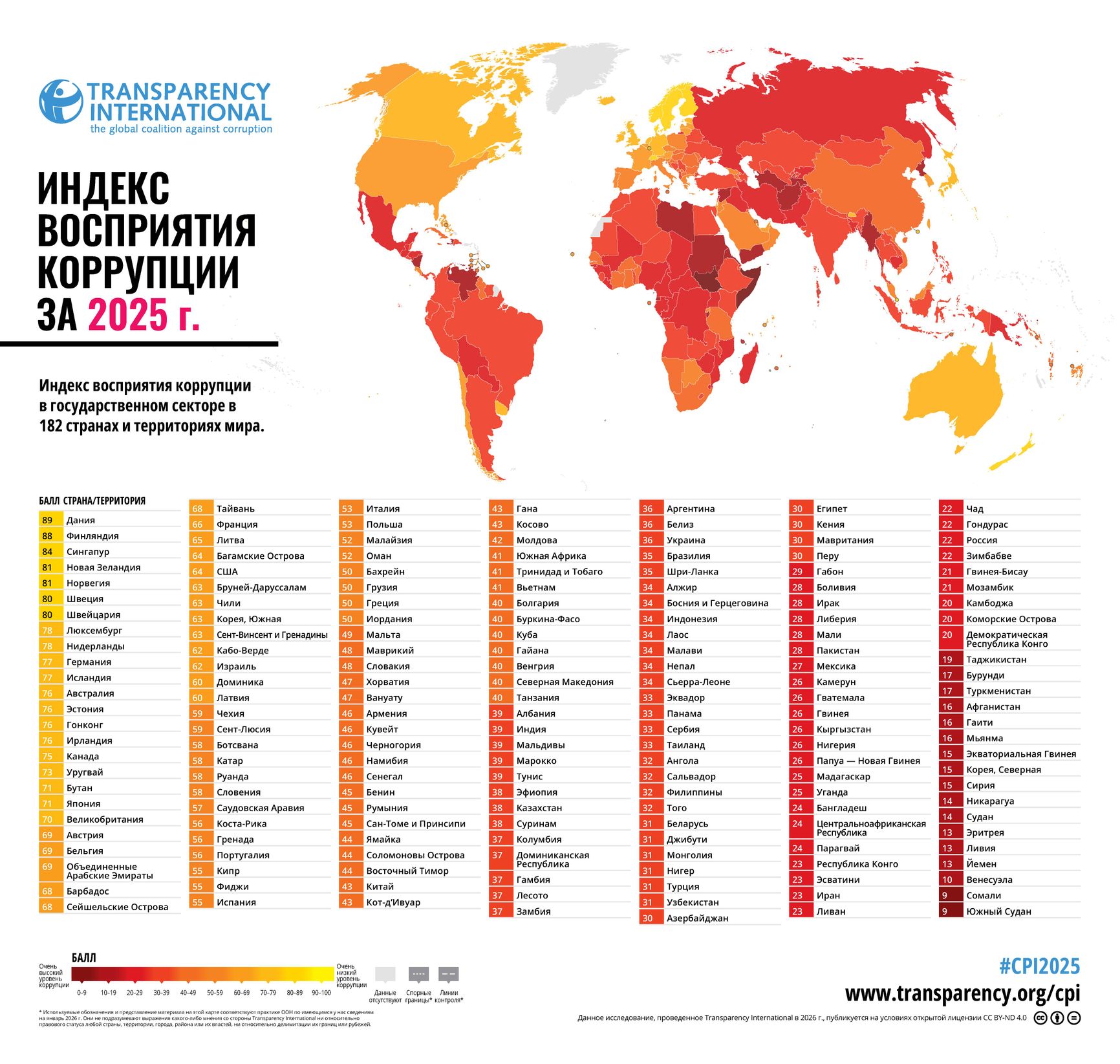
Transparency International: The level of corruption in the world continues to rise, including in democracies. Russia is in 157th place out of 182 • The Insider • RIMA — Russian Independent Media Archive
The level of corruption in the world continues to grow, including in democratic countries. This is according to the 2025 Corruption Perceptions Index (CPI) published by Transparency International. The organization associates this trend with the weakening political will of leaders and a decrease in commitment to international norms.
What is IVC?
In a conversation with The Insider, a representative of Transparency International Russia explains:
“The Corruption Perceptions Index is not a direct measurement of the level of corruption, but an assessment of how corrupt the public sector is perceived in different countries. According to the CPI 2025, the world recorded the lowest average in the last ten years, which means that most countries are failing to control corruption and are not showing significant progress.
The CPI does not measure public tolerance or sentiment. This is not a public opinion poll, but a composite index, which is calculated based on expert assessments and data from analytical organizations, including assessments of business risks and the quality of institutions. Therefore, the decrease in scores does not reflect a change in attitude towards corruption, but a deterioration in the situation in public administration: increased opacity, weakened control, and ineffectiveness of anti-corruption mechanisms.”
Indicators for 2025
According to the index, worsening indicators were recorded in the USA, Canada, New Zealand, as well as in a number of European countries, including the UK, France and Sweden. Transparency International notes that in 36 of the 50 countries where CPI scores have declined significantly since 2012, the space for civil society activity has also declined. We are talking about restrictions on freedom of speech, assembly and pressure on journalists and NGOs.
The report specifically highlights the weakening of anti-corruption policies in Europe. Since 2012, the performance of 13 countries in Western Europe and the EU has worsened significantly, and only 7 countries have recorded significant improvement. In December 2025, the European Union agreed on the first pan-European anti-corruption directive, but the final document was not tough enough due to the fact that countries did not agree to criminalize abuse of power, Transparency International notes.
The United States in 2025 received the lowest score in the history of the index. Transparency International attributes this to measures undermining the independence of the judiciary, weakening enforcement of foreign corruption laws and declining support for foreign civil society. The organization notes that these steps were perceived by other countries as a signal that pressure on independent institutions is permissible.
Russia
The corruption perception index in Russia is 22 points (this is 157th place in the ranking out of 182 countries). Director of Transparency International - Russia Alena Vandysheva says that corruption in the country remains a persistent problem against the backdrop of closed government, pressure on independent institutions and a lack of real control. According to her, this directly affects the quality of medical care, the work of the courts, the environmental situation and the protection of citizens' rights. Russia's neighbors in the rating are Honduras, Zimbabwe and Chad.
The global average CPI score in 2025 was 42, the lowest level in more than a decade. More than two thirds of the world's countries scored below 50 points. The number of countries scoring more than 80 points has decreased from 12 to 5 over ten years.
Denmark remains at the top of the rankings for the eighth year in a row (89), followed by Finland (88) and Singapore (84). At the same time, Transparency International notes that a high score in the CPI does not guarantee the complete absence of corruption, since some countries with the highest scores - for example, Switzerland (80) and Singapore (84) - contribute to corruption in other countries, which is not taken into account in the CPI.
The lowest rates were recorded in South Sudan and Somalia (9 points each) and Venezuela (10).
Transparency International called on governments to renew their political will to fight corruption, end pressure on civil society and journalists, and close international financial loopholes that allow corrupt proceeds to be hidden and transferred.
Since its inception in 1995, Transparency International's Corruption Perceptions Index has become the world's leading indicator of public sector corruption. The index ranks 182 countries and territories around the world on perceptions of public sector corruption and is calculated using data from 13 external sources, including the World Bank, World Economic Forum, private consultancies and rating agencies, think tanks and other organizations. The ratings reflect the opinions of experts and entrepreneurs.
The CPI calculation methodology is regularly reviewed to ensure maximum reliability and consistency.