
Translated material
Utopia of rights
How does Russian law protect indigenous peoples?
On February 17, 2022, Russian senator Grigory Karasin, speaking at the UN, described the situation of indigenous peoples in Russia as a stable system of guarantees. According to him , Russian laws “consistently consolidate” the rights of indigenous peoples to priority and free use of land, water, hunting and other natural resources in the places of their traditional residence and economic activities.
This formula sounds like the answer to most concerns: there is a Constitution, there are special federal and regional laws, there are lists of territories, there are support programs, there are compensation for damage. Raipon , the Association of Indigenous Peoples of the North, Siberia and the Far East, the largest in Russia, writes that the country has three special federal laws on the rights of indigenous minorities , and more than 20 federal laws contain norms guaranteeing them special rights. The government, in its new concept of sustainable development of indigenous minorities until 2036, also proceeds from the fact that “a legal framework has generally been created” to protect the rights and traditional way of life of indigenous peoples.
In a recently published report, we showed through concrete examples of large infrastructure projects in the Arctic that this legal framework works differently in reality than on paper. For example, a project may be licensed before the indigenous community becomes aware of its impacts.
The legal framework for protecting rights already exists, but it works selectively, sometimes after a trial or when it is too late. And sometimes it is completely forced out due to the priorities of the industrial sector. "Arktida" explains what laws govern the rights of indigenous peoples in Russia, why protection does not apply to everyone, and where Russian norms diverge from international standards.
The law protects, but not everyone
The Russian system of protection of indigenous peoples is built around the category of “indigenous small peoples” (IMN), which narrows the group of indigenous peoples to those recognized by the state as “small in number”.
For comparison: in international optics, indigenous peoples are considered to be those who maintain a historical connection with the territory, their own institutions, culture and self-identification.The Russian special legal framework knows only the category of indigenous minorities, which includes peoples that meet the formal criterion of a population of less than 50 thousand people and are included in the government list , which currently includes 47 peoples. Some indigenous peoples, for example, the Arctic Sakha, Komi or Karelians, do not receive protection in this system, since they are not formally classified as indigenous peoples.
In 2020, another level of bureaucratization appeared: the register of indigenous peoples of the Federal Agency for National Affairs (FADN), that is, a list of persons belonging to the indigenous minorities. As planned, it should help a person confirm their status and subsequently simplify the exercise of rights and obtaining the required support measures. But getting on the list requires significant bureaucratic efforts, and sometimes a court decision . This is especially difficult for a person who lives by fishing, is nomadic, or depends on the seasonal use of the territory.
But even after obtaining the necessary status, the implementation of rights is not guaranteed, since another difficult issue is the status of the land on which people live and the project can be planned.
Where are the indigenous lands?
There is no concept of “indigenous lands” in Russian legislation, but there are two legal regimes that are often confused in public discussions:
- places of traditional residence and traditional economic activities (MTP and TCD);
- territories of traditional environmental management (TMP).
MTP and TCD are listed in a single document , which inherits the Soviet delineation of the geographical areas of residence of indigenous peoples. It shows where the state recognizes the traditional residence and economic activities of indigenous peoples. In addition, it forms an administrative-territorial basis for the interaction of indigenous people with other actors, such as government, subsoil users and others. Within such territories, indigenous peoples have additional rights, and, for example, in Sakha, ethnological examination is expected.
But the very fact that a territory is included in this list does not mean that traditional environmental management has priority over mining, road construction or a port, but only recognition that the interests of indigenous people there should be taken into account.TPP is a stronger regime of “specially protected areas” (SPA), which can be established in the territory included in the MTP and TPA. The federal law describes them as protected areas created for the traditional use of natural resources and the indigenous people's way of life. It is the TPP that is closest to the idea of a territory where external economic activity should be limited and coordinated with the interests of the indigenous inhabitants. This involves the creation of territories that cannot be alienated for industrial development unrelated to the traditional economy without the consent of indigenous peoples.
In practice, some of the possibilities of the legislation on TPP are not implemented. Federal TTPs have not actually been created for many years, and regional and local ones depend on the work of a particular region in their formation and accounting. The latter is critically important, since at the federal level the criteria for the delimitation of powers and the procedure for creating a TTP are not regulated.
In some regions such territories exist, and registers are maintained. For example, in the Khanty-Mansi Autonomous Okrug, where legislation on ancestral lands appeared even before the federal law on TTP, and later largely formed its basis. A quarter of the Autonomous Okrug was classified as ancestral lands.
In total, TTP registries are maintained by 13 Russian regions (among them in the Arctic are Sakha, Khanty-Mansi Autonomous Okrug, Nenets Autonomous Okrug, Karelia and Krasnoyarsk Territory), although at least framework acts on the formation of TPP have been adopted in all Arctic regions.In some regions, restrictions have been established on the creation of TTPs, for example, depending on the location of subsoil plots, industrial facilities or leased areas in the territories. Sometimes the creation of a TPP is fraught with difficulties and litigation. This was the case in the case of the formation of the TTP in the Krasnoyarsk Territory, which was created only after the decision in cassation. In another case, in a territory that already has this status, residents have to go to court for the exercise of the rights that the already established status gives them.
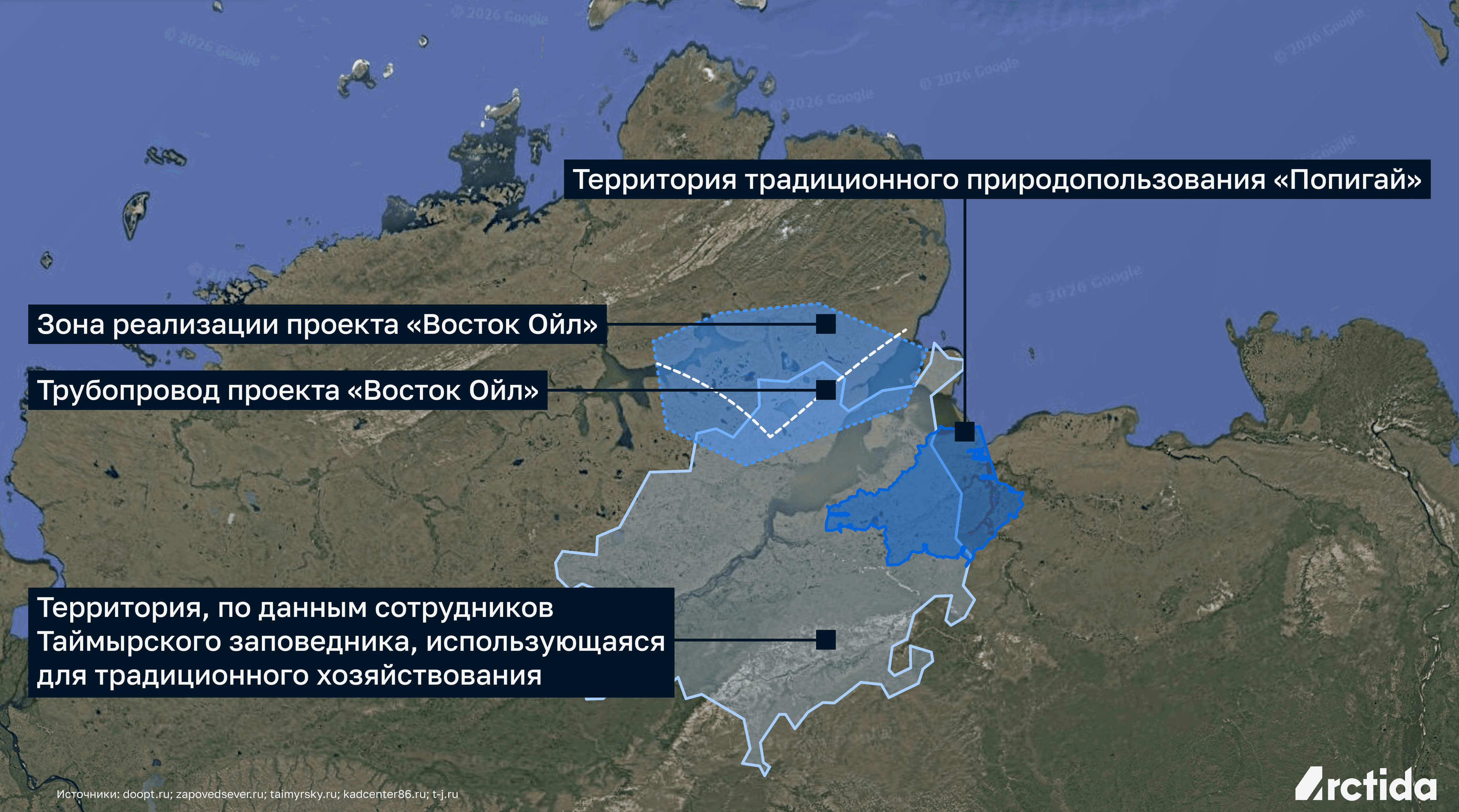
And even if the TPP is created, its borders may not coincide with the actual nomadic routes, pastures, hunting and fishing areas. For example, the territory of Rosneft’s large-scale Vostok Oil project in Taimyr does not cross the borders of the nearby Popigai TTP, but in fact they enter the territories used by reindeer herders, according to employees of the Taimyr Nature Reserve.
Let's summarize:
- “Indigenous lands” are asserted through two legal regimes. Both are associated not with ownership of land, but with special rights to use it. Territories of traditional natural resource management are the stronger of the two, but their regulation does not have an established structure.
- Regional and local TTPs can be created using different protocols. Their documentation depends on how accounting is organized in a particular region.
- In some regions, for example Khanty-Mansi Autonomous Okrug and Sakha, TTPs exist and work, but this is not the case everywhere.
- The creation of such territories may be limited due to the location of subsoil or industrial facilities. Often TTPs do not take into account the actual reality of life for indigenous peoples and do not include all the territories in which people live.
Experience of the Republic of Sakha
The region with the most advanced standards regarding the rights of indigenous peoples in Russia is the Republic of Sakha. This is the only relatively systematic Russian case of institutionalizing the assessment of the impact of extractive projects on indigenous peoples. In 2010, ethnological examination was introduced in the republic. Unlike conventional environmental impact assessments, this one looks not only at nature itself, but also at how changes in the environment will affect the traditional way of life, crafts, culture, socio-economic situation and development of the people.
Sakha's experience is often cited as an example of how the Russian system could work better. In addition to the law on ethnological examination, the regulation of TTP has been developed in the republic. Local acts provide for the participation of representatives of indigenous peoples in expert commissions, and for violation of the requirements for conducting an examination, administrative liability is established and these sanctions are applied .
The regional program indicates that as of December 1, 2024, 66 ethnological examinations were carried out in the republic, and 53.7% of the total area of the republic is TTP.
The law of the Republic of Sakha is unique for Russia: at the federal level, attempts at such institutionalization have so far failed . Another region where an attempt to introduce ethnological expertise took place is Chukotka. There, in 2022, the District Law “ On Responsible Subsoil Use ” was adopted. It outlined the standards of conduct for subsoil users and ordered the study of the impact of projects on indigenous peoples using ethnological examination in accordance with federal legislation. Since the mechanism for such an examination was never established at the federal level, the norm of the Chukotka law remains declarative.
Ethnological examination is also mentioned in the legislation of the Krasnoyarsk Territory. After the major Norilsk oil spill, the Krasnoyarsk Territory planned to develop a law on ethnological examination in 2021, but, according to available data, it has not been adopted.
The rules for creating a TTP are also different. In Sakha, the regional situation allows the inclusion of zones of limited industrial activity and other functional zones in the TTP, subject to compliance with conditions and examinations. In the Krasnoyarsk Territory, on the contrary, strict restrictions have been established : TTPs of regional significance are not formed in territories where existing production facilities are already located, and the basis for refusal may be the location of already used subsoil plots within the declared boundaries. In the Yamal-Nenets Autonomous Okrug, they may be refused if a legal entity already operates within the territory’s borders, whose activities are not related to traditional natural resource management, or if there are subsoil areas of federal significance there.
This leads to a vicious circle. As long as there is no industrial interest, the community may not have the resources and administrative support to formalize the TPP. When industrial interest has appeared, its very formalization - a license, a subsoil plot, an operating facility - can become an argument against the creation of a protected territory.The example of Sakha shows that legislation protecting the rights of indigenous peoples can be created and unified. And at the same time, in the context of Russia, the example of a republic is an exception.
When law is involved in court
Even in the Sakha Republic, the law does not always work automatically.
In 2025, the territorial-neighboring Even community “Sebyan” appealed to the arbitration court with a demand to oblige JSC “Prognoz” to organize an ethnological examination of the TTP of local significance. We were talking about a licensed area in Sakha. The company objected: it referred to the fact that the site has the status of a geological allotment , and the study of subsoil within such an allotment can avoid examination under certain conditions.
The court pointed out something else. The Sakha Law establishes that an ethnological examination is carried out without fail and before decisions are made on the implementation of economic activities in places of traditional residence and in the TTP. The decision also stated that the boundaries of the Sebyan TTP were included in the cadastre, and the fact of the company’s activities in this territory was not disputed. As a result, the court ordered the company to take measures to conduct an examination.
What is important here is both that ethnological expertise acts as a tool for the indigenous community to protect its rights, and that even in the presence of TTP, a regional law and a mandatory procedure, the community has to prove in court that the company must undergo an impact assessment on its land.
In another case related to the gold mining LLC Rudnik Taborny, the prosecutor’s office also sought an ethnological examination. The company attempted to challenge this submission. LLC "Rudnik Taborny" carried out geological exploration and mining within the boundaries of the Tyan national nasleg, the entire territory of which belongs to the Evenki TTP. After an appeal from the Association of Indigenous Peoples of Yakutia, the prosecutor’s office found that the company had not carried out the mandatory ethnological examination and demanded that the violation be eliminated. The company challenged the prosecutor's submission, citing the fact that some of the licenses were issued before the introduction of the relevant requirements. The first instance supported the prosecutor's office, the appeal supported the company. Finally, the cassation court upheld the decision of the first instance, indicating that re-issuing a license or starting activities without an examination does not relieve the subsoil user from the obligation to conduct an examination.
There are even situations where an examination has been carried out, but the issue rests on the implementation of its conclusions. Thus, according to the report of the Commissioner for the Rights of Indigenous Minorities of the North of the Republic of Sakha for 2022, the very first negative conclusion of the ethnological examination was not properly implemented. The reason is the lack of clear federal regulation of enforcement.
The legal framework that has developed in the republic is a good example, but for its full implementation there are not enough control levers, as well as bringing good practices in the republic to the norms of federal legislation.
Subsoil license, life on the surface
The Land Code of the Russian Federation does not provide guarantees of non-alienation of lands for traditional natural resource use, and the right to use subsoil is not equal to the right to land: they are legally separated.
A license to use subsoil as a state resource (geological study, exploration, production) is issued under a separate procedure. Such a license does not provide the right to a land plot on the surface: for the construction and placement of objects, roads, infrastructure.
On paper, this distinction may look like a defense: the company has not yet received the land, which means there will be approvals ahead. But this also works in the opposite direction. If there is a subsoil use license, the company may not agree on what will be on the surface, including not interacting with the indigenous communities on the ground. A decision on subsoil use may be made before the community receives full information about the project and its consequences.
Procedures involving indigenous people are often triggered when a project moves into subsequent stages of implementation, and information about the future of the project is delayed in reaching the local community. And when the discussion reaches the ground, the project already exists as an economic and administrative fact.This creates a gap between the point of decision and the point at which the indigenous community has a chance to influence the project. This example shows why the public hearings required by Russian law with the opportunity to make non-binding comments are not enough. The international principle of free, prior and informed consent is not limited to information and comments. On the contrary, it demands that the project be discussed in advance, without pressure, in a culturally adapted manner, with the indigenous peoples' own institutions of representation, giving them the opportunity to say no. In Russian law, there is no such mandatory federal mechanism for mining and infrastructure projects .
What remains outside
Russian officials are right about one thing: the legal framework does exist. Its very presence is presented as evidence of sufficient protection, although it does not meet international standards, and its implementation is imperfect and not fully developed - the situation here differs from region to region. General guarantees are not a substitute for “inclusion” of strong legal mechanisms that would correct the power asymmetries between huge corporations and indigenous communities that lead traditional economies.
Such mechanisms have been developed in international documents on the rights of indigenous peoples. The UN Declaration speaks to the right of indigenous people to determine development priorities for their lands and resources and the need to obtain Free, Prior and Informed Consent (FPIC) before projects affecting their territories are approved. ILO Convention No. 169 , which Russia has not ratified, but which is commonly referred to in the documentation of Russian companies, enshrines the obligations of states for consultation and participation of indigenous peoples in decisions that affect them. The Convention on Biological Diversity requires that the knowledge and practices of indigenous and local communities be respected and the equitable sharing of benefits from their use promoted.
The Russian system is structured primarily reactively. It can start work after the project has received a license, after the community has discovered a threat, after a dispute has arisen, after it has had to go to court, after damage has become the subject of compensation.
Между тем термин «СПОС» имеет в себе критерий предварительности: информирование, независимая оценка, согласие или отказ должны предшествовать самому решению о реализации проекта или о «нулевом варианте» — отказе от его реализации. Здесь как практика, так и правовая рамка в России расходится с международными стандартами.Часть идей, созвучных международным стандартам, присутствует в России фрагментарно: в законодательстве о ТТП, в якутской практике этнологической экспертизы, в рекомендательном стандарте ответственности резидентов Арктической зоны. Но они не складываются в единую общеобязательную систему, в рамках которой коренное сообщество может не просто получить компенсацию, но и заранее определить, допустим ли проект и на каких условиях. Объём компенсации же формируется по договорённостям с компанией, справедливость которых никто не регулирует.
Несмотря на наличие законов о КМН, коренные сообщества — даже те из них, которые относятся к этой категории — всё ещё вынуждены доказывать своё право быть услышанными тогда, когда решение о будущем их земли уже фактически принято.
Фото обложки: Е. Митрошин / Depositphotos