
Translated material
Camp riot. Alexander Podrabinek - about political prisoner Florinsky
From the verdict:
He began to share the radical ideas of the non-systemic opposition, which completely denies the legitimacy of the existing government in the Russian Federation... A criminal intent arose aimed at making public calls for terrorist activities using the Internet ITCS.
Florinsky Ilya Vladimirovich, born on December 7, 1988. Before his arrest, he lived in Orel.
Convicted on April 19, 2023 by the 2nd Western District Military Court of the city of Orel under Art. 205.2, Part 2 of the Criminal Code of the Russian Federation ("Public calls for terrorist activities, public justification of terrorism or propaganda of terrorism" using the Internet). Sentence: 6 years in prison. The beginning of the term is August 14, 2023, the end of the term is August 8, 2028.
However, what is the “end of sentence” in the Russian penitentiary system? This is only a convention written on a piece of paper called a verdict. After two years in prison, Ilya Florinsky is again accused of a crime. Now under Article 321, Part 2 of the Criminal Code of the Russian Federation - “Disorganization of the activities of institutions that ensure isolation from society.” Up to 5 years of imprisonment.
From the camp description of Ilya Florinsky:
He does not attend educational events or classes on social and legal issues; his attitude towards the classes is extremely negative and even hostile and actively counteracts the desire of convicts to participate in them. He does not take part in sports and cultural events and has no desire to participate in them. Doesn’t participate in group work... Doesn’t engage in self-education. Higher education... Doesn't visit the library... Reacts to educational measures with disdain. Has 542 penalties. In relation to the administration of the PS, he behaves tactlessly. Dismissive attitude towards work. He did not admit guilt in the crime. CONCLUSION: the convicted Ilya Vladimirovich Florinsky is characterized negatively.
This is the villainous portrait of the political prisoner painted by the camp authorities. Particularly impressive is the remark that having a higher education, the prisoner does not engage in self-education. He does not raise his educational level even higher, which spoils the indicators of cultural and educational work in the colony. He doesn’t participate in circle work, just think! And yes, as bitter as it may be for fans of Melpomene and Thalia to hear, theatrical performances on the camp stage are counted as an asset to the prisoner, and the authorities consider refusal to participate in cultural events to be a refusal to take the path of correction and characterize the prisoner negatively.
They are outraged by demands to comply with the law. They simply go berserk at such demands.
But this is all just a necessary background for a new criminal case, but what was the riot? How did Ilya Florinsky disorganize the work of correctional colony No. 5 in the Sukhinichi district of the Kaluga region?
As a “malicious violator of the regime,” Florinsky sits in the EPKT - a single cell-type room. Simply put, this is a solitary cell, usually 2 x 3 meters in size; the bunk is fastened to the wall during the day, and sleeping is strictly prohibited even while sitting at a table or on the floor; walk – one and a half hours a day in the exercise yard; shower twice a week. Rise at 5 am, bedtime at 9 pm.
Five minutes after getting up, the prisoner must hand over the mattress, pillow and blanket to the storeroom. Will receive it back in the evening before bed. On December 20 last year, Florinsky leaves his cell in the morning, but instead of a mattress, he has a sheet of paper in his hands. He asks the officer on duty to turn on the dash cam to read out his statement. The officer turns it on. Next to the duty officer is the head of the colony, Major Alexander Nikolaevich Arkhipov. They listen to Florinsky for some time, but his independent behavior is unbearable for them. And even more (I know from my own experience) they are outraged by the demands to comply with the law. They simply go berserk at such demands. Meanwhile, Ilya Florinsky, based on the norms of the law, asks to be allowed to have a telephone conversation with his mother, who suffers from cancer. Major Arkhipov interrupts Florinsky and demands to put his hands behind his back - this is how prisoners are supposed to behave outside their cells. Florinsky puts one hand behind his back, but cannot remove the other - he holds his statement in it and continues to read. "Disobedience" is brewing. Arkhipov interrupts Florinsky, bickering begins: the head of the colony addresses the prisoner first name, Florinsky answers him in the same way. Finally, Arkhipov tells Florinsky to turn his face to the wall, raise his arms, and spread his legs shoulder-width apart. Florinsky obeys. Now there will be a personal search. However, Arkhipov orders him to move to another place, grabs him by the sleeve, pinches his shoulder and drags him to the side. Afraid of losing his balance, Florinsky brushes the boss’s hand off his shoulder. This is where the incident essentially ends. The head of the colony personally (!) searches the prisoner and, of course, does not find anything prohibited. As a result, there are no complaints against the political prisoner; no one filed a report on violation of the regime. Everything could have remained without consequences, but Ilya Florinsky is outraged by the rude treatment of him and writes a statement to the prosecutor’s office - he demands that the head of the colony be called to order.
This is where disorganization begins. The law allows one month for consideration of applications, and two in exceptional cases. Having met the deadline, the prosecutor's office of the Kaluga region informs Florinsky that everything is fine, the head of the colony is not guilty of anything, no violations of the current legislation have been established, and there are no grounds for prosecutorial response measures. Standard formulations.
But this turned out to be not enough. According to the prosecutor's office, the normal organization of a colony's activities is when a prisoner is on his knees, obediently carries out any orders from his superiors and does not complain if the warden or officer wants to have fun: give the prisoner a toothache, twist his arm or hit him with a rubber truncheon. But when a prisoner demands respect for himself and compliance with the laws, this is obvious disorganization and disorder. Therefore, the prosecutor’s office transfers the inspection materials to the Investigative Committee, which on February 9, 2026 initiates a criminal case against Ilya Florinsky on charges of disorganizing the activities of the colony.
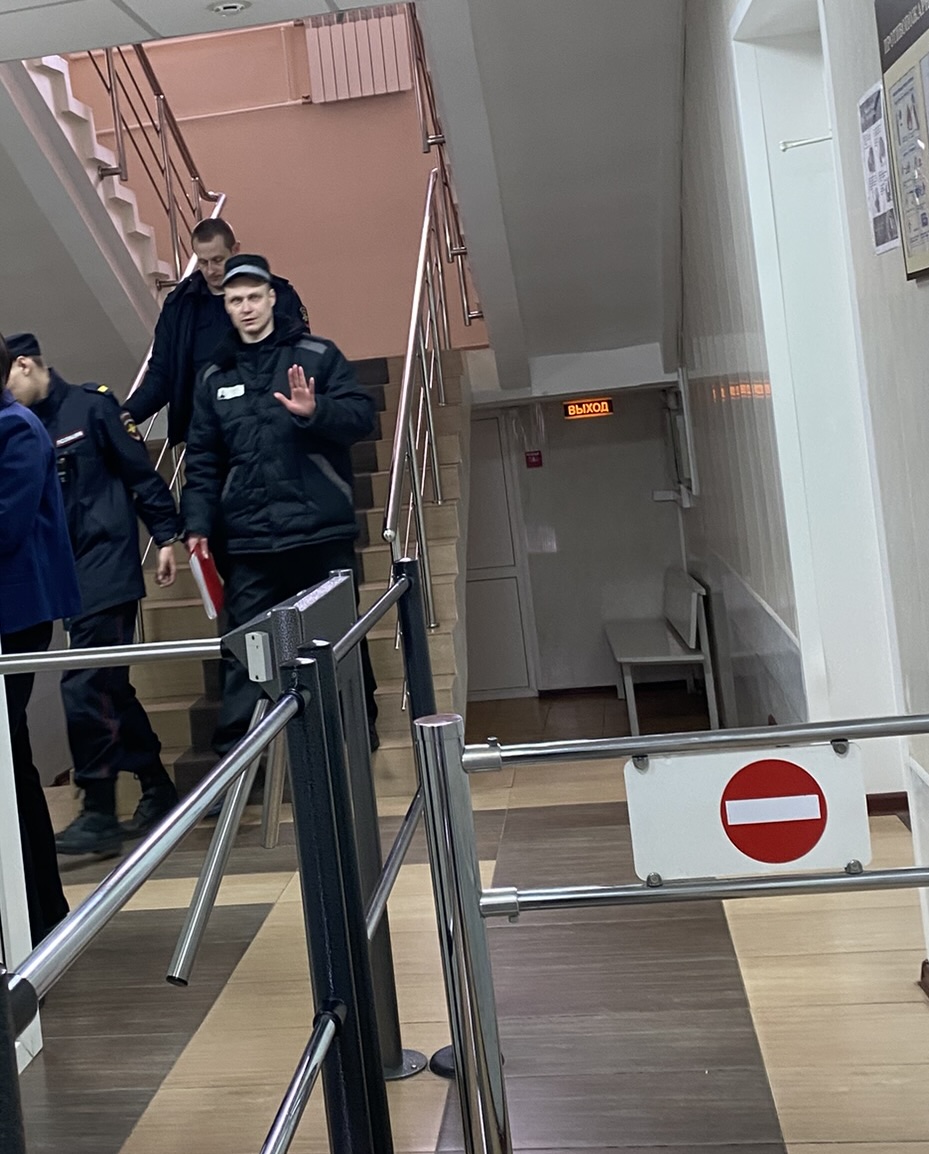
For more than a month and a half, no one knew anything about this “crime.” No one filed a report about what happened. The head of the colony (he was later recognized as a victim) did not write a statement against Florinsky. And it’s funny for a grown man to be tormented by a prisoner who threw his hand off his shoulder. The matter was not worth a damn, but, apparently, higher powers intervened. A political prisoner who fundamentally does not cooperate with the administration, much less accepts rudeness, is a challenge not only to the prison system, but to the entire authoritarian regime; This is an attack on historical bonds and age-old traditions. Such political prisoners are the main enemies of the system.
On April 24, the trial of Ilya Florinsky began in Sukhinichi. The start of the trial did not bode well. The defense filed a large and well-reasoned request to return the case for further investigation, since the rights of the accused were significantly violated at the preliminary investigation stage. He was not given the opportunity to invite his lawyer, they did not respond to his petitions and statements, he was not even able to fully familiarize himself with the case. Judge Anastasia Vinyukova refused to grant the request. She found the argument to be deadly in its simplicity and simplicity: everything that was not completed in the preliminary investigation could be completed in court. In confirmation of this, the very first day of the trial began with the fact that the defendant Florinsky was nevertheless allowed to familiarize himself with his criminal case.
But there was one small hitch. The city of Sukhinichi has everything that a Russian regional center should have: a city park, an 18th-century Orthodox church, a square of Military Valor, the Museum of Military and Labor Glory, a silver-painted monument to Lenin in the city center and, of course, the police, the prosecutor's office and the court. The catch is that there are only two halls in the court, and both were occupied - there was no place to seat Florinsky to get acquainted with the volumes of his criminal case. A solution was found: he was put in a prison hopper in the courtyard, in which a convoy brought him to court. There he got acquainted with his business. In my opinion, it is very symbolic: the defendant has not yet been sentenced, but he is already in the hole.
Alexander Podrabinek – Moscow human rights activist and journalist, former political prisoner
Opinions expressed in the "Blogs" section may not reflect the views of the editors
Camp riot. Alexander Podrabinek - about political prisoner Florinsky