
Translated material
What is happening to the labor market in Russia
html
This material (information) was produced and distributed by a foreign agent, Project Trait, or relates to the activities of a foreign agent, Project Trait. 18+
What is happening to the labor market in Russia
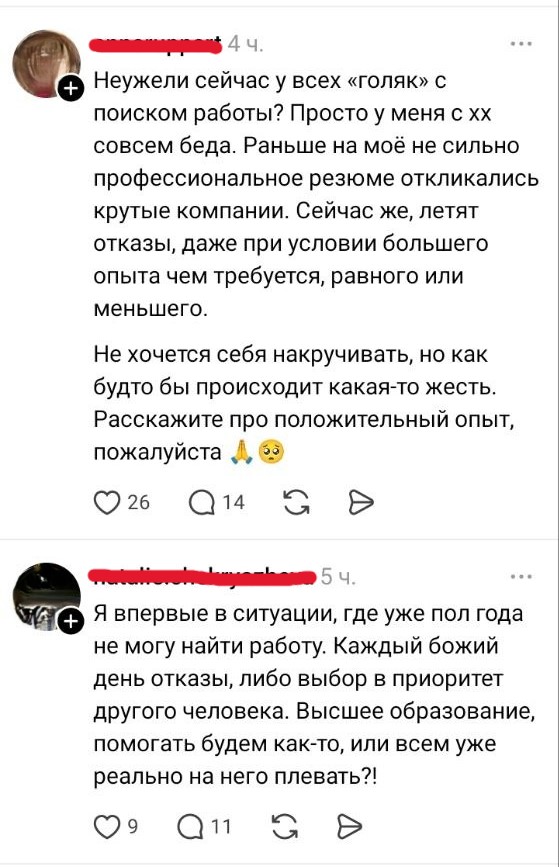
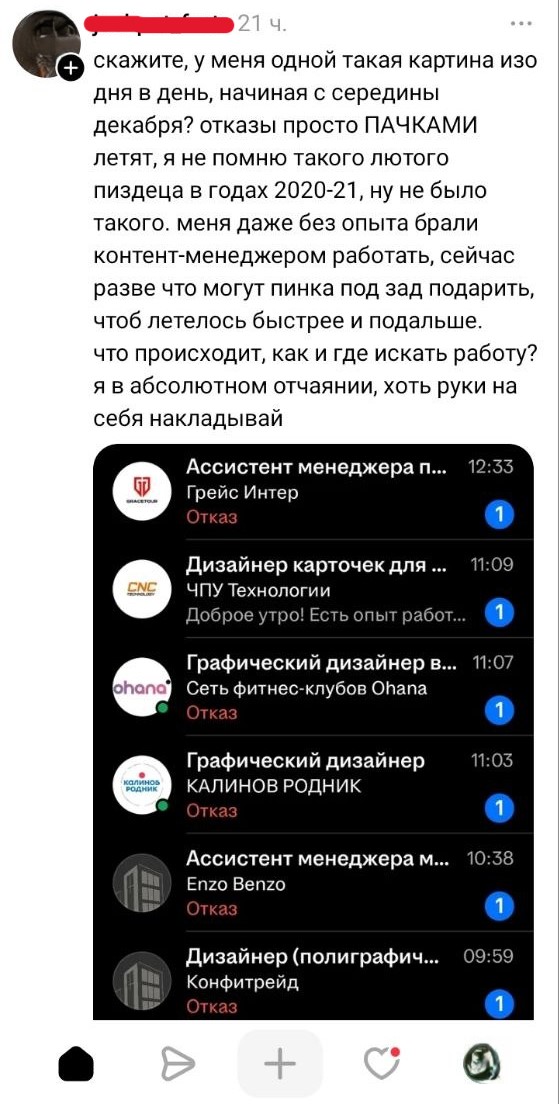
Social media users are complaining en masse that they have been unable to find work for months. The job application ratio has reached its highest level in recent years. “Cherta” asked recruiters about what is actually happening in the labor market - and how to effectively look for a job now.Looking for a job for six months is the new norm
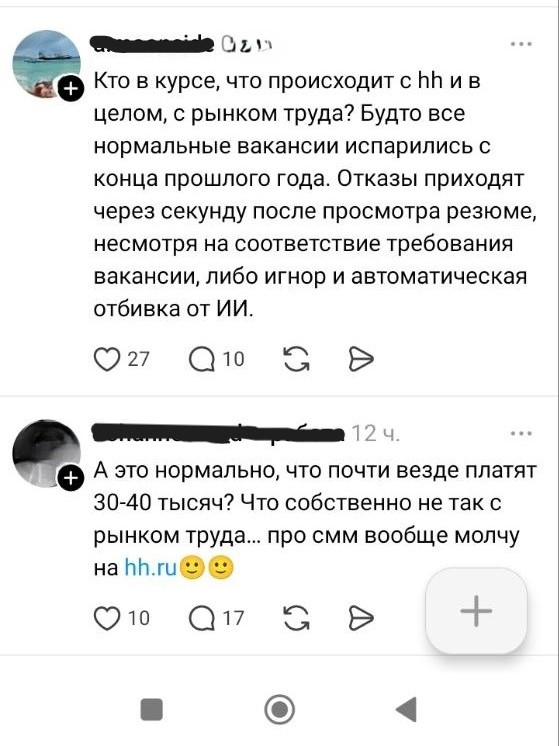
“Who knows what’s happening with hh and the labor market in general? It’s as if all the normal vacancies have evaporated since the end of last year. Refusals come a second after viewing a resume, despite meeting the requirements of the vacancy, or they are ignored and automatically rejected by the AI,” Anastasia, author of a travel blog, asks Threads users.
“300 responses to hh, or How I give up. More than 100 cold letters to agencies and companies. More than 10 tests. More than 10 interviews. Every time it’s dancing with tambourines,” the designer complains.
“18 years of experience in marketing and commerce, projects completed. I went to HH - 415 responses, 5693 resume views, about 50 Google forms filled out, 4-5 interviews, refused for vague reasons,” marketer Nikita shares his experience.
IT specialist Artem told Cherta that he couldn’t find a job in his specialty for six months. He worked in a foreign project, led the development of a CRM for a Russian travel agency. “In 3 years, I went from 5,000 rubles/month to a rate of $25/hour. In 2025, my project was frozen, and all my friends suddenly had no free places, and they themselves were in a similar situation,” says Artem. “Before, I didn’t even have a resume; I easily found a job based on recommendations from friends. Then I switched to telegram chats, but the frequency of vacancies there has recently decreased significantly: from several per week to one per month. I didn’t count on HH, I got about 100 responses there, all with refusals - I quickly got tired of it.”
Data from the most popular job search platform, HeadHunter, confirms that the situation on the labor market is changing rapidly. The average HeadHunter index—an indicator of the number of resumes per vacancy—over the year increased from 5.9 to 11.4. Career consultant Olga Bizyukova, in an interview with Chertaya, notes: an index in the range from 8.0 to 11.9 means that competition for jobs is at a very high level.
“This can also be seen in the number of responses to vacancies: some positions receive 150–300 responses,” she says. “The record I saw was 1,870 responses to the vacancy of an HR manager.”
The highest hh-index is in the fields of art, entertainment and mass media (47.7), strategy, investment and consulting (46.3), top and middle management (32.3), marketing, advertising and PR (27.3), information technology (22.9), personnel management and training (22.1), security (20.1). There is also high competition for vacancies in the fields of science and education, administrative personnel, and transport.
Career consultant and founder of the @bezpanikiIT project Vyacheslav Litvinenko calls the hh-index for the IT sector a historical maximum: “Horrifying numbers, this has never happened in the Russian market. If before you knew how to write something, code something, they tore you off hands and feet.”
For lawyers the figure is 19.8. CEO of the recruitment agency Magic Staff Dmitry Utukin explains that the norm for this profession in recent years has been 9–11.
Compared to last year, the number of vacancies in personnel management has decreased by 40%, and in procurement, marketing, advertising, PR, art, entertainment, mass media, sales, customer service, and consulting by a third. Demand has fallen even for specialists in finance and accounting.
These figures explain: the long job search that social media users complain about is not an anomaly, but a new norm. “The search stretched from one or two months to about 3–6 months, if we are talking about the middle segment, and more than six months in the top segment,” says Utukin. Bizyukova has similar observations: “If previously applicants received an offer on average after 3–6 weeks, now it takes 3–6 months.” Litvinenko names the average period as 4–6 months.
They lay off those who are not bringing in money now
“Since January of this year there has been no work/projects, and it’s not just me,” says video content producer Lesya. She is looking for a job through hh, acquaintances, social networks. “There are a lot of refusals, a lot of interviews, tests and questionnaires when you get a job even in just one company. In general, a long response and a long wait for offers.”
“Companies/any customers are saving on everything now. Filming of TV series and films is postponed or cancelled. They are cutting budgets for videos and advertising, which means there are fewer people on the team. The production market has now been cut at least twice. That is, half of the specialists were left without work,” says Lesya.
In her opinion, the reason was both the economic crisis and the introduction of AI.
The girl also began to apply for vacancies as a project manager. “Because producers are actually very strong managers. And it will be easy to be a project, just by pulling up the necessary hard skills.” But employers don’t give you the opportunity to try even during a test month.
Trait's interlocutor in the video production industry confirms: customers save on everything. Those who previously pursued the highest quality are now settling for the merely acceptable through the use of AI.
 More on the topic “Sometimes there are three hands or six fingers, but I forgive them for that”: how relationships with neuropartners are taking over the world and teaching us to love each other
“There are more tenders. Clients simply come with a ready-made budget. If earlier they looked at the directors we offer and their treatments, now they look more at the estimate,” says the interlocutor.
Budgets and personnel are being cut in other areas as well. According to Vyacheslav Litvinenko, now even companies with state participation are cutting budgets. “We have a huge number of domestic projects on the Russian market, namely large ones, that have been tied to import substitution for the last 4-5 years. And huge budgets were allocated for this. What they wanted, they substituted imports; what didn’t work out, they gave up on it,” says the expert. With the end of government subsidies, many projects were closed. Including Sberbank, Gazprom Media and the Rutube division.
“The story with the digital ruble was very funny. They planned, in my opinion, to launch it by 2025. And in connection with this, they recruited a huge number of outsourcing teams. And then they extended the deadlines for another year, and they disbanded these outsourcing teams. These people poured into the market, and now they have a gap of three months in their resumes,” says Litvinenko.
 More on the topic “We are burying our child.” How can business cope with new taxes and what will happen to prices?
The business is also actively cutting costs - and staff. “The market is cutting back-office, cutting functions that don’t bring in money right now,” explains Utukin. — There is also a tendency that people are less likely to apply for external hires. They began to grow their own personnel more, because external hiring has become very expensive - both from the point of view of attracting recruitment agencies, and from the point of view of searching on our own.”
Litvinenko confirms: now the priority for companies is cost savings, not process efficiency. That's why middle managers, accountants, and HR managers go under the knife.
Personnel records management is now actively transferred to the accounting department, explains Litvinenko. “If previously they hired a separate person to do this, now they just give it to accountants and say: figure it out yourself somehow.”
Recently, the Central Bank published the results of a survey of enterprises. For those who recognized a shortage of personnel, the figure was the lowest in the last two years - 51%.
More than half (64%) do not plan to hire new employees this year. Moreover, some companies are removing already published vacancies.
Several social network users encountered this situation: when the offer was already ready, they were informed that the vacancy had been closed. Olga Bizyukova confirms that employers now often withdraw offers.
According to a Central Bank survey, 14% of companies are ready to cut about 10% of their staff. At the same time, according to Rostrud, the number of employees recommended for dismissal over 10 months increased by 43% - from 73.5 thousand to 105 thousand people.
Job Search Like Tinder
The number of applications for vacancies has grown rapidly not only because of the economic crisis, according to recruiters. The reason also lies in the behavior of applicants on the platform. Thus, a robot automatically responds to a vacancy for a living person if it believes that the resume matches the request. But in practice it often doesn't work out that way.
Users of social networks often notice: under many vacancies there are 300+ responses. But in reality, most of them are automatically generated, and resumes are completely irrelevant.
 More on the topic “Fifteen million debt is normal for a seller”: how the dream of success in online trading leads Russians to bankruptcy
According to Litvinenko, some applicants themselves respond to vacancies indiscriminately. “HeadHunter, as a monopolist, has turned job search into a conditional Tinder,” he says. — That is, a person is on the bus from work. He presses the “reply” button, flipping through the feed. There is no need to put in any effort. You just press a button and think you’re looking for a job.”
The expert gives an example: the vacancy for an IT tester that he posted received 3,000 responses. Most of them are sales consultants, plumbers, electricians, and sales managers.
“That is, there were approximately 600 people who were relevant from these responses. Half of them did not fit the stack, another half cannot work abroad, some need full remote work. As a result, the relevant candidates remain, as before, 20–30 people per position,” states Litvinenko.
A passive approach to job search is also manifested in behavior during initial interviews (they are also called screening interviews). Litvinenko compares the experience of interviews with Americans and with immigrants from the CIS countries. The first ones, even after a 10-minute conversation, send a letter thanking you for the communication and additional information. For the latter, “the area of responsibility ends with pressing the “disconnect” button.”
He notices similar behavior among Russians on the LinkedIn platform. “The VKontakte phenomenon of the tenth years arose there, when you needed to get yourself a large number of subscribers - and you were cool,” he notes. — But the main task of LinkedIn is networking. 10–20 people are added to me every day. I manually write a message to everyone. Like: hi, I'm doing this. Of these people, God willing, one in 100 will answer. Naturally, when I have a vacancy, I won’t go to such people. I’ll go to the person who answered the message.”
Litvinenko believes a passive position is one of the main reasons why many Russians now spend months looking for work. Job seekers have not yet accepted the new reality, in which it is not enough to simply apply for vacancies and go to interviews. “Now the labor market is an employer’s market,” warns Litvinenko. “And he can dictate terms.” The company has the resource to hire a person for six months. A person does not have the resource to look for a job for six months. Accordingly, salaries and median market expectations are falling on average.”
Are resumes read and written by robots?
Users of social networks complain that they receive refusals without any explanation - sometimes within a minute. They suspect that HR work has long been transferred to AI, and the robot filters resumes according to unclear criteria and therefore does not let through really good specialists. To bypass these filters, many share prompts for the AI to create the perfect resume for the robot.
“If you are rejected within a minute of viewing your resume, it’s a robot,” explains Litvinenko. “And he refused you based on key words.”
There is no AI magic on job search platforms - refusals most often occur based on formal criteria that applicants indicate incorrectly. For example, if a person hides his age, he will automatically be rejected for all vacancies where age limits are indicated.
HeadHunter has also learned to calculate from a resume the work experience required for a specific vacancy. “At first you were a journalist for 2 years, then you were an editor for 2 years, and then you were a journalist again for 2 years - he will still highlight to me that you have 4 years of experience as a journalist,” says Litvinenko.
Another popular filter is salary. If the applicant does not have it indicated, but the employer has set a “fork”, an automatic refusal will arrive.
Litvinenko urges you to be careful with resume prompts from AI. According to him, most HR see the generated texts - they look like a carbon copy.
“If a person, while working in IT, has not learned to use artificial intelligence and write a resume so that it is not visible that it was written by ChatGPT, then this also speaks about his professional skills,” the expert states.
He also advises to prepare for the fact that AI statements about improving some indicators on past projects will have to be explained.
Another reason for refusals is the lack of direct contacts in the resume. According to him, among the applicants there are many who do not want to answer calls from unfamiliar numbers or have installed programs that block such calls. It happens that people limit the ability to write to them in instant messengers to people not from their contact list. They expect the employer to write to them, for example, in the HeadHunter chat. But in reality they won’t waste time on this.
HR can quickly refuse even after checking the candidate’s social networks . “We go to Telegram, see stories, a link to some of our channels,” Litvinenko describes. “And the first thing he writes there is: “all HR are assholes, employers are crap, I will never work, in general I have my own project, I’m looking for a job in order not to do anything.”
 More on the topic: Theft, attitude towards Putin and relatives in the SBU: how Russian employers test employees with a polygraph
Even just mentioning your personal projects can be a red flag. “The employer wants you to earn money for him. Your freelance work, which you indicate on your resume, is of no interest to anyone,” the expert is sure.
It can also be a mistake to format your cover letter incorrectly. “The vacancy states experience with GPT chat, but our resume does not indicate experience with GPT chat. Well, we just didn’t add the keyword there. What are we doing? We write in the cover letter that I worked with GPT chat, I used it in such and such a place for such tasks. But with us, they often simply copy information from a resume and send it.”
How to look for a job correctly
Trait's interlocutors advise focusing on HH statistics. The highest demand - and it continues to grow - is for specialists in sales, customer service, labor, as well as in the fields of construction, real estate, transport, retail, medicine and tourism.
If there is an opportunity to learn some manual labor, then this will be useful, Litvinenko believes. If this is not possible, you need to adapt to the market and master new tools in your field. “We are not talking about the fact that artificial intelligence will replace everyone, it won’t happen that way. Everyone will be replaced by people who know how to use artificial intelligence,” he explains.
“Adaptability is a key skill in the labor market now. This can be seen in the example of IT specialists who cannot find work. They don’t want to adapt, often it’s difficult for them to even write a resume - they’ve never done it.”
The expert advises not to automatically respond to hundreds of vacancies, but to choose a specific role, direction and make the top 30 companies where you want to work. And after that, turn on the radar and start looking for company representatives and vacancies on LinkedIn and social networks.
Anastasia Bagan also recommends: “Calm down and sit down, and clearly write on paper what kind of job the candidate wants to see,” and then look in the right direction, without being scattered on irrelevant vacancies.
Litvinenko advises to be active not only in the search, but also in correspondence and at the interview. “If we come to an interview from the position of ‘you owe me everything,’ then the employer is not interested in such an employee,” he believes. — If you don’t bring money to the company, then what’s the point of the company hiring you? And people cannot explain how their work will bring money to the company. It’s easier to whine on Twitter or Threads about how unfair the world is.”
Anna Petrova