
Translated material
“To exhibit indigenous peoples under the Russian flag now is the utmost hypocrisy”
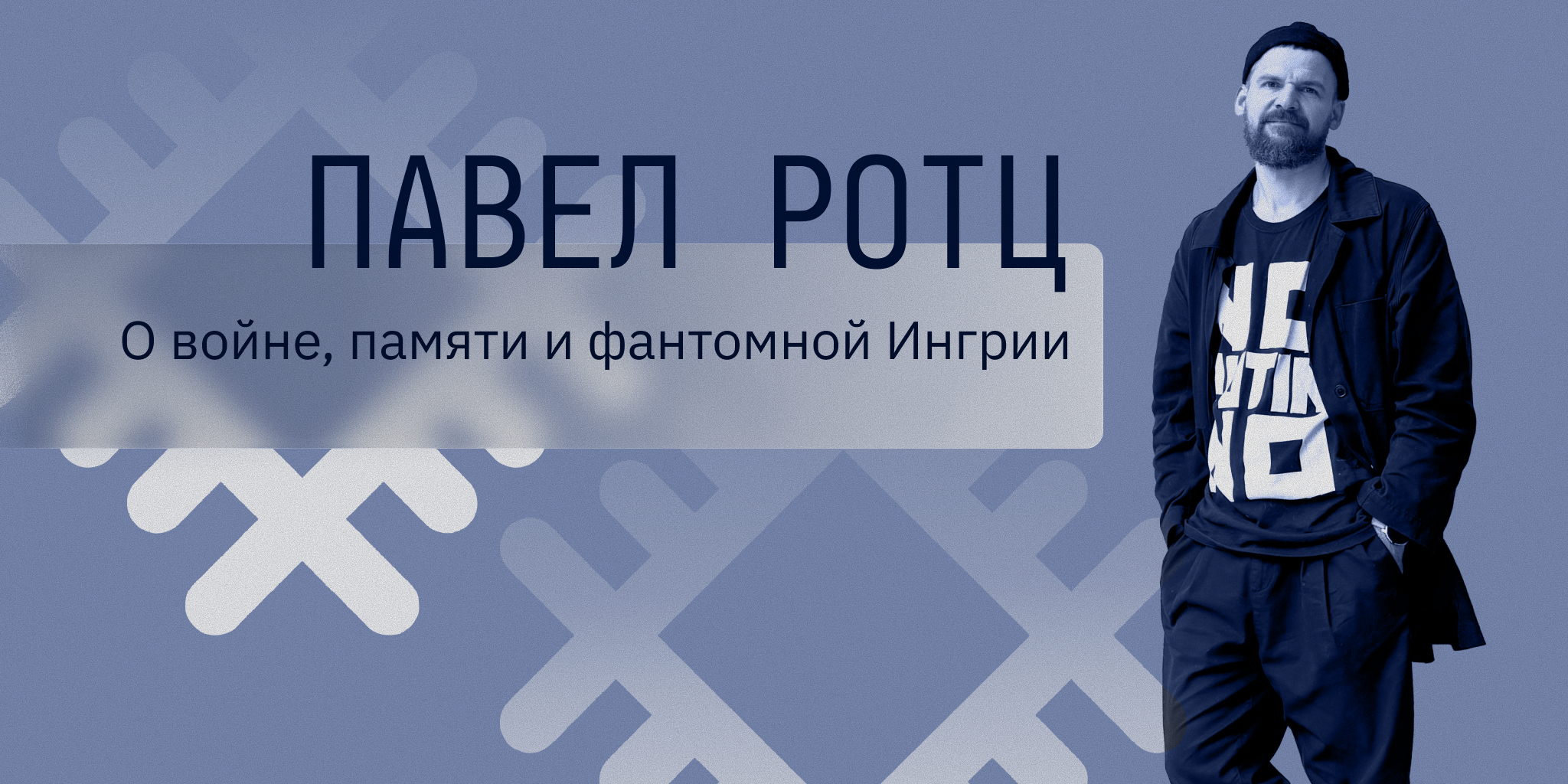
Helsinki-based artist Pavel Rotz works with themes of memory, deportations, war and disappearing identities. A descendant of Ingrian Finns, he has been researching the traces of the Gulag, family history and the experience of forced migration for many years. At the Venice Biennale, Rotz presented the “wandering Ingermanland pavilion” - a project about a people scattered around the world and about a memory that cannot be completely repressed. We talked to him about repression, Ingria, contemporary art and why Russia’s participation in the biennale during the war seems impossible to him.
— Tell us a little about yourself and your artistic path.
— I was born in Petrozavodsk. Our family was exiled there after the war, and it was only after I was 30 years old that I realized that I was born in exile. Initially, we lived in Ingermanland, in the Leningrad region, in the village of Kuttusi. My other grandmother lived in Gatchina, that is, I had Ingrian people on both my maternal and paternal sides. They then mixed with the Belarusians and someone else, but I have the Ingrian line on both sides.
—Are you talking about Ingrian Finns?
- Yes. I grew up in Petrozavodsk, and then moved to St. Petersburg. He entered the Mukhina Academy, where he studied for 4 years. Then he graduated from the Pro Arte Institute of Contemporary Art.
I lived in St. Petersburg until 2015, and then I moved to Finland precisely under the program for the repatriation of Ingrian Finns. My relatives started moving back in the 90s. But the closest ones - mom, dad, grandfather, grandmother - moved there in 2008 and 2011. I, in fact, jumped into the last car of the program, the same one that was announced by President Mauno Koivisto (editor's note - President of Finland from 1982 to 1994). In 1991, after the collapse of the Soviet Union, he invited Ingrians to repatriate to Finland.
In my artistic practice, themes of memory appeared, rather, after leaving Russia. I started working in contemporary art around 2008–2010, then I moved away from it a little and switched to design: I created jewelry, and my partner and I had our own brand for a long time. But after moving to Finland, I returned to contemporary art, because I always felt that I wanted to devote myself to it.
WITH from the very beginning of my studies at the Helsinki Academy ( Finnish Academy of Fine Arts ) and in general from the very beginning of my practice here in Finland, I somehow began to work with my own identity, including the Ingrian one. Because at that moment I started the “KANAVA” project, which was dedicated to the Gulag. We traveled a lot to places where there were camps and studied them. We studied the GULAG and the memory of it, how it exists in modern cities, in the modern context. We traveled to many places - from Vladivostok to Belomorsk. It was a large five-year project, the results of which were eventually shown in Helsinki at a large exhibition. But they also appeared in residences, locally.
And somehow, through the prism of this project, I realized my ethnic component, namely my identity, my belonging to a repressed small people.
I opened my own eyes with this project. Previously, I dealt with these repressions as if they were something else. I just lived in Petrozavodsk, the White Sea Canal was being built nearby, but it didn’t seem to concern me, and I kept asking myself the question: do I even have the right to deal with this topic if I don’t have repressed relatives?
It was only in Finland that I realized that, in fact, I was born in exile. I didn’t have this connection for a long time.
— So this topic wasn’t even discussed at home?
“Even when this topic was discussed in my family, it was presented like this: well, we weren’t shot, we weren’t imprisoned, we were simply not allowed to return home. It seemed like something not so serious. Grandfather said that his father told him how in an Ingrian village, first one, and then another neighbor, a crow came. When, even before the war, Ingrians were sent to Norilsk or Yakutia, my relatives did not seem to be affected by the repressions; we were lucky.
And the fact that dad and mom met in Karelia, because their parents were exiled there and sent to logging, felling trees in the north of the republic, apparently did not seem something terrible. Some relatives were even able, as if in a pirate way, to stay in Petrozavodsk, because the great-grandfather was a savvy man and a good turner, he got a job at the plant illegally. This was absolutely prohibited; there were minuses in the passports, which meant that one could not live in big cities, even in regional centers. This is all clear and familiar.
I started working on this project through the prism of my grandfather’s memories and numerous interviews with him. Covid has given a big impetus to understanding family experience as part of the Gulag project “KANAVA”. Restrictions during the pandemic have provided a greater opportunity to concentrate on something that can be done while staying at home. I started an online project - the film “Home” , dedicated specifically to the memory of how both lines of my family ended up in Karelia. And he was already sharpened for family memory. I processed all the interviews I recorded over ten years, sometimes just by accident, on my phone. I was always writing things down, stories that seemed meaningful to me. And he put all of them into this film.
Now I work a lot with the topic of memory, war, trauma and so on, as a continuation of this whole story, not only in the Ingrian field, but in general. I have a big project about the traces of war in public space - Climbing a Memory , where I use my body to climb along the traces left by bombs. But this is about World War II, first and foremost. Naturally, this became even more relevant and sensitive with the beginning of the full-scale invasion [of Russia in Ukraine].
Now my co-authors and I have started the project Lucid Plexus , which is based on the Ingrian line, on migration during the war, and traces precisely the migration routes of the Ingrian Finns. And not only them, but also the Baltic peoples, when there was the Great Escape from the Baltic States to Gotland (editor's note - the mass flight of residents of the Baltic countries to Sweden across the Baltic Sea in 1944 after the return of Soviet power).
The Ingrians fled along the same paths, and we use this frame to look at large historical processes. This project is currently supported by a Finnish grant and will officially continue until next summer. But we plan to continue it for several more years.
— Tell us about your project at the recent Venice Biennale . That's where we met. What was the idea behind this project, and how did other countries react to it in the pavilion where you exhibited your work?
— There are several components here. First of all, the project was very intuitive, very spontaneous. I work on a theme and, at the same time, earn money as an exhibition technician. Benjamin Orlov , an artist who represents Finland, invited me as his assistant to the Nordic pavilion. Naturally, it is impossible to refuse the offer to go to Venice for a whole month. And then, the day before my departure, the participation of the Russian pavilion was announced. We worked in the Nordic Pavilion, which is opposite the Russian pavilion, just face-to-face. And I was really confused because I looked at Instagram, then out the window and saw the same thing.
And when I was going there, I just jokingly thought to myself, and then told my curators, acquaintances, friends, girlfriends that I was going to Venice to build the Ingria Pavilion. And then my friend, curator Adele Kim, says: “everything counts” - they say, Pasha, no matter what you do, everything will count.”
And this phrase stuck with me. The next question was how to implement this pavilion. Maybe build some kind of booth in the bushes? But I quickly abandoned this idea because it was too straightforward a view.
When we first walked into the Nordic Pavilion, there were five personalized storage boxes inside for five different countries. And there are only three countries: Norway, Sweden and Finland. Three had the names of countries written on them, one said that it was for everyone, and one more said Iceland. I started asking around and found out that the original idea was Pan-Nordic countries, like a pavilion for all the Nordic countries. But Iceland fell away, and Denmark built its own pavilion.
And somehow I liked the idea of absent, disappeared countries. This immediately intersects with Ingria. And then I found copper letters inside one of the boxes that should have been on the wall of the pavilion. And I thought that I could make the word “Ingria” from them, then I realized that I was missing “R” and “G”.
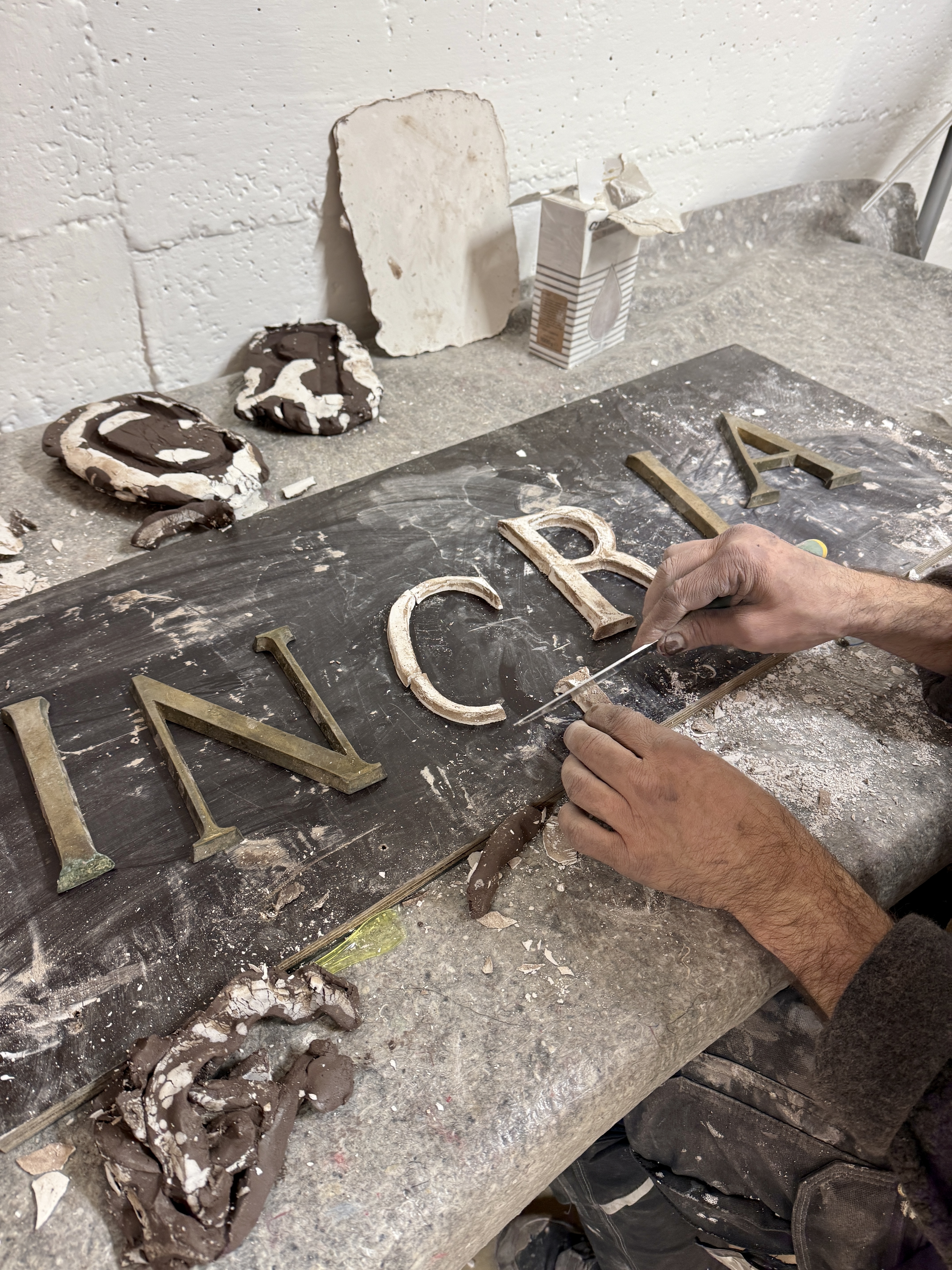
This is where the idea of making the letters myself arose. When I work with traces of war, I work with casts, plasticine, plaster and silicone. I cast them, making them like negative sculptures. I thought that I could continue this methodology - moldmaking (editor's note - the process of creating molds for reproducing products) - imprinting the letters that I was missing. And making them out of clay was also part of the idea. The finished letters for the pavilion were cast in bronze, and here is a clay inscription, such a contrast.
There, as they say, “cast in granite,” but here it is made of clay, not yet fired, from a self-destructive material. That is, a kind of phantom presence, which, it seems to me, very well expresses the concept of “Ingria” as a concept. Because it is such a non-existent state, a phantom entity that both exists and does not, which is still (in Russia) half-allowed and half-prohibited.
Then the only question was that I did not want this gesture to look like a claim against the Northern Pavilion, because this claim is against Russia. At the same time, I also didn’t want to place these letters on the facade of the Russian pavilion, because it was a gesture of such a separation: I’m not with you, I’d rather be with them.
In the end I decided that I would just make a lot of letters and they would be wandering. I placed them in different places, and the result was a migrating pavilion, which, it seems to me, expresses the essence of the Ingrian people, who ended up scattered all over the world, because they were pushed out by the country where they lived, and by other countries, like Sweden, which deported them to the Soviet Union, or like Finland, which after the war, in fact, handed them back to Stalin. People fled further and further - to Australia, to the USA, wherever. The wandering letters reflect this idea of migration, deportation.
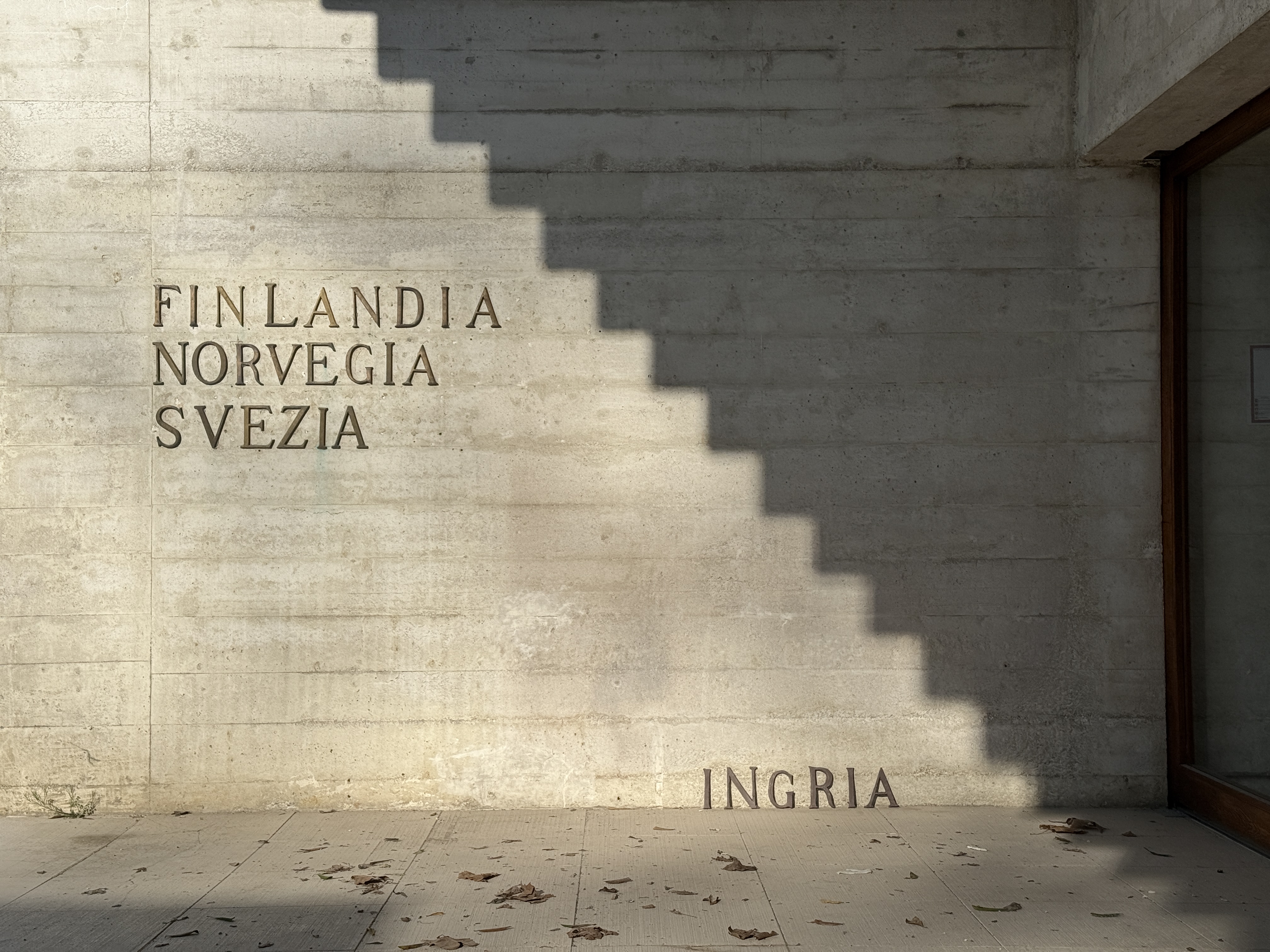
I didn't want to make too harsh a gesture, I only placed the letters at the opening. They stood for a day, I removed them and took them to Helsinki. Now these letters are with me, and I'm going to display them in different places. Maybe we will create an Ingrian pavilion in Helsinki, then in Narva, there are such plans.
Benjamin was enthusiastic about my idea. I spoke at the biennale with other artists and curators - with Tori Vrones , an artist from Norway, with Anna Mustonen , a Kiasma curator from Helsinki. I was worried that the letters were in the background of Tori's sculpture, that she would see it as an intrusion, but she was very enthusiastic about the idea and said something like: “Yes, yes, leave them there altogether.” It was very nice.
I didn't want to ask permission in advance because it's better to apologize than to be rejected. Therefore, already during the opening, I said: “I have a small intervention here, I will remove everything.”
— How do you actually feel about Russia’s participation in the Biennale? After all, the indigenous peoples of Russia were represented in the Russian pavilion, in particular the Komi, Tyvinians and others. There was the idea of a tree of life rooted in the sky. How do you like the participation of Russia, on the one hand, and the representation of indigenous peoples, on the other?
- This is the worst thing you can think of. Recently, someone wrote a very good post on Facebook that if Russia had brought to the Biennale that exhibition, “Russian Imperative”, which is now taking place in Manezh, dedicated to the new “heroes of the Northern Military District” and “monumental sculpture from the times of the new war,” this, perhaps, would not even need to be banned. It would be honest, and it would be the true face of fascist Russia.
And here it’s kind of a shy gesture: we’ll show you everything except what’s actually happening. And I’m not even talking about the fact that this is the utmost hypocrisy - to expose peoples whose representatives are banned and imprisoned just because they identify themselves with these peoples, speak openly that they have some interests of their own, and so on. This is the worst possible scenario.
As for the talk about “there are artists, there is art, and should we cancel artists from Russia?”, I want to say right away that I was against it. I distributed and supported petitions against Russia's participation in the Biennale. I don’t want this to sound like “everything is not so simple.” But when we say that artists from Russia can also be exhibited, it is clearly not under the Russian flag. There is a point here that the Venice Biennale is called the Olympics of art.
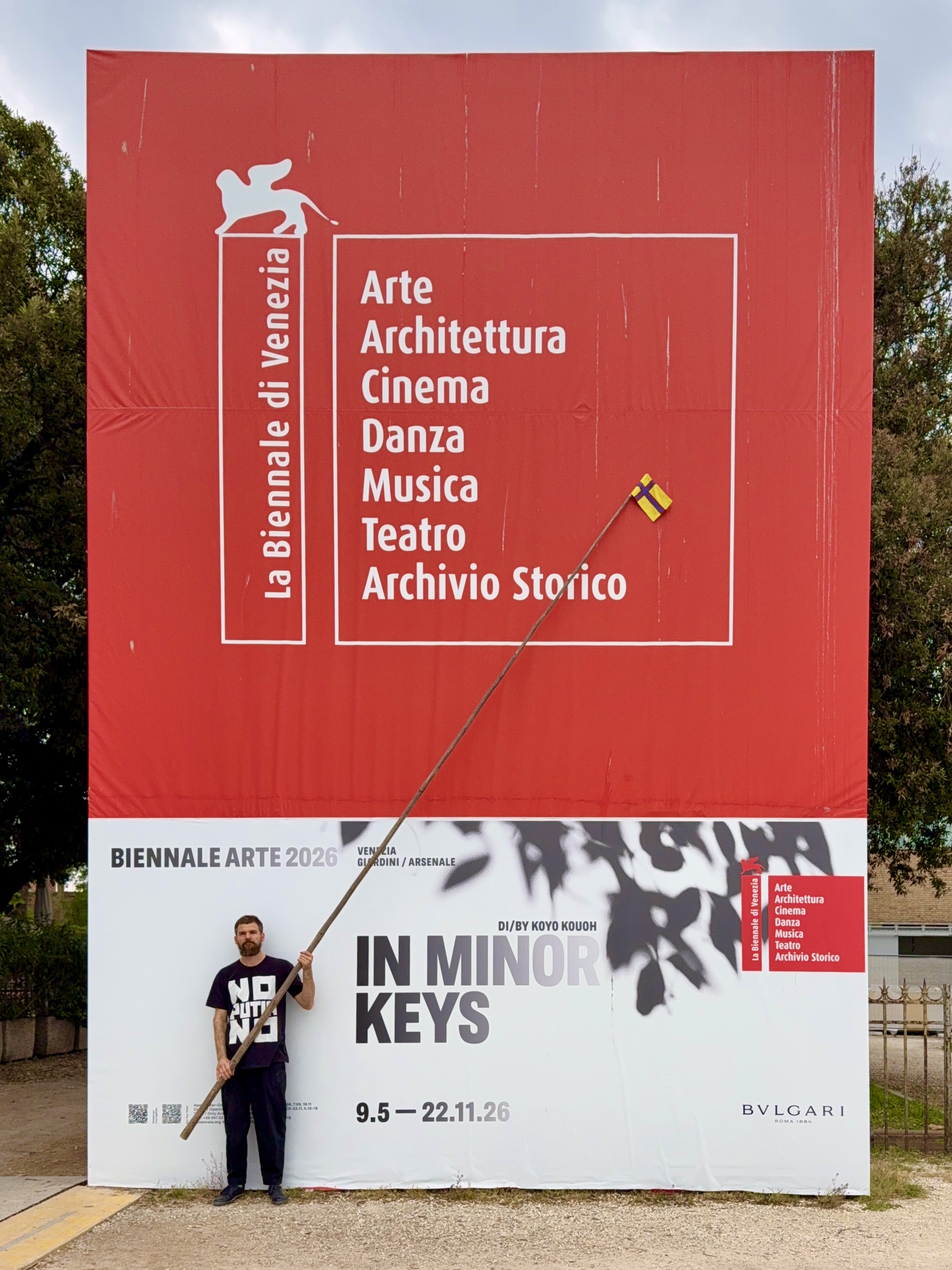
I haven't found it yet an example of an international exhibition where artists would represent their countries. It will be interesting to know if they were. For example, I recently learned that the first Olympiads also had art or culture sections.
And it turns out that the Venice Biennale is like the Olympic Games , only from art, where artists represent their countries. This is a dubious issue for many artists who do not necessarily represent the aggressor country. Here you are faced with a moment where you are not just a free artist, but also a representative of the state, you interact with the authorities. And for many this is a controversial issue, even in democratic countries.
Therefore, for me this is a completely clear point. Of course, I feel a little sad for those who were used. I just mean that no matter who comes to the Venice Biennale, they will represent the state. I think this is completely inappropriate. When you enter the pavilion, you represent your state and perform under its flag. In this context, during a war (Russian aggression against Ukraine), this is absolutely impossible.
