
Translated material
You'll have to choose
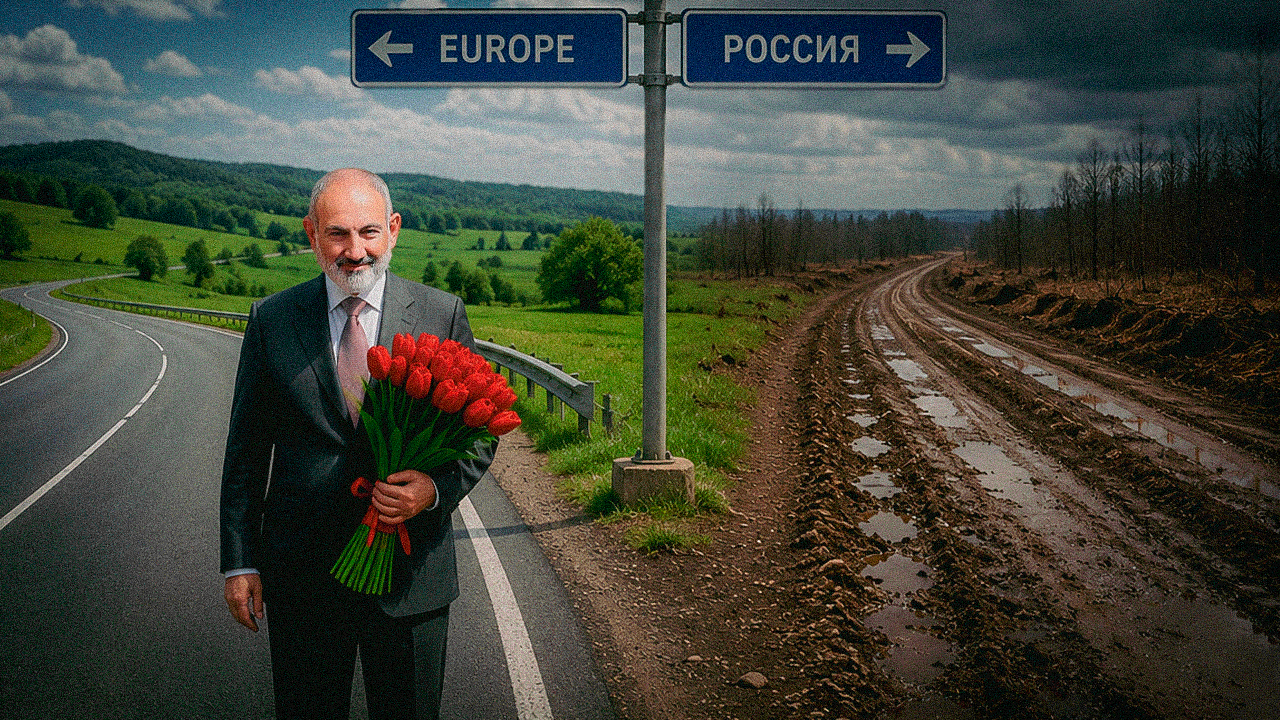
Russia does not want to let Armenia into the EU: what the Kremlin is ready to do
Armenia may lose access to cheap Russian gas if it refuses integration with Russia, the Kremlin says. Armenia plans to join the European Union, and Moscow clearly does not like this. Yerevan is a member of the Russian-led Eurasian Economic Union and is heavily dependent on energy imports.
The head of the State Duma, Vyacheslav Volodin, accused Armenian Prime Minister Nikol Pashinyan of “dishonesty” and “meanness,” as well as the fact that he “is pursuing an unfriendly policy towards the Russian Federation, cynically using the opportunities provided by our country.” Volodin is concerned not only about the process of Armenia's accession to the European Union, but also about Armenia's recognition of the jurisdiction of the International Criminal Court, which issued an arrest warrant for Vladimir Putin.
Deputy Chairman of the Russian Security Council Dmitry Medvedev also openly criticizes Pashinyan. According to Medvedev, Pashinyan maneuvers between political trends in an attempt to earn “inflated authority in the West.”
Russia has already banned the supply of flowers, Jermuk mineral water and alcoholic drinks from three manufacturers from Armenia.
Earlier, Vladimir Putin said that Yerevan is obliged to choose “as soon as possible” between the EU and the Eurasian Economic Union, and for this, according to Putin, a referendum should even be held.
At the same time, 75% of Armenians support the country’s possible accession to the European Union, according to a survey by the US International Republican Institute. Armenia expects to introduce a visa-free regime with the European Union within two years.
Parliamentary elections will take place in Armenia on June 7. If he wins, Nikol Pashinyan will continue the policy that leads to rapprochement with the EU.
We are discussing with political scientists Ruben Mehrabyan and Alexander Morozov what lengths the Kremlin is ready to go to prevent Armenia from getting closer to the European Union.
On May 26, US Secretary of State Marco Rubio visited Armenia. At a meeting with Armenian Foreign Minister Ararat Mirzoyan, he signed a charter on a comprehensive strategic partnership between the two countries and other documents. The visit took place two weeks before the parliamentary elections in Armenia, in which, as journalists from the Dossier center found out , the Kremlin plans to intervene. The documents they discovered speak of a group of Russian political scientists who were sent to accompany the campaigns of several Armenian politicians. Their task was to weaken the position of the country's Prime Minister Nikol Pashinyan .

Russia does not want to let Armenia into the EU: what the Kremlin is ready to do
by Radio Liberty Text copied width px height px The URL has been copied to your clipboard
No media source currently available
In addition to the charter for a comprehensive strategic partnership between the two countries, the United States and Armenia signed framework agreements on critical minerals and rare earth metals and on cooperation in creating the so-called “Trump Route for International Peace and Prosperity,” a transit corridor from the Nakhichevo Autonomous Region of Azerbaijan through Armenian territory to the main territory of Azerbaijan.
What do the documents signed with the United States mean for Armenia, and how Russia’s interference in the parliamentary elections can affect their results, says political scientist Ruben Mehrabyan :
This visit fulfilled its purpose - Armenia and the USA have become closer
– The signing of these documents indicates that relations between Armenia and the United States, which were at the level of strategic partnership, have acquired a comprehensive character. The visit of Secretary of State Marco Rubio was just a working one, and a working one not just in terms of its diplomatic status, but also in its functionality. And this visit fulfilled its task - Armenia and the United States became closer. In contrast to Armenia’s rapprochement with the EU, in relation to which Russia can indulge in the most vulgar exercises and statements, Moscow is more courteous with the United States. Now Russia will have to reckon with the fact that the Republic of Armenia is a state that has its own state interests. Armenia strives to improve relations with those partners with whom it has common goals, interests and values, and, please note, none of these parameters are about Russia.
As for the ban on the supply of Armenian products from Armenia to Russia, Moscow is targeting the vulnerability of Armenia and is trying to present the problem as a sanitary one, whereas this is a political issue. Russia is simply doing petty shit against those manufacturers whose products are not of impeccable quality. What happens happens. And Armenia will have to move very quickly in two directions: work on the quality of its products for export and redirect them to other markets. We are also solving the logistics issue. As you know, Armenia, together with Georgia and Turkey, received open access to the operating railway. Thus, it receives rail transit to Europe. I think there is a reason to appeal to the European Union with a request to launch temporary relief for Armenian exports in order to minimize economic damage.
In this situation, Russia is behaving like a prison guard or, in the language of Varlam Shalamov, a camp guard. With its behavior, Moscow leaves Armenia no choice, because it puts it in a dilemma: if you want to sell flowers from us, give up the state to us. If you want to sell tomatoes, give up your sovereignty. If you want to trade cucumbers, please see your strategic assets. And so on ad infinitum. The recipient of this pressure is not so much the government of Armenia as the average citizen of the country. Moscow’s goal is to intimidate him with some possible apocalyptic consequences and influence his choice. This cannot be called anything other than a hybrid war. The key word here is war, and war is waged by enemies. Armenia will not tolerate the hostile actions of an organized criminal group that has taken over Russia, says Ruben Mehrabyan.
Russian propagandists Margarita Simonyan and Vladimir Solovyov called Prime Minister of Armenia Nikol Pashinyan a drug addict. In one of the TV programs, they said that Pashinyan “eats psychotropic mushrooms and went ‘on the road’ of Ukrainian President Vladimir Zelensky.” Commenting on the statements of Simonyan and Solovyov, Speaker of the Armenian Parliament Alen Simonyan called them “fantastic creatures.”
Why Russia is increasing pressure on Armenia on the eve of the parliamentary elections, and how this will affect the future of the country - discusses political scientist Alexander Morozov :
Polls show that support for Nikol Pashinyan and his party is only growing
– This is a shot in the foot, because polls conducted in Armenia last week show that support for Nikol Pashinyan and his party is only growing. There is a rhetorical attack from Putin himself, who directly stated that either Armenia will continue to make a choice in favor of the European Union, or will remain with Russia. This is formulated as harshly as it was once formulated for Ukraine during its attempt to associate with the European Union. The declared trade war is also the fulfillment of Putin’s demands. In addition, there are direct attempts to support or somehow lead those forces that are playing against Pashinyan in the elections. The Dossier center writes about this. The result of this works in favor of Pashinyan and his support from the citizens of Armenia.
The summit of the European Political Community, held in Armenia in early May, sounded very strong for the Kremlin. There has not been such a powerful presence of European leaders in Yerevan for a long time. And it was obvious that Europe was ready to further expand cooperation with Armenia. This is certainly important for Armenia. Before this, Pashinyan came to Moscow, met with Putin and emphasized that Armenia is interested in maintaining economic relations with Russia. At the same time, he said that Armenia is a democracy, these are free elections, and therefore the outcome of the elections cannot be dictated either from Moscow or from anywhere else. So the summit probably played some role, but it must still be said that Pashinyan chose a certain political strategy and follows it. This irritates the Kremlin, but nothing can be done about it. The Kremlin is always irritated by the manifestation of any political independence or sovereignty on the part of neighboring countries.
As for the embargo on the import of products from Armenia to Russia, the older generation remembers that in the 90s, during the conflict with Latvia, Moscow Mayor Yuri Luzhkov called for a boycott of Latvian sprats. At the time it sounded anecdotal, but today the line of such threats, oddly enough, continues. This happened in relation to Moldovan wine, in relation to goods from Georgia, and now in relation to Armenia. At the same time, sanctions are not a fatal blow for Armenia. Armenian suppliers are reorienting themselves. Actually, this has happened many times already. Moscow will act in relation to Armenia as it acted in relation to Ukraine - put pressure on energy resources and threaten the military base that exists on the territory of Armenia. Let me remind you that the presence of a Russian military base in Sevastopol played a rather important role in fueling the need for some kind of military action to defend it in 2014 during the annexation of Crimea. So such a game is also possible here,” believes Alexander Morozov.
Read Freedom on Telegram Make Freedom a priority source on Google  Install the Mobile application
Radio Liberty