
Translated material
Why the liquidation of local self-government is especially dangerous for Komi
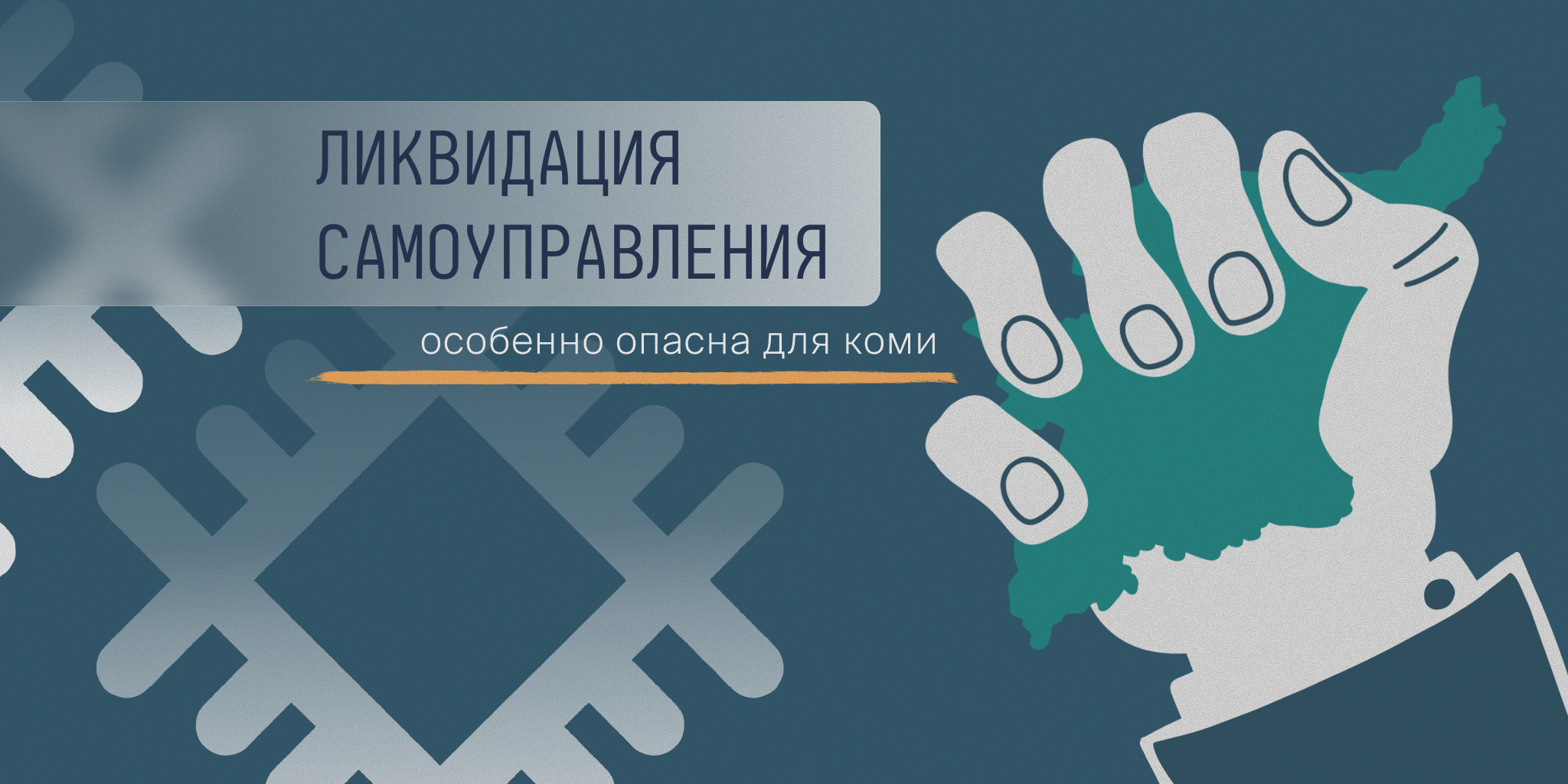
In the Komi Republic they are trying to stop one of the most large-scale reforms of local government in recent years. The Communist Party of the Russian Federation has submitted documents to hold a regional referendum against the liquidation of rural settlements and the transition to a single-level management system. If the reform is fully implemented, many decisions will no longer be made at the level of villages and hamlets, but in regional centers and municipal districts.
Supporters of the reform talk about “efficiency” and a lack of personnel, opponents talk about further centralization of power, the disappearance of real local government and an even greater separation of power from village residents. The reform could also worsen the already deplorable demographic situation in Komi. For the northern region with vast distances and sparse settlement, this issue is especially sensitive.
We talked in detail about local government reform almost a year ago. You can listen to the audio version of this article in our Telegram channel.
In this text, we look at why local self-government is vital for regions such as the Komi Republic and why the federal government wants to destroy it, and also take a short excursion into history and look at how local self-government is structured in other countries.
What is local self-government in Russia and why is it needed?
Local government is the “lowest” level of government: rural settlements, small towns and districts. It deals with many everyday and infrastructural issues: landscaping, local roads, lighting, utility problems, public spaces, local budgets and part of the social infrastructure. For example, local authorities organize school bus routes or the operation of rural libraries.
The control system divides powers between those who accept the rules of the game and those who implement them. Representative bodies (Councils of Deputies) determine priorities. For example, they allocate budget funds for summer holidays for children instead of mass celebrations. The administration, headed by the head, puts these plans into practice: holds tenders for food in kindergartens, monitors the work of municipal markets and is responsible for the cleanliness of the streets and the organization of leisure activities.
Municipal financing is based on a combination of their own tax revenues and external assistance. Part of the taxes remains in the local treasury, but for the implementation of large projects, such as replacing a park of water towers, there are almost always not enough own funds. In such cases, municipalities can attract subsidies from the regional budget. But this makes them dependent on the development programs of the republic and requires detailed justification of each expenditure before higher authorities.
How can local government influence events important for the whole country?
The example we will give is not directly related to Komi, but concerns the history of opposition to the garbage dump at Shies station, on the border with the republic. From the very beginning, the large-scale construction faced the problem of a lack of electricity. To solve this problem, it was decided to build a power line from Urdoma to Shies. In January 2019, someone cut down the poles of a power line under construction, and the project could not be continued. This became possible, first of all, because the power lines were carried out illegally - the builders did not receive permission from the Urdomskoye municipality, whose deputies opposed the construction of the landfill.
Problems with power supply led to the actual stop of construction of the landfill at the end of February of the same year. Thus, even at the lowest level, it is possible to block decisions of the federal authorities if they do not suit people on the ground. This example partly answers the following question.
Why does the federal government want to destroy local self-government?
The new local government law, finally adopted in 2025, changes this system. Formally, we are talking about the transition to a “unified system of public authority,” but in essence this means further centralization of management. Instead of a two-tier system (rural settlements and district or municipal authorities), in many regions there will be only one level of government. Small settlements and village councils will gradually disappear as independent structures.
This system is more convenient for federal and regional authorities. The fewer independent municipalities, the easier it is to control the territory, appoint loyal leaders and build a vertical power structure. Governors are gaining more influence on the appointment of mayors and heads of administration, and local leaders themselves are increasingly dependent not on residents, but on the regional center.
The authors of the reform explain the changes by management efficiency and resource savings. Indeed, it is expensive to maintain full-fledged administrations in small and dying villages, especially in northern regions like Komi, where there are vast distances and complex infrastructure. It is easier for the state to govern a territory from large centers than to support many small municipalities.
What consequences can this lead to?
If previously residents could at least formally influence local authorities through the election of village heads and deputies, now many decisions will be made by officials appointed from above. In small settlements, local authorities will actually turn into a representative of the district administration without its own budget and serious powers.
This may be especially acute in the Komi Republic. Due to large distances and inaccessible areas, the connection between village residents and administrative centers will become even weaker. Formally, the law allows the creation of territorial representative offices and remote workplaces, but this is no longer a full-fledged local government, but rather branches of the district administration.
Along with administrative independence, the ability to quickly solve local problems will disappear. For remote areas, this may mean worsening access to services and accelerating population outflow.
To summarize, the reform will most likely lead to the following consequences:
- infrastructure degradation,
- population outflow,
- decreased trust in government,
- feeling of abandonment of the periphery,
- growth of local discontent.
The reform is also perceived negatively because local self-government in Komi has deep historical roots.
History of self-government in Komi
The history of local government in the Komi region was noticeably different from many regions of Russia. Unlike the central provinces, there was almost no private serfdom here: most local residents were state peasants. This meant that they were directly subordinate to the state, paid taxes and carried out duties, but at the same time retained more internal independence. Volost assemblies, elected elders and local communities played a much more important role here than in the landowner regions.
Due to the vast distances, harsh climate and poor communication with the center, many issues in the Komi region actually had to be resolved on the spot. People were accustomed to a certain autonomy and reacted quite sharply to attempts at external interference. This is clearly seen in the conflict surrounding the construction of the Pinego-Mezen road in the 1830s.
After the reforms of Alexander II, zemstvos appeared in the Russian Empire, but in the North and Komi their influence was limited: the region remained a remote outskirts with poor infrastructure and weak connections with the center.
After the revolution of 1917, local self-government formally passed to the Soviets, but rather quickly became integrated into a rigid party vertical. During the Soviet period, Komi actively industrialized, cities and enterprises were built, but real decisions were made not at the local level, but through party and government structures.
After the collapse of the USSR, Russia tried to build a more independent system of local self-government based on the European model. Rural settlements, municipal districts and elected local authorities appeared in Komi. But already from the beginning of the 2000s, a new wave of centralization began: municipalities became increasingly dependent on regional authorities and budgets, and direct elections of mayors were gradually reduced. In recent years, this trend has intensified. Small settlements are becoming larger or losing their independence, and powers are increasingly concentrated at the level of regional and federal authorities. For Komi, with its vast distances and sparse settlement, this is especially sensitive: the distance between residents of remote villages and those who make decisions is becoming ever greater.
What about others?
In many countries with harsh climates, long distances and low population densities, strong local government has become a practical necessity. We are talking primarily about Canada, Sweden, Norway and Finland. The conditions there are in many ways similar to northern Russia: vast territories, inaccessible areas, sparse settlement and complex infrastructure.
In such conditions, centralized management does not work well. The metropolitan authorities are physically unable to manage all remote territories equally effectively, so a significant part of the powers is transferred to the local level. Municipalities receive their own budgets and the right to independently decide many everyday issues.
This is beneficial for both the center and the regions. The state does not need to manually manage each village or town, and local authorities respond faster to problems and better understand the specifics of their territory. For example, northern municipalities know better how to organize transport, medicine or heating in conditions of long winters and long distances.
In many ways, such a model could be natural for Russia, especially for the North, Siberia and the Far East. The country is too big and too diverse for all local issues to be effectively managed from Moscow. But the current government of the country does not strive for an effective distribution of powers; it is not concerned about the deteriorating demographic situation. The federal authorities, led by Putin, continue to build a rigid vertical power structure and strengthen the control of the center over the regions.
Komi Daily will continue to monitor the situation.
