
Translated material
Butina in Komi: who is moving the person involved in the FBI case to the State Duma
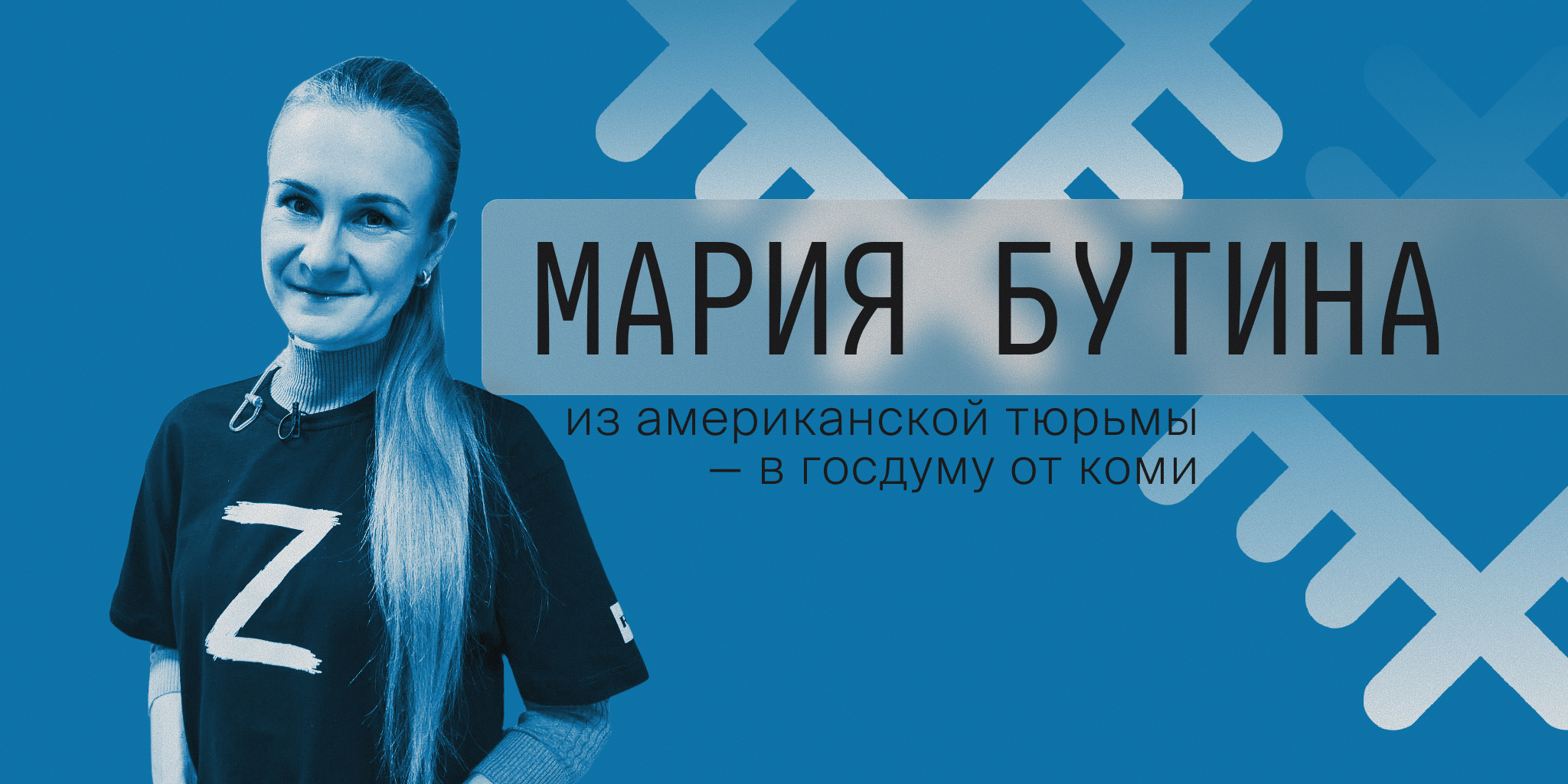
Maria Butina and Stanislav Kochev became candidates from United Russia in the State Duma elections from Komi. And although they come from the same party, different departments seem to be promoting them. A newcomer to politics, Kochev was included in the list of the Presidential Administration’s personnel program for “SVO participants.” Butina has a more colorful biography: the fight for the free carrying of weapons, close contacts with Republicans in the United States, time in an American prison, a trip to Navalny’s prison as an RT correspondent and a deputy in the State Duma.
In this material we look at what connects Maria Butina with the Komi Republic and whose interests she will actually represent.
Complete scam
“Was Butina “asked” from the Kirov region to the State Duma? The head of Komi wants to “shelter” her from Komi? How is Jabarova in the Northern Fleet?” This commentary on the website of the Komiinform agency appeared in early April under one of the first news stories about State Duma deputy Maria Butina. The news reported on assistance to mothers with many children in obtaining northern work experience - which may or may not happen.
The news from the pro-government agency does not tell about an event that happened, but about the fact that certain initiatives have appeared that are supported by a certain person. The main goal here is not to notify mothers of many children about possible improvements; in this case, they are just a PR tool for a new character in the Komi Republic. Therefore, the headline is not about concern for mothers, but about the fact that Maria Butina has taken control of the issue. She is the main character of the publication, the news about her, that she exists, does something and somehow relates to the region.
One of the simplest methods of media pumping is that the name of the character they want to make familiar and recognizable is mentioned on any occasion and put in the headline, because the news itself may not be read. The PR people of the current head of Komi, Rostislav Goldstein, used this technology back in the late 2000s: he expressed his opinion on a variety of issues, and the republican media regularly published this, putting his name and quote in the headline.
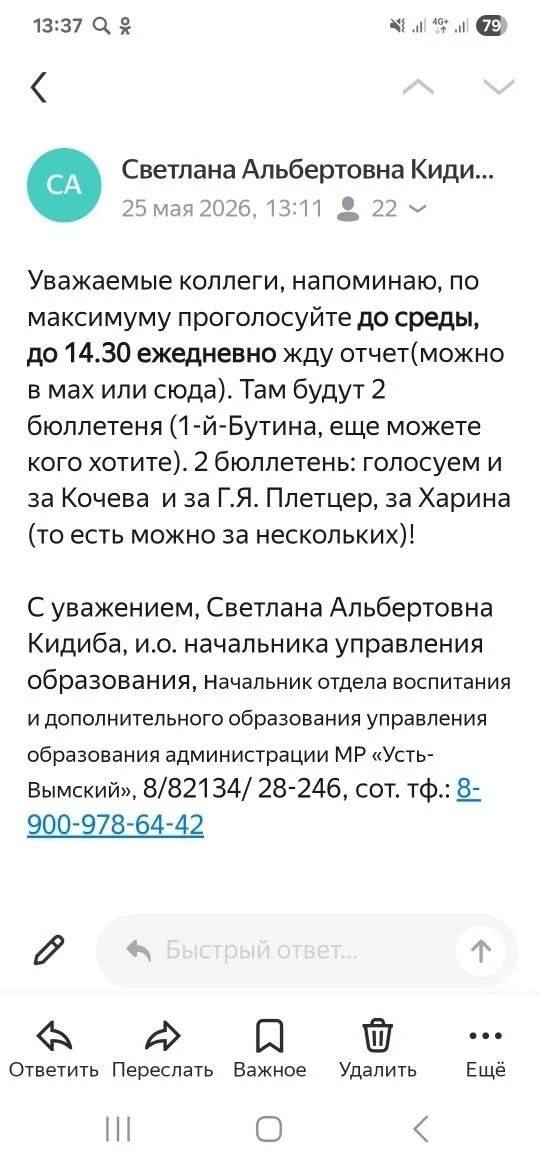
And, of course, promoting a candidate cannot be done without the use of “administrative resources.” Here, for example, is a screenshot of a message from the acting Head of the Education Department of the Ust-Vymsky District Svetlana Kidiba, where she reminds her colleagues of the need to vote and report in the Max messenger .
It seems that there are also temniks that explain why you need to vote for Butina - she supposedly has access to the president. This is how one of the residents of the republic described it (spelling preserved): “We were told yesterday that if we support, then it will have access to the top person in the state!)))) and can achieve a lot for the region, and our support will also show that here everyone politically supports the party line, does not rebel, and therefore the center will give us, then what will we ask for)))) in approximately these words, in response to the question, without this, what should we do - not expect improvement? There was no answer."
This is quite familiar rhetoric, and it sounds every time the republic needs to “sell” another “Varangian”.
You don’t need to be an expert in media manipulation to understand who is achieving what using such methods. The heroes of publications that appear at various events are simply “inflated”, made larger and more recognizable. And readers understand this. Therefore, under the text about Butina’s nomination to the State Duma on the website of the BNKomi news agency there are hundreds of comments and almost all of them are disapproving. Commentators doubt that she knows anything about the republic, and also make irony and mention the “sociologist” Shugaley.
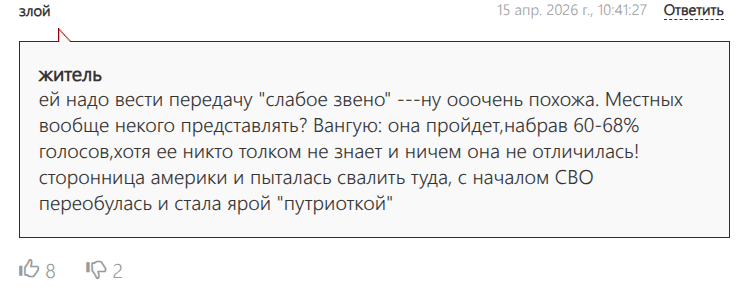
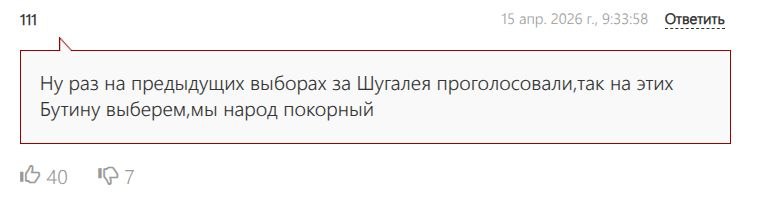
The name Maxim Shugaley did not arise by chance. In 2020, Prigozhin’s political strategist, who had absolutely nothing to do with the region, was dragged from the Rodina party to the State Council of Komi in order to be rescued from a Libyan prison. The trick worked. But to do this, they had to launch an entire film franchise in which the patriotic “sociologist” (or simply “Russian”) stoically endured torture and did not bend in the face of the Libyan “fanatics” and the Americans behind them. The regional electorate was asked to vote for this film image.
Apparently deciding that such narratives are a good way to sell their product, Butina’s PR people worked according to the same patterns. Although she was no longer required to be pulled out of prison (more on this below). As telegram channels reported , one of the theaters in Komi has planned a production based on Butina’s book “Prison Diary”. According to the descriptions of the authors of the premiere, which took place in 2022, in the play:
“The viewer sees the struggle of a strong Russian character against the repressive machine of American justice. Maria’s arsenal includes truth, innocence, faith in God, the Fatherland and a family that never stops fighting for her return home. In the hands of the American power elite are chains, shackles, prison basements, huge money and false propaganda.”
"The Wedding Lieutenant"
Another candidate from United Russia for a seat in the State Duma - member of the Northern Military District, Guard Lieutenant Stanislav Kochev - is being promoted by the Presidential Administration. The AP is working to form a layer in parliament of people who fought (or pretended to fight) in Ukraine. Our sources in Komi suggest that with virtually mandatory support from the SVO, such candidates have a lot of chances. In addition, it is difficult to criticize them without the risk of being subject to an article about discrediting the army. “The advantages of them are clear: they are loyal, obedient and ready to carry out any order,” says one of our sources.
Kochev went to fight in Ukraine in the spring of 2022. In the summer of 2023, he was seriously wounded and sent for rehabilitation. After being wounded, he received the title of Hero of Russia.
The rise of the SVO fighter’s political career was rapid. In July 2025, Kochev started a channel on Telegram, where the first thing he said was that he headed the support headquarters for United Russia. In September 2025, Kochev became a deputy of the Komi State Council and immediately received the position of vice-speaker.
Kochev’s media promotion was also quite intense: he launched a patriotic event, spoke to school graduates and summed up the results of a regional competition of school museums. Having become a participant in many events, Kochev received the nickname “wedding lieutenant” from his ill-wishers.
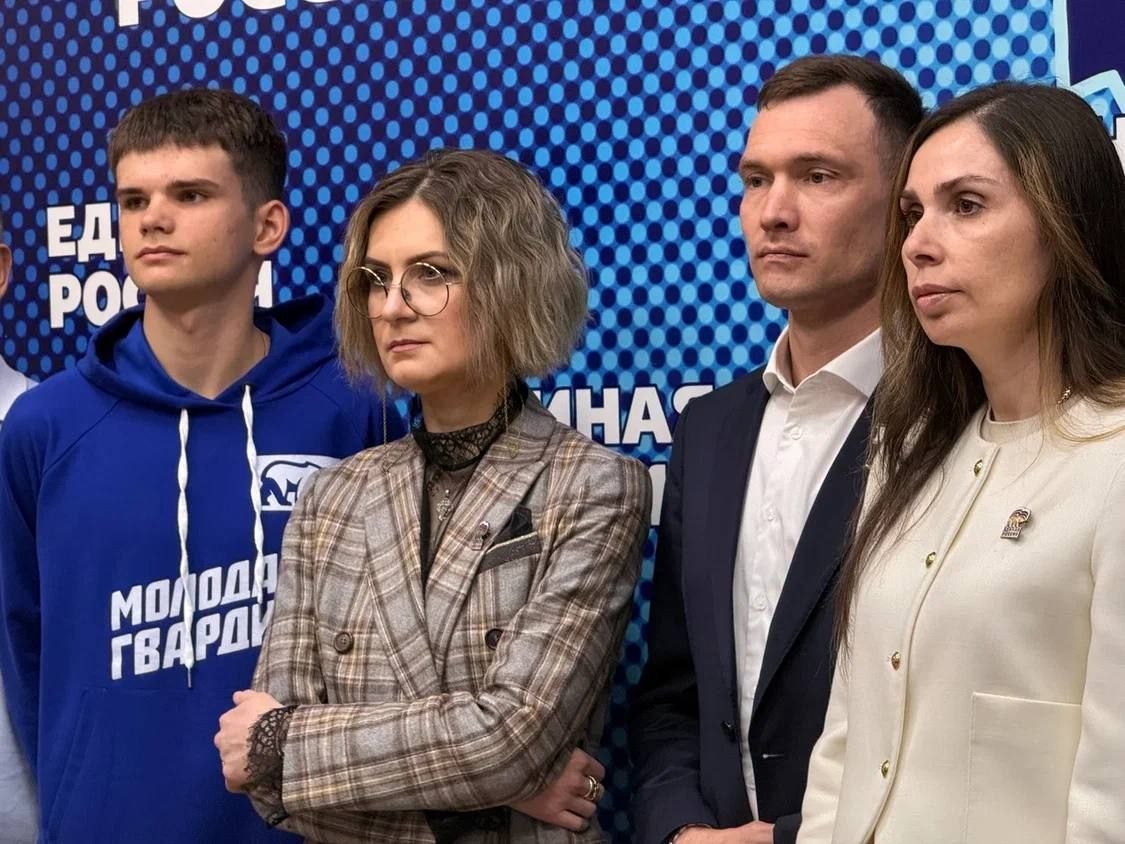
Kochev was included in the list of candidates under the same quota from the Presidential Administration asNursultan Mussagaleev from the Orenburg region, whom Ukraine accuses of shooting civilians in Bucha.
At the same time, Kochev’s understanding of political and social life is so poor that even during a trip to the Izhemsky district, a meeting with him was held not in the regional center, but in the village of Mokhcha. This did not save the vice-speaker of the regional parliament: Kochev openly floated in response to the question of why, given the budget deficit, there are cuts in schools, but no savings are made on bonuses to the head, business trips of officials and trips of deputies.
The effectiveness of information pumping methods can be debated, but perhaps it is not important here. It is important to demonstrate that the character became recognizable, that a positive image was created for him, and that after this he was elected to government.
How Butina wanted to arm the Russians
Maria Butina was born in 1988 in Barnaul. She studied to become a political scientist, then became involved in social activities. While still studying, Maria joined the Public Council of the Altai Territory and began doing business. She created a chain of furniture stores in Altai villages and then moved to Moscow. There, Butina abandoned further development of the furniture business, sold most of the stores and opened her own advertising agency. By the early 2010s, she was already combining entrepreneurial activity with social and political activity.
If now Butina is interested in issues of motherhood and childhood, then before her interests were completely different. In the early 2010s, she was known primarily as an activist and advocated for the liberalization of gun laws in Russia. In 2014, GQ magazine profiled her as a young entrepreneur and one of the most famous social activists who created the Gun Rights movement with thousands of supporters across the country: “Long-legged, beautiful, with a tight red braid, alert gray eyes, pearls in her ears and a shiny gun badge. She has a double-barreled shotgun from the Tula Arms Factory TOZ-34, she loves to shoot and hold weapons in her hands.”
Her supporters saw her as an energetic reformer, while her opponents saw her as a lobbyist for the arms industry. Butina herself called her activities a struggle for the human right to protect himself, his family and his home. Her movement, created back in 2010, sought to expand the rights of citizens to own and carry firearms for self-defense. Its supporters believed that law-abiding Russians should be able to defend themselves in the same way as is the case in many European countries and the United States.
The organization held congresses, public discussions and collected signatures for changes in legislation. One of the most famous initiatives was the “My Home is My Fortress” campaign, which proposed expanding the limits of necessary self-defense.
This is how Maria Butina was described by a person who communicated with her in those years (we cannot name him for security reasons): “She seemed to me a person with a very sharp mind. Butina was excellent at finding the nerve of a topic, building a clear and memorable story around it, and promoting it in the public sphere. That’s how she made gun rights her political issue—though why the issue captivated her so much is hard to say. If she had been born in the USA, she would probably have made a quite successful Republican politician. She had good connections with the NRA (National Rifle Association, “National Rifle Association” of the USA - editor's note ), most likely through Alexander Torshin. It would be interesting to know why he needed these connections.”
Indeed, among Butina’s allies was Senator Alexander Torshin, with whom she promoted the idea of legalizing short-barreled weapons for civilians. However, the Russian authorities did not support these proposals.
At the beginning of 2010, Butina began actively collaborating with the already mentioned NRA, participated in events of the weapons community in the United States and established contacts with American conservative circles. It was these connections that later attracted the attention of American intelligence agencies and played an important role in her criminal case.
Love for Republicans and a criminal case in the USA
At the beginning of 2010, senator and then deputy chairman of the Bank of Russia Alexander Torshin became one of the main patrons of Maria Butina. She subsequently worked as his assistant. The Insider wrote in detail about this period of her life.
In 2015, Butina entered a master's program at the American University in Washington and moved to the United States. According to American investigators, study was only one of the reasons for her stay in the country. At the same time, she actively attended NRA events, Republican conferences and political forums, met representatives of conservative circles and built a network of contacts among Republicans.
An important role in this was played by the American political consultant Paul Erickson, with whom Butina was in a relationship despite an age difference of almost 30 years. Through him, she gained access to influential figures in the Republican Party and the gun lobby.
In July 2015, Butina became famous after she asked Donald Trump at the FreedomFest event about the possibility of improving relations between the United States and Russia and lifting sanctions.
In July 2018, she was detained by the FBI. The investigation alleged that Butina acted in the United States in the interests of the Russian state and Alexander Torshin, trying to establish an unofficial channel of communication between the Russian authorities and American conservative circles through the NRA and representatives of the Republican Party. However, she did not register as a foreign agent, as required by American law.
Among the evidence, the investigation referred to Butina’s email correspondence, documents seized during searches, as well as her contacts with Torshin and representatives of Russian official structures. The case materials included letters that discussed the creation of communication channels between Russia and American Republicans.
In December 2018, Butina pleaded guilty to one count of conspiracy to work in the interests of a foreign state without proper registration. After serving her sentence, she was released and deported to Russia in October 2019. After her return, she began a political career, which led her first to the Public Chamber and then to the State Duma.
Butina vs. Navalny
In the early 2010s, politician Alexei Navalny publicly supported the idea of legalizing short-barreled weapons for law-abiding citizens and in 2014 advocated Butina’s inclusion in the Russian Public Chamber. At that time, many perceived her not as a pro-government politician, but as a social activist and leader of the “Right to Arms” movement.
When Butina was arrested in the United States in 2018, Navalny criticized the American investigation for trying to present her as almost a spy. He noted that her activities were public and that the charges seemed disproportionate to her real role. At the same time, Navalny did not support the political activities of Butina or Torshin, but rather considered her a person who found herself at the center of a large geopolitical conflict. Later, after Butina admitted guilt and the publication of the investigation materials, his attitude became much more critical.
However, Maria Butina can hardly be called grateful. After the attempt to poison Navalny, his return to Russia and arrest, it was she who went to the colony to see the politician. As a member of the Public Chamber and an employee of Russia Today, Butina came to IK-2 in Pokrov, Vladimir region. Without Alexei's permission, she tried to film him, accusing him of refusing to work and clean up after himself. The visit took place as part of a group of pro-Kremlin journalists and social activists. After the visit, Butina said that Navalny’s conditions of detention were good, and the colony itself looked better than many American prisons she had visited. There was a public dispute between them, fragments of which were then distributed by state media.
From prison to parliament
After serving time in the USA and returning to Russia, Maria Butina’s life improved. In 2019, she first worked on the RT television channel, then in 2020 she became a member of the Public Chamber of Russia, and already in 2021 she received a deputy mandate in the State Duma.
At the time of her election she was 32 years old. In the State Duma, she joined the Committee on International Affairs and since then has been actively involved in issues of foreign policy, compatriots abroad and international relations.
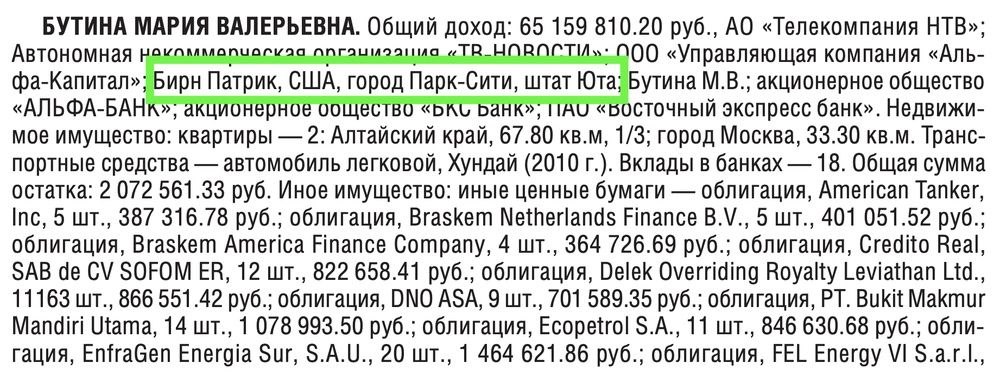
Before being nominated as a deputy, Maria, as expected, filed an income statement, according to which she received more than 65 million rubles for the previous year. One of the sources of her income was the American businessman, Republican Patrick Byrne. Information about this appeared on Alexei Navalny’s blog, which was then maintained by his colleague Maria Pevchikh.
In the 2021 State Duma elections, Butina was included in the regional United Russia group associated with the Kirov region. As a result of the voting, the governor of the Kirov region, Igor Vasiliev, who headed the list, refused his deputy mandate, and this mandate passed to Butina. This is how she became a State Duma deputy from the Kirov region. Back in 2013, people close to the leadership of the Komi Republic informed the author of this article that the then head, Vyacheslav Gaizer, would be removed from his post. At that time, Igor Vasiliev was named as a contender for his place. A native of the FSB, in 2004, in an interview with Zyryanskaya Zhizn, he claimed that he served in the same department (then the KGB of the USSR) with Vladimir Putin.
Why Butina nominated from Komi
In the spring of 2026, it became known that the party plans to nominate Butina from the Komi Republic. According to Vedomosti, one of the goals of her campaign in Komi is to work in a region that in federal politics is often perceived as a territory with noticeable protest sentiments. Examples usually include the Shies protests, environmental campaigns, and the traditionally higher level of political activity compared to many other regions of Russia.
Our sources in Komi associate Butina’s appearance in the region with the fact that she is closely connected with the structures of the FSB. And the point is not only that for the first time she was actually given a deputy position in the State Duma by someone from the department. We wrote about how much the FSB has recently strengthened in Komi in the article about the new buildings of the department.
Butina herself denies these connections, but the materials of the American investigation and the FBI included information about her contacts with people whom the American authorities considered connected with Russian intelligence services. Также следователи ссылались на обнаруженные у Бутиной контакты нескольких сотрудников ФСБ и на её встречу с человеком, которого американская сторона считала сотрудником российских спецслужб под дипломатическим прикрытием.
В Коми после ареста правительства во главе с Вячеславом Гайзером в сентябре 2015 года активно муссировалась тема того, что теперь республика находится под полным, хоть и неформальным контролем ФСБ. Говорилось также о связях ведомства с компанией «Газпром».
Расследование издания «Проект» утверждает , что на протяжении многих лет группа бывших и действующих сотрудников спецслужб участвовала в решении бизнес-задач, связанных с интересами главы «Газпрома» Алексея Миллера и активами компании. Авторы расследования описывают систему, в которой бывшие сотрудники спецслужб используются для сопровождения корпоративных и имущественных проектов.
Смещение правительства в Коми также связывали с интересами ФСБ и конфликтом вокруг строительства газопровода «Бованенково-Ухта-Торжок», когда руководство республики подпитывало бюджет за счёт крупных поступлений от «Газпрома».
В апреле 2014 года против Виктора Попова, главы Княжпогостского района, через который тянули газопровод, возбудили уголовное дело. По словам его адвоката, Михаила Жилина, в результате переговоров между муниципальными властями, правительством Коми и структурами «Газпрома» республика получила 15 млрд рублей (почти полмиллиона долларов по тогдашнему курсу) на развитие инфраструктуры и социальные проекты. Из открытых источников достоверно подтверждаются около 3 млрд рублей прямых социальных инвестиций, тогда как более высокие оценки, вероятно, учитывают также налоговые поступления и другие косвенные доходы, связанные со строительством газопровода.
«Когда строительство закончилось, видимо, кто-то наверху схватился за голову: около полумиллиарда долларов на районы республики выделил Газпром. А ведь надо было строить второй поток трубопровода. Это какие же деньги надо выделять на места дополнительно! На мой взгляд, придумали следующий вариант: лучше этих глав [районов] убрать, другие придут и требовать ничего не будут. And so it happened. Сегодня по второму потоку никто ничего не требует», — рассказывал Жилин в интервью изданию «7х7» в июле 2017 года.
Жилин также обвинял ФСБ Коми в похищении своего подзащитного и в том, что спецслужбисты оказывали давление на Попова, чтобы заставить его дать показания на Вячеслава Гайзера. Это дело было не единственным, в 2010-х годах в Коми под раздачу попадали и другие главы районов, мэры городов, а также руководства различных ведомств.
Глава Коми Вячеслав Гайзер и другие члены правительства были задержаны 19 сентября 2015 года. Оперативное сопровождение дела осуществляли сотрудники ФСБ. А 27 октября того же года стартовало строительство новой ветки газопровода «Ухта-Торжок-2», поставляющей топливо для «Северного потока-2». На этот раз обошлось без существенных вливаний в бюджет республики.
В республике с начала 2010-х годов действительно шёл передел сфер влияния. В ряде стратегически важных регионов России влияние силовых структур на политические и экономические процессы заметно выше среднего. Особенно это касается приграничных территорий, Северного Кавказа, регионов с крупными оборонными объектами или, как в случае с Коми, с крупными запасами сырья.
Если Мария Бутина действительно представляет интересы ведомства, то её продвижение в Госдуму через регион, в котором роль ФСБ существенна, выглядит логичным. Возможно именно так ведомство пытается усилить своё влияние во всех ветвях власти, включая законодательную. Но в этом случае Мария Бутина скорее будет отвечать запросам ведомства, а не жителей Коми. Похоже, что за 15 лет она прошла путь от дерзкой и самостоятельной политической активистки до послушного исполнителя. Такой вот путь из дамок обратно в пешки, причём, в чужой игре.
Автор — Елена Соловьёва, при участии Николая Вокуева