
Translated material
Think differently
Why Yuk Hui fragments the future
Yuk Hui (yes, we know that he is no Hui, but we will follow the established tradition) has been haunting everyone who is interested in contemporary philosophy in the light of unstoppable technological progress for many years. And now his next, but not at all passable collection, “Fragmentation of the Future”, through the efforts of the publishing house “Ad Marginem”, saw the light at the end of the tunnel in Russian. Anastasia Pyari explains why this book outwardly seems like fragments of thoughts on a random occasion, but in fact represents a complete statement.
All of us, since February 24, 2022, have found ourselves in the face of advancing barbarism, violence and lies. In this situation, it is extremely important to preserve at least the remnants of culture and support the values of humanism - including for the sake of the future of Russia. Therefore, the editors of Gorky will continue to talk about books, reminding our readers that there is still a place for thought and fiction in the world.
Yuk Hui. Fragmentation of the future. M.: Ad Marginem Press, 2026. Translation from English by Anna Nordskova. Content
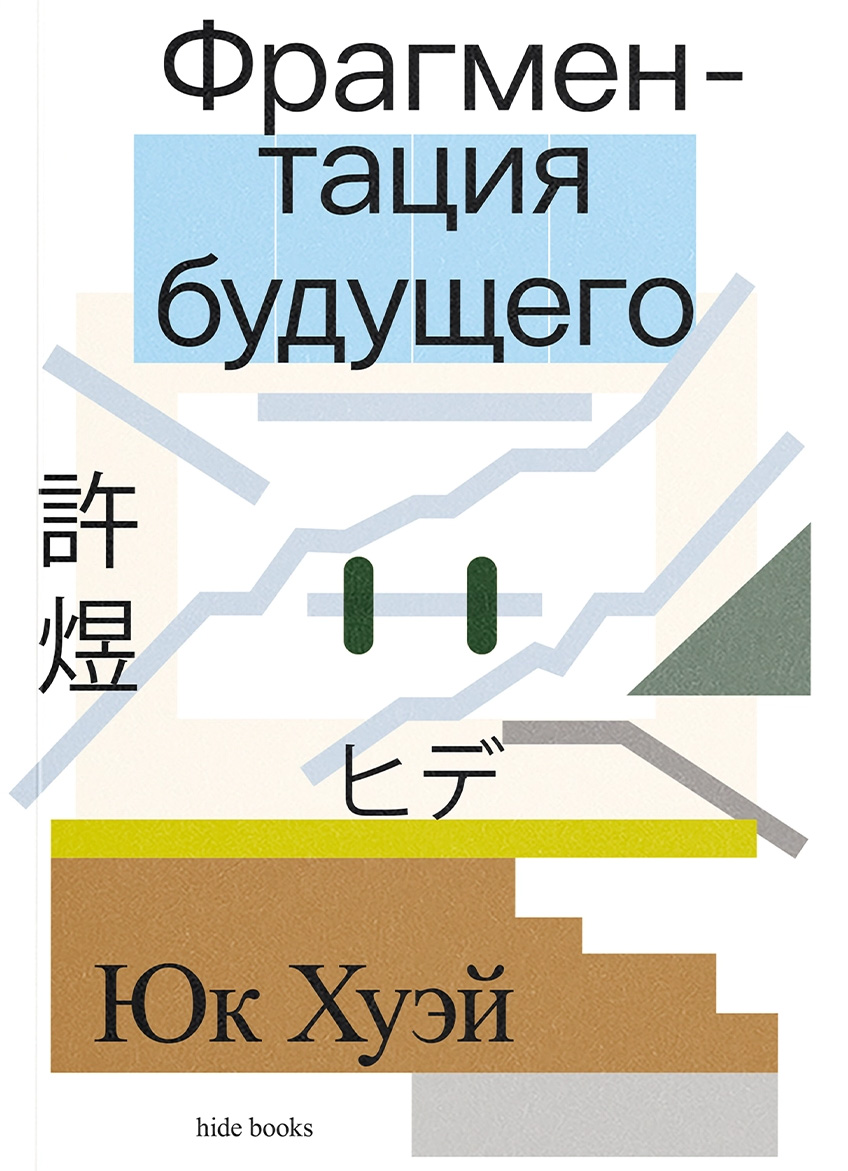
Yuk Hui has long been one of the main providers of concepts for humanists who claim modernity. Reading his work, it’s nice to feel that no one is forcing you to choose between the techno-optimism of Silicon Valley and nostalgia for the pre-digital world.
Fragmenting the Future consists of eight essays written between 2017 and 2023. Formally, these are texts on seemingly disparate topics: neoreaction and the crisis of the Enlightenment, artificial intelligence and cybernetics, Chinese landscape painting. The collection is a little reminiscent of a folder with selected files on the author’s desktop, from which they decided to make a book just because Hui is now in fashion. However, when reading, they gradually form into a single intellectual stream, trying to answer the question: what to do after the idea of a common world future ceases to seem convincing?
Already the first essay on neoreactionaries sets the main conflict of the book: modernity has lost the ability to produce a convincing image of the future and therefore rushes between acceleration and restoration. Hui then moves this question into the philosophical register, developing his concept of cosmotechnics and his critique of the universalist model of modernity. The central texts of the collection are “Cosmotechnics as Cosmopolitics”, “What Begins after the End of the Enlightenment?” and “Machine and Ecology” - form a kind of theoretical core in which the main thesis about the plurality of technical rationalities and the need for technodiversity is formulated. The final essays on artificial intelligence and Chinese aesthetics no longer so much prove this thesis as demonstrate its work on specific material.
Hui likes to return to the same figures of continental philosophy: Martin Heidegger, Georges Simondon, Bernard Stiegler, Johann Gottfried Herder. For a trained reader, his texts, of course, acquire a multiplicity of layers, but Hui’s individual theses roam through his articles and monographs almost unchanged. However, this repetition always looks unobtrusive and harmonious. Each new chapter highlights an already familiar problem from a different angle, as if testing whether the proposed concept will withstand a collision with the next subject - politics, ecology, art or machine intelligence.
All of these essays are like a series of concentric circles around one idea. This structure may irritate the reader expecting a strict philosophical architecture, but it is precisely this that allows Hui to gradually increase the scope of the concept of “cosmotechnics” without turning it into yet another all-explanatory theory. As a result, Fragmentation of the Future feels like a more coherent book than many monographs.
The problem with some modern technophilosophers is that they love technology too much. Even when they criticize her. Some of them are waiting for the singularity as a religious revelation, others mourn the loss of certain genuine values in the spirit of the late Heidegger. Hui does not belong to either of these camps. And this is clearly visible in the collection. The object of his criticism is not artificial intelligence, not algorithms, and not fed-up capitalism, but the idea that there is only one trajectory for the development of technology and only one version of modernity.
To put it very roughly, the author tirelessly promotes his idea of refusing to think about the present and the future in the vector set by European philosophy. And in this book, like Post-Europe , the reader is confronted with a purely Hui version of anti-globalism and decolonization, which posits a plurality of technologies, always embedded in certain cosmologies, in various separate understandings of the world and man's place in it, existing in a variety of cultures. There is no universal technique. There are different ways to connect the technical, moral and cosmic dimensions of human experience. Therefore, Hui does not ask the question of when and how superintelligence will appear. He is interested in why we decided that superintelligence should generally be the same for everyone.
In the first half of the book, Hui engages in intellectual territory clearing. He examines neoreactionary thought in detail, from Nick Land to Peter Thiel, viewing it not as a political anomaly but as a symptom of historical crisis. Neoreactionaries, in his opinion, correctly diagnose the exhaustion of the old model of globalization, but offer a cure worse than the disease. Their answer is acceleration, technological race and a new hierarchy. Hui is interested in something else: is it possible to get out of the crisis of universalism without slipping into reaction and without turning the future into a competition between successive empires.
Referring to a passage from the book The Age of AI, written by Henry Kissinger together with Eric Schmidt and Daniel Huttenlocher, the philosopher notes that the very formulation of the thesis, where the Enlightenment proceeded from the assumption that the human mind is capable of understanding the world, establishing cause-and-effect relationships and on this basis managing society, may be alien to a significant part of humanity. Next, Kissinger talks about the development of artificial intelligence and systems that produce results that are not always understandable to humans. If machines begin to make decisions more efficiently than humans, and the logic behind those decisions becomes opaque, then the fundamental Enlightenment belief in the rational agent is undermined. So Kissinger speculates about the possible “end of the Enlightenment.”
But Hui reads this particular historical situation much more broadly and critically, proposing to consider Kissinger’s thesis as an indication of the full realization of a single global axis of time, in which all historical eras converge to the synchronizing measure of European modernity. According to the philosopher, disagreement should begin with this starting point in the research position.
“This is a moment of disorientation - loss of orientation and loss of the East relative to the West. From this inability to navigate comes the unhappy consciousness of fascism and xenophobia - in response, it offers a simplified politics of identity and an aestheticized politics of technology,” notes Hui. Note that he plays with the word orientation. Etymologically, orient is the East. For Hui, modernization led to the fact that the East ceased to be an independent source of historical orientation and found itself included in the Western temporal scheme as its periphery.
He interprets the so-called right turn in modern Western politics not as a return of the past, but as a by-product of globalization. Neo-reaction is an alarming response to the fact that the West is gradually losing its monopoly on the production of the universal and on the production of the future. His analysis is especially interesting today, when technological rivalry between the United States and China is gradually replacing old political schemes. The philosopher clearly enjoys observing all geopolitical shifts, offering an unusual, non-linear, non-right, non-left, and non-centrist view of them. It should be noted that “Fragmentation of the Future” is devoted not so much to politics as to the philosophy of history. Hui proposes abandoning the idea of a single time axis on which all societies move from tradition to modernity and then to a digital future. This scheme seems to him to be a legacy of the Enlightenment, which had its own historical context, which had largely exhausted itself. Instead, he proposes to think of multiple futures for different groups of people with unequal patterns of technological development.
Here we come across the most interesting and at the same time the most vulnerable side of the book. Hui is a compelling writer in his critique of the limitations of progressivist universalism, revealing the metaphysics of digital capitalism and reminding us that conversations about cultural diversity often end in the standardization of technology. But when it comes to a positive program, the text noticeably fades. Space technology remains a horizon of reflection rather than a developed concept. Quite quickly it becomes clear what the author is against, but what is much worse is what exactly the techno-diverse civilization he describes should look like.
However, this is not necessarily a disadvantage. In recent years, philosophical literature has been filled with projects to save the world. Against this background, Hui’s refusal to issue a ready-made recipe looks quite revolutionary.
Another feature of the book is its intellectual geography. Hui moves constantly between Kant and neo-Confucianism, between Heidegger and modern Asian thought, between cybernetics and anthropology. He constantly tries to change the very perspective of the conversation. This can make Fragmentation of the Future a challenging read. However, for those who are already familiar with Hegel, Heidegger, Simondon, Stiegler, Deleuze, the reading will seem quite fascinating, including because Hui is something fundamentally “different,” but at the same time, his philosophy is like a landscape in which at first you don’t see anything familiar, and then you suddenly find that you can navigate it better than the long-established territory of European thought. He articulates what many of us have probably felt but have been unable to express because we are in thrall to the conventional philosophical thesaurus. Hui also expands these boundaries, introducing many new concepts without contrasting them with old ones.
In the essay “On the Diversity of Artistic Experience,” Hui addresses Heidegger's thesis about the completion of metaphysics, but does not use it as a reason for cultural pessimism. Chinese thinkers generally do not tend to make a tragedy out of everything, which is also discussed in this text. The problem is not that Western thought has failed, but rather that it has triumphed too successfully. European modernity, its ideas about reason, progress, technology and history became the basis of global civilization. This gives rise to a paradox: the more universal this language turns out to be, the more difficult it becomes to think differently. This is why Hui speaks of the need for “fragmentation,” as an appeal to multiple intellectual perspectives that have been displaced by universalist logic. And this is not at all the same as the disintegration of the world into closed identities.
The collected articles in this book reflect fragmented attempts to find ways to reorganize the relationship between man, technology, and the world. The book does not try to reassure the reader by presenting him with some conditional “way out of the crisis.” It reminds us of something that modern technology discussions have all but forgotten: the future is not what awaits us all.