
Translated material
Even his own party wanted Starmer to resign - was he really that bad? And who will replace him?
Summing up the results of almost two years of rule
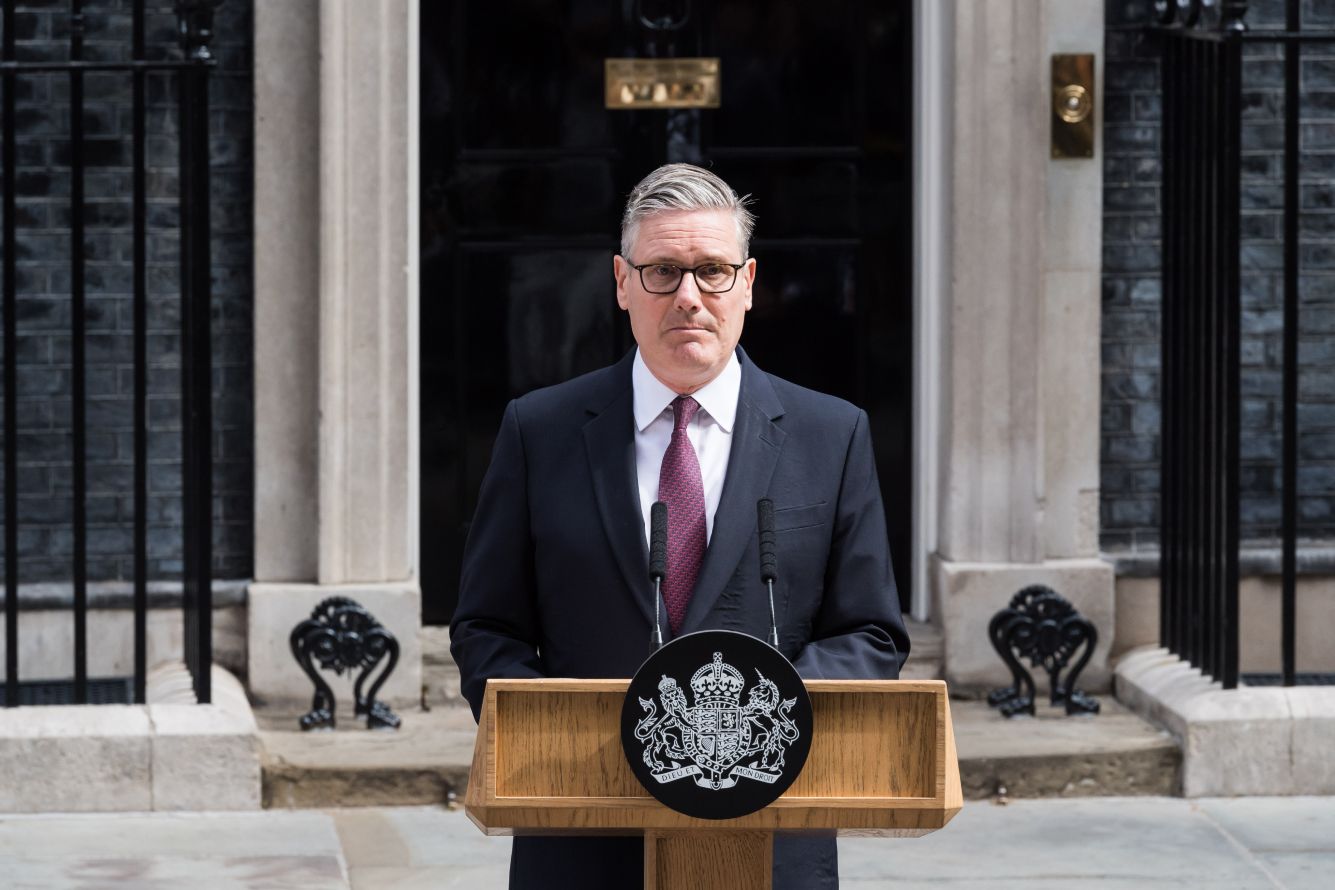
23 months after taking office, British Prime Minister Keir Starmer announced his resignation. Rumors about it have been circulating for a long time and only intensified after the disastrous local elections for Labor in May and the resignation of some of the key ministers. Meduza sums up Starmer's reign and tells who might replace him.
Listen to the audio version of this text on Radio Medusa
On the morning of June 21, British Prime Minister Keir Starmer stepped up to the microphone in front of his official residence in London. Barely coping with his excitement, he read his resignation speech. When he got to the point that he would now “devote more time to the most important job of being a better husband to my amazing wife Victoria... and a better father to my wonderful children,” he looked like he was about to cry.
His speech was perhaps the most emotional speech during his almost two-year tenure as prime minister. Previously, he showed almost no emotions in public. Both in the media and in polls, Starmer was consistently considered faceless, boring and even “wooden”, which was one of the reasons for the decline in his popularity. Although far from the only one.
Way up
However, image was not always a problem for Starmer. His image as a hard-working, down-to-earth lawyer served him well when he began his Labor Party career in the mid-2010s. Here he is playing football, here he is drinking beer with friends - a simple and honest guy for whom it is pleasant to vote.
Having passed through all levels of the party hierarchy, Starmer led Labor in 2020. The party was then in a deep crisis: in the parliamentary elections a year earlier, it received its worst result in 90 years, achieving only 202 parliamentary seats.
The new leader proposed his program, which, among other things, included the development of renewable energy, the fight against illegal migration, the construction of 1.5 million new apartments, bringing order to the national health care system and a willingness to increase spending on the country's defense.
In the elections on July 5, 2024, Labor won - 390 seats in parliament out of 650. It seemed that this result would give Starmer carte blanche to implement the election program and overcome the dire consequences of Brexit, which the Conservatives, who ruled the country for 14 years and, in fact, who arranged it, were unable to cope with.
The Starmer government really has something to write home about. He pushed through parliament with a package of labor law reforms that expand workers' rights to vacation and sick leave, protect them from unfair dismissal, limit non-guaranteed contracts and fire and rehire practices. In addition, additional measures were introduced to support families, introducing free breakfasts for children in primary schools and removing restrictions on child benefits for families.
Under Labour, the situation with migration has also changed. Border controls have been strengthened, deportations of people ineligible for asylum in the UK have increased, and cooperation has been established with other European countries in 2025. As a result, the number of immigrants in 2026 amounted to 813 thousand, which is 20% less than a year earlier. And the number of people trying to reach the country by boat across the English Channel from January 1 to June 21, 2026 decreased by 40% (to 11 thousand people) compared to the same period last year.
Finally, in the field of foreign policy, Starmer, unlike many of his EU colleagues, managed to maintain relations with Donald Trump throughout 2025. This led to a trade deal between London and Washington, according to which the US reduced tariffs on British cars from 27.5 to 10%, and completely abolished tariffs on aerospace products. In addition, in 2025, Starmer's cabinet signed an agreement with India, which, according to British estimates, will increase trade between the two countries by 25.5 billion pounds.
Way down
However, upon closer examination, it turns out that not everything was smooth for Starmer in both social and foreign policy.
For example, in 2024, the authorities decided to change the terms of the payment that pensioners received to pay for heating. If previously it was given regardless of income level, now it is only given to the poor. This deprived about 10 million pensioners of subsidies and caused discontent not only among the population, but also among the Labor Party itself - 53 of its deputies abstained from voting in the House of Commons. As a result, the payment was returned to all pensioners with an income of up to 35 thousand pounds a year.
The situation repeated itself in 2025, when the Starmer government tightened the conditions for receiving disability benefits. The most painful consequence was not the street protests (although there were those too), but the fact that more than 120 deputies of the Labor Party itself opposed this measure. In the end, the authorities had to back down here too - the reform was postponed.
The so-called tractor tax also caused serious resistance. In 2024, Labor proposed introducing a 20 per cent inheritance tax on agricultural property worth over £1 million. This caused violent protests - some farmers even came to London on tractors. And again, Starmer partially retreated - in December 2025, the tax threshold was raised to 2.5 million. The result is a sharp drop in Labor's popularity in rural areas.
Relations with the United States, which Starmer could take credit for last year, have fallen apart in recent months. In the spring of 2026, Great Britain refused to support the American-Israeli bombing of Iran. In response, Trump said Starmer was “no Winston Churchill,” and when asked what was special about the U.S.-British relationship, he replied , “It’s that when we asked them for help, they didn’t respond.”
Added to this was the scandal surrounding Peter Mandelson, who enjoyed great influence in the Labor Party in the 90s. In January 2025, Starmer appointed him ambassador to the United States, but in February 2026 it became clear that Mandelson maintained close ties to Jeffrey Epstein. The British prime minister fired Mandelson and said that he would never have appointed him to the post if he had known about his connections with the American financier.
However, journalists from The Guardian found out that Mandelson did not pass the test for suitability for a position at the British Foreign Office and the department made an exception for him. The scandal led to the resignation of the prime minister's chief of staff and adviser Morgan McSweeney, who advised Starmer on Mandelson's candidacy, and was a heavy blow to the cabinet.
Starmer's fall
The indecisiveness and inconsistency of the cabinet, the lack of charisma of the prime minister and the lack of tangible positive changes in the country quickly undermined the popularity of the Labor Party.
According to Politico, a year after the government was formed, the share of voters willing to vote for them fell from 34 to 23%, and today is at 18%. In turn, according to the international analytical company YouGov, the activities of Starmer himself already in August 2025, a month after taking office, were assessed positively by 36% of respondents, and negatively by 43%. Today these figures are 18 and 74%, respectively.
Labour's decline in popularity was fully evident in the local elections held in May this year. Labor lost 1,496 local councilor seats and lost control of 38 councils. For the first time in the history of local elections, the party found itself in fourth place, losing not only to its traditional rivals, the Conservatives, but also to the Liberal Democrats and the far-right party Reform UK .
Starmer accepted responsibility for the defeat but said he also took "responsibility for delivering the changes we promised to build a stronger, fairer Britain." In other words, he made it clear that he had no intention of resigning.
However, key ministers soon began to turn their backs on Starmer. On May 14, Health Minister Wes Streeting resigned , saying he had lost confidence in the prime minister and that the cabinet had “no vision for the future.” On June 11, Defense Secretary John Healey followed suit, accusing Starmer of underfunding national defense.
However, these were not Starmer’s first personnel losses: last September, Deputy Prime Minister and Housing Minister Angela Rayner, who was one of the most recognizable faces of the cabinet, resigned . The reason for her departure, however, was not disagreements with the prime minister, but a scandal surrounding the incorrect payment of taxes when buying a house.
Need a break from the news? Then we are coming to you - with books! In the Meduza app you can read books by Elena Kostyuchenko, Mikhail Zygar, Anton Dolin, Kira Yarmysh, Alexander Rodnyansky and many other authors for free. Both fiction and non-fiction fans will find something to their liking. You can also play the best Jellyfish games in the app. Well, you won’t miss the most important news either (if you turn on push notifications). Anyway, here's the link to download the app - you know what to do!
Who will be the next Prime Minister of Great Britain?
Keir Starmer's position was also undermined by the conflict with his fellow party member, 46-year-old Andy Burnham, mayor of Greater Manchester since 2017. He is now called the main candidate to replace Starmer.
Thanks to active social policies (such as anti-poverty initiatives and the expansion of Manchester's public transport system) and a focus on ordinary people's problems and regional inequalities, Burnham gained great popularity among both Labor and city residents. At the same time, he does not hesitate to criticize his own party for its isolation from the people and the lack of an “idea of the future.”
In January 2026, Burnham decided to be elected to parliament from the constituency of Gorton and Denton in Manchester - this is necessary so that the politician could compete for the post of prime minister with Starmer.
However, Burnham did not receive permission from Labour's National Executive Committee, which considered that if the politician were elected, a new election would have to be held in Manchester - this would require additional costs from the party and create political risks. Labour's left wing accused Starmer of pushing through the decision to prevent a potential rival from entering parliament.
Nevertheless, Burnham still found a way to get into parliament. In May, the party's executive committee allowed him to stand in another Manchester constituency, Makerfield. On June 19, the politician defeated the candidate from Reform UK. This was probably one of the reasons why Starmer announced his resignation now: he has no chance of holding on.
The list of candidates for leadership of the Labor Party has not yet been determined, but there is unlikely to be any intrigue here. Angela Rayner shows no desire to join the fight, and Wes Streeting, one of the most prominent representatives of the party, has already announced that he will support Burnham.
As the BBC writes , “everything points to Burnham becoming prime minister in a few weeks.” In the meantime, until the election of a new party leader, which is due to take place in mid-July, Starmer will serve as acting prime minister.
Little is known yet about what Burnham will do once he wins. Before the Makerfield election, he refused to answer questions about national politics because he was only running for parliament. It is not known whether he has a list of candidates for ministerial positions or whether a program of action is ready in case of election.
In foreign policy, his views are also not very clear. According to political scientist Anand Menon, Burnham is a supporter of Britain's return to the European Union, and in this his position coincides with the opinion of the overwhelming majority of Labor members. However, he prefers not to speak out clearly on this issue, for fear of alienating some voters.
It is difficult to say how successful the future Labor cabinet will be. Over the past ten years, the country has had six prime ministers, and none of them managed to bring stability to the country after the political earthquake that was Brexit.
On the contrary, British politics is becoming increasingly turbulent. After all, Labor and the Conservatives, who dominated the political arena throughout almost the entire twentieth century, are forced to compete with new, more radical parties.
It turns out that they are getting worse: according to the latest polls , the far-right Reform UK is now in first place, for which 25% are ready to vote, Labor and Conservatives have 18% each, and in fourth place with 15% are the Greens, a much more left-wing alternative to the party of Burnham and Starmer.
The Economist magazine called the UK Britaly back in 2022, hinting that the level of political instability in Foggy Albion can now be compared with Italy . Today it seems that the British are losing in this comparison too: in Rome, the current cabinet has been in power for almost four years.
Alexander Dunaev