
Оригинал материала
The Real Russia. Today.
Putin doesn’t declare a full mobilization (yet), dozens killed in airstrike on school, and more antiwar messages slip into Russia’s mass media on Victory Day
Monday, May 9, 2022
For ongoing coverage of the invasion of Ukraine and its consequences back in Russia, follow Meduza’s live updates. Please note that the authorities are now blocking our website in Russia, and we’re turning to you, our global audience, for financial support.
In today’s newsletter:
- Latest news
- Putin revisits ‘cancel culture’ in his Victory Day speech
- Even full mobilization, if it’s ever declared, might not be enough for Russia to win the Donbas
- Russia’s WWII vets reflect on the war against Hitler’s Nazis
- They survived WWII, now they flee Russia’s invasion
- 30 years ago, Moscow’s Victory Day parade was another world
- Meduza’s readers describe what Victory Day means to them
- Remembering Russia’s last mass opposition movement
Major recent events in Russia and Ukraine
- 🥸 Sabotage at Lenta.ru: On the morning of May 9, anti-war articles filled the homepage of the Russian pro-government outlet Lenta.ru. Egor Polyakov, head of the outlet’s Economy and Environment sections, confirmed to Meduza that he and fellow editor Alexandra Miroshnikova were responsible for replacing articles that had already been published on Lenta.ru with the anti-war materials. “We’re searching for work, lawyers, and, most likely, political asylum! Don’t be afraid! Don’t be silent! Fight back! You’re not alone — there are many of us! The future is ours! Fuck war. Peace to Ukraine!” the journalists wrote.
- 🕯️ A deadly school attack: The Luhansk regional authorities reported that about 60 people had likely been killed by an airstrike on a school in the village of Bilohorivka on May 7. According to Regional Governor Serhiy Haidai, of the 90 people hiding in the school, about 30 were saved from under the ruins, but “the remaining 60 people left under the rubble most likely died.”
- 📺 Too-smart-for-its-own-good TV: Early in the morning on May 9, Russian Smart TV owners saw an anti-war message appear in the channel descriptions on their devices. “The blood of thousands of Ukrainians and hundreds of their murdered children is on your hands. The TV and the authorities are lying. No to war,” read the message, which appeared in the descriptions of a number of different channels. Additionally, on the morning of May 9, hackers attacked the video service Rutube, causing the site to crash.
- 👋 Kherson the ghost town: According to Hennadiy Lahuta, Zelensky’s appointed governor of the Kherson region, nearly half the residents have fled the city since Russia’s occupation began. (He is one of them.)
- 👮 A busy day for the police: Across Russia on Victory Day, police arrested 82 antiwar demonstrators, plus another 43 individuals for past opposition activity and “for preventative purposes.”
- 🧙♂️ The shaman’s hangover treatment: Moscow police are investigating the sudden death of former Lukoil senior executive Alexander Subbotin, who apparently suffered a heart attack after agreeing to a shaman’s treatment that allegedly involved frog poison.
- 🪖 A secret mobilization? The wife of a Moscow subway worker claims that her husband and his colleagues were summoned to a staff meeting and told to undergo health exams for potential “volunteer” deployment to Ukraine. Managers allegedly threatened anyone who refused with termination or even prosecution for violating “the laws of war,” the man’s wife told Verstka.media.
- 🚨 An attack on Elena Osipova: Two young men attacked Elena Osipova on Monday, stole her antiwar banners, and ran off. The 76-year-old activist is a fixture of St. Petersburg’s antiwar movement. Meduza interviewed her in April 2022.
- 📉 The economic collapse is still coming: Russia is facing the deepest economic contraction in nearly three decades as pressure from sanctions imposed by the U.S. and its allies mounts, according to an internal forecast by the Finance Ministry, as reported by Bloomberg, whose sources say GDP is likely to shrink as much as 12 percent this year (deeper than the 8-percent decline expected by the Economic Ministry).
👨👩👦 ‘The West has decided to cancel these thousand-year-old values’: An excerpt from Vladimir Putin’s Victory Day speech (3-min read)
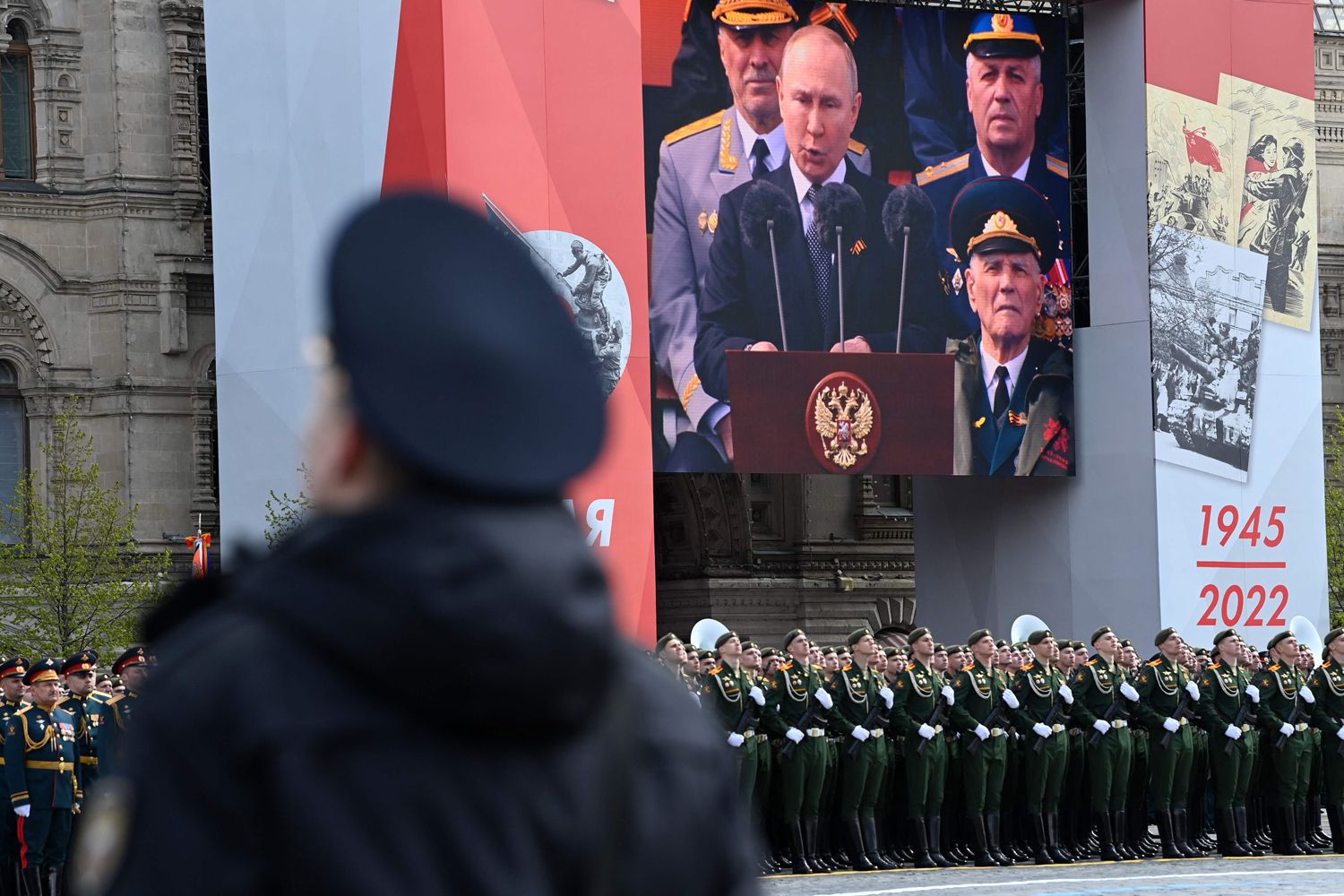
Instead of officially declaring war against Ukraine in his speech at Moscow’s Victory Parade on Monday (as many anticipated), Vladimir Putin used the occasion to play many of the old hits, including accusing the West of plotting to undermine Russia’s “traditional values,” claiming solidarity with World War II veterans across the world, and leaning into the idea of Russia as a multiethnic haven.
🪖 Even with a potential full mobilization, the Kremlin’s war could sputter to defeat in eastern Ukraine (11-min read)
Western intelligence “does not rule out” that Vladimir Putin could declare a full military mobilization. Though the Kremlin denies any such plans, and it’s uncertain whether officials in Europe and America have any real data on Putin’s plans, mobilization has long been a hot topic in Russia, where the army plainly lacks the numbers needed to continue its offensive in Ukraine. In early April, the Russian military reduced its frontline by almost half, in order to surround and smother the greater part of Ukrainian troops in the Donbas region. Still, for more than a month now, complete encirclement or any breakthrough has eluded Moscow’s fighters. Eventually, the Russian authorities might try to shift the balance by mobilizing the country’s full military might.
🕯️ ‘I can’t watch television — I just cry all the time’: Russian WWII survivors on the war in Ukraine (15-min read)
On the eve of Russia’s Victory Day, Vladimir Putin published a statement that referred to Russia’s “sacred duty” to “prevent the ideological heirs” of the Nazis from “getting revenge” on Russia for their defeat. The Russian authorities have been using the idea of “Nazism” to justify their invasion of Ukraine for almost three months now, and their definition of “Nazi” keeps expanding. To mark the 77th anniversary of the end of the Second World War, Meduza spoke to Russians who actually have lived through a war against Nazis.
🕯️ These Ukrainians survived World War II. Russia’s invasion made them refugees. (17-min read)
Russia’s all-out war against Ukraine has driven more than 5 million people out of the country. Most of these refugees have sought safe haven in neighboring countries like Moldova, which has taken in nearly 500,000 Ukrainians. Among those who have sought refuge in Moldova are elderly people who survived World War II as children. Photographer Sergei Stroitelev spent nearly two months photographing refugees from Ukraine at a shelter in Chișinău. While there, he interviewed several survivors of World War II about what it’s like to live through two wars in one lifetime.
🤝 Photos from Moscow’s 1992 Peace Parade: In Russia’s first post-Soviet Victory Day celebrations, veterans from Europe and the U.S. joined as friends (4-min read)
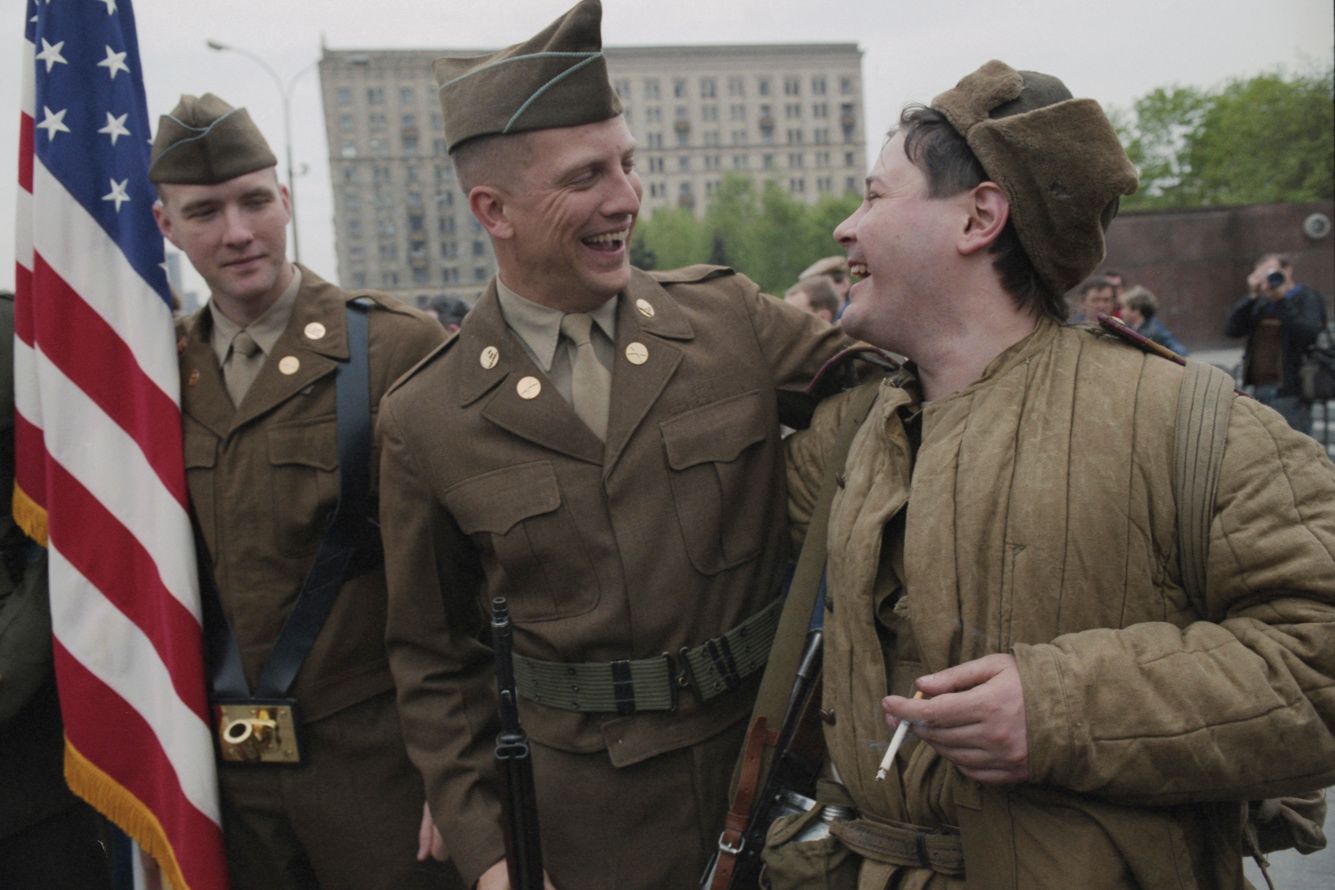
In 1992, Moscow’s first Victory Day parade after the fall of the USSR featured no military salutes and no tanks or military equipment. The city gathered World War II veterans from the old Soviet republics, France, the United States, Great Britain, Germany, and Italy. The former soldiers joined a ceremonial march through the center of Moscow to Red Square. That day, a delegation from the U.S. arrived and planted 50 “trees of life” in a show of friendship between Russians and Americans. Here’s what it looked like when Russia celebrated peace.
✉️ Meduza’s readers on how the war has changed the way they view Victory Day (11-min read)
The weekend before Victory Day, Meduza asked readers to tell us whether their feelings about the holiday have changed since the war began — and whether they plan to observe the holiday at all. We received more than 1,600 answers from readers in Russia, Ukraine, Belarus, and other post-Soviet countries. Many of them plan to avoid the official celebrations.
⚖️ An activist imprisoned for attending the last major rally of the ‘Bolotnaya’ protest movement looks back at Russia’s political development in the decade since (11-min read)
On May 6, a decade ago, Moscow hosted the “March of the Millions” — a demonstration organized by the protest movement that formed in response to Russia’s December 2011 parliamentary elections. The march ended with violent clashes between protesters and police on Bolotnaya Square, ultimately resulting in the so-called “Bolotnaya Case.” Of its 30-plus defendants, most were sentenced to significant prison terms. On the 10th anniversary of the protest, Meduza special correspondent Svetlana Reiter (one of the original chroniclers of the Bolotnaya Case) spoke to left-wing activist Alexey Gaskarov, who served three and a half years for supposedly rioting.
Yours, Meduza