
Translated material
Towards a critique of modern metaphysics
The collapse of the Soviet Union, with all the shortcomings of its structure, was a severe blow to the world labor movement, as well as to rational thinking. Professional scientists and philosophers who dedicated their lives to scientific knowledge, entire departments slipped into theology, mysticism, the search for torsion fields and alternative history. What happened among the masses is also known to everyone: deprived of their means of livelihood and hope for the future, people rushed into crime, alcoholism and superstitions of all kinds: communication with ghosts and aliens, prayers to Christian and pagan gods . Under restored capitalism, knowledge of palmistry and astrology, rather than physics and astronomy, was in demand; not intelligence, but stupidity; not knowledge, but ignorance.
More than 20 years have passed since the late 90s. And it would seem that the wildest forms of religious-magical obscurantism should have disappeared from the public consciousness since then - at least from among the intelligentsia involved in some form of enlightenment. Nevertheless, lately Russian philosophy has not ceased to amaze us with phenomena indicating that the obscurantism of the 90s is far from being eradicated in our culture. Let's list some of them:
1 . This year, the Egalite publishing house published a book by Vladimir Shallar, an Orthodox “Marxist” and angelologist, “Angels and Methods of Production.” In it, the author seeks to prove that in order to achieve truly libertarian socialism, we must “believe” in the Christian God and angels. Since the Christian God-Trinity, in his opinion, is the prototype of a commune or cooperative of three equal, but different individuals, and therefore real communes cannot be organized without the Christian faith. Materialism and atheism, in his opinion, are bourgeois, modern teachings. And since the era of modernity and capitalism is ending, we should all “dialectically” return to pre-capitalist forms of belief in gods, angels, devils and the like. The author proves all this and much more with references to Florensky, Berdyaev, Foucault, Deleuze and Meillassoux.
2 . Since the publication of this book, I have not seen any clear criticism of this concept, which is probably explained by the fact that more or less orthodox Marxists do not read such books, and those who do read them are not far from the ideas of “angelological communism” in ideological terms. Criticism ( stream and article ) from the St. Petersburg philosopher and “Marxist” Anton Syutkin makes one recall Voltaire’s paraphrase: with such friends , socialism does not need enemies! Namely, Syutkin argues that the alternative to Shallar’s angelology is “Christian atheism,” which he and the Slovenian philosopher Slavoj Zizek adhere to. According to which we should believe in the world proletarian revolution because it is even less likely than the somewhat supernatural state of angels, with God at the head , which V. Shallar preaches! It is clear that if A. Syutkin manages to convince someone that a proletarian revolution is less likely , than the angelic kingdom , then the practical conclusions from here would be directly opposite: after all, if capitalism is invincible, and the probability of communism is zero, then it would be rational to join United Russia, or, following the example of Dugin, go as a lackey to the oligarch Malofeev, or write a denunciation to the prosecutor's office against the city. Syutkin for not loving the Russian state and its leader enough.
3 . Finally, for some reason, Moscow artist and co-indentologist Alek Petuk, as part of his spring lecture series, brought to the podium the St. Petersburg “philosopher” Konakov, who spent two hours talking about the greatness of the pseudoscience of astrology, “proving” its rationality with various sophisms. The shamefulness of this lecture is evidenced by the fact that at the beginning of it this citizen was not ashamed to show to the public his own natal chart , which some charlatan had drawn for him.
Subsequently, I had a discussion with Alec, during which I was surprised to discover not only a complete lack of understanding of the shamefulness of the propaganda of such nonsense, but also the justification of religious obscurantism with references to the authorities of a number of modern philosophers, most notably Jean-Luc Marion, Alain Badiou and Yoel Regev .
As previously noted, such eclectic-irrationalist metaphysics is the other side of the metaphysics of the Enlightenment, dogmatic Marxists. On the one hand we have the camp of those who recognize the materiality, knowability and changeability of the world through class struggle, but believe that the development of Marxism ended a hundred years ago. On the other hand, there is a camp of those who recognize the philosophers of the last hundred years, but reject development as an “authoritarian metanarrative.” At the same time, both parties claim that a certain “postmodern era” has arrived in the modern world, and differ only in their assessment of this period. Some moan: the whole world is mired in bourgeois irrationalism! - others echo them in a major note: we have finally freed ourselves from the dictatorship of reason and science!
The key point of demarcation with both factions of the party of postmodern metaphysicians is to question the very way of dividing world history into the eras of pre-modern, modern, post-modern, meta-modern, etc. Because, as was proven a century and a half ago by Marx and Engels, the structure, and therefore the periodization of society, is determined by the method of production, and not by belief or disbelief in certain ideas about the structure of the world. And therefore, we have no reason to either recognize the onset of the postmodern era or fight against it, since this era itself in reality never existed and does not exist. What we have is global capitalism, which emerged 400 years ago and continues to transition to global communism under the influence of the logic of its own immanent laws of development.
Accordingly, there is no reason to believe that with the pace of progress, driving into the ground magical, religious and humanistic ideologies , as well as the metaphysicians clinging to them, something has happened. Moreover. As Marx correctly noted in the “Introduction to the Critique of Hegel’s Philosophy of Law”: “For Germany, the criticism of religion is essentially over, and the criticism of religion is the prerequisite for any other criticism.” And further: “The criticism of heaven turns, therefore, into the criticism of earth, the criticism of religion into the criticism of law , the criticism of theology into the criticism of politics .”
People who have not read Marx, or who have read but do not understand, today call on us: let us concentrate all our strength, all our intellectual efforts to get at the materialist grain of Christian theology, the secret meaning hidden in religious dogmas, in order to understand how we can reach communism. However, over four centuries of criticism, all semantic rational grains from theology had long been worked out, if they existed at all. Today, the values hidden by theology from the gaze of academic professors, bloggers and artists are power and property - accounts, real estate and precious metals, measured in billions of dollars, owned by professional charlatans who fleece the fools who believe them, both directly and through government fraud. Their socialization is the point at which materialist philosophy and the interests of the majority of society members coincide.
Academic philosophers and enthusiasts echoing them “creatively” complement the distorted reading of Marx with the distorted reading of Deleuze, Heidegger, Hegel, Kant, Spinoza, Descartes and other major modern and earlier thinkers. Thus, Deleuze’s most important metaphilosophical idea that the territory of philosophy is the plane of consistency , that is, the space for the removal of contradictions, is systematically glossed over, or it is given a subjectivist interpretation. None of the Western or Russian “Deleuzians” will find a clear definition of what the plane of consistency is, or any of the other terms that were invented in the Guattari-Deleuze tandem. By default, under the plane of consistency or the plane of immanence, these authors mean the uniqueness of their personal subjective experience, consecrated by the academic regalia that the Ministry of Education of the bourgeois state issued to them for their faithful service. On the contrary, by the plane of consistency we will mean the space where philosophy comes into contact with other practices of changing and transforming the world - with experimental science, with revolutionary politics, with effective art, with large-scale machine production and with the practices of everyday life. From the latter’s point of view, philosophers who are unable to give a clear answer to questions about how the world works and what is the meaning of life - after all, it is precisely these questions that subjects who are not philosophers usually turn to us with - can and should be sent in a certain direction as the incompetent fools that they are.
In this sense, it is difficult to imagine something more erroneous and vulgar than R. Gachet’s book “Geophilosophy”, in which the universality of the plane of consistency is reduced to a pseudo-individual event in Greek culture , 2.5 thousand years distant from us and having no actual significance today.
So, there is a fundamental discrepancy between materialist and metaphysical philosophy in understanding the subject, methods and goals of criticism. Metaphysicians believe that the subject of criticism is the meaning of texts, the method is hermeneutics, and the goal is academic publications, lectures and seminars. Materialists, on the contrary, believe that the subject of criticism is social reality, the method is permanent revolution, and the goal is the establishment of a socialist republic with the transition to global stateless communism. All this can be expressed in the form of the following table:
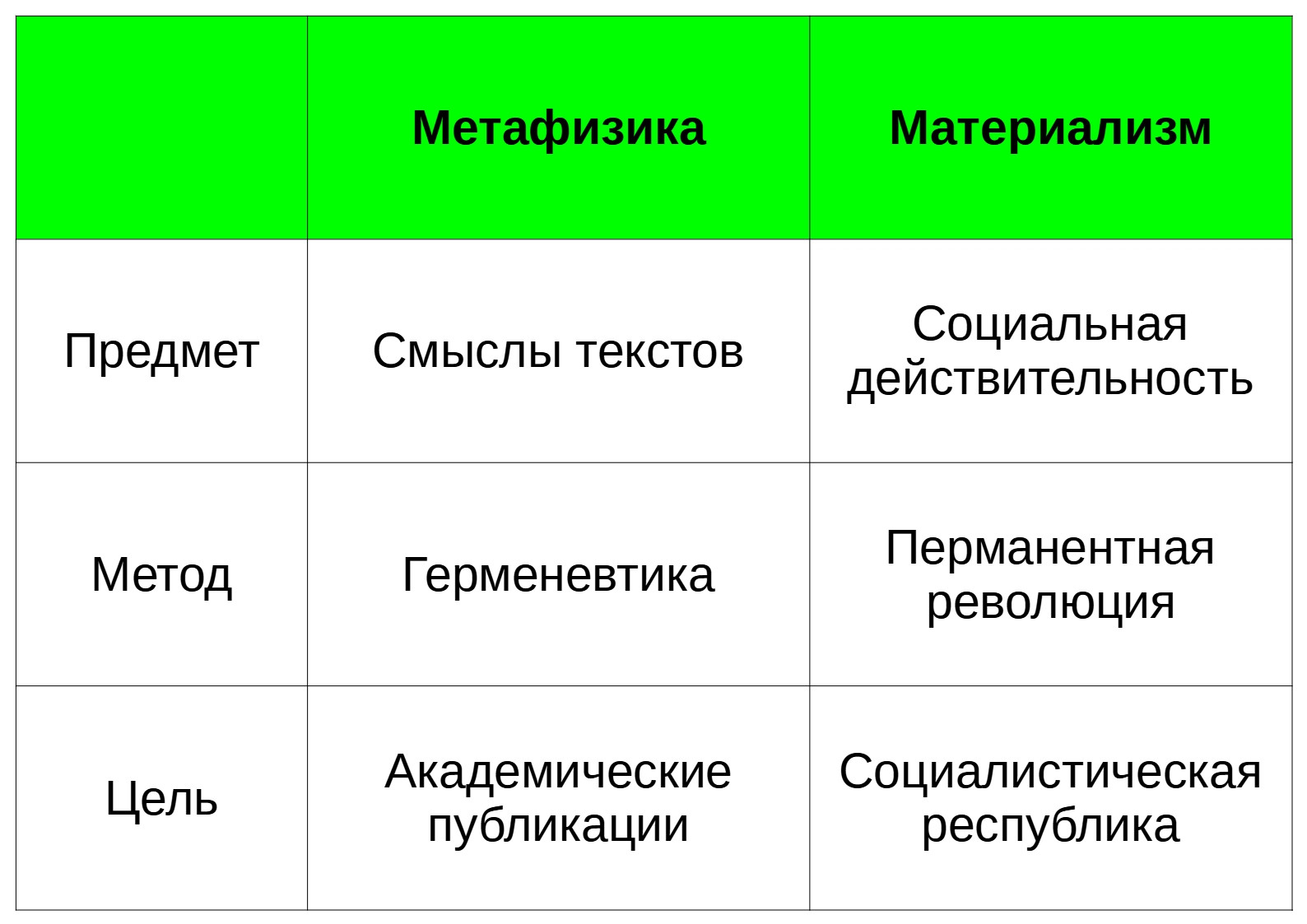
Since the permanent revolution has at least three aspects - scientific-technical, political-economic and cultural, then within the framework of the latter, as a complement or replenishment of the other two, it is possible and should give conceptual criticism to the metaphysical methods of philosophizing and the entire party of metaphysicians.
At the same time, the criticism of metaphysicians falls into two parts:
Firstly , the actual criticism of inadequate ways of philosophizing;
Secondly , a positive presentation of one’s own philosophical program.
As for the first, thanks to the efforts of our opponents, the list of pearls worthy of criticism is regularly updated. Some of them have already been listed above, namely angelology, the “Christian atheism” of Syutkin and Žižek, the “coindentological” justification of astrology and religion, the attribution of pro-priestly views to Alain Badiou, and much more. At the same time, a convenient format for presenting criticism is an article,
As for the second, the scope of work outlined here is no less than six books, clarifying the history of Marxism, leading to the conclusions on which we stand and which we are not going to abandon:
1. Marxism: history of development - an expansion of my previously published article “ The Evolution of Marxism ” outlining the views of 15 schools of Marxist thought and more than a hundred of its representatives from Marx to the present day; is necessary to contrast all sorts of confusions that synthesize Marx with Weber, with Berdyaev and St. Augustine with a clear and distinct path of development, in which there is an accumulation of complexity without involving all sorts of metaphysical nonsense.
2. Marxism: logic of development - reflection on the history of Marxism, highlighting the logical structure of the mechanism that generates the evolutionary tree of developing Marxisms; necessary to substantiate the history of Marxism and further methodological conclusions.
3. The beginnings of metaphilosophy - second-order reflection on the mechanism of development of Marxism; necessary to substantiate the mechanism of development of Marxism in the context of modern philosophy as a dialectical sublation of the latter.
4. Alienation or structure? — criticism of Marx’s “Economic and Philosophical Manuscripts of 1844,” as well as the ideas of theoretical humanism contained in them; is necessary to differentiate ourselves from ordinary and critical humanists who preserve the idea of a society consisting of people in literal or partial form.
5. Criticism of German Freudo-Marxism - criticism of the negative idea of Enlightenment Marxists who reject the Freudo-Marxist synthesis or imitate its acceptance.
6. Theses on demarcation - a systematic presentation of the points of demarcation from modern idealistic and pseudo-materialistic metaphysics.
Everything else is a matter of practice. As historical experience shows, there is nothing fundamentally difficult in first shaking and then overthrowing any system of metaphysical prejudices, no matter how great it may be, and no matter how large the number of its bearers. Descartes , Spinoza, La Mettrie and their like-minded people, whose circle was outlined by Dunbarr's number, overturned medieval Judeo-Christian metaphysics, and their students in the second or third generation sent particularly stubborn obscurantists and enemies of the working people to the guillotine. Marx , Engels and their like-minded people formed a scientific understanding of communism as a real movement that destroys the existing state of affairs and imposed a materialist understanding of history on society because it was true - and with its help they won the two largest revolutions of the 20th century - the October and Chinese. Our comrades in the 60s continued the great revolutionary process of overthrowing bourgeois ideology, reaching its very heart - to the impersonal structures of oedipalization and interpellation, collecting anthropomorphic markings of social reality from cognitive distortions. Our task is to continue their work and strike at this heart until the vermin of ideology that justifies the existing state of affairs dies forever, and with it the system of private ownership of the means of production that gave birth to it!