
Translated material
The church reached out to culture
Vladimir Kara-Murza: The Council on Culture was created in the Moscow Patriarchate, the competence of which will include interaction with cultural institutions and creative unions. According to today's "Kommersant", "it is the new department that will probably have to conduct a difficult dialogue with museum workers who protest against the transfer of their property in favor of the Russian Orthodox Church." On March 9, a round table was held in the pilgrimage center of the Moscow Patriarchate, dedicated to the interaction of the church and the museum community of Russia. The issue of returning the church belonging to it has recently acquired a wide public outcry in connection with the development of a new specialized law by the Ministry of Economic Development of Russia. “The bill is sabotage in nature,” the director of the Rublev Museum, Gennady Popov, said today during the meeting. He believes that "if the law comes into force, then after 5 years there will be no values." For her part, the director of the Tretyakov Gallery Irina Lebedeva recalled that there are examples of incorrect behavior of representatives of the church and fear among museum workers did not arise from scratch. We discuss the problem of transferring museum values of the Church with the historian, author of Solovki: 20 years of special purpose "Yuri Brodsky, director of the Center for Eastern Christian Culture Alexei Lidov and senior researcher of the Old Russian Gallery Levon Nersesyan. What are the main threats to museum values in the case of their transfer to the church?
The threats are quite serious, since the law does not spell out the regime of the protection of these values

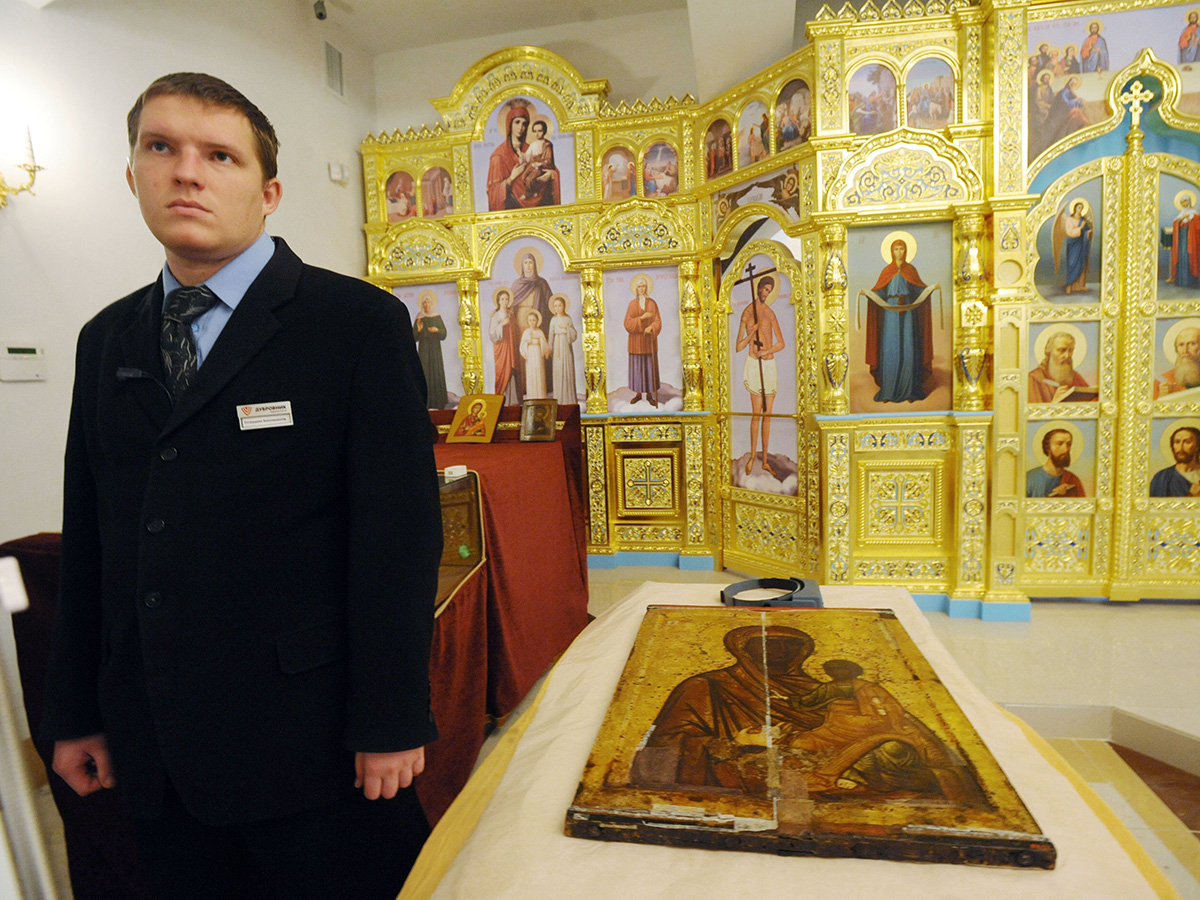
Alexei Lidov: Threats are quite serious, since the law does not prescribe the regime of the protection of these values at all. And in fact, it refers to the property of religious purposes, but it is not said about the monuments of cultural heritage, to which most of these temples preparing for transmission are. And first of all, experts, art historians, the museum community are concerned about this, since we have enough examples when we see that the monuments are just dying or are in a threatening situation. The last case is bright connected with the icon of the Mother of God of the Bogolyubsky, unique Byzantine and Old Russian icon of the 12th century, which, as a result of improper storage, was first covered with mold, and now it is urgently hospitalized for restoration and now even experts do not know how to save this monument, because the situation is serious. It’s just that this is a private illustration of how dangerous the situation can be with thoughtless transmission and ill -conceived law.
I must say that what happened today, namely a round table organized by the Russian Orthodox Church in the pilgrimage center, is a very important and first step towards establishing some constructive conversation and cooperation between the Russian Orthodox Church and the expert environment. As a matter of fact, this is what we sought when preparing a letter from cultural figures and science to the Holy Patriarch. And I am very happy to say that in this sense we were heard and received the reaction that we counted on, and for the first time in a long time a serious professional and constructive dialogue began.
Vladimir Kara-Murza: What are the most egregious examples of ill-conceived transfer of museum values in the bosom of the Church?
Levon Nersesyan: You know, the example that Alexei Mikhailovich cited, he is a textbook and exempter. The fact is that I was part of an expanded restoration council, which was just about 10 days ago to decide the further fate of the icon, more precisely, the prospects for its restoration, since this is a serious problem. You know, I have no comforting news, the question remains about the restoration open, since the processes of destruction in it have not yet been completed. I’m talking a little strange now for the non -specialists. But in order to understand what happened, you just need to begin to understand how it happened. By the way, during the restoration council, we restored the whole picture of events.
It turned out the following: the icon in 92 was transferred to the current Assumption Cathedral of the princess of the monastery in the museum capsule, which by 98 failed. After that, the church at its expense ordered a climatic capsule in Germany, which is equipped with four heaters, which simultaneously worked like the dryers, aligned the climate. Because the climate was very heavy, and as if there was not enough capsule. The heaters rarely and irregularly include, because they consumed a lot of electricity, buzzing during worship. And in the end, two of them failed, and two were
We are talking about everyone to do their own business so that specialists can keep museum monuments in the mode in which they should be stored, and the nuns were engaged in what was supposed to be on the monastery charterSold. The next action is the installation of the granite floor, which killed completely moisture exchange in the temple and the device was baptized next to the icon. As a result, no climatic capsule helped, the icon sucked moisture all this time, it is already in serious condition. And now it lies on the museum table, moisture from it continues to leave, swelling the colorful layer and no restoration intervention is still impossible until this process is stabilized. Then it was decided to wait with this icon before the summer, then the restorers will look for ways to strengthen.
What morality can be taken out of this long story? From this story, I would absolutely not want to derive morality: ah, what bad churchmen, how they brought the poor icon to such a state. This is completely not about that. And when we perform, we do not want to keep anything like this. It is very sorry that we are heard in this way. We want to say a very simple thing that everyone should do their own business. The monks of the princess of the monastery are completely unable to be the guardians of museum values, they are not obliged to maintain the necessary regime, they should not observe all those hundreds of precautions with which, generally speaking, the storage of monuments of such a rarity and such preservation is connected. This should be done by specialists. Therefore, we are talking about everyone to do their own business so that specialists can store museum monuments in the mode in which they should be stored, and the nuns were engaged in what was supposed to be on the monastery charter. I am for such a divorce, a meaningful divorce of the functions of both sides in this situation.
Vladimir Kara-Murza: Is it possible to consider a successful example of cooperation between the museum and the church in the Solovetsky Islands?
Yuri Brodsky: There is no longer cooperation or cooperation is stopped, apparently. Because on Solovki it somehow happened very quietly. The governor of the monastery Archimandrite Porfiry was appointed director of the museum, so the museum is preparing for transfer, the museum will disappear, although they say that the museum will remain. The fact that Archimandrite is set by the director of the State Museum, I do not know this person, the reviews about Porfiria are very good, they say that he is a good specialist, a young man, unlike the previous leaders of the monastery. Maybe something will turn out, just a lot of people depends directly. We lose the Solovki as a state museum.
Vladimir Kara-Murza: Boris Yakemenko, the head of the Orthodox corps of the “ours” movement, a member of the Public Chamber, does not see a problem in the situation.
Boris Yakemenko: The problem is not the same as before, nevertheless, she continues to be very relevant. The church and the state, of course, will be able to agree. Because there is a positive experience of such joint agreements. In particular, the Vladimir Museum-Reserve agrees perfectly. The unique cathedral of the 12th century, the Assumption Cathedral of the city of Vladimir is used together by the Church and the museum, no one complains. Just as the Bogolyubov icon of the Mother of God, for example, was issued to Princess Monastery of the city of Vladimir and was there for a long time. Now a planned inspection of this icon is being conducted, and then it will return to the monastery again. That is, everything is completely normal. Scientists monitor this, and the Tretyakov Gallery stores the Vladimir Mother of God in the Church in Tolmachi. So, it seems to me that this problem is invented.
The full text of the “City of Time” program will appear on the site in the near future.