
Translated material
Legislative Internet terror
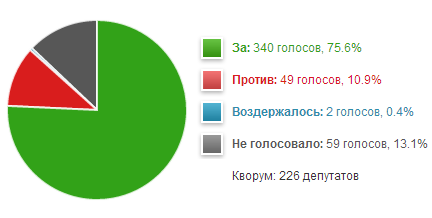
All three bills from the so -called State Duma deputies adopted the “anti-terrorist” bloc in the third final reading, scoring again to the opinion of society and the IT industry, not even organizing the appearance of a serious discussion of such super-resonance laws . If they are approved by the Federation Council and the President of the Russian Federation sign them, then they will enter into force on August 1, 2014. Read more about what the company threatened by society, the Internet and business of this package of new laws can be read in the selection: rublacklist.net/7604 (paragraphs 7-9) and in this article: Rublacklist.net/7068 with regard to bloggers, we advise you to study FAQ: habrahabr.ru/post/219935
So, how the deputies voted in the final reading by namely:
Bill 4288884-6 (on bloggers, monitoring of communications of citizens, registration of sites in RKN, storage of data on users and their actions for six months, etc.): vote.duma.gov.ru/vote/85592
Bill 428896-6 (on restriction of electronic payments): vote.duma.gov.ru/vote/85591
Bill 428889-6 (on the expansion of the powers of the FSB): vote.duma.gov.ru/vote/85590
3rd reading of all three bills (2 minutes) :
The text of the most odious from this block of law is completely given, because It cannot be torn to quotes - it is all beautiful from beginning to end:
Bill No. 428884-6 to 3 reading (on restrictions on Internet communications of citizens with amendments to bloggers) from artem kozlyuk
PS Yandex company spoke like this as a result of the adoption of these bills:
“In our opinion, the adoption of the law will be another step towards strengthening state control over the Internet in Russia, which will negatively affect the development of the industry.
It is important to understand that the regulation stipulated by the bill can be applied not only to blog hosts and social networks, but also to almost any services on the Internet, including e -mail, applications for mobile devices, and so on. In fact, any site owner, cloud service or other Internet service provider is obliged to store in the territory of the Russian Federation data on all its users and exchanging them by any electronic messages. For failure to fulfill the requirements of the law, the resource can be blocked even in the absence of any illegal information on it.
As for the identification of bloggers, it is worth noting that they have wide duties of the media without the provision of media rights, including checking the reliability of information. The same requirements apply to comments, which transfers them to the premotation mode. At the same time, the responsibility for the identification of bloggers lies with the blogs and social networks, which will impede the development of these services.
The draft law introduces the rule of preventive identification of bloggers and obliges the organizers of electronic messages to store data about all the facts of exchange between all users within six months. Such requirements contradict the international obligations of Russia, adopted within the framework of the European Convention on the Protection of Human Rights and Fundamental Freedoms.
In addition, at the beginning of April 2014, the European Union court recognized as invalid the directive, which for the past few years prescribed the storage of logs about all users' actions in telecommunication networks (Internet, telephone networks). The court considered that the action of this directive is contrary to articles devoted to the right to respect personal and family life and the protection of personal data. According to the logic of the court, a similar collection of information about a citizen is possible only if he is suspected of committing an offense. ”
PS2: The Human Rights Council under the President of the Russian Federation asked Valentin Matvienko to reject this bill. “According to many members of the Council and representatives of the Internet industry who participated in a special meeting of the HRC on April 21, this law does not meet the realities of the modern Internet, and in a number of provisions contradicts the legal and technical nature of the network. Also, the law does not take into account the cross -border nature of the relations taking place on the Internet, which makes its application extremely difficult. ”