
Translated material
Bloody Libelaw on the air of “Channel One”: whether Konstantin Ernst will apologize to the audience
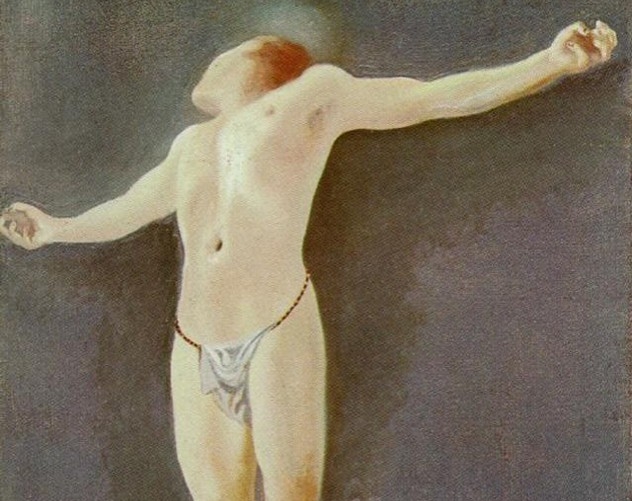
Illustration: Salvador Dali. Sketch fragment to Corpus Hypercubus
This hyperlink is empty, broken, it doesn’t lead anywhere yet, but I asked the elephant editors to leave it in this form and fix it a little later, when the “Channel One” website will appear in connection with the incident on the weekend. On Saturday, the “Time” program showed a woman who was called a refugee from Slavyansk and in paints told how the Ukrainian military, entering the city, gathered all local residents on the main square and arranged a public execution of his wife and little son of one of the militias, and the boy, according to the heroine of the plot, was crucified on the board of ads and the woman was tied to the tank and the woman was tied to the tank Dragged along the street until she died - and all this in front of local residents. The public execution, moreover, is so cruel - such news usually become world sensations, and journalists, thanks to which this sensation has become known, receive the Pulitzer Prize. The names of the dead (and ideally executioners) in the heading, shocking photos or videos, the whole world is crying, and then in collections of “one hundred photographs that changed the world” next to the photos of the South Vietnamese General NGUEN NGOK , who kills the partisan, and the plane that crashes into the Twin Tower, this picture will appear: the Slavic, the bulletin board and the bulletin board and the confusion to it. A three -year -old boy in panties and a T -shirt. What could be worse?
The question is rhetorical, but the answer to it exists. The worst of the murdered boy may be a shame, especially if the boy was invented, and the shame is real. On the Saturday program “Time”, this frankly caught my eye - the apologizing tone of the host Vitaly Eliseev (“A conversation with Galina left a difficult feeling ... The heart does not believe that it is possible at all ...”), a defiantly unsuccessful correspondent of Yulia Chumakova (five of her five remarks in the story - variation on the topic “isn’t you afraid of this, Julia Chumakov is not nothing else Interested). How so? People have a big sensation in their hands, and they behave as if they are talking about a rally “Gay for Yavlinsky” : “It’s awkward to us and you ourselves, but you will understand us.” In Slavyansk there is no Lenin Square, refugee Galina Pyshnyak did not come from Slavyansk, but from Donetsk, and besides Galina herself, there are no witnesses of supposedly public execution - all this was not difficult to find out at all. It was not difficult to discover the source: on July 9, the philosopher Alexander Dugin on Facebook, referring to an anonymous eyewitness, wrote about a six -year -old boy who was crucified in Slavyansk on the board of ads. It is easy to reconstruct the further; Dugin has many fans, including in the Kremlin, and, probably, at the next meeting on “information planning”, some big boss who read the day before, said that, they say, imagine what the punishers have reached, the child! On the board of ads! And why is our television silent? Television sighed and went to look for at least someone who agrees to repeat the city legend in front of the camera. Galina Pyshnyak was found, we saw the rest. When the head of the Russian state media Margarita Simonyan writes : “And still, Lord, make it not to be war”, she hardly means: “Lord, make me not to be,” but it would be stupid to deny the role of Russian television in inciting military moods and expectations. Military standards of factschecking on state television are markedly different from peaceful ones. When Igor Korneluk reported in the Donbass, his television company (obviously, trying to avoid the scandal) even changed his latest reporting number of his last report. It was : “In the village of Happiness, the punishers cut out almost the entire local population”; It became : "The battle in the village of Happiness: shells beat where it got." As in the case of a crucified boy, the author of the report referred to an eyewitness, to whom another eyewitness told about the cleansing - that is, evidence, in general, no, but the war.
Ilya Ehrenburg’s military texts can also be approached with the standards of journalistic objectivity, and then from four volumes there will be, perhaps, half a page about pre -war France, the rest will have to be rejected, because the author has not been concerned about evidence. I bring this argument because it will probably still come up in discussions of the first-handed plot and someone will probably ask that, they say, and Erenburg had to take care of the facts? Probably, it should not, but the problem is that all the military traditions of Russian television formed long before the start of the Ukrainian crisis, that is, the war has nothing to do with it. Living and, in general, normal people work on state channels. They know that it is not good to lie, but they also know (I judge by their friends , who, by the way, are sure that their colleagues around the world, from CNN to al-Jazis, behave the same) that you can lie in cases when it comes to enemies, about protecting state interests and other matters of the same order.
In vain, critics of Russian television are looking for the origins of the current features of Russian propaganda in the Soviet and even more so Hitler (even despite Putin’s famous statement about Goebbels ) - our propaganda is much younger, and its direct ancestors are not Goebbels and not Ehrenburg, but the post -Soviet media people who always worked out, and the Kremlin always got into line. Soldier of information wars. The route, which led them to the current state of affairs, was this: from October ninety -third through the operation “Muzzle in the Snow” and the first Chechen war; through the elections "Yeltsin - Zyuganov" of the ninety -sixth year and the war for "Svyazinvest" in the ninety -seventh; Through the programs of Dorenko and “Gays for Yavlinsky” to “Anatomy of Protest”, “Vesti of the Week” and, while this is the highest point of development, to the current propaganda masterpieces on the Ukrainian theme.
We are accustomed to the fact that the TV is engaged in propaganda, we roughly imagine what you can expect from it, but when this plot appeared with a crucified boy, it somehow immediately became clear that it was a facet. Such things cannot be prescribed in any law on insulting feelings, but at the same time people really have feelings, and the bloody hibl on the air of the main nationwide canal is really offensive even for those who are already used to the current appearance of Russian television.