
Translated material
Nikolai Molok: "The parallel program was not invented by us, but the" Manifesto "itself"
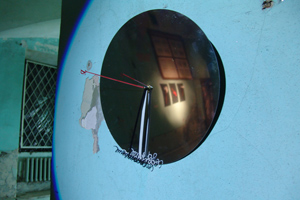
The coordinator of the parallel program “Manifesto 10” Nikolai Molok is about the balance of forces between the main and parallel programs of the Biennale, censorship and festival “Manifesto”.
- What are the responsibilities of the coordinator of the parallel program "Manifesto 10"?
- I collected applications, processed them, made an initial screening on formal signs, checked whether the requirements of the “manifestos” were complied with: all the organizers had to finance their projects themselves and agree on the place of their holding. And there were about 15 applications about the following: “I want to show my project in the Hermitage”, to which I replied: “A wonderful idea, but where is the confirmation of the Hermitage that the museum will accept you?” That is, I had no aesthetic criteria. Then the jury began to work, which took 57 projects, then I coordinated the preparation of exhibitions, although, of course, basically everyone did their projects. In parallel, we had the first cadet corps, where I met with curators and artists, we made decisions who would occupy which zone. Then we prepared the catalog.
- What projects were preferred?
- It did the jury, not me. The jury consisted of professional art historians, curators, critics with great visual experience and understanding what the Biennale of contemporary art is. All these people were on the Venetian Biennale, the “document” and even on the Marrakesh Biennale. We, as the organizers, did not offer them any selection criteria: they already understood everything. For them, the main criterion was professional - the quality of the project. In controversial situations, preference was given to young artists and projects that take place in unexpected places. For example, the refugee camp project, which was held in the former garages of the ambulance station on the Fontanka embankment (curators “Refugee camps” - Alexander Belov, Vlad Kulkov, Alina Ushakova. - O.R. ), had certain advantages. And the ordinary, planned gallery exhibition could be, on the contrary, rejected, because it would have taken place.
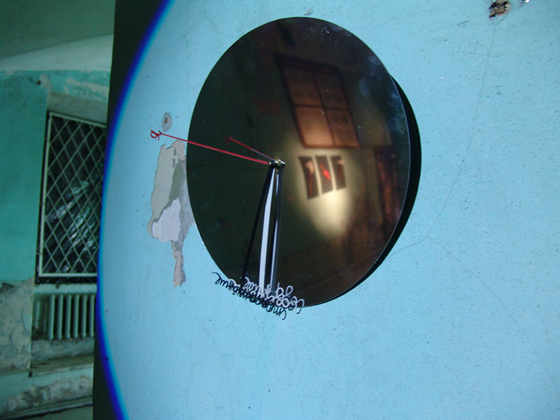 © Olga Ryabukhina Lech Garikovich, Sergey Prokofiev. Project "Quiet Light", fragment. First Cadet Corps
- What give the parallel program “Manifesto” as a holistic exhibition project such sites that will be used once as an exposition space and then disappear?
- Or maybe they will not disappear. In general, this is characteristic of "manifestos". All past "manifestos" were dispersed at several venues in the city, which often were former factories, factories and other non -artistic places. What is happening in St. Petersburg is such an exclusive “manifesto”, where the main project is on the same site - in the giant museum. At the Manifesto 4 in Frankfurt, one of the exhibitions was also in the museum, but so that the whole Biennale showed in the museum - this was not the case. "Manifesto" has always used strange places in the hope that they will remain and turn into conditional art centers. The creation of new art clusters is one of the tasks of the Manifesto and us as the organizers of the parallel program as well. I understand that it is hardly possible to expect that these garages of ambulance stations will remain an exhibition platform (although why not), but the Street Art Museum will most likely remain so. Theoretically, the first cadet corps - it depends on the university, not on us - can continue the exhibition practice.
- As far as I know, the place where Stas Shuripa and Anna Titova took the exhibition Observatorium will become a hostel, and the building, occupied by the exhibition under the curator of Vladimir Logutov “ Not a Museum. *Laboratory of aesthetic suspicions ” will be given to the hotel.
- The old -timers told me that this building, where the Logutov project was taking place, has been in a state of repair for several years. It is possible that next year there will be another exhibition. I don't know. Even if this does not happen, the “manifesto” gives the city a chance to use non-core platforms to create new art centers. If there are one or two clusters, there will already be a big victory. Maybe next year someone will want to make an exhibition at another factory and remember that there was an exhibition at the plant of layered plastics. So all kinds of centers arise in Moscow and St. Petersburg, and around the world. Tate Modern set a tone, and now in other places - for example, in Shanghai - museums of contemporary art appeared in the buildings of former power plants.
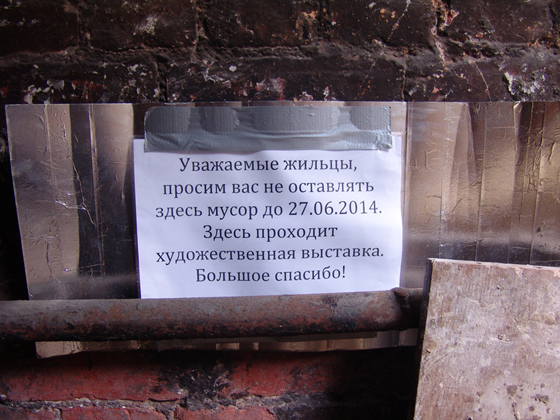 © Olga Ryabukhina Announcement on the way to the exhibition of Stas Shuripa and Ani Titova “Observatorium” in Kovensky Lane
- A catalog came out at a parallel program. It is curious if there was something similar on previous "manifestos"? After all, the release of a catalog is a serious gesture, which means that a parallel program is a whole.
-I was on two “manifestos”-in Frankfurt and in San Sebastian , I don’t remember catalogs of parallel programs, although I know that they were and differed from the catalog of the main program-just like ours. According to the rules of “manifestos”, a parallel program should have its own style - its own logo, its font, its own design. The Moscow Biennale has catalogs of a parallel program, however, there it is differently called special projects, but in fact the same. There is a second volume of the Catalog of the Venetian Biennale, given to a parallel program. In the end, this is all one exhibition consisting of different parts.
- On COLTA. RU has recently been an interview with Viktor Misiano , where he acted as an opponent of a parallel program as a festival, entertainment. Could you agree with him or, on the contrary, opposite?
- Viktor Alexandrovich Misiano is absolutely right, because he appeals to that “manifesto”, which was 20 years ago and which he did as one of the curators . "Manifesto" really began as a discursive platform, as an experimental exhibition, and not as a festival. But it was 20 years ago. The fact that the “Manifesto” was first headed and makes one curator , not a group of curators; The fact that the "manifesto" takes place in the classic museum and on the same site; The fact that the “manifesto” refused an emphasis on young artists - all this indicates that the “manifesto” itself has changed. She herself was festivities, without the help of a parallel program.
The creation of new art clusters is one of the tasks of "Manifesto".
Victor, of course, leads a wonderful and very flattering comparison with Berlin. But Petersburg is not Berlin. Indeed, in Berlin, a parallel program, perhaps, would not even be needed very much, because there local institutions work perfectly and do everything themselves. For example, Berlin Biennale, which, by the way, is, like the previous “manifesto”, takes place on several sites of the city, but does without a parallel program, does not really affect the artistic life of the city: any large exhibition - say, at the Gamburg station - receives a significantly greater resonance than the whole Berlin Biennale. But in St. Petersburg, firstly, there are not so many institutions of contemporary art, and secondly, they do not do so much. Here is a Russian museum. He does not participate in the parallel program, lives his life, shows Roerich, but could show something modern.
In addition, in his interview, Victor is a little mistaken. Indeed, the parallel manifesto program did not begin immediately, not with the first Biennale, but, as manifesty colleagues told me, they had 40 projects of a parallel program on the previous Biennale in Belgium , and at the “Manifesto 8” in Spain there were 100 projects in Spain . That is, the parallel program was not invented by us, but by the manifesto itself.
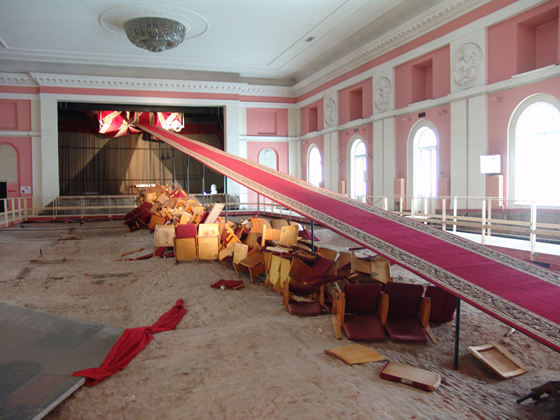 © Olga Ryabukhina Ivan Poyshch. The process of passage. First Cadet Corps
- Is it possible to say that the parallel program of the current Biennale replaced the “manifesto” that was before? “Manifesto”, as you noted, has changed, and the parallel program took the function to show fresh, young art, up- to- Date ?
- I am not a supporter of such a rigid division into a basic and parallel program. This is all one exhibition. There is no conflict, there is an addition. It is absolutely logical that local artists participate in a parallel program to a greater extent. A dialogue is created between local and international art scenes. On the one hand, no one can compete with Bruce Nauman anyway, or with Katarina Frich, or with Thomas Hirschorn . Especially with piranesi. And on the other hand, in a parallel program there is Jeremy Defler , the same classic as Katarina Frich. If the König exhibition is built on the same dialogue, then here, in the city, another dialogue is created. This happened both on the Manifesto in Spain, and on the Marrakesh Biennale, where the main project makes English management, and a parallel program is local Moroccan artists.
I do not like your words that a parallel program performs some kind of function. Partly you are right: since this time the “manifesto” did not spread so much around the city as in the old days, the parallel program helped her a little in this. It seems to me that there is nothing wrong with that. It is better to address your question to Cohenigu or Hedwig Feyn, who, for some reason, have now for the first time abandoned the previous concept of “manifestos”: one curator, not three, one site, not ten.
Since the entire “manifesto” is largely funded by the state and the Hermitage - a state institution, like other museums and university, we were obliged to comply with Russian legislation.
Previously, in fact, the "manifesto" was slightly different. For example, Manifesto 7 in Northern Italy took place in two cities, and its press conference took place in the train connecting these two cities. Brilliant imagination. Or, for example, the only abolished “manifesto 6” , which was supposed to take place in Nicosia. According to the plan of the curators, primarily Anton Vidox, was supposed to take place both in the Greek and Turkish territory of Cyprus, but because of a political conflict, this could not be done.
- I did not expect that the parallel program would be so saturated. For some reason, it seemed to me that most of the projects would simply stick to the main one.
- There were really a lot of such applications, counting on “just to stick”. Of course, they did not pass. The saturation of a parallel program is the merit of the jury with his uncompromising approach. I participated in the organization of the Moscow Biennale, mainly engaged in the catalog, but also entered some working groups. On the fifth I entered the qualifying committee of a special project - an analogue of a parallel program. At the Moscow Biennale, at first, too, everyone thought that some kind of nonsense would show some kind of nonsense. But there were always megachites who, if they did not overshadow, were on the same level with the main project. There were exhibitions "accomplices" and "Russian pop art" Andrei Erofeev or the recent "reconstruction" of Elena Selina . These exhibitions are important not only for the local art community, but also for foreign guests-after all, they are more or less familiar with the work of foreign stars, and it is more interesting for them to see the local context. Our exhibitions are Vladimir Logutov, or Olesya Turkina about Vladik Monroe, or Natasha there, who collected the projects of the classics of modern Russian art, are in themselves hits.
This is all one exhibition.
- Have you had to deal with censorship intervention, had to adjust your choice?
- No. We did not have censorship as such. No one came to us and said: then remove it, put it, here we must write this, then - then. But since the whole “manifesto” is largely funded by the state and the Hermitage - a state institution, like other museums and university, we were obliged to comply with Russian legislation. We can treat the laws on the use of state symbols and on the “promotion of homosexuality,” but since they are, we must observe them. In the main headquarters - amazing photos of Wolfgang Tilmans. And this is a fairly frank artist. When Tilmans participated in the III Moscow Biennale, held in 2009, he exhibited several photographs that were more frank, because then there was no such law. Then it was not necessary to hang the “18+” sign, but now it is necessary to hang it. We have a naked running girl - we must hang “18+”. I do not think that this is censorship, this is compliance with the law. Censorship is another thing.
- But the parallel program is made up for the most part of the exhibition at private venues.
- Of course, each private gallery has every right to decide what to put up and how to do it, and she will be responsible for it, not us. And we cannot ban or allow anything to her.
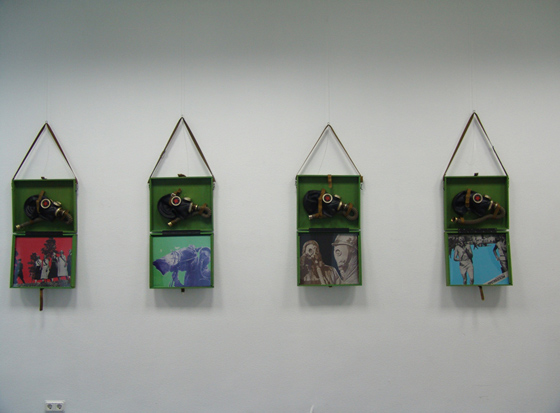 © Olga Ryabukhina Mikhail Karasik. The project "Sergey Tretyakov. Gas masks ". Library of book graphics
“But you may not choose it.”
- We did not have self -censorship. I mean the jury in the first place. There were simply no projects on the topic of power, homosexuality - there were simply no such radical projects.
- That is, you did not have to refuse anything?
- For these reasons - no. There are several exhibitions selected by the jury that did not take place, but for organizational reasons, and not for censorship. Someone had a platform, financing. And this is wildly sorry, because these several exhibitions should have been very powerful. There was, for example, a funny story: the organizers of the exhibition from Kyiv recalled their application immediately after the start of events in Crimea. And then one of the artists, a participant in this exhibition, wrote on her Facebook: “We refused to participate” - although at that time the jury had not even begun to consider applications. They recalled the application, of course, for political reasons, but the project itself was not on the topic of politics. It is unfortunate that it did not take place, because the project, judging by the presented materials, was very good, and I am sure that the jury would have taken it away.
- The group "What to do?" I recalled my application before or after?
- Similarly - before. I do not know how everything was arranged in the main program "Manifesto". I think Kasper König conducted negotiations with them and was supposed to include them in the final list, and they decided that they were already included, but this list itself was published only two weeks after they refused to participate. If they hoped to arrange some kind of scandal, they refused too early. I am friends with Dmitry Vilensky and respect their choice, but the situation came out somewhat comic: they have not yet been announced, and they have already refused. In any case, it is annoying - I am sure that their project would decorate the Manifesto.