
Translated material
An article with which everything is wrong
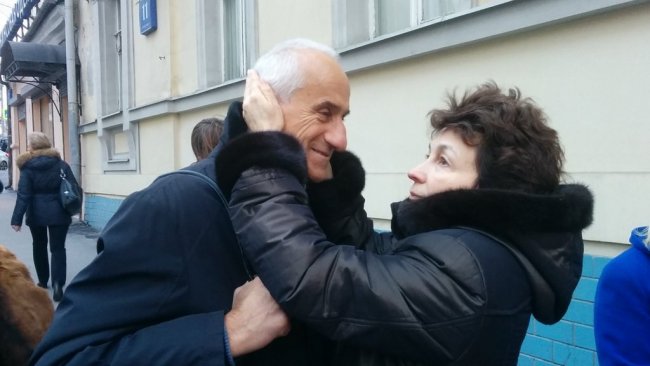
On December 23, a meeting in the Preobrazhensky District Court will be held in the case of Vladimir Ionov on “repeated violations at public events” - perhaps the verdict will be announced on this day. Moreover, there will be no one to speak with the last word - Ionov, whom the prosecutor asked to be sentenced to three years in prison, left Russia and is currently located in Ukraine.
In January 2015, the 75-year-old Ionov became the first in Russia the accused under the new article 212.1 of the Criminal Code, but the sentence was not sent to the first: on December 7, under the same article, Ildar Dadin was sentenced to three years in the colony. Currently, two more accused under Article 212.1 of the Criminal Code - Mark Galperina and Irina Kalmykova. Both are under the subscription about the lower place, Kalmykova has already begun the court, Halperin has no yet.
What is wrong with this article?
Not so. Starting with the theory.
Article 212.1 of the Criminal Code, added to the Criminal Code in the summer of 2014, provides for a penalty of a fine of up to a million rubles or imprisonment for up to five years for participating in street actions that occur without any aggression, without the use of violence, without weapons, without pogroms, unrest or destruction. The criminalization of participation in peaceful actions is contrary to the constitution: "Citizens of the Russian Federation have the right to gather peacefully without weapons."
A new article implies a second punishment for the same action: the accused of violation at the rally is first sentenced to an administrative fine or arrest, and then they have a criminal case on it. This also contradicts the Constitution: "No one can be repeatedly convicted of the same crime."
Administrative cases suggest significantly lower opportunities for protection than criminal ones. In the case of Article 212.1, the rally participant is initially defended precisely according to the rules of administrative rather than criminal proceedings. Thus, the accused actually deprive the right to defense.
The article is formulated in such a way that it is impossible to predict the consequences of its actions. Criminal liability does not occur after several violations at rallies for a certain period (for six months), but for several (or rather four) indictment decisions. The court can consider such cases during the year, and only on it will be held between the decisions for six months or they will be issued one after another - the participant of the action himself cannot influence this in any way.
New legislation destroys freedom of assembly in Russia: statement of PC "Memorial"
There are other legal subtleties. For example, the article considers the repeated violations to qualifying characteristics. This would not contradict the Criminal Code of the USSR, according to which a person could be recognized as a “especially dangerous recidivist”. However, according to Russian laws, the court can take into account repeatedness only when choosing punishment. According to a number of lawyers, the use of repeatedness as a qualifying attribute violates the principle of equality of all before the law and the right to not be twice convicted for the same act guaranteed by the Constitution.
What does this mean in reality?
The main evidence base for holding accountable under the new article is decisions on administrative offenses. Decisions on an administrative offense under article 20.2 of the Code of Administrative Offenses (violations at rallies) are issued by district courts. In Moscow, the share of accusatory decisions under this article in 2014 was more than 90 percent. Court meetings in such cases, as a rule, are held quickly. The testimonies of the defendants are not taken into account. The motivating parts of the solution look something like this (hereinafter the spelling and punctuation of the original are preserved): “The version of K., the court regards the court as the method of protection it chosen in order to avoid administrative responsibility for the deed, which does not contradict its procedural situation as a person in respect of whom the proceedings are being carried out, however, gives reason to critically relate to its version.” (Unfortunately, so far the second instance has not recognized the decisions illegal due to their illiteracy). The judges, as a rule, refuse to call witnesses to the defense of the judges, well, and if they still listen, then: "The testimony of witnesses contradict the testimony of the police and therefore are questioned." So court decisions are completely relied on protocols and reports drawn up by police officers.
Documents on an administrative offense are written in the police department, as a rule, those employees who did not participate during the detention and did not see their own eyes what happened to the shares. In order not to complicate the work, especially if several people are detained, the finished printed form is regularly used in the departments, in which the surname and the name of the detainee fit in hand. The fact that in the end about the detained women are written in a male gender is still half a bastard. The main thing is that the documents contain very general formulations without details (“conducted a mass public event in the form of a picket, the notification of which was not submitted to the executive authorities of the city of Moscow, while holding a poster of thematic content in their hands”) and a frank lie, attributing to the participants of the action fictional slogans and actions that they did not perform. “It’s written for me that we were detained,” says one of the detainees on Manezhnaya Square on January 15, “and the time was not that, and we did not do it, and they said the wrong thing, and shouted“ for Navalny ”, when no one even in general Navalny remembered.” The report, meanwhile, claims : “Crowed out the slogans,“ Freedom Navalny ”to the legitimate requirements of the police did not react to the occupying territory.”
Obviously, article 20.2 threatens primarily to those participants in the action that the police detained. Detention at street events, often more reminiscent of abductions - people in police uniforms approach a person and, without introducing themselves and without explaining, grab him under his arms and drag him into the car, sometimes beat - they pass in Moscow regularly. Sometimes there are more, sometimes there are fewer of them, but these are hundreds and thousands of people, these are dozens and hundreds of shares per year-peaceful shares, without violence, without calls to violence, without attempts or calls to break something or attacking someone. According to international standards , the police should not disperse rallies, even if their individual participants behave aggressively: it is enough to separate violators from peaceful demonstrators. In Moscow, the formal basis for the detention of participants in the action in most cases is only that the event was not agreed with the local authorities in advance. Only its organizers, not ordinary participants, can know about this.
Little depends on the actions of a person: someone will be detained and then draw up a protocol under Article 20.2 of the Code of Administrative Offenses, someone-no. Only luck or correct political views can help here. On January 15, the Moscow police said that 450 representatives of the Antimaydan movement and only 50 of their opponents gathered on Manezhnaya Square without a pre -filed notice. According to the ATS-Info, 13 people from among the opposition were detained, they made protocols about violations at the rally, three of them remained in the police department at night. Of their opponents with St. George’s ribbons, three were detained, they were freed from the autozak, of course, without drawing up the protocol.
Photographers, journalists, people who approached law enforcement officers can get under the hot hand of police officers to find out what was happening, and simply passers -by who found themselves in an unsuccessful place in an unsuccessful time . The people who are alone with posters are delayed. A single picket is the only legitimate way to express your opinion on the street without coordination. However, even here the police easily finds a reason for the detention: it can be a provocateur standing nearby (after that the picket ceases to be single), verification of documents, “a similarity with orientation”.
How and for what did the first cases of repeated violations at rallies have started?
Naturally, with such a system, to get several decisions under Article 20.2 of the Code of Administrative Offenses, primarily permanent participants in protest promotions risk primarily. It was on such people that the first criminal cases of “repeated violations” were instituted.
Vladimir Ionov and Mark Halperin were detained on Manezhnaya Square on January 15. Initially, on this day, they should have announced the verdict to the brothers Alexei and Oleg Navalny in the Yves Rocher case, but then the announcement was urgently transferred to December 30. On January 15, there were almost no supporters of Navalny on Manezhnaya Square - but there were many of their opponents from the recently created Anti -Maidan.
“I just came to the Manezhnaya Square - to see who comes,” says Ionov. - I appeared there at half -hundredth. Literally a few meters passed, then an officer comes up to me, whom I know in the face, and he knows me, because he is all the time on Manezhnaya Square. He said: “This one,” and that’s all, led me to a car carrier. ” Soon, Mark Halperin was placed there, who was detained at the exit of the metro and first was put in another car. “The police came and very rudely dragged Galperin,” one of the detainees describes what happened in the first autosak. “We shouted that he himself would come out, he did not resist ... his bag remained.”
Ionova and Halperin were brought to the Chinese Gorod police department, they were left in custody at night and the next day in handcuffs was brought to the Tver court. Both were judged at once in two cases: first for the picket on January 10, and then - for the “repeated” violation on January 15, and referring to previous violations, committed even before the law on “repetitions” entered into force. Halperin was discharged on 8 and 30 days of arrest and taken to a special -reception. Ionov ordered to pay two fines: at 20 and 150 thousand rubles, and then, instead of releasing, they brought back to the police department. After some time, the pensioner, without explaining to him, was again put in a police car, which drove to the prosecutor's office. “No one wanted to talk to me in the prosecutor's office. They told me: “Do you have a lawyer?” He says. - I say: "there is a lawyer." And until the lawyer arrived, they didn’t say anything to me. And then they said: against you, since you have a number of violations, a criminal case has been instituted. ”
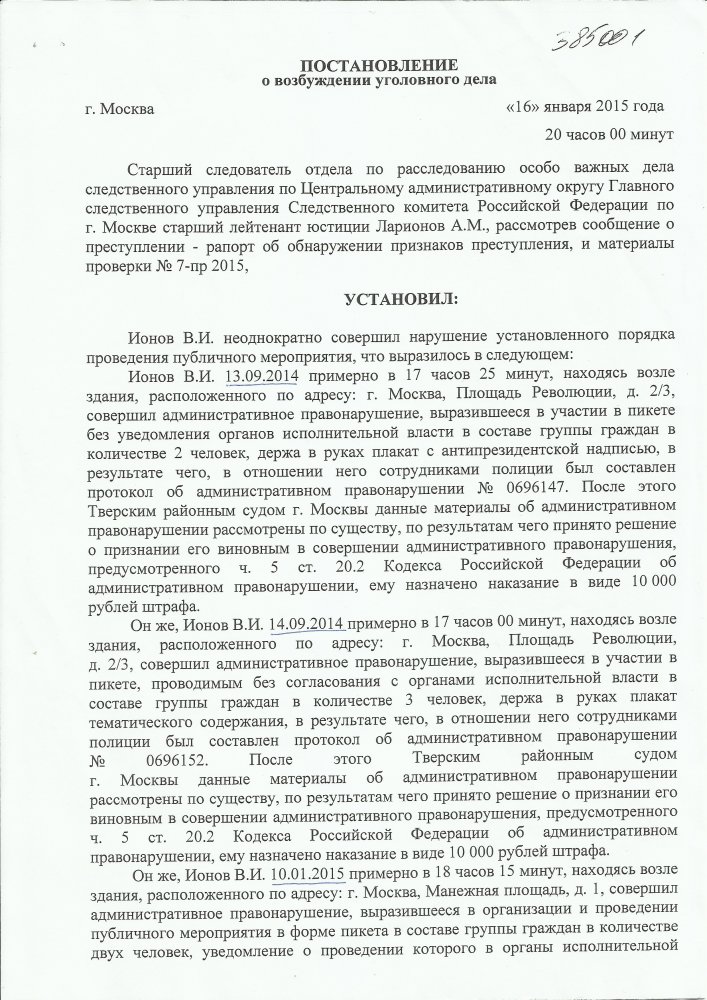
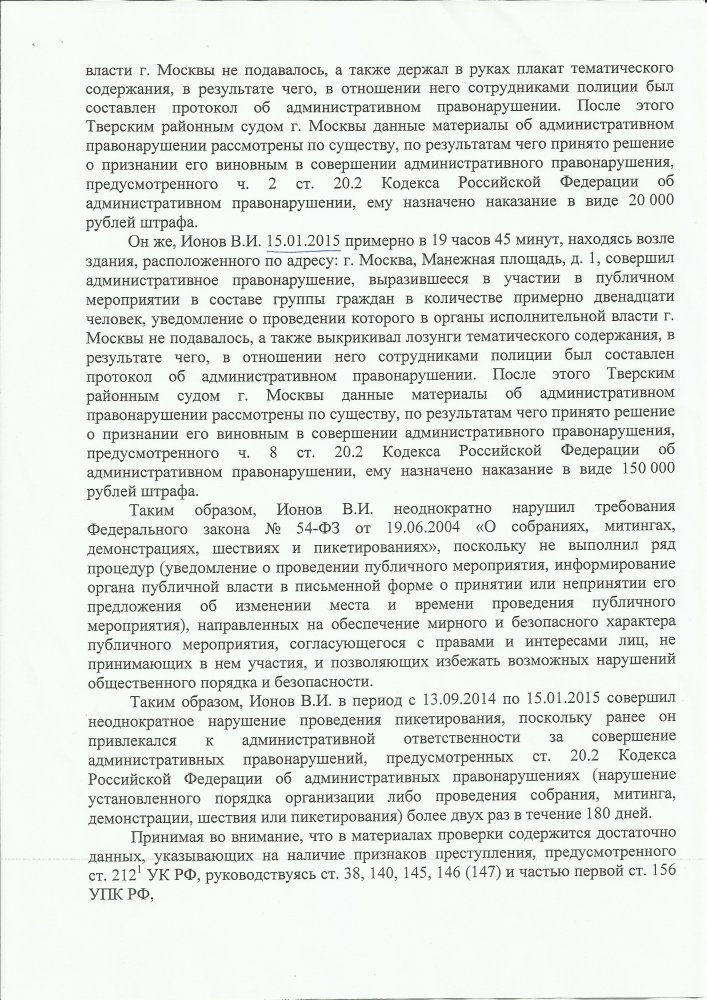
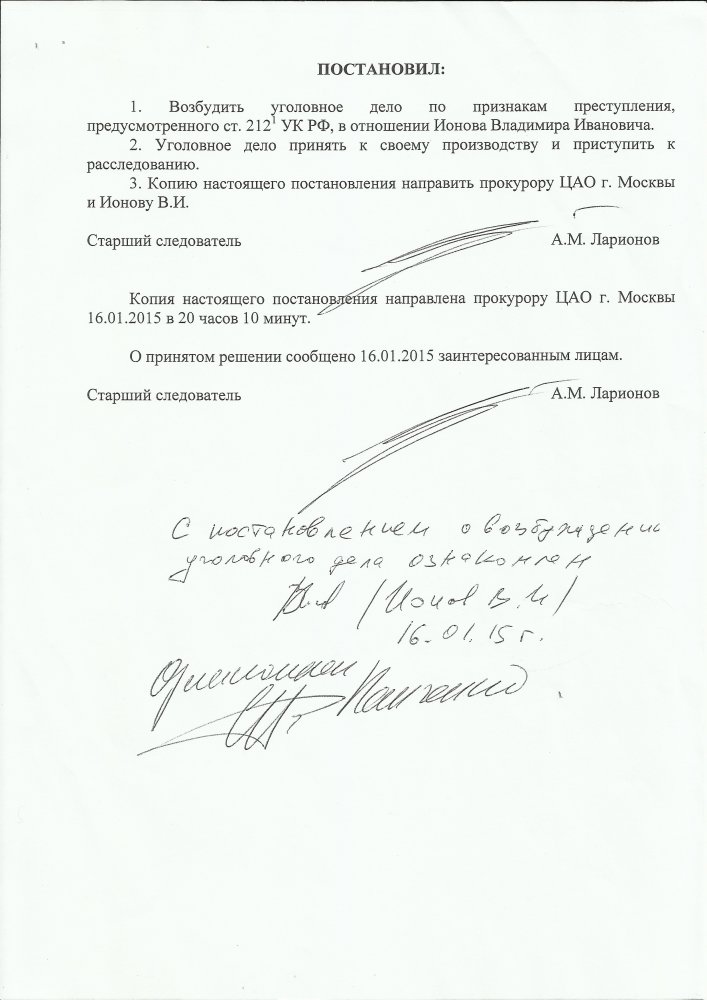 A few days later, on January 20, the case under Article 212.1 of the Criminal Code was also brought to Mark Halperin.
The basis of both cases was decisions on violations at four events: on August 6 and December 5, 2014 by Halperin and September 13 and 14, 2014 - at Ionov, as well as the shares mentioned above on January 10 and 15, 2015, the decisions of which, issued on January 16, were not even appealed (this can be done within ten days). “They already in the decision to initiate a criminal case indicate that he was brought to administrative responsibility by the Tver court,” lawyer Sergei Panchenko, who represented the interests of Ionov, was indignant. “Indicate the decision that have not entered into legal force, as a failed fact.” In July, it turned out that both September episodes crossed out of the case of Ion, adding protocols about later, already spring detentions.
What were these stocks? On January 10, a single picket was held on Manezhnaya Square. Several people replaced each other: one person stood with a poster at the monument to Marshal Zhukov, then the following stood in his place. The police detained Vladimir Ionov when he raised the Je Suis Charlie poster - the action took place a few days after the attack in the editorial office of the French satirical newspaper Charlie Hebdo.
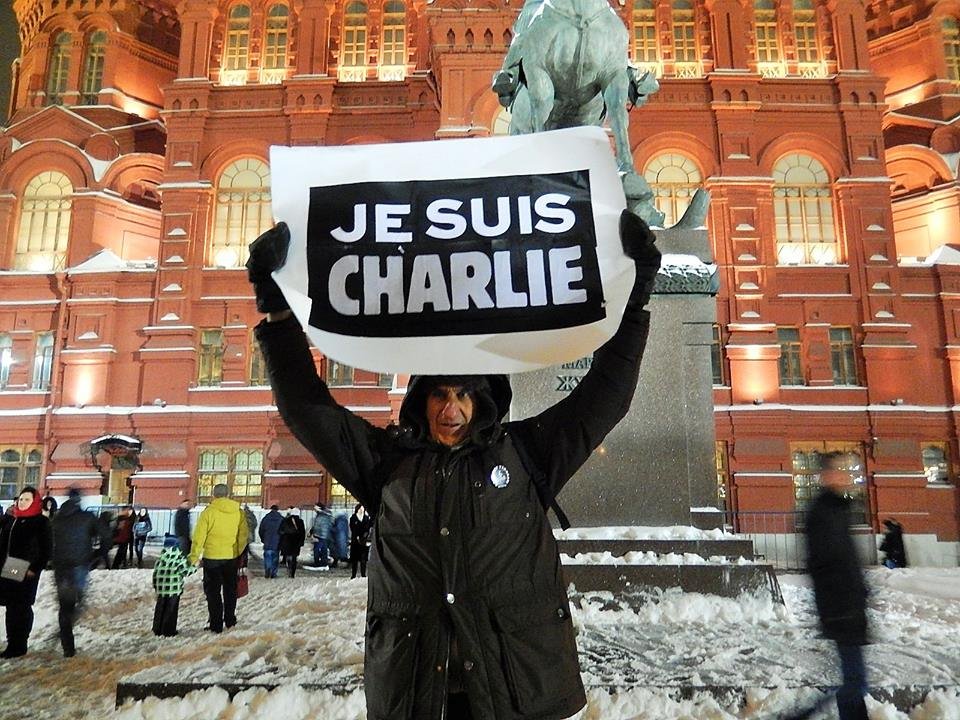 Here is how one of those present describes the detention: “Volodya stood with his poster. And on the same day, the famous Lavrov ran around Paris ... They pretended to be very sorry and condoing, but here at that time they were doing ... In general, Volodya stood, some young man suddenly approached him-all this happened instantly-with some piece of paper that it was written on it, no one, in any case, of my friends, did not understand. As soon as he came up, the police ran up immediately and swinted Volodya. Mark went to understand what it was. And then the brand was planted. This is what, it is believed that he was given 8 days - because he was slipping to intercede Volodya. "
Vladimir Ionov was detained on September 13 and 14, 2014 on Manezhnaya Square, where several single pickets took place at the same time. It is difficult to restore the details of these shares: pickets on Manezhnaya Square regularly pass according to the same scenario. The decision to initiate a criminal case states that on September 13, Ionov “committed an administrative offense ... as part of a group of citizens in the amount of 2 people, holding a poster with an anti -prescription”, and on September 14 “as part of a group of citizens in the amount of 3 people” he held a “poster of thematic content”. Ionov himself emphasizes: standing in a single picket, he never violated any rules.
“At the September pickets, the situation was standard: as usual, they delay, no longer bothering even an imitation of the execution of their own laws,” says one of the participants in the protest actions. - They even detained single pickets, they have tricks for this, sometimes without tricks, the cameras do not bother them. Do as they are told. On Manezhnaya there was always the same thing. Usually people come to the Zhukov monument, for some time they allow them to stand, and then they begin to detain, the system is the same. Titles also come up constantly. When you need to delay a single picketer, they always appear. Disputes with a clear provocation on some response, begin to insult-they see all this, and police officers sometimes do not even hide that they themselves instruct these titles. It can be seen how they say with them that people who are not dressed in form, begin to provoke to some kind of conflict, begin to provoke a verbal skirmish-and exactly at the moment when someone is trying to open their mouth or push in response, and immediately the police are ready. Naturally, they work always in one direction: if there is a group of oppositionists and several provocateurs, then, of course, if provocateurs are suitable and begin to insult, the police notice only response from the opposition, and there is always a punishment in the form of a premises in a carZAK. The actions of the provocateurs themselves, as it were, do not see point blank.
I can say one thing as an eyewitness. I know that there are people in protest, who can really do something in response to some provocative actions, which, theoretically, can be considered as some kind of offense, again, small-hooliganism or something else, he, say, was pushed, and he can push in response or send somewhere a mat. As for Vladimir Ionov, this is just a man, well, super intelligent, who, in my opinion, will not offend the fly. That is, it was impossible to seduce him to any provocations in order to get any such answer from him. He simply does not notice. He stands - and that's it. They begin to mock him, begin to laugh, this person stands - and that’s it. Sometimes it can say some two or three words, just some generally distant, philosophical. The verbal is never drawn into this skirmish, at least I have never seen him allow himself to draw into some skirmishes, allowed himself to somehow insult in response. It has resistance, stone nerves. Seduce him to something that theoretically can be regarded as some kind of criminal, but even an administrative article, well, it is simply impossible. He stands alone - and that's it. "
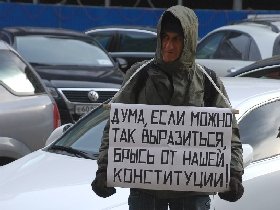 Of the two episodes added to the criminal case later, one is dedicated to the events on March 21, when Mark Halperin entered Pushkinskaya Square with a single picket for the replacement of power, and Vladimir Ionov simply stood nearby without a poster. Soon two strangers approached the picketer and also launched posters. Although Halperin immediately removed his sheet, the police detained all four. The provocateurs, apparently, were soon released, and the activists were left to the police department, not letting the lawyers to them and took the phones. When two days later, on March 23, bring them to administrative cases, Ionov was hospitalized from the court of the court with a heart attack. Later, the court fined him in this case for 150 thousand rubles.
The last episode is dedicated to alternate single pickets at the Moscow Silence pre -trial detention center on May 11, on the birthday of Nadezhda Savchenko. Vladimir Ionov, who turned out to be among the detainees,, together with two activists, was carried from the department to the department, he was greatly beaten in the Sokolnikov police department. The court later returned his administrative case to the police department. The same episode appears in the case of Irina Kalmykova.
What happens in the courts?
The case of Vladimir Ionov: Who is the "participant"?
Three of the four cases started under Art. 212.1 of the Criminal Code. Investigative actions are not completed only by Mark Halperin. This is apparently explained by the fact that he still formally the last offense is the episode with the detention on September 15, according to which there is already a court decision. Now you need to include some similar episode that has not had administrative consequences.
Суд по делу Ирины Калмыковой начался 1 октября, но за это время прошло всего несколько заседаний. Свидетели обвинения — полицейские, задерживавшие Калмыкову, — нетвердо помнили обстоятельства: в частности, один из них не смог вспомнить, что именно кричала Калмыкова, но уверенно заявил, что «точно что-то кричала» (после этого публику удалили из зала за смех). Показания свидетелей, данные в суде, по словам Калмыковой, отличались от того, что было написано ими в протоколах.
На заседаниях по делу Ильдара Дадина свидетели-полицейские заявляли, что задерживали обвиняемого на акциях, где в которых участвовали активисты «в количестве примерно двух человек», при этом про загадочного второго человека они ничего вспомнить не могли.
Второй человек упоминался и на суде по делу Владимира Ионова: как говорилось выше, одно из задержаний произошло из-за того, что рядом с Ионовым, стоявшим в одиночном пикете, встал кто-то еще — но опять же полицейские не смогли ответить на вопрос, кто это такой. Кроме того, по непонятным причинам в суде разбирался эпизод, который был из дела исключен — задержание 13 сентября 2014 года.
Не исключено, что большинство участников процесса понимает: обвинение, предъявляемое активистам, не очень-то убедительно и состоятельно. Поэтому прокурор и свидетели обвинения всячески пытаются представить подсудимых неблагонадежными людьми, фактически врагами государства. О Калмыковой и Ионове обязательно говорится, что они выкрикивали антиправительственные лозунги и вообще выступают против власти (хотя это им не вменяется и даже не запрещено законом). Но самыми темными красками обвинение рисовало портрет Дадина. Было упомянуто, что он разговаривал с родственниками и соседями о государственном перевороте (свидетели это не подтвердили) и был в Киеве (этот пассаж даже попал в приговор).