
Translated material
Without Dostoischina
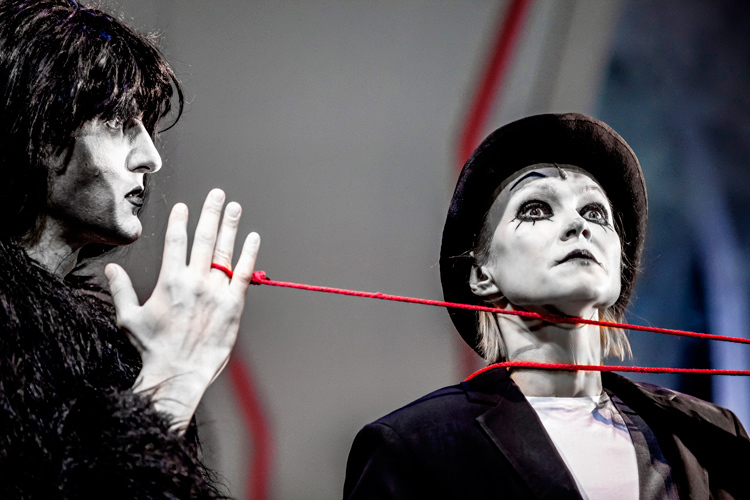
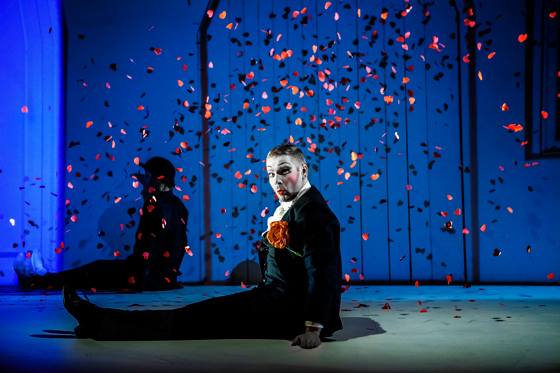
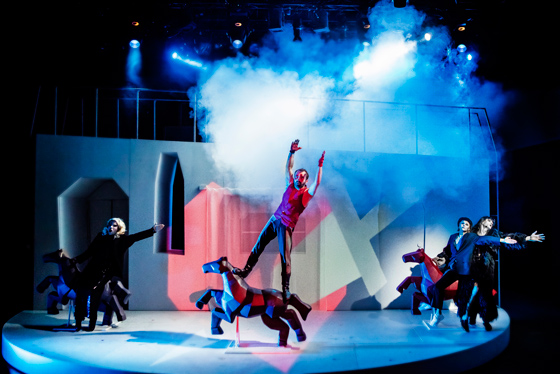
A large Russian novel is not the most obvious material for the nations of the St. Petersburg director Maxim Didenko debuting in the theater. Starting with Anton Adasinsky in Derevo , he inherits the traditions of the pre- and post-perepretting St. Petersburg underground, at the same time quite consistently swearing allegiance to the ideals of the Russian avant-garde of the twentieth century. Last season, Didenko staged performances on the verses of Daniil Harms ( Harms. Myr in Gogol Center) and the Monthly film by Alexander Dovzhenko (“Earth” on the new stage of the Alexandrinsky Theater)-in this series Dostoevsky looks like a stranger, which, however, does not prevent the director from putting an “idiot” in an organic genre of clowning for himself. Or the “clowning noir”, as Diedko himself clarifies the genre specification. The artists wear circus makeup, sometimes put on masks - by the way, witty and completely self -sufficient - and jump on toy horses: the director’s prosaic carriage preferred the poetic Gogol’s three. Habitually attentive to the capabilities of the body, Didenko refuses words, retaining only a few monologues, and replaces “psychology” with plastic sketches.
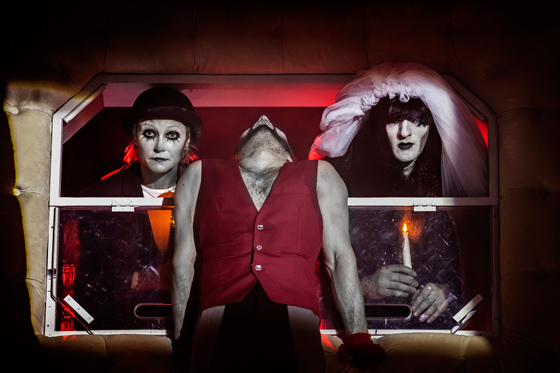
The game nature of the performance can be judged by the one who performs it. There are only four artists on the stage, among them are an experienced actress-star and three young actors: go play the “idiot” in this composition. It is necessary, however, to clarify that the main male role is being understood, and its young colleagues are both female, and, in fact, male. In the surroundings of Pantomima Myshkin Ingeborg Dapkunaite looks like a more complex modification of the vulnerable and shy Pierrot. For Harlequin, Didenko, as you might guess, Rogozhin, in the image of which Evgeny Tkachuk and Alexander Yakin alternately act, the tragifarsal female characters are divided - Nastasya Filippovna (Roman Chaliapin) and Aglaya (Pavel Chinarev / Artem Tulchinsky), they are reincarnated into episodic characters - Ippolita, Ganya, Ganya, Ganya Evgenia Pavlovich.
 © Theater of Nations
The game, formal theater of Didenko enriches with digital technologies, DJing-Art: the electronic soundtrack for the “Idiot” was written by the permanent co-author of the director Ivan Kushnir , the computer animation was created by the Ahe Ilya Starilov, who collaborated with the Russian engineering theater. The artist immerses Dostoevsky’s heroes in the cartoon world - as naive as frightening. The scenography of Achaez Pavel Semchenko works like a screen: here they replace each other schematically drawn backs - a house, road, forest, mountains, a flock is circulating over Nastasya Filippovo, and an insect -like monster breaks into reality.
A video row on the episode is especially effective, where the prince visits Rogozhin in the house on Gorokhova. In the program, the director writes about “an important, but for some reason, an insufficiently investigated leitmotif of the novel”-about Parfen's gaze pursuing Myshkin. This detail Didenko emphasizes the deliberately illustrative technique: the floor and walls of the gloomy merchant house are dotted with his eyes, like the body of the giant Argus. The next picture continues the plot with surveillance: we see heroes in the portrait gallery, under the supervision of the dead - native Rogozhin. Suddenly, the space is transformed: now this is the desert under the scorching sun, which is crossed by a person bent under the weight of the cross - and here the viewer must remember that the Partin’s house has a copy of the famous work of Hans Golbein “The Dead Christ in the Tomb”.
 © Theater of Nations
The most controversial moment of the performance is a meaning not related to the main action of a monologue about Russian liberalism, which boils down to a well-known thesis that liberals do not hate a regime, but Russia. “In order to evaluate all his irony,” the director notes everything in the same program, “we must understand that Evgeny Pavlovich Radomsky pronounces it in the novel.” It can be argued to him that for Dostoevsky, Evgeny Pavlovich, with all his frivolity, is still prettier than liberals, but at least Didenko made it clear that the character’s words were not related to his own position. The gullible audience, meanwhile, are still: at my show, the actor was escorted with applause. A ambiguous hint of a political agenda was also in a recent performance by Dovzhenko’s film, but if the director is misleading the “soils” in the “Idiot”, then in the “earth” he was able to deceive the expectations of liberals: one of the heroes makes a speech against “Great Russian chauvinism”-everything would be fine if the author of this text was not a certain Ulyanov-Lenin. Sometimes it seems that Sidenko is only occupied by the issues of aesthetics, but he has potential and ambition for the political theater: he knows how to separate and provoke the hall.
 © Theater of Nations
Nearest shows of the performance - January 17 and 18