
Translated material
Summer minutes of the structure

The summer is over. It was marked by many events, the hum of which subsides a little by September, by the beginning of the new exhibition and educational season. Initially, I intended to write reviews of projects that opened as part of the youth, but the internal critic suggested that something more, something structural should be hidden behind a simple enumeration and description of the exhibitions. It is necessary to look at summer projects not in the field of contemporary art, but a little wider. Is it possible to describe and summarize the experience of all these exhibitions, lectures, summer schools and festivals?
The key to this understanding can be the Moscow International Biennale of young art and its results, which have already received a critical assessment, but have not led to theoretical conclusions. In general, I agree with the position of Viktor Misiano : it is stupid to evaluate the events of all institutions in the city through the prism of Biennale - this is a provincial view. However, this Biennale has become so symptomatic for me that, apparently, I was able to say much more about today's position than it expected. What did we see? I believe that it was a very sealed, closed project. In a sense, he turned out to be the complete methodological opposite of last year's Moscow “adult” exhibition , where there were “event”, performances and the position of the viewer, never capturing an integral picture. You always got only to part of the project in time. This year, the opposite is true: an object exhibition, narcissistic themes, a triumph of metaposition and melancholic all -legged.
Nadim Samman introduced what really for a long time walking a ghost in the world - nihilism, which becomes intellectual fashion and artistic strategy.
Sometimes there was a feeling that the viewer did not need this art at all, he was, as it were, rejected in advance. This was criticized - there is no context, there is no look at the local situation. Only it seems to me that this statement is an important step in recognition of today's position. Nadim Samman introduced what really for a long time walking a ghost in the world - nihilism, which becomes intellectual fashion and artistic strategy. If the previous project Elliotta still tried to instill hope and faith in the prospects, then the exposition of this summer was more likely like the track “Black Siemens” Pharaoh . But only after such an exhibition generalization of these ideas can we thematize the essence of this attitude. What does it consist of and how visually settles in art?
Magic against politics
Among other things, Graham Harman came. In an interview with Anastasia Shavlokhova and Andrei Shental, they ask one of the most common questions to the creator of object -oriented ontology: is his version of mystical LLC? He denies this accusation, while rather strangely defining mysticism as a faith in direct access to reality. I would rather describe objectively oriented philosophy as magic. Magic is a special nature of the relationship between objects, built not on a scientifically understood causality, but on the coincidence and derive of patterns from the coincidence. This was clearly disassembled in the work of Abi Warburg, dedicated to the snake ritual. He shows how people believe in the connection of different objects such as a natural phenomenon and a snake, using it in rituals. The snake becomes Aikon, a link between heaven and earth. People believe that the snake will cause some effects that it is somehow connected with the weather or will of the gods. If you bring such logic to the limit, we will get a very characteristic modern “horizontal” thinking that does not build a connection in the hierarchy - for it all connections are equivalent.
In the book of Timothy Morton “Realist Magic: Objects, Ontology, Causaly” this position takes on the final theoretical articulation. In the art field, critic Sukhail Malik calls this anarcho-realism. He claims that art is the power of free horizontal binding, in which objects, discourses, people, and space participate on equal terms. We find ourselves in a field where everything is possible, nothing is excluded, but nothing can happen, because all connections are virtual. As in Facebook, which filters your access to information until you find yourself in a non -conflict sterile field of like -minded people, contemporary art becomes a screen for playing virtual conflicts and pseudo -produces. Objectly oriented ontology occupies an important role in this movement. In my opinion, it is the main ideology and rhetoric of neoliberalism. Indeed, neoliberalism was interpreted economically, sociologically, but until recently he had no his own ontology, a way of describing the world. LLC has become such a description. If we look at the origins of the Harman system, we will see among the most important authors of the philosopher Nicolas Malbransh , who formulated the so -called occasionalism. His thought is built on the statement that a direct connection between things is impossible, but nevertheless the world is connected thanks to God. Thus, the connections between things are explained arbitrarily, and the difference between the phenomena disappears. In the book “Political Romanticism”, Karl Schmitt considers the ideas of Malbrand as the basis of political romanticism. For him, romanticism is “subjectivated occasionalism, since it is characterized by an occasional attitude to the world, but instead of God a romantic subject occupies a central place and makes only a reason from the world and everything in it” [1] . The romantic always does not act seriously, its constructions and mental experiences are nothing more than literary arbitrariness, which means that its art is not access to reality, but is a kind of dream in reality. Harman and Timothy Morton go further, their occasionalism rotates not around the subject, but around the objects. It is they who turn out to be the sources of “will to communicate”, but this connection is always virtual.
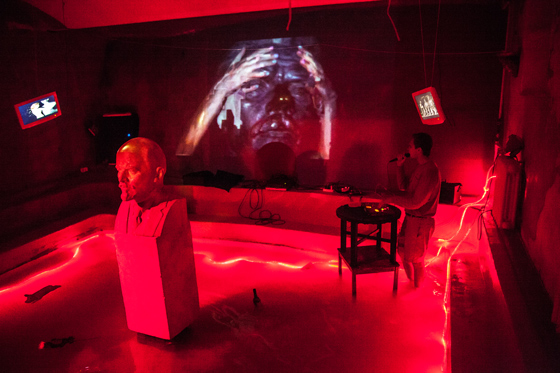 © Maria Shimchuk Maria Shimchuk. Erotic vandalism. 2016
How to demonstrate this on specific material and how to realize it in the field of art? I would like to turn to the project of Maria Shimchuk “Erotic vandalism” ( 1 , 2 ), which was held in the Palace of Plutus “Petlyura” in the very middle of summer. She submitted the documentation of erotic acts with monuments to Lenin during the disconnection of electricity in Ukraine. This political icon -viability is extremely important in understanding what the policy for contemporary art seems to be (or for some of its flank). Lenin, a figure that has made irreversible revolutionary changes, is immersed in a mythological field, finding himself in a source of desire. “I wanted to somehow revive the monuments and not leave without love, because they are often outside the field of our vision, including sexual,” says the artist. “These monuments are so beautiful that you forget about everything in the world.” Lenin falls and stand - almost like a crop, cyclic changes in seasons. The artist fucks Lenin at night, suspending the usual order of the world. Politics suddenly begins to read magically, moreover gloomy.
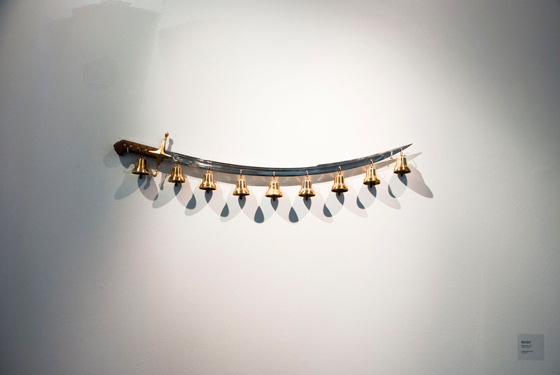 © Arundart.org / Olga Danilkina Denis Stroyev. Ass. 2013
Another similar exhibition is “Heliogabal” by Alexander Plusnin in the Pop/OFF/Art gallery. A direct reference to the feasts of this strange emperor again rehabilitates mythology in the field of contemporary art. The exhibition, in fact, is very similar to the main project of the youth Biennale in its mood, raises the question of the magical joint of objects. This is most pronounced in the works of Denis Stroyev, who gives the ligaments of objects with strange eroticism: his “asshole” could become the understanding of the very “magic” in art, which we constantly hear from the lips of Morton. Unlike Sarah, Lucas, which illustrates sexuality with objects, Denis Straev always suggests that sexuality actually always belongs to the objects themselves, is born in their connections. The same erotic was his weight in oil. His works come to life at the expense of eroticism emanating not from a person, but from the things themselves. What is magic? This is a kind of “reverse fetishism” when you suddenly discover the erotic will of objects, whether it be a monument to Lenin or a weight in oil. In modern capitalism, you do not want things, but things want you. You move in the field of their desire, not your own action. This is a fundamentally important fact. In the exhibition of Plusnin, the connection between the works is the same: they are sleeping pills, as it were, they can be continued endlessly-and this is the main definition of the same anarcho-realism. Facts and realities are just an occasion for liberated joint. If all objects are equal to each other, then the field is homogeneous and can expand endlessly. There is a feeling of lack of resistance that discourses and things themselves are ready to dance in a fit of free associations.
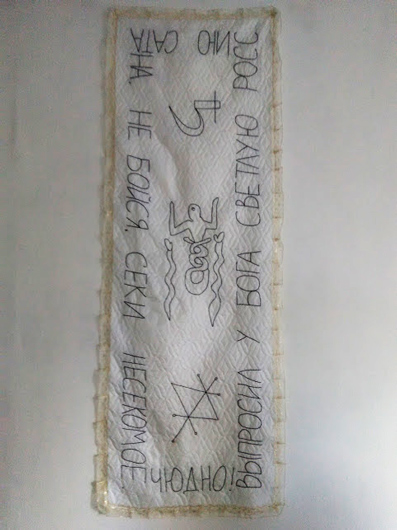 © colta.ru Irina Petrakova. Explain this dark. 2016. Fragment of the exposition
In addition to obvious dark mythologicalness, Shimchuk and Plusnin, we must also remember sects. The summer project of Irina Petrakova, Mikhail Klimin and Dmitry Skopintsev “Explain this dark” builds assembly of references about sects and their rituals to the biographical story about the artist’s grandmother. On the projection, she says something about God, the narrative is interrupted by the essay about Russian expanses and Dalya, suddenly returning to the soul-saving dialogues. Mikhail Klimin distributed a sectarian brochure at the exhibition, parodying the usual booklets with their speeches and revolutions. The space itself resembled either a total hut, or a wooden temple. At the opening of the girl, a Tverk danced, which, according to the curators, is a modern version of the devilry and paganism under the larva of the trip .
The exhibition of the beginning of autumn from Sonya Rumyantseva and Pavel Gladkov (also in the center of Red ) also reproduces the gloomy and auratic space. By the way, it is called Macbeth . The main problem of such exhibitions is that any connections between discourse and objects are almost arbitrary and very artificial. They do not try to analyze the context to change it - on the contrary, they declare freedom to list and insist on horizontals nihilistically. As a retreat, it must be said that my bomb exhibition was like romanticism and expressed the same problems as Heliogabal or the Petrakova project. At that time, I was fascinated by the fact that today, it seems to me, it needs an mediating sense. Exhibitions of summer are very close to me, they are flesh from the flesh associated with my own nihilism, but this is exactly what needs to be overcome.
If magic is built on arbitrary relations, then politics is on the connections of exceptional, contextual and necessary.
The exhibition "Fresh Blood" (curator of Antonina Baver) offered the same romantic cargo in his youth and Rave, using the same principle of objectivity. In this exhibition, however, unlike others, there was a slightly more forced phenomenology: our “narcotic”, very fresh chicken sensation when “covers” when it smokes when it sprouts. The rave should not be torn off from magical discourse, from merging with nature through technology. The rave, like Black-Metal, the culture of the late 1980s-early 1990s, is electronic paganism, a forest shelter in the middle of the city. However, do not think that Russian art suddenly became pagan. This world art has become pagan. For example, here is the recent project “Neo-Pagan-bitch-witch!” , but a critical article that comprehensions of witchcraft .
 © Gallery "Triumph" Antonina Baver. Cover. 2016
I propose an alternative to magic in what can be called "politics." If magic is built on arbitrary relations, then politics is on the connections of exceptional, contextual and necessary. For me, an important exponent of political connection in art is Joseph Koshut in his manifesto "Art after philosophy." He says that in any period of art you can leave one work. He imagines the field of art not as an arbitrary language, but as a necessary action . This gesture has important distinctive features. He risks not to be realized, and if it is carried out, he is irreversible. If magic and political romanticism are a field without resistance, arbitrary speaking, then politics is not always realized, it is resisted, and it cannot be canceled. In this sense, Duchan is fully political, since he imagined art as a field of conflict, where there is a limited amount of necessary gestures (which is why he did not produce radi-maids, but insisted on their exhaustion). What exhibitions today they implement this direction - I do not know. I will leave this question open, because the answer to it depends on collective efforts and constant analysis. But back to sects, witchcraft and magic. The proposed opposition of magic and politics does not exhaust what is happening. There is another structural issue.
Sentimentalism and romanticism
The Petrakova exhibition and the baver is also the thesis about the construction of the community. The rave, like the sect, is not building a political community, but an irrational one associated with the theme of faith or ritual. Nevertheless, this community keeps afloat, showing an important example of political theology: even if there is no magic, it works. Even if there is no God, he applies things (like Malbrand). In addition to political romanticism, contemporary art also has collectiveness, which is aggravated in the face of institutional adversity. Petrakova rightly believes that contemporary art in Moscow is also a sect. Agree, to be an artist today means sharing common affiliation with his friends, reproducing hope for utopia or unification, even if Darkovoye and carbon monoxide.
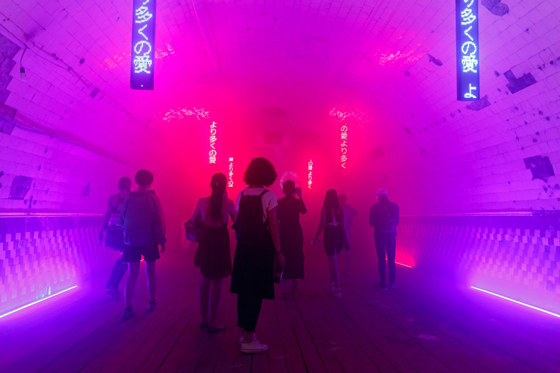 © Gallery "Triumph" Kira Borisova and Vitya Eroshenko. Russian rave. 2016
In the book “The appearance of the Hero”, Andrei Zorin, analyzing the context of Russian sentimentalism, suggests that this direction expressed the emotional culture of the nobles who are fleeing the arbitrariness of the monarch in the zone, where they could count on honest emotions and “genuine” relations. By this, Zorin explains the popularity of Freemasonry. Contemporary art, preoccupied with “friendship”, also turns out to be a refuge, where faith in genuine groups remains. One way or another, the rhetoric of all actors of contemporary art is still being built on this. In this regard, the theme of the summer “arches” - “refuge” is indicative. It is contemporary art in Russia that is a special refuge where you can come and find peace and peace. Retire from problems. The essence of sentimentalism lies in a special emotional community that contrasts itself with official culture.
For example, the Psycho project Ilmira of the Bamps at the Factory was an archive of diaries, personal experiences, which people can freely share, building new trust ties. Her exhibition is a place where you could finally tell everything. In the same system of sentimentalism, the “Marathon of recognition” of the Union recovering (at the exhibition “On the Web of the Form” at the Krasny Center, the curator Maria Kalinina. - Ed .) They are trying to provide a platform for all -consuming, where there is almost no hidden. In fact, the intentions of the union are good - to give people the opportunity to express their feelings. However, this is always associated with a number of problems, the most important of which, as shown in the Book of Zorin, is the question of its own compliance with the “level of sensuality” asked in the community. In the end, the sentimental hero closes into reflection: does he express himself enough and does he hide his feelings from “friends”? In this regard, the heroes of the films of Gorilshchikov express this ultimate paradox of sentimentality.
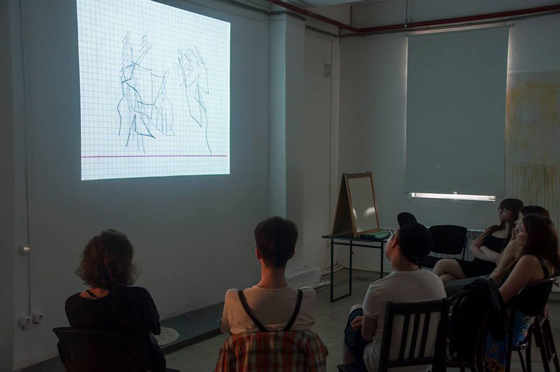 © Elena Sedova Master class Jan Tamkovich “Automatic drawing session. Ginzburg medium at the exhibition "On the Web of Forms" in the Krasny Center. 2016
 Having broken through this circle from the adequate of feelings, loners that have opened the falsity of such sentimentalism become “heroes”, leaving this island in favor of a radical refusal. Such figures are today interested in Jan Tamkovich, who introduces us to the practices of Joseph Ginzburg , the most radical of loners. The romantic artist is interesting again. He shows how to survive, having lost faith in the communities. Both sentimentalism and romanticism put before us a similar spectrum of political problems, which, perhaps, was best formulated by Khrogoff: art becomes an outcome, where you can afford the deepest dream [II] . The urgent question is whether we can make art differently, without regard to our fear of life, without faith in a happy community given to us too much and as if on credit, virtually. I think this summer in Moscow took a huge step towards recognizing the true state of things. In my opinion, it is that we saw in the game of the Russian national football team. Everyone said that we have a team, there is football, “professionals” are working on this issue. But then the team played as it played. The contemporary art is almost the same problem: everyone pretends that there is a process, that everyone works, experts write and make ratings that exalt artists. Бюджетов нет, но все до сих пор делают выставки с объектами, пытаются красиво, побогаче, монтировать. И все эти силы брошены на поддержание магических связей и сентиментальности. Это воспроизводит нашу тусовку, чтобы давать нам убежище, которое рушится, как надежды болельщиков сборной. Когда все смотрели те самые заветные матчи, оказалось, что мы стоим посреди голого поля и руин, вскормленные оптимизмом и ложными обещаниями. Во многом это лето показало, что эта система функционирует довольно сложно: за счет выставок, риторики ООО, постоянного ложного самопиара и рейтингов, за счет неолиберального самоуспокоения и сентиментализма. В общем, полный Рагнарёк.
[1] Цит. по: Юрлова М. Политический романтизм сто лет спустя: взгляд из прошлого в настоящее // Социологическое обозрение. 2015. Т. 14. № 3.
[2] Rogoff I. et al. Productive anticipation // Cultural politics in a global age: Uncertainty, solidarity and innovation. 2008. С. 346—357.
The heading "prints" is supported by the Fund for Assistance to the Study of Russian Fine Arts "Russian Art The World".