
Translated material
"This is just Oldskul"
Maxim Kovalsky, Demyan Kudryavtsev and others-about the closure of the magazine "Kommersant-Vlast"
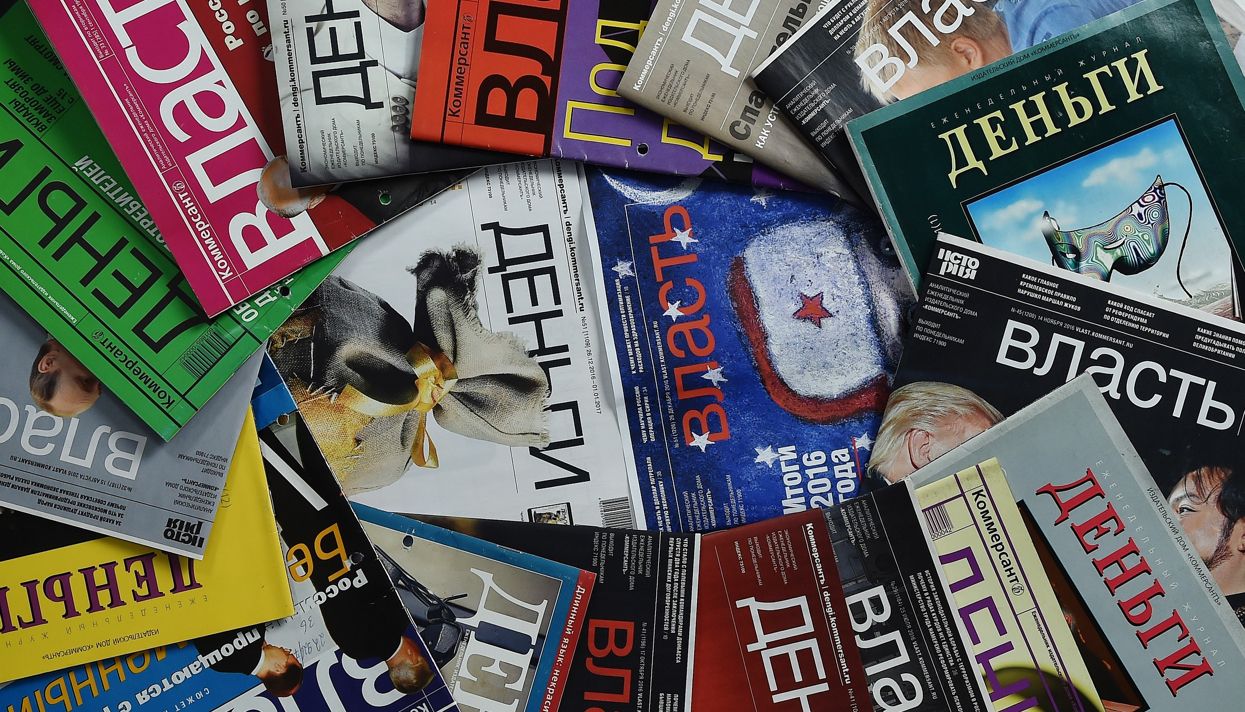
On Monday, January 9, the leadership of the Kommersant publishing house announced that the magazines “Power” and “Money” would cease to be released on paper. The leadership of the ID promised to preserve the teams of publications; Materials will be published on a large (and very difficult organized) website of Kommersant. In the zero "power" was the main socio-political weekly in Russia. The last high -profile event in his story was the dismissal of the editor -in -chief Maxim Kovalsky at the end of 2011: one of the articles of the magazine about the election of deputies of the State Duma was illustrated by a photograph of the ballot ballot with an obscene inscription addressed to Vladimir Putin. The material outraged the owner of Kommersant Alisher Usmanov; Kovalsky left by agreement of the parties. Medusa asked Maxim Kovalsky and other authors of the “authorities”, as well as the former general director of Kommersant, Demyan Kudryavtsev, to tell how the magazine was different from other publications that were published under the Kommersant brand, and why it was closed.
Maxim Kovalsky
The editor-in-chief of Kommersant-Vlast magazine from 1999 to 2011
Due to my personal characteristics, I have not come out anywhere and did not hear any reviews about the magazine at all, so I did not know how it is perceived in the professional community. I followed the numbers and the audience. When I was fired, I first ended up in a restaurant. Each time someone says: “Once the“ power ”was a good magazine,” I am so pleased as I heard it for the first time. The magazine absorbed me entirely.
When I began to make a magazine in 1999, I believed that his biggest problem is that he was considered just an application to the newspaper. I purposefully engaged in the fact that I tried to create an idea of the magazine as something separate. It required great efforts. When Vlad Borodulin was appointed the chief editor [of the Kommersant newspaper] in 2005 - and it became easier to cancel the joint editorial office [of the publishing house]. And before that, the same people wrote to the newspaper and the magazine, and it was hard.
In the creative sense, the best time was the mid-2000s, roughly speaking, the second Putin term. Despite the fact that we wrote about the president and the authorities, the Kremlin for me was the hero of the cartoon, which we created - and I never came across living characters. Sometimes Andrei Vasiliev could tell me that the publication impressed. For example, there was a special nominee about the death of Yeltsin, and Vasiliev said that he really liked him in the Kremlin. However, the Kremlin was not interested in us for a long time.
There were things that I consider brilliant; Some peaks-both in idea and by execution. Suppose several materials from Olga Allenova - both in the Caucasus and in Sochi, at the Olympic construction site. We had a plot about the person who was evicted from the house: Allenova was there on the day when the bulldozer came to tear the house. There was a magnificent literary project [“Kremlin Renania”] - future memories of the Kremlin people. What memoirs will write Vladislav Surkov, Roman Abramovich, Konstantin Ernst and Vasily Yakemenko? They were written by the memoirs of Dunya Smirnov , Oleg Kashin , Stas Belkovsky and Zakhar Prilepin . There was a project “who belongs to Russia” , we made it together with Leonid Parfenov ( at that time - the host of the weekly final program “The Pacific” on NTV - approx. “Medus” ) in parallel - both in the journal and on television; They took the entire Russian economy in the sectors, where are some active individuals; For several months there were both shootings and texts. I know that then often people used it. There were great reference books - “the whole Russian army”, which was made by Sasha Stukalin [and Mikhail Lukin].
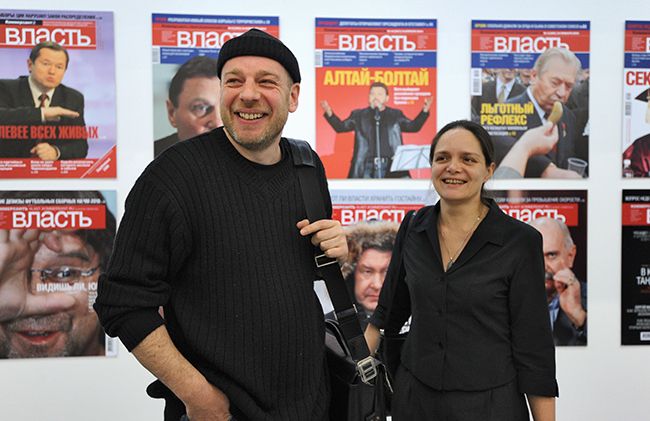
My favorite is the cover. A lot of time was spent on them, and we died with laughter when they came up with. For example, the ingenious cover was [in 2011], when Russia [by decision of President Dmitry Medvedev] abstained from the UN resolution in Libya. Then there was a small conflict between Putin and Medvedev. Putin said: do not do this; And Medvedev said, they say, “there is no need to clap wings on the body”, I decide here. The title was like this: "And not a friend and not an enemy of attacks."
The best covers were with Medvedev. The most ingenious was when Putin still decided who would be [his successor] - [Sergey] Ivanov or Medvedev, and we had to make the cover. And we made a decision: we put Medvedev. And he was still chubby, rather funny. And they put Medvedev with an almost childish chubby face, and Pasha Chernikov came up with a title: “Smooth a package”. And then for four years, Medvedev worked as a smooth pusk. Maybe they were offended, of course - but how do I know?
Can I remember another cover? When Putin and Medvedev at the Congress of United Russia announced the castling, there was such a cover. Medvedev stands with a glass of wine, and the signature: "And immediately dropped out."
“Archive” is a separate beautiful thing. We had an agreement with the author Evgeny Zhirnov - we never make material without new documents. It has always been exclusive. 12 years, once a week - a mandatory exclusive. And Zhirnov maintained this rhythm.
The most time -consuming section for me in the magazine was about the news of the past week. I wanted to give her a new meaning. I developed the form for four years. Then he even wrote a text on 20 pages for domestic consumption - about how to make news in a weekly edition.
Now I have no emotions. Not a single one. And this is not a political answer, it is literally so. For me now this publication, whose name coincides with the name of the publication that I made. I don't even know what is his essence. And after all, this [closing the paper version] is not a sudden solution, talking about this for a long time. This is not a thunder among the clear sky.
Before the Internet, the scheme was: the newspaper - news, weekly - analytics. And on television the same way. The Internet has broken this structure. Now the news is the Internet, and the daily newspaper should inevitably become more analytical.
Alexander Gabuev
The head of the program "Russia in the Asia-Pacific region" of the Moscow Center of Carnegie, the former deputy chief editor of Kommersant-Vlast
For the past few years, the magazine "Power" in the Kommersant Publishing House has been the only platform for long analytics on political and social topics. The main longings were there, since many materials simply were not placed in the format or size in the daily newspaper, where each injecting should begin with the words "yesterday" or "as it became known to Kommersant."
The format [magazine] made it possible to make long stories that are not tied to the events of the week. You can recall, for example, the cycle of Olesya Gerasimenko about regional separatism in Russia, which she did in 2012-2013 - then he came out with a book; Or the cycle of Olga Allenova about orphan institutions.
It is clear that the paper as a carrier is slowly dying, people read the analyst more and more on sites. I hope that Kommersant will figure out how to transfer the unique content of “authorities” and “money” to DJed.
Olga Allenova
Special correspondent for ID "Kommersant"
Large investigations, large texts with several stories could only be done in the journal, because such materials require the appropriate format. The "authorities" had a wide audience-for example, they wrote to me from some distant villages or from prisons. It is clear that there is no Internet in prisons, but there are magazines in libraries. Now these people will remain without access to the "power".
Another category of readers that will lose the magazine is officials. The materials that I wrote to “Power” always had a response on their part, and much more than the materials published on other sites of the publishing house - or in other media. The magazine "Power" is a short path from a common person whose problems I talk to high -ranking officials who should find out about them. For me, the current situation is a big drama, I do not understand how to find this path in a different format. I am sure that officials will not look for the magazine "Power" somewhere on the Kommersant website; These are people to whom the secretaries put the press on the table.
Of course, we knew that the leadership was thinking about the termination of the release of the printed version. As far as I know, the "power" was not unprofitable, but it did not bring profit either. I am afraid that after some time “power” and “money” will not at all, they will merge with the Kommersant website, and we will lose these brands. Perhaps I'm not right; The leadership said that the reporters of the “authorities” do not need to change anything in work, and they will find a new format for them.
Grigory Tumanov
GQ editor, former special correspondent of Kommersant ID
I read “power” both under Maxim Kovalsky and after him. Being a young employee of Gazeta.ru, I looked at the magazine as a place of work of unattainable heights - and suggested that terribly cool people work there.
Under Kovalsky, the magazine had a certain main idea. There were awards of the week, quotes of the week, the same Evgeny Zhirnov with the "Archive". But then [after Kovalsky’s departure], the main idea disappeared somewhere. Was a weekly, but what? It seems about the authorities, like about society. The magazine is about everything, but not a “light” who is trying to speak in a more folk language. “Power” was a paradoxical phenomenon in the Kommersant Publishing House, this is why: no one fully understood how correctly, why and why - and how it should be interesting to the reader. At some point, I opened the magazine on the plane-and despite the fact that there is still high quality, because it is a “businessman”, I saw blind pages filled with dry facts. There was an academic magazine in places, but it seems not. Something about reading, but it seems, too.
Until recently, the magazine moved by inertia. I wrote there with great pleasure, because a bunch of large texts could be brought to the magazine; True, we did not always coincide with the concept. It happens that you write a text that seems to fit - but it does not go. Not that censorship, but different visions.
Recently, the “power” has been a clear reflection of Azer Mursaliev as the editor -in -chief. Azer is a man of gigantic knowledge of international and domestic policy, he is an expert, but rather academic. It happened that the flyers with him dragged on for many hours. When someone brought his story, Azer began to supplement it with his knowledge of the subject. With him it was a smart magazine, but it was a magazine that is difficult to read to an unprepared person. It was a collection of good complex texts, such a thin brochure, but everything was irregular and uneven. At some point, it was necessary to stop and just think over more, how to distribute the headings, texts.
I must say that the magazine always persecuted the quality in the old -fashioned sense of the word. This is just Oldskul. But the consumption of information has changed in recent years. I do not really imagine how many people who are devoted to paper "power" are in Russia. I do not really understand the economic model. As it turned out, the “power” was more expensive to print than not to print. The feeling that something should happen was not the first year, but everyone has always reassured themselves that the paper “power” was an important image fetish of a publishing house. However, in 2017, all this is no longer important.
Demyan Kudryavtsev
The owner of the newspaper Vedomosti, General Director of Kommersant from 2006 to 2012
The magazine "Power" was arrived when everything was relatively profitable, in the well-fed years between 2000 and 2008. After the financial crisis, in which advertisers - and readers - re -overestimated their needs and tools that the market offered to them, the Internet began to take budgets from the printed press.
The point is not specifically in the format of weekly, the fact is how their niche corresponded to time and needs. With the "power" there was an obvious problem. This magazine is not massive, from which the Internet began to take the “speed of reaction” to political events. And the total political silence and deafness of the new time began to take from him the “depth” of this reaction. As part of the classical model and standards of “serious” publication, it became difficult to write about politics - there are no sources, there are no evidence of documents, the society is skewed, alone to maintain balance and not slide in the other direction, which scares advertisers, in particular, it was difficult.
“Power” introduced new headings and genres, but not one of them was close to the real life of its reader, was or did not seem to the advertiser a “useful reader”. Unfortunately, with this edition - and with those who were forced to change it, this mood could not be changed. The magazine drifted between the political satire and the diary of picket vests - but so far there was money for the press on the market, it worked, and when they disappeared, it was easier to decide that changes in content would not save the publication.
Of course, these reasons are not the only ones and, perhaps, not the most important, because the magazine “Money” is also closed, but it was not just arrived in good years, but very profitable, and was relatively arrived at the beginning of the skinny years. And this did not save him, because he also had to re -make that the editorial office could not do without update, but they update it forced to do this that this cannot be done.
Despite the fact that Kommersant has examples of such a re -thinking and update. In particular, the “light”, which no longer went out when the “Kommersant” picked it up, is now very slowly, but correctly becomes breakers. The “light” is also an important example that the update does not always come with the editor’s change and does not always come from the editor at all, although his role is certainly important - but it is clear that the dying and reviving “light” was mainly the creation of Viktor Loshak. Thus, we understand that renewal and salvation can not go from the editor, but from the managerial side. Sometimes there is enough change of format, price, design, distribution systems, so that the content of the publication is rebuilt and it becomes in demand. But with the "power" it was not possible to do this. Nobody succeeded.
In the case of “money” and “power” the reason for the death of a total: the conservatism of the old teams, the weakness of the new, the destruction of distribution schemes, the high cost of printing with a high currency component, the onset of the Internet in these niches. The company's management arrived correctly, although it is sad that everything is so.
And between the “power”, which is now, and the one that was, I do not see a fundamental difference. Kovalsky’s “power” was more important, more secret, but it also did not correspond to the time-as a publishing product-from 2005, approximately.
It’s not sad to anyone that the paper edition is closed, it is sad that this intonation, these topics, these reader needs and relations with the publication did not find an adequate analogue that would correspond to time. Despite the fact that different publishing houses had such attempts, and sometimes they were interesting. But the Kommersant has done much more, I believe in the success of my friends and colleagues, if they - if they all do not interfere with us.
Recorded Ilya Zhegulev and Evgeny Berg