
Translated material
The choir is fine
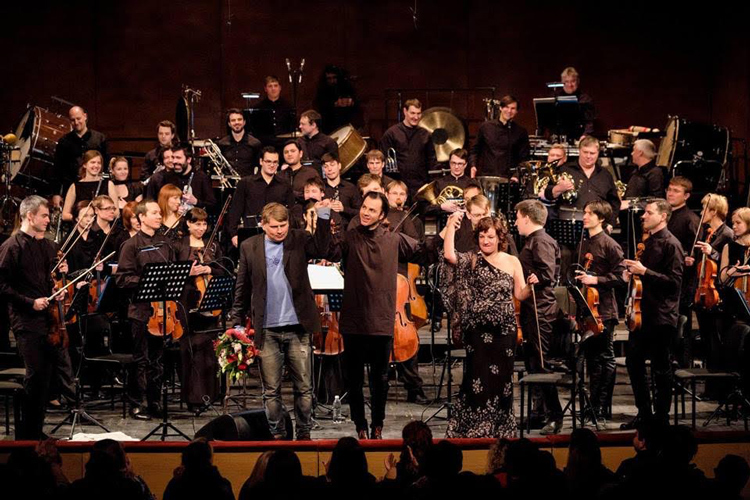
In a small interval between the competitive shows of the “Travials” on the “Golden Mask” and the preparation of the premiere of the “ Wedding ” Ana Sokolovich - Anton of Adasinsky Theodore Krentzis managed to carry out a very important concert in Perm - which passed away from the festival of the festival and media hype, but in the atmosphere of concentrated hard work on both sides of the ramp, it became ultimately One of the obvious climaxes of the Russian music season 2016/2017.
Kurentzis built a witty program on the traverse of a traditional Philharmonic matrix: instead of overture- “Komm, Jesu, Komm” of Bach, instead of a classic-romantic concert- “Cloud Ground” by Sergey Nevsky , instead of the symphony- “Coro” Luchano Berio. Three compositions - three compositions of musicians - two long rearrangements on the stage: in addition to purely production necessity in these pauses, it was difficult not to notice the desire to give the public time not only to recover after immersion in diametrically opposite acoustic worlds, but also to reflect their sum and difference.
 © Anton Zavyalov
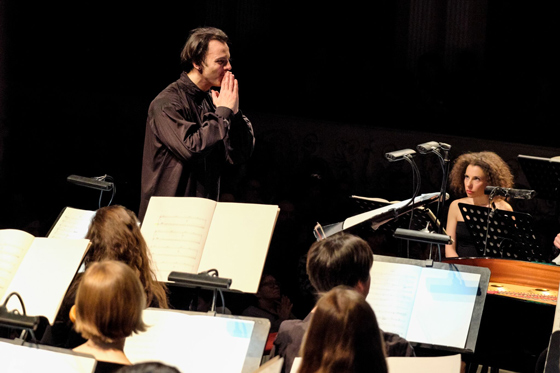
Formally, the role of Main Course was assigned to the Russian premiere “Coro” , although, in essence, each of the program numbers, including the eight -minute Bachsky motate, could apply for the status of the central event of the concert: Theodore Kurentsis is too rarely played by the music of the Leipzig Cantor. It was a very unusual bang - Protestant severity was completely dissolved in the playful baroque dance - after which it would be very curious to hear the twice planned Musicaeterna and both times canceled the “Passion in Matthew”. It was not long to wait: the Bakhovsky Passion appears in the next joint plans of Kurentsis and the Sony Classical label.
“Berio is known only to professionals. There were no noticeable attempts to organize the execution of its large opuses. To imagine for someone to cope with the grandiose polyetonic “Coro” is decisively impossible. Thus, we are unknown to the standard, in comparison with which most of the modern World Music is only a conceptual repetition, ”Pospelov wrote in 1995 in 1995. The situation described 22 years ago began to change only this season: last November, Vladimir Yurovsky was the first in Russia to play the legendary symphony (1969), now Theodore Krentzis introduced the multiculturalist “Coro” (1974-1976) into the domestic concert everyday life. It’s better late than never: a lot of new music grew from the epic hourly score later, and Berio’s ideas were adopted by a host of authors, including from the late USSR.
 © Anton Zavyalov
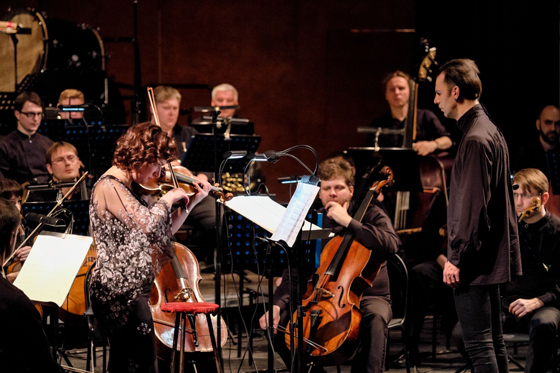
The main character of this impressive act of restoration of artistic justice predictably became the Musicaeterna choir: instead of protecting his angel voices for Persell and Mozart, Vitaly Polonsky’s wards with Samurai fearless rushed into attack, not sparing neither ligaments nor a diaphragm. In the spring, Musicaeterna will repeat this hourly battle scene in Munich, Cologne and Hamburg, this time together with the legendary Malera Chamber Orchestra. Krentzis and comrades continue to consistently fight the Western stereotypes in the perception of Russian musicians: a choir from Perm, bringing the classics of the second wave of avant -garde to Germany - a repertoire proposal is even more unexpected than the notorious Ural Mozart.
Against the backdrop of the performance of “Coro”, the second premiere of the evening was not lost - written for one of the best Russian violins of Elena Revich “Cloud Graud ”. The co -products of the Perm opera and the status festival Eclat - in a certain sense, is also a quite historical event: academic music is created mainly in the calculation of ensemble compositions to write for a large orchestra, we need orders, and they are the same Vladimir Yurovsky and the Yekaterinburg festival “Eurasia” - no one in recent years has not been especially striving to initiate.
Krentzis played Nevsky as a living classic.
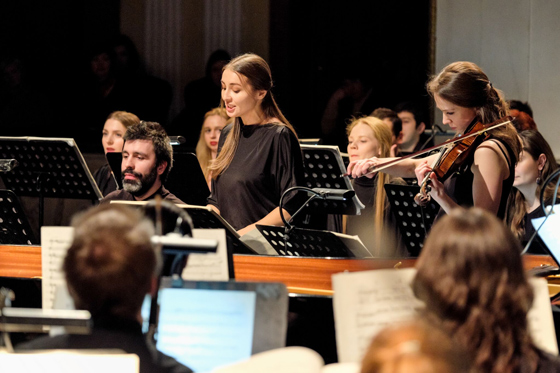
Listening to the lace dressing “Cloud Ground” , it is difficult to believe that this is the first symphonic composition of Sergei Nevsky. The composer works here as an architect who rethinks in a modern context a traditional form-not only an instrumental concert, but also a one-parted structure characteristic of the era of romanticism, the internal division of which corresponds to the four parts of the sonata-symphonic cycle. The entire genetic memory of the genre is loaded into the cloud storage of the Nevsky score-to observe how the “Cloud Ground” modernist facade gradually appears the usual relief with orchestral lyrical digressions, dashing solo tricks and kunstuki, purely baroque cuts and desperate, as if borrowed from some kind of mid-middle concert XIX century cadence. This mutual attraction and repulsion of the canon and heuristics is very accurately felt by Elena Revich, who actualizes in its interpretation all the Cloud Ground hyperlinks.
 © Anton Zavyalov
The Russian premiere of “Cloud Gran” is generally the rare case in modern academic music when not only the score itself deserves a detailed conversation, but also its execution. The interpretation of the cientsis is not interesting to the jewelry technique of the Musicaeterna orchestra - they have already managed to accustom this in Perm - but an unexpected systematic approach. When the Greek maestro executes the repertoire of two- and three hundred years ago, from it you are already habitually waiting for the imperious appropriation, overrunction . The paradox is that with music written in the year before last, he addresses exactly the same-in his own way placing accents, rebuilding paradoxical dynamic balances, juggling with sound plans. From the world premiere held in Stuttgart, the music specialist Emilio Pomariko , which sounded in Perm, differs quite radically: Krentzis played Nevsky as a living classic - and listening to his breath, and then the audience that erupted with a standing ovation, it seems, understood and appreciated.