
Translated material
The government against the presidential administration, new problems of Turkey, and why there is no Apple and Amazon in Europe
A week ago, the government called for a business to come to terms with the seizure of superpituals according to the plan of Andrei Belousov. But in a week everything has changed. Details - in the evening newsletter The Bell
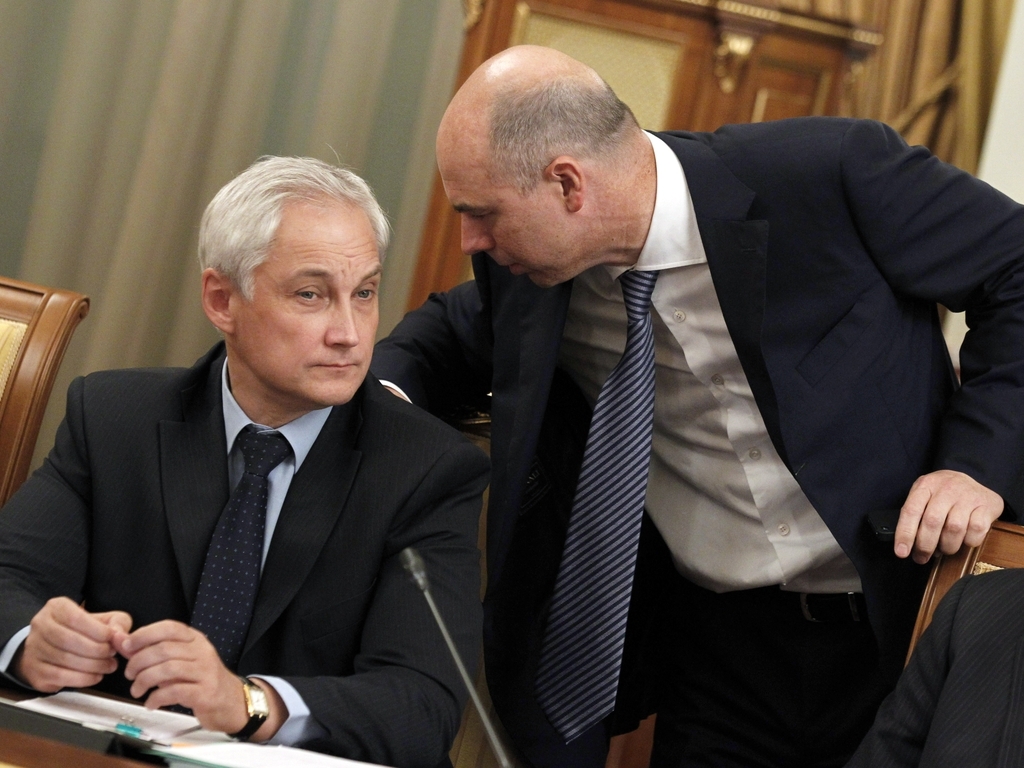
Andrei Belousov (left) and Anton Siluanov parted in the views on super -profits of the business. Photo: kremlin.ru
The intermediate result of the scandalous proposal of the assistant to President Andrei Belousov to remove 500 billion profit from large companies was the first public confrontation between the economic bloc of the government and the presidential administration. Today, the Ministry of Economic Bloc presented their reviews for the proposal of Belousov - at least four out of five specialized departments, led by the Ministry of Finance, spoke negatively. Belousov, nevertheless, invited the chapters of 14 companies mentioned on his list to discuss the seizure of over the superior to exposure.
- The overall position of the government should be represented by the Ministry of Finance; He collects reviews from other relevant ministries. At least three of them - the Ministry of Economic Development, the Ministry of Industry and Trade and the Ministry of Natural Resources sent negative reviews, RBC found out. The Ministry of Finance, according to the publication, also prepares a letter with a negative review. The Ministry of Energy in its recall “supported the petrochemists,” federal official told Vedomosti.
- The letters of the ministries outlive numerous negative consequences of the seizure of the profit of metallurgists and chemists - the reduction of investment programs and personnel, the loss of foreign markets, a decrease in GDP and the “undermining of the principle of stability and predictability of fiscal conditions”. Another argument of officials is to withdraw profit from the business for the implementation of the May Decree of Putin to execute the points of the same decree on increasing labor productivity and increasing non -resource non -energy exports.
- During the week, the position of government officials has changed significantly. Last Friday, according to the sources of Interfax, at a meeting in the Ministry of Industry and Trade, representatives of the companies said that the order should be executed, the list can be expanded, and companies can only offer the measures necessary for this.
- Belousov himself is now on vacation, but this did not prevent him from making an appointment with the leaders of 14 companies from the list on August 24. Representatives of the companies are surprised why the meeting is needed after the formation of the government’s position, which the presidential administration refer to the administration of the president to the whole week.
What am I to me?
How the government dispute with Andrei Belousov will end is still incomprehensible, although the ministry peremptory position suggests that something has changed this week. But throughout the fourth period of Vladimir Putin, such contradictions will arise again and again: they are laid down in the very idea of the May decree - an expensive development program in conditions of limited financing and international sanctions.
MONEY
New sanctions are being prepared against Turkey
Only the markets managed to digest the Turkish crisis of the late last week, and the ruble exchange rate to the dollar - more or less stabilized , as a new unpleasant prospect arose before Turkey. Today, US Minister of Finance Stephen Mnuchin said that the United States is already ready to impose new sanctions on Turkey if the country's authorities do not release the American pastor , due to the arrest of which the current conflict began. He did not name the deadlines, noting that this will happen "soon." So, we must prepare for new jumps in developing markets, including Russian. The Turkish government is already preparing for them. In words, it denies any possibility of increasing the key rate, but in reality the local Central Bank quietly began to increase the cost of borrowing for banks, stopping conducting auctions of a weekly repo.
Deripaska in Russian offshore
The first since the 1990s, Russian domestic offshores are ready to accept the first resident-an EN+ Oleg Deripaska, registered in Cyprus, Oleg Deripaska. Following this, the chairman of the Board of Directors EN+ and the author of the Deripaska Layting Plan from the sanctions, Lord Barker, promised to think about transferring to one of the Russian offshore zones and the head+, registered in Jersey. Registration in Russian offshore will give the company tax preferences, the lack of currency control, and also limit access to information about its beneficiaries for all other than Russian regulators and vessels.
Signals
Anna Pavlikova and Maria Dubovik were released under house arrest
Dorogomilovsky Court of Moscow released two accused in the case of an extremist organization “New Greatness”, 18-year-old Anna Pavlikova and 19-year-old Maria Dubovik. Their liberation was demanded by the participants of the inconsistent "Mother Mother" who took place on Wednesday in Moscow. Details about the case, which became the most striking example of a police provocation in Russia, you can read here .
PRACTICE
Niches for unicorns
Analysts believe that in the near future there may appear much more unicorns (startups, which, even before the IPO, are estimated at least $ 1 billion) than in all previous years. Where will they appear? About 40% (103 startups) of the current unicorns are concentrated in the five main sectors-data analysis (10), Fintech (31), healthcare (20), software development and Internet services (25), and 17). Most of the unicorns (47%) opens in the United States, they gradually catch up with China (30%).
Problems of European technological startups
Why in Europe there are no technological companies compared in scale to the American Apple, Amazon, Google, Microsoft, Facebook and Chinese Alibaba and Tencent with a capitalization of $ 400 billion to $ 1 trillion? The times of Nokia and Ericsson have already passed, the largest technological companies in Europe today are Swedish Spotify (estimated at $ 34 billion) and German SAP ($ 140 billion). The problem is that some startups (for example, Zalando - “Berlin Amazon”) do not even seek to enter the international market, trying to create a regional analogue of a successful foreign company; It is simply difficult for others to go beyond their country because of cultural, linguistic and legal differences; The growth of startups inhibit unforeseen shocks like Brexit. Because of this, many startups either burn themselves, or they are bought by foreign investors (as in the case of the Dutch booking.com). But it is today that European startups have a chance to get around their competitors, around which loud scandals are recently flared up (such as data leakage with Facebook or Google surveillance ). More details - here (paid in English).
Peter Mironenko