
Translated material
Far to decay
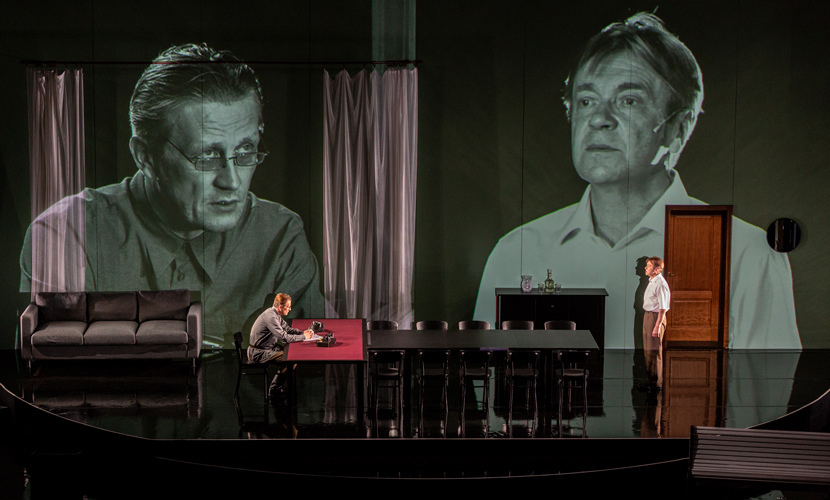
The performance of Bogomolov is fully consistent with the latest trunk trends of the BDT: “bad” text and game over time. Almost every significant performance of the updated theater has implemented at least one of these principles or both together. “What to do” , “drunk” , “pound of meat”, “three fat men” are texts of varying degrees and different nature of stylistic imperfection. Their venerable textbook, quasi-esoteric, parody-philosophical or programmatically deliberate tongue-tied-up (or even direct violation of grammatical norms) relieves the theater from the dictatorship of good taste and honed style (attributes of old-custody bourgeois).
Time as the subject of the theater game is used with more or less ingenuity, this is no longer a new drama, but “New Physics”: the mighty in the “governor” shakes two decisive seconds in the fate of the hero (scarf and shot) in a single moment, but this moment stretches for the whole performance. “Three fat men”, thick every season, turn into a series, inside of which certain tasks are solved with the help of conceptually-grafting monologues and staging voids, the performance everything stretches and stretches, while the main event-the uprising and execution on the star of the star-occurred before the curtain raised. Time stretches and compresses, breaks and stops. Even the uncomplicated “three sisters” hint at something like that, allowing the neighborhood on the stage of young and pretty matured sisters of the Pro-Road, past and future. The BDT is not always with brilliance, but invariably consistently and honestly states: with this time something is wrong. It is not that “it has come into diminution” (although not without that), it really seemed to have worsened and offended, a look, Alice.
Konstantin Bogomolov is habitually radical. If the “bad text” is already the worst. And if time is very special.
 © Stas Levshin / BDT
The play by Victor Gusev “Glory” (1935) is a drama that it was impossible to think about in modern BDT, and even in the modern theater in general. For that, we, one wonders, got rid of the communist ideology, so that one of the main scenes of the country again ("Glory" to go here in the 30th) appeared a condo Soviet play of the most Stalinist style?! Moreover, generously hungry with a “good crafty” and sickeningly -preferential loyal verses. What did they fight for?! One young engineer is eager for a feat, because he is longing for fame, but the wisdom of the Soviet leadership is such that another engineer, a modest and hard worker have been sent to a dangerous business, and a professor of medicine is right there to give his blood to the wounded hero, and the hero of the hero realizes his mistakes and fly (generally realize her mistakes and fly to the hero, and the mother of the hero is already waiting for an exit with a suitable monologue, But the government is nearby, it calls everyone to the table, as it usually enters. “Believe me, Kolya, a lot of mountains / is on the road of socialism. / Stand, conceived too much. / We will explode them, Kolya, to the glory of the Soviets. ” "Our party even raises people on disasters." And, of course, unsurpassed: "Stalin is the son of a working people, / and I am a daughter’s working people." Kolya, do something, in fact, do not pull something.
And after all, it seems that it is still not so bad that these plays are directly forced to accept for the production. Could the director choose this material himself, is it really “he is voluntarily”? It is worth assuming how it turns out immediately that with the play “Glory” - even at the level of the text - everything is not so simple.
In addition to the "roads of socialism" there is, for example, such a passage:
A thunderstorm wandered on the slopes at night,
Overthrowing the cliffs, breaking trees,
The avalanche hung like a cloud, threatening
Hydroelectric power station "First May" .
And so on. And this is not the only place in the play where the traces of the foreign poet Kipling’s foreign poet, of course, of course, are more difficult to find in the USSR, of course, the Kiplin’s translations into Russian. With all their imperial pathos, with harsh romance pioneers, discoverers and soldiers, with gym engineers, taming chaos, fierce rhythm and hypnotizing meter. I want other verses? With ease: Lena’s repentant monologue with the refrain "And I - I doubted his heart!" - This, of course, is an innocent parody of Blokovskoye "how my heart was torn." Viktor Gusev, author of the poetic scenarios “Swinars and Shepherd”, “At six o’clock in the evening after the war”, “Spring in Moscow” (“Nadia Kovrov, honestly ...”), the song “Polyushko-Paul”, etc., was not a great poet, but he had a taste for the word, and he came across good lines.
Even more entertaining with the structure of the play: the initial conflict (a positive moths are in no hurry to a mortal feat, and the mistaken Napoleous lighthouse is in a hurry to glory) is not enough for action, the “Woe-Hero” quickly retires from the game, moving away into reflection. The playwright is in the know: his play was effectively built not as a conflict between a good Soviet guy with a beautiful, but as a phased struggle with three natural elements: a mountain avalanche, death and love (direct instructions in the text).
Death as a plot engine is at least curious. (Gusev has done a similar trick more than once: in the actual domestic cinema, it is generally believed that the meeting of the heroes “at six o’clock in the evening after the war” was posthumous. It seems that even Pyryev understood this. The heroes did not survive-Ladynin died before our eyes-but after his death on the Victory day they still came to the Kremlin. The victorious salute, against the background of a cardboard Moscow. The playwright did not live to the end of the war.
There is a fixation of every second decay, elusive increase in entropy.
Following the heroic self -sacrifice of the engineer Motykov, a turn of self -sacrifice of Professor Blacks occurs, and there a stone's throw to the monologue of a mother, raising a self -sacrifice in the basic principle. “In life, there is always a place for a feat” - in any life, therefore an inconspicuous moths, dreaming of beer, wife and samovar, are preferable to a bulky lighthouse. To solve all the tasks of the "Party of Educational Disasters" you will not attack Napoleon. Voluntarily, “on the first sign” should go modest beer lovers. “Nails would be made of these people,” the famous “Kiplingian” Nikolai Tikhonov will say. Nails are scary. But the nails may be more honest than oil.
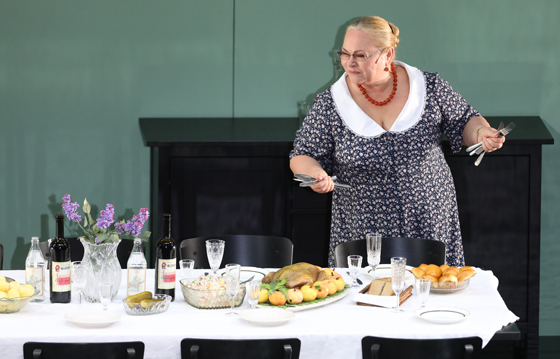
Bogomolov understood and “forgive” would certainly if he had set the “glory” as a parody. Why would he do this is another question. But even a monotonous three -hour KVN with ironic bullying over the dead style would be accepted easier than what the director did in the end. He initially deprived the viewer of the main filter of perception, disarming the highest enhancement: manners and intonation of actors do not reproduce the thick, fat, “concert” style of the Soviet 30s, but strictly correspond to the most modern ideas about reliability, “simplicity and naturalness”. This is a real triumph of the Russian acting school - with such a depth of penetration and the degree of assignment of material, it would probably be possible to play the notorious “telephone book” or any other neutral text at the appropriate level of skill, but the honor would be small. “Glory” is not neutral at all. In some places it is almost unpronounced. Well, therefore, in the life of the leading actors of the BDT there is also a place for a feat. The quiet, lyrical moths of Valery Degtyar, the fiery lighthouse of Anatoly Petrov, the capricious flyer Lena Alexandra Kulikova, the good-hearted Fat Medvedev (actor “from the former”) Dmitry Vorobyov, the intellectual control of Vasily Reutov (a role in which it is much easier to present the eternal party mall of Vladimir Volodin than “ intellectual ”), the existing (-the) on the verge of absurd, Professor Black Elena Popova and, of course, Mother heroine Nina Usatova, whose organic organic propaganda turns either into a table or lullaby-all this is excellent acting work. In dramaturgy, which, it would seem, is saturated through the false sincere, false smiles and unambiguous cannibalism.
 © Stas Levshin / BDT
Professor Chernykh, who turned out to be a woman, is not the most important traverse move of “Glory”. There is still. From an unpretentious decision to give two young engineers to play the actors who are significantly older than their heroes, the director extracts the main trick of the performance. The true truth of existence along with this acting anachronism give a striking result: we observe the movement of time as such on the stage. Not burdened with either the quirks of style, or an alien ideology. Cocteau called this effect "death at work." The heroes speak of themselves as young, they are cheerful, incomplete, full of hope, they make plans for the future, for the 1936th, 1937th, further, further-and the viewer at that moment sees what he sees. There is a fixation of every second decay, elusive increase in entropy.
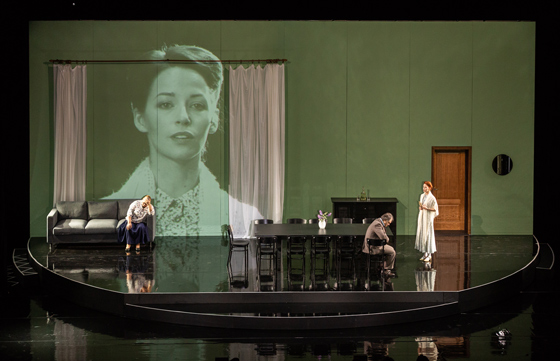
It is characteristic that Coctea spoke of cinema. “Firing death at work” is the most essence of mechanically captured on the film of art. The theater, on the contrary, no matter what games he played in time, was usually proud of the effect of presence, the opportunity to survive the event "here and now." In the "Glory" of Bogomolov there are screens - they are projected by large plans of actors in real time. These images are deprived of aesthetic claims-there it would have been in vain to look for photogenic, some particularly meaningful light or angle. This is literally enlarged "here and now." In other words, in the performance of Bogomolov, the theater works as a movie, and cinema as a theater. Burners of such a degree of complexity - a rarity even for this expert travee. Probably, the day when the viewer will see the sound and hear the color in his performances-some unprecedented degree of freedom is hidden behind the elimination of this scale.
And again, not without surprise, you can find that the playwright is able to support the director:
So, twenty -four hours.
A thousand four hundred and forty minutes.
A lot of time! We can say
Still very far to the decay.
Of these, I will see my mother for ten minutes
And ten minutes talk to Lena.
Motylovs are not God the news of what philosopher, but he feels the destructive work of time. The hero, played by the tar, that is, touching by definition, terribly lonely: he cannot tell his mother that he goes to death, and her beloved woman finds a reason to reject him at the wrong time. It would seem that at least the auditorium should be on his side and in tears - so not. The viewer is more or less indifferent to the Soviet engineer, his tongue-tied lyrics, the no wonder of the party and devotion of the party. We already remember what the play is from and what its author wrote about Stalinist repressions. The seconds of death counts the hero who holds attention, but which, in essence, does not give a damn, is a paradoxical situation for the theater. And then Bogomolov is performed by one of those outwardly simple, but completely dizzying tricks that are capable of (still!) Enter the public into a state of second shock. “I fly away ... far away, rather gylm ...” - Motylkov gives the last instructions to the postman. And the director, slightly correcting the length of the line, reports this elusively changing poems to sweet pain the familiar intonation of Brodsky. The same rhythm, the same pronons (the tar is impeccable here). So - better? Closer? So this hero is more mortal? Deserves sympathy? Actually yes. Better and closer, and more. But there is nothing to be proud of. And for sure - this is a parody of Brodsky.
This move is similar to what Bogomolov once did in the “ideal husband”, releasing Rosa Khairullin and Pavel Chinarev to sing a duet “You will wake me up at dawn ...” (The bride, having completed a swan song, also died on stage from old age). It was impossible not to admire this, it was impossible to forgive it. Bogomolov does not need to explore the extensive mythology of Stalin's times - he is enough for him that is still alive and daily multiplies illusions (including the indifferent complexes of Stalinism). He finds the cherished point, carefully stored in the intelligent soul, a place half -forgotten, but determining unexpectedly a lot in the personal biography of another viewer, and shuts down there with nails. Just because Alyosha Karamazov should live and believe even after the elder Zosima “wandered”. Bogomolov’s decisions are often spectacular - but do not seduct: they are rarely simple.
Music is responsible for simplicity: the singing “Lord, have mercy” instead of some “march of enthusiasts” is able to make even the most simple-minded part of the auditorium to suspect something wrong. A variety of reactions is included in the fabric of the performance, it is essential for it. “Glory” rejects and beckons everyone in different ways: someone-on the new one-connects to the romance of victories over the elements, someone experiences nostalgia for the times when the faith in the general “happiness of people” was alive, someone is fascinating the fullness of life on the edge of death, forever lost cheerfulness, and for someone-all this is naphthalin, an ideological sabotage, and an imperial “Imperia evil ". Moreover, during the performance, you can have time to stay with all these “someone”. The personal audience trajectory of the perception of “glory” is extremely whimsical and does not depend on ideological, political and aesthetic attitudes (political like -minded people can quarrel here), age or gender, and, probably, from the individual “work of time”, from the course of the internal watches. “There are such accuracy in our days, / that boys of other centuries, / probably, will cry at night / about the time of the Bolsheviks ...” Let's try to put today's date. Let's see what happens.