
Translated material
Siberia of the year: torture, memes and corruption
Elections, mockery of prisoners, the death of the police, memes and corruption that kills children. Taiga.info on the main phenomena and events of 2018 in Siberia.
The editors proposes to look at the last year after the Urals, as for a mosaic. Having folded 12 of its elements, you risk seeing the image of the future.
The pipe of the year
In January, it became known that the “Siberian generating company” of the oligarch Andrei Melnichenko redeems the Novosibirsk monopolist in the field of heat supply-Sibeko, who was part of the RU-Com holding, the former chairman of the Board of Directors of which was the ex-minister of the Russian Open Government Mikhail Abyzov .
After the closing of the transaction, SGK actually became the only major player in the heat supply market for the inhabitants of half of Siberia. Under her control were the TPP and the GRES in the Novosibirsk , Kemerovo regions, the Altai and Krasnoyarsk regions, Tuva and Khakassia .
Circus of the year
The presidential election campaign stretched for several months, its main part took place in February. Perhaps it is best illustrated by two leaflets prohibited by the Novosibirsk Oblast of the Novosibirsk, which in a comic formcalled on to vote for Vladimir Putin.
The texts are given according to the commission decisions:
“The leaflet contains an appeal on behalf of [the head of the CEC Ella] Pamfilova with the invitation of voters on March 18, 2018 to the elections of Vladimir Vladimirovich Putin, [with] an indication that“ we decided to prevent any of his competitors to participate, so that it is easier for you to make a choice and give the president’s friends the opportunity to continue to rob our country. We hope that you will not become a victim of destructive forces who urge you to join the voters' strike and not go to polling stations on March 18. ”
“The appeal on behalf of the chairman <...> Pamfilova to voters that“ March 18, 2018 will be reassigned by Russian President Vladimir Putin, which we traditionally call the elections will be held. ” “Come! We simplified the task for you as much as possible and did not allow any real competitor to participate. ”
The oppositionist Alexei Navalny was not allowed to the polls, and his supporters chose a boycott . Putin’s competition was depicted by communist Pavel Grudinin , LDPR leader Vladimir Zhirinovsky, TV presenter Ksenia Sobchak and some other people who have already forgotten about. Grudinin andSobchak even appeared in several regions of Siberia.
The campaign also showed the "personnel reserve". The President’s Irkutsk headquarters said that they were ready to “treat” voters for “wrong” words, and the co-chair of Novosibirsk, the ex-deputy of the State Duma, Sergei Dorofeev, decided to joke that in the “warm republics of the turnout”, and we have someone toequal .
In addition, Taiga.info talked in detail about the new voting technology at the location - she could help increase Putin in traditionally disloyal regions, as well as overexcite the appearance by reducing the general list of voters. The old methods of struggle remained the same .
Pain of the year
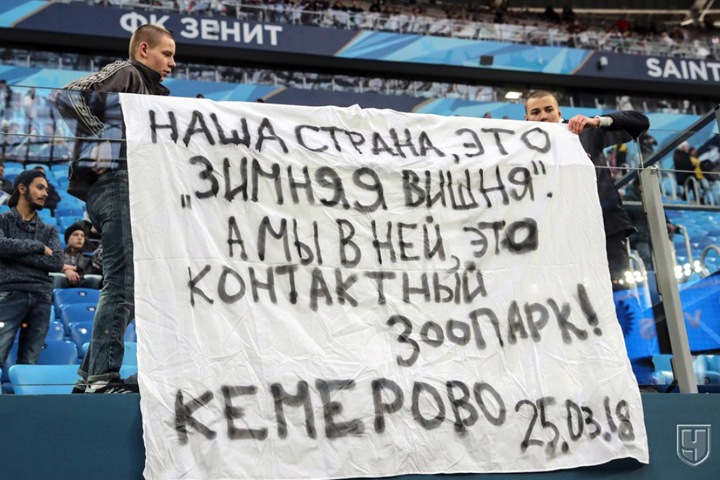
The main event of March could be the presidential election. But a week after them, the Winter Cherry happened in Kemerov. During a fire, 60 people were killed in the shopping center, according to official figures, most of whom were children.
The tragedy turned out to be a terrible miniature of what was happening in Russia. A huge shopping center, belonging to the "candy oligarch", worked for several years without permission in the heart of the capital of Kuzbass - near the regional administration and the city hall. The prosecutor’s office sabotage on the instructions “from above”, and some of the dead children came to watch a movie in the shopping center on tickets that their parents received on the day of the presidential election in the areas.
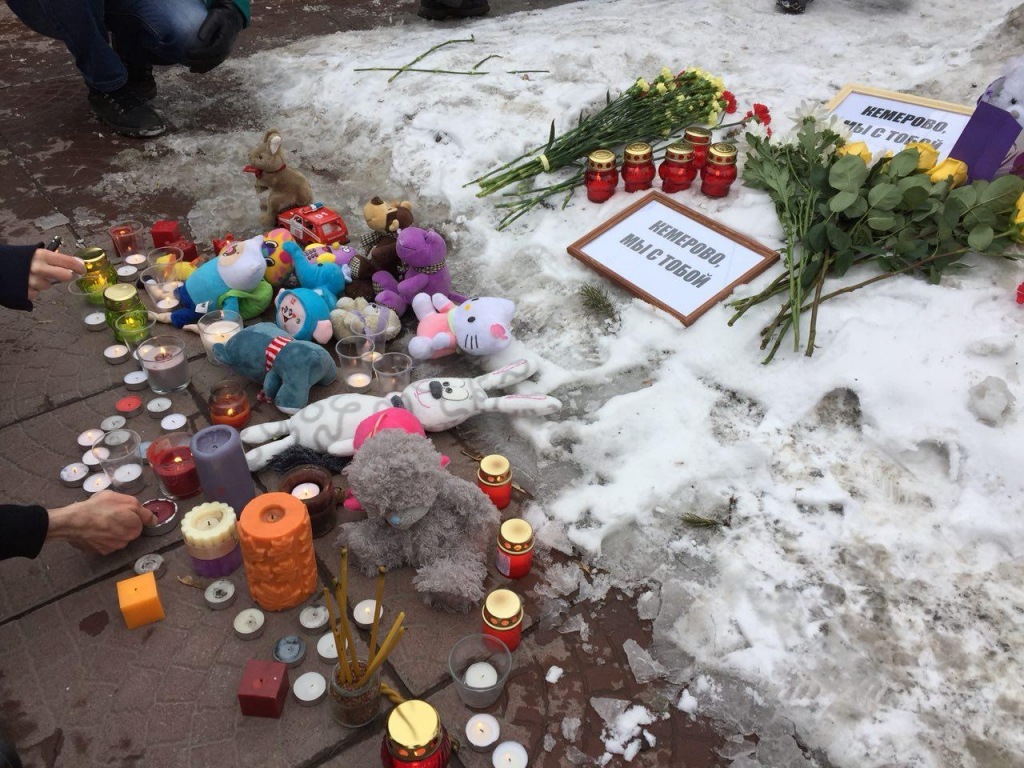
Two days after the fire, thousands of Kemerovo people gathered for a spontaneous rally near the regional administration. But the governor Aman Tuleyev at a meeting with Putin who arrived with provocateurs called them, stated that there were no relatives of the victims among them, and for some reason apologized not before them, but to the president. Then it turned out that it was now possible to grieve with us only by decree of the state - in dozens of cities, civil actions of memory were organized, and when the president announced a national mourning, participants in the “unauthorized” mourning were called to proceed to the official one.
In the case of the fire, there were a dozen defendants, the most senior of which was the head of the regional department of the Ministry of Emergencies. City or regional officials almost did not affect. The investigation is delayed, it turned out on the ships on preventive measures that the friends of the accused firefighters threaten the families of the victims. The main evidence in the case of the fire - the “winter cherry” itself - was demolished.
The resignation of the year
April departure of Aman Tuleyev from the post of governor is perhaps the main resignation of 2018 not only Siberia, but also the country. She showed that at a certain moment people can be reached so much that no cosmetic measures will help. The Russians saw what the absolute 20-year-old power threatens and what reaction of society it can lead to, despite all past merits.
Since 1997, when Tuleyev became the governor, the opposition was suppressed in Kuzbass, independent media were destroyed, and coal prey has passed from mines to huge incisions that threaten cities and villages. The region was nicknamed the “Siberian Chechnya” not only for the incredible indicators of the turnout and the results of “United Russia” in the elections, but also for the fusion of law enforcement and regulatory bodies with the executive branch.
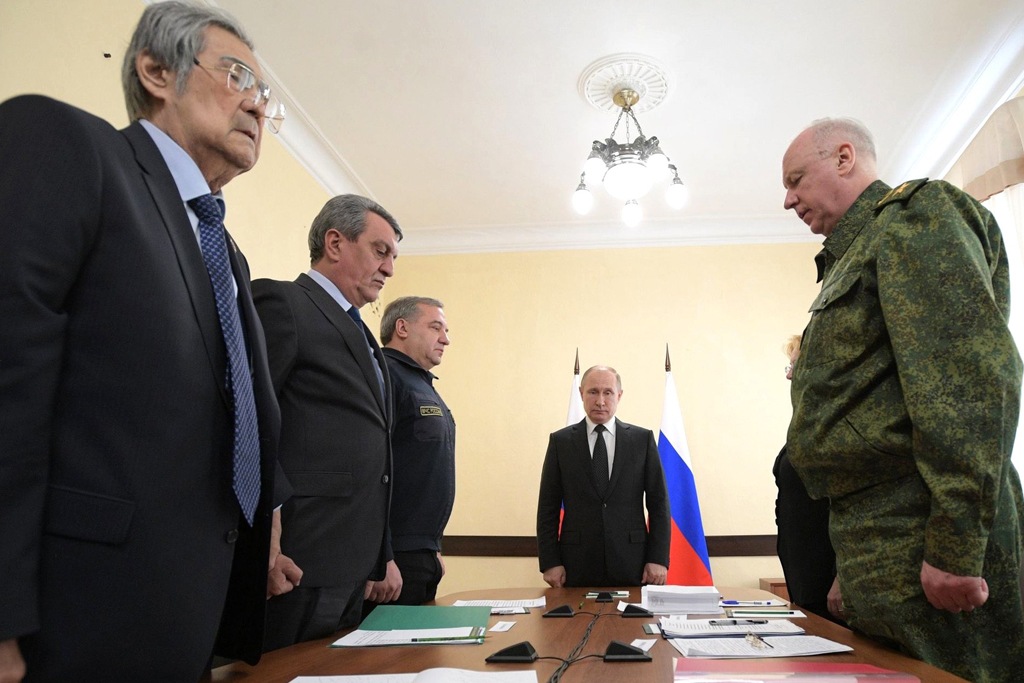
It seemed that Tuleyev reluctantly parted with the authorities. After the resignation, he was made by the speaker of the regional council, and he officially demanded that the prosecutor's office check the “stream of insults, targeted lies and misinformation” about his real estate in federal and regional media. The authorities also banned the next rally against Tuleyev, and the police detained its participants at the entrances to Kemerovo.
He did not go to the elections to the regional council and in September he received a chair of the rector of one of the regional institutions. His successor appointed by the president was the coal oligarch Sergei Tsivilev. In the election of the governor, he scored 81%familiar to Tuleye times.
Protest of the year
On May 5, in 90 cities of Russia, thousands of residents held actions against the federal authorities "he is not a king for us." Participants called for the resignation of the president and the government. If the action was held peacefully in Novosibirsk, then there were mass detentions in Krasnoyarsk and Kuzbass. In the regions of Siberia, preventivearrests of alleged organizers began to practice, as they have been doing in Moscow for a long time.
On September 9, on a single day of voting, the detention became even wider. In Novosibirsk, police blocked a peaceful procession of protesters against raising the retirement age, which the authorities did not agree on. They used batons, detained 10 people. In total, more than 100 people were taken from the streets in large Siberian cities.
The organizers and participants massively started administratives after the shares. Arrests for 30 days for an expression unauthorized with officials no longer surprise.
The detentions took place against the backdrop of the “official” protest against the pension reform, which was headed by the Communist Party and trade unions. However, they were also preferred to clean away from the centers of cities. If the protest of the left forces was at first really massive, then by winter it came to naught - besides, the participants almost did not use Putin's name in vain. He signed the law on raising the retirement age on October 3.
Oh yes, Pervomaisky monstration in Novosibirsk gave perhaps the slogan of the year: "north of Korea."
Drill of the year
The elections of the Novosibirsk governor were to become a central campaign on the political map of Russia-2018. But in June, the mayor of Novosibirsk Anatoly Lokot (Communist Party) announced that he would not run and support the acting governor Andrei Travnikov appointed by the Kremlin.
The campaign actually began in the spring . In the capital of the region, banners with portraits of the elbow appeared and its “Strategies 2030”, in response, mass telephone polls with the “black PR” were launched against the mayor, then dozens of Prochrevsky telegram channels, who were frail for the United Russia, were brightly manifested. He denied participation in the discrediting of the head of the city and pressure on him. Travnikov suspected a “double game” of an accented “sketch” on the elbow.
The surrender of the elbow on June 8 was not a surprise, but rather a disappointment in the entire system, which did not allow the only more or less serious “systemic” opponent of the party in power to register in the governor's elections in Russia.
Crime of the year
In July, criminal cases for reposts on social networks came to the fore. Barnaul became a leader, where several cases are considered at once about the insult of the feelings of believers and “inciting the growth” on the Internet. The city, due to the zealous employees of the E-E, was nicknamed the “capital of extremism”.
144321 Siberian extremists
At the same time, Russians have been judged for publications in social networks for several years, but the case of the Altai student of Maria Motuznayawas probably the most vivid illustration. Almost daily news appeared about the next persecution .
At the end of December 2018, the federal authorities partially decriminalized the most popular “extremist” article 282 of the Criminal Code of the Russian Federation (excitement of hatred or enmity). Now, for the first in the year, “inciting the REAR” will be punished with a fine, mandatory work or administrative arrest. Although the very entry of suspicion is already leading to defeat in rights, about which Taiga.info told in detail.
At the end of the year, the Krasnoyarsk Senator Andrei Klishas proposedto plant people completely for “disrespect” to the authorities in social networks, as well as to equate “false news” with extremism.
Violence of the year
Following the stories of reposts, society suddenly learned that in Russian colonies they were tortured and killed by prisoners, and law enforcement officers with fists, current and humiliations are knocked out. The New Gazeta published a video torture from the Yaroslavl IR No. 1, the Mediazona spoke in detail about the “network case” and the roles of the FSB. The atrocities of the Buryat police became known, in the Omsk IR No. 3 and the Khakassa IR No. 33, history from Barnaul and Kemerovo .
As a result, we simply give a case, the details of which have not yet been published in the media. In August, the verdict of the Soviet District Court of Ulan-Ude entered into force in respect of seven employees of pre-trial detention center No. 1, who were accused of beating and using special equipment. They forced the arrested to abandon testimonies against two criminal authorities. The prosecutor’s office escaped with a stingy release. In the verdict, as the taiga.info found out, the details turned out to be much more colorful .
In January 2013, the head of the fifth shift of the pre -trial detention center Yuri GOSTEV, employees Dmitry Tkachev, Sergey Goryunov, Alexander Astashov, Tsyden Dorzhiev, Roman Rodionov, Yuri GOSTOV and Arthur Popov took the suspect of extortion to the basement of the insulator. Earlier, he concluded a pre -trial agreement with the prosecutor’s office that he would testify against accomplices - two “criminal leaders” of Buryatia.
The man who is called “P” in the verdict was threw to the floor. Goryunov fastened one pair of handcuffs on his left hand, Rodionov clicked the other pair on his right wrist. They began to pull for handcuffs in different directions, Astashov sat on the back of the lying. To begin with, the employees of Tkachev, Popov and Dorzhiev, as the court established, inflicted at least 40 strokes with rubber batons to the lower back, buttocks and shoulder blades: “Next, Tkachev and Dorzhiev, in order to enhance the pain, removed from the“ p ”and panties. Tkachev, Popov, Dorzhiev <...> were applied with special means of "PR-73" (batons) at least six strokes on the bare buttocks, at least four strokes on the bare hips of the legs. "
The prisoner was turned over on their backs, first lifted his left leg and at least 25 times hit the foot with a club. They did the same with the right. All this time, Rodionov and Goryunov pulled a man crucified on the floor. He was finished off in the head, beat with batons around his neck, demanding that he change the testimony. The victim was forced to write an explanation under the dictation that during the morning check of the camera he prevented the employees and insulted them, so special equipment was applied to him.
The senior assistant to the prosecutor of Buryatia, who personally conducted an audit on the application for torture, handed over materials to the UK. All the defendants said that they were stipulated, and they did not know the criminal authorities at which the arrested testified. The court found them guilty and sentenced each to the age of four conditionally, forbidding to work in the bodies for three years.
In 2018, the “criminal agenda” began to reflect reality much more brightly than any other.
The failure of the year
United Russia failed all major competitive campaigns in September. The party lost according to the lists of elections to the Supreme Council of Khakassia (Communists) and the City Council of Krasnoyarsk (LDPR). The opposition significantlyincreased the fractions in the Legislative Assembly of Transbaikalia and the People's Khural of Buryatia.
In the Irkutsk region, most mandates both in the lists and districts were received by the Communists (although the “EP” in the Culuar strugglepulled out the post of speaker). In Khakassia and Transbaikalia, now the opposition can block any solution, for example, in the South Siberian Republic, the united Communist Party and LDPR did not allow United Russia to get their senator. The time of coalitions and at least the visibility of parliamentarism returned to part of the constituent entities of the Russian Federation.
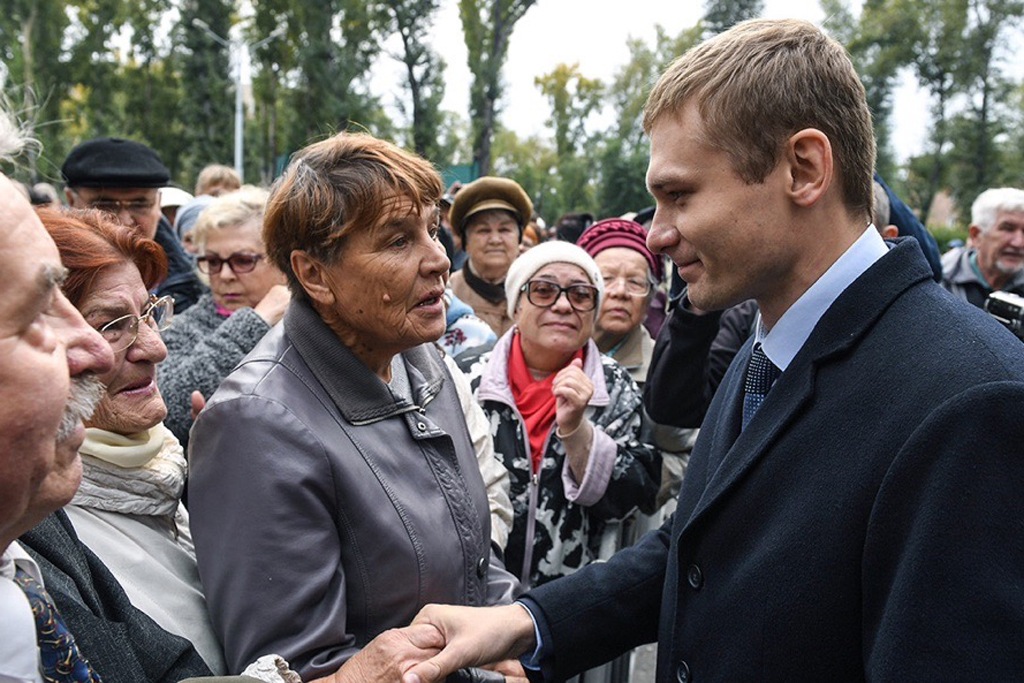
In the Governor’s elections, “EP” received Kuzbass, Krasnoyarsk, Novosibirsk and Altai Territory, where they managed to clean up all real rivals. The Omsk region was given to Socialist -Revolutionary Alexander Burkov, although he was elected as a self -nominated person with the support of the "EP" and the Communist Party. But even for the appointed sparring partners in some regions, residents voted more willingly than for United Russia-the head of Khakassia, despite the crazy pressure and actually permitted campaign to disrupt the second round of elections, was the young communist Valentin Konovalov.
In general, a single voting day on September 9 was much more remembered by mass protests, not elections.
Pyramid of the year
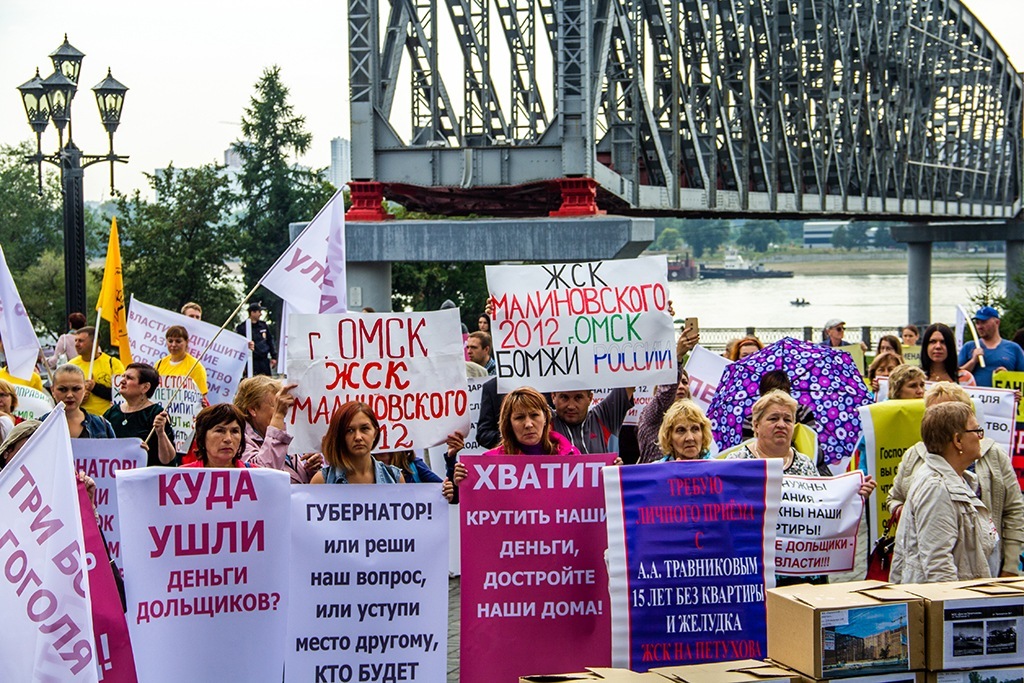
In October, at a meeting in the Siberian plenipotentiary,they noticed an increase in the number of deceived equity holders per year by a third - up to 3.6 thousand people. And these are only official figures based on regional registers. The real amount, according to the deputies, is several times higher in the Novosibirsk region alone.
On the way, new parties of deceived investors. The Federal Law on the transfer of shared construction to escrow accounts, according to experts, can only aggravate the situation with existing objects. In addition, new buildings themselves rise in price by 15–20%.
The apartments of conscientious developers will become more expensive, real incomes of the population continue to fall, and mortgage rates are in no hurry to decline.
Police officers of the year
A separate phenomenon of 2018 was the police complaints about their criminal prosecution. Only in November, Taiga.info learned about three similar cases in Novosibirsk and cities of the Kemerovo region. Law enforcement officers announced fabricated evidence, talked about threats from SK employees.
In 2018, several police suicides occurred. Their friends spoke about a sharp increase in paper work, described various methods of pressure on them, recalled conflicts with the authorities.
Mostly employees of the Ministry of Internal Affairs and the Russian Guard in low ranks became the defendants in cases and the dead.
Opera of the year
In December, regions accept waste management tariffs. On average, in the Novosibirsk region, the export and disposal of garbage cost 2.5 rubles per square meter. From January 1, 2019, the tariff will be 92.42 rubles per person (this is one of the highest rates among the Siberian capitals). That is, if a family of three people living in an apartment with an area of 50 square meters. m, now pays 125 rubles to managing companies, it will pay 277 rubles to the Unified Regoperator Ecology-Novosibirsk , related to the ex-deputy of the State Duma and the top manager of one of the companies of Igor Rotenberg.
From January 1, tariffs for water, heat and electricity will traditionally increase. VAT increases from 18% to 20%, which means that goods and services additionally rise in price. In December, in the regions of Siberia, the fare in public transport was already significantly increased (from 10% to 150% for different categories of citizens in different constituent entities of the Federation).
Real disposable income in January-November 2018 fell by 0.1%in the country, according to Rosstat. In the Novosibirsk region, the fall amounted to 5.4%.
The text of Yaroslav Vlasov
Fet Kirill Kanin, Margarita Loginova, Kremlin.ru, VK.com and Championat.com