Date
Author
Константин Валякин

Preserved copy
Translated material
How the most “folk” 228th article of the Criminal Code of the Russian Federation changed
Two hundred twenty -eighth - the most “folk” article: according to the statistics of the Federal Penitentiary Service, since 2006 the number of convicts for drug crimes has doubled. They composed songs about the 228th, invented memes and sewed hats . Today, according to the article, popularized by Russian rap music, more than 130 thousand people are sitting-this is the largest category, almost a third of all convicts. Most of these people received sentences for actions that are not related to sales. From a fine of 300 rubles for the sale of cocaine - up to five years in prison for smoking marijuana: Samizdat studied how the anti -drug legislation evolved.
“In the fall of 2015, the exact time and date were not established, Nechaev A.I., having intent to illegally acquire and storage of narcotic drugs, without the purpose of marketing, illegally acquired for personal use, without the purpose of marketing, the substance of plant origin, which, according to the reference to the expert’s research and conclusion, is a narcotic drug - cannabis (marijuana), in a dried state,” says he says. Sentence No. 1-180/2016 of the Komsomolsky District Court of Togliatti.
The defendant first kept a bag with grass weighing 11.2 grams with him, and then, judging by the testimony, left the house until spring. On April five, at 22 hours 20 minutes, Nechaev, who had already been tried for drug storage several years ago, was detained by police officers. During the inspection, a significant dose of prohibited narcotic substance was seized from him. On May sixth, 2016, the court, taking into account the mitigating circumstances - the recognition of guilt and good characteristics at the place of residence, considered Nechaev A. I. guilty of the crime under Art. 228 h. 1 of the Criminal Code and appointed a year of imprisonment.
The fate of convicts on narcotic crimes is diverse: the articles have changed and strongly modified many times. If A.I. came across in 2005, he would have escaped just an administrative fine, and if in 2011, he could have settled for five to twelve years for a large-scale deed.
Under the king and the leader
Russia later other countries began the fight against drugs at the state level. The first conversations that opium was still not for the people, began in the 1860s, and for example, in France, back in 1845, they adopted a law prohibiting opium smuggling into the country. Russian emperor Nicholas the Second issued a decree on measures to combat opiokation only after 80 years (in 1915) and only in the Far East. Such a segregation was not accidental: the neighborhood with China influenced, from where Opi for many years was imported in large batches.
The revolution in Russia opened drugs market for the working class - morphine, opium and cocaine. Until 1917, drug addiction in the country was limited and almost did not go beyond the borders of the bohemian environment. The use of drugs mainly belonged to the category of luxury available to the upper strata of society, but after the revolution the substances began to perform an entertaining, and not just a healing function for the proletariat. “Just three months after the Bolsheviks came to power, the People’s Commissariat of the Interior was forced to state:“ Entire gangs of speculators who spread cocaine have appeared, and now a rare prostitute has not been poisoned by them. Cocaine has recently spread among the layers of the urban proletariat, ” writes the researcher of Soviet everyday life.
In the 1922 Code, only article 215 existed , punishing “preparation of toxic and potent substances by persons who have no right” with a fine of up to 300 rubles or forced labor. During the years of the NEP, cocaine children who are begging “on bread” became a familiar phenomenon, and working youth added to the “marathot” and “flour”. At the same time, the Soviet government continued the struggle against alcoholism in 1914. The restriction on the sale of alcohol freed the “market” place for cocaine and opiates, which exacerbated the already growing problem of the use of substances.
In response to the growth of the popularity of opium and cocaine, the country's leadership introduced a criminal punishment for the turnover of narcotic drugs along with poisons and potent substances. A decree of November 6, 1924 appeared in the RSFSR, prohibiting the distribution, manufacture and storage in order to sell substances "destructively acting on public health." For a violation, it was possible to get a term of up to three years, while storage without a purpose of sales and use was not criminally persecuted .
In 1925, drug dispensaries began to create, and in Moscow the first clinical department for cocaine children was opened . The treatment was carried out voluntarily.
Subsequently, the decision on the distribution and sales wandered from the Code to the Code, supplemented and updated, for a long time was punished only for distribution.
Great -grandmother "Two hundred twenty -eighth"
In 1958, the Central Committee of the CPSU and the Council of Ministers of the USSR adopted a new resolution on the fight against drunkenness, limiting the sale of alcohol. The next anti-alcohol campaign repeated the situation of the 20s: the moonshine predictably increased and the sharp increase in the number of drug addicts began , and after it was the next tightening of anti-drug policy. In 1960, in the new and last Criminal Code of the RSFSR, the ancestor of today's “folk” article appeared .
The list of everything that was possible to suffer criminal liability for several times: now the manufacture, purchase, storage, transportation, sales, sowing and cultivation of prohibited crops threatened up to ten years with confiscation of property, and if they were caught on a relapse, then from six to fifteen.
According to the researcher Artyom Suna, the 1960 Code is considered especially important for anti -drug policy, because for the first time in Russian legislation, drugs were defined as a separate threat. Doctor of Legal Sciences Vladimir Vedyakhin wrote that the subject of the crime was too wide - before the adoption of the Code, narcotic substances stood on a par with potent and toxic, and for the legislation the threat of cocaine was comparable, for example, with arsenic.
Due to the fragmentation of anti-drug legislation in the republics of the USSR in articles on drugs, discrepancies arose. Somewhere, criminal liability occurred in the absence of a margin, somewhere-only in case of sales. Then in 1974 a decree was issued by the Presidium of the Supreme Soviet of the USSR "On Strengthening the Bust of drug addiction." It introduces signs that affect the measure of punishment: for example, large size of narcotic drugs, actions performed again, or by prior conspiracy, or a particularly dangerous recidivist.
The healing power of labor
In the seventies, due to the transformation of ideas about the drug threat, the methods of combating drugs became more repressive. In August 1974, a decree “On the forced treatment and labor re -education of patients with drug addiction” was issued , according to which alcoholics and drug addicts could be directed for forced treatment for a period of six months to two years. For this, treatment and labor dispensaries were created. In fact, the LTP was a place of restriction of freedom, where forced labor was the main method of treatment. Patients were held behind a high fence and barbed wire, and doctors wore shoulder straps. A public organization, a beloved labor collective or a stateganese, could sue and send there.
By the end of the 70s, LTP, like labor camps, began to embed in industry as sources of labor. “The government had the task of filling out jobs. And then narcological hospitals began to appear on the basis of industrial enterprises, such, for example, had ZIL and Moskvich, ”says Oleg Zykov, director of the nation of the nation. - The meaning of these hospitals was in one thing: to make people with drug addiction go to work in factories where there were not enough hands. And the LTP were part of industrial narcology. ” Due to further economic changes in the nineties, the need for cheap labor at enterprises has disappeared-and narcology from the "industrial" became pharmacological.
The dispensaries were a sign of the anti -drug policy of the USSR. Eighty-one percent of the participants in the survey conducted in 2015 “Levada Center” spoke out for the return of the LTP. But sociologists note that measures of repressive and prohibitive nature are generally quite popular among Russians.
Perestroika
The third and most famous anti -alcohol campaign of the USSR, deployed by Gorbachev during perestroika, brought the same results as the previous two. On May 19, 1985, a decree “On measures to overcome drunkenness and alcoholism, eradicating moonshine” was adopted. Alcohol prices rose, and its sales were sharply limited. This, as in the 20s and 60s, increased drug consumption. “The campaign is a starting position for the anti -drug policy of all subsequent years,” Zykov believes. - Then the youth subculture began to experiment with other psychoactive substances, because the availability of alcohol was reduced, and demand was preserved. Quite quickly, all the positive effects from the anti -alcohol campaign came to naught, and interest in drugs became stable. The market of psychoactive substances has been very diversified, and their popularity has grown. ”
Following the anti -alcohol, anti -drug propaganda also reached out. In June 1987, new corpus delicti were introduced into the Criminal Code of the RSFSR: now it was possible to sit down for “involving minors in non -medical consumption of medicinal and other means entailing stupefying” and “illegal sowing or growing oil maca and hemp”. On June on June 1987, a resolution of the CPSU Central Committee is adopted , where bureaucracy and inaction are criticized in the fight against the unfolding drug trafficking. However, the problem has reached a colossal scale in the next decades. It turned out that there is still a “social environment” for drug addicts in the country, and the conditions of developed socialism did not save the situation.Democratization for the people
In 1990, the rapidly democratizing USSR decided to soften the attitude to drugs. The Committee of Constitutional Supervision decided that the Decree of the Presidium of the Supreme Soviet of the USSR of April 25, 1974 “On Strengthening the True of Drug Administration” “unreasonably limited the rights and freedoms” of citizens. Guided by the constitution, the committee decided: if a person does not violate public order and rights of other persons, it is impossible to force him to medical and labor dispensaries. The Committee also considered the 10th article of the Decree, which provides for administrative and criminal liability for the use of unconstitutional. Members of the commission noted that the legal basis for the article was the obligation of citizens of the USSR, which was recorded in the law on healthcare, was “to be careful about their health”, while neither the Constitution nor international agreements force this. In fact, the committee recognized drug consumption by an integral right of the individual. Thus began the shortest period of anti -drug policy - the period of liberalization.
In 1991, the Supreme Council of the RSFSR abolished administrative and criminal liability for drug use, along with the abandonment of the death penalty for theft of state property and other human -loving initiatives. One of the main arguments in favor of decriminalization was called the experts called the opportunity for consumers without fear of seeking medical help. At the same time, the responsibility for the acquisition, storage, sales and other drug manipulations have not gone anywhere.
In 1993, Yeltsin, continuing democratization, finally eliminated the system of treatment and labor dispensaries by his decree.
After the collapse of the Soviet Union, the Russian Federation used the codes adopted in the USSR for many years, including criminal and administrative. The new Criminal Code was adopted only in 1996, as before, a series of articles providing for liability for drug crime (228–234 of the Criminal Code of the Russian Federation) was included in it, but it was the most common 228th.
Back to regulation
Liberalization in drug policy, like any other liberalization of the 90s, did not last long. Critics of decriminalization of use required administrative responsibility, emphasizing that the number of drug addicts on medical records, over four years of decriminalization, increased more than doubled - from 35.2 thousand in 1992 to 88 thousand by the end of 1996. Supporters of liberal legislation explain the growth of dependent quite simply: in the 90s there was an prohibitively high level of violence, and modern narcology believes that the level of violence directly affects the amount of dependent. Nevertheless, the arguments of the human rights activists did not convince the Supreme Court, and the pendulum of anti -drug legislation moved in the opposite direction to tighten responsibility. The Russian Federation, as the heir and successor of the USSR, was supposed to comply with international conventions and limit the use of narcotic and psychotropic substances only by medical purposes. At that time, as in Soviet times, the anti -drug policy in Russia and all over the world was similar.
After long discussions, the decision was made, and in 1998, together with the Federal Law “On Narcotic Psems and Psychotropic Substances”, administrative responsibility for use was returned to the country, Article 44 appeared in the Code of the RSFSR on administrative offenses, and then migrated to the Code of Administrative Offenses under number 6.9. Together with them, the government has published a list of prohibited and spread of substances.
Federal Law No. 3 of 1998 caused many complaints. Oleg Zykov, director of the Narcological Health Institute of National Health, believes that the law proposed a certain system philosophy that perverts the ideas about drug policy:
“All the drug policy of Russia and other countries is initially aimed at reducing use. This is funny, but often the super-task falls and discuss only some separate actions, for example, how many drugs were seized, ”the narcologist notes. - There is a certain basic value, it is important for understanding that there is a drug policy with us and around the world. A drug policy is a struggle against a proposal and some actions to reduce demand. Speaking of drug policy, we must always discuss the balance of these two hypostases. In our country, in the early 90s, this was not taken into account, and in the heads of people involved in drug policy, there were stamps born of the American “War with drugs”. This led to the adoption of the Federal Law No. 3, who perverted everything that could be perverted. "
Oleg Vladimirovich believes that throughout the 90s, in the thinking of Russian figures, a repressive attitude towards narcotic substances that were transferred to people who consume these substances were preserved. As in Soviet times, a rather repressive approach prevailed in the legislation, from which problematic legal norms grew.
Tables and doses
Until 2004, the country was operating a “dose table”, developed by Eduard Armenakovich Babayan. The doses that Babayan identified were criticized for too small; So, in his table, criminal punishment, for example, for storage, acquisition and sale already 0.005 grams of heroin, says Oleg Zykov. With such dosages, it was possible to detain anyone, with such a table it was quite easy to gain drug consumers and attribute actions to them under the 228th article, which also favorably reflected the reporting of power structures.
In 2003, at the outcome of the first Putin term, on the initiative of the president, large -scale liberalization of criminal law was held. In a large package of amendments, among other things, changes were adopted by the 228th article. Now the article was divided into two articles: 228 and 228.1. The first provided for the liability for storage, and the second - for sales. Then, “Two Two -Eight” was complemented with a note: from now on, the size was determined based on the “average one -time doses” - the amount of substance that the drug addict needs to get a “buzz”. Doses separately for all prohibited substances calculated and approved the government. Over ten "average doses" were recognized as large in size, and more than fifty in a particularly large size.
Changes in the Criminal Code had return, many cases were revised - and more than forty thousand people were released.
When leaving places of imprisonment, many people die from an overdoseOleg Zykov was one of the initiators of the amendments. At that time, he, as a member of the Human Rights Commission,, together with Lev Levinson and other human rights defenders, was able to lobbilize the mitigation of the law . The main task of the commission was to shift the focus of the fight against drug addicts from consumers to distributors and stop planting people acquiring in small volumes. However, a year later the government took a step back. The fact is that during the year of using the "average one -time doses" the number of drug addicts died from an overdose has grown significantly; Critics of the new variation of the article also noted the overestimation of dosages that allow small sales. Так, допустимая доза героина составляла 0,9 грамма, гашиша — 4,9, а высушенной марихуаны — 19,9.
«При выходе из мест лишения свободы многие люди погибают от передозировки, — объясняет неудачу Зыков. — Это известный факт, люди не знают своей физиологии и качества веществ на рынке, потому массовый выход из тюрем увеличил процент передозировок, в остальном статистика была на нашей стороне: количество передозировок среди детей не изменилось, и рост смертности был связан исключительно со вчерашними заключёнными». Тем не менее в 2006 году статья была вновь пересмотрена и идея «средних разовых доз» оказалась в нормативной помойке, а правительство понизило дозировку вдвое , уголовная ответственность за хранение, например, героина наступала уже от 50 миллиграммов.
Тогда же был введён термин «смеси», и людей стали судить за куда меньшие дозы вещества. Любое количество вещества из списка запрещённых, присутствующее в смеси, автоматически превращало всю смесь в наркотическое вещество.
FSKN
Одиннадцатого марта 2003 года президент Владимир Путин создал на базе одного из комитетов МВД Государственный комитет по контролю за оборотом наркотиков (Госнаркоконтроль) — орган исполнительной власти, курирующий наркополитику. Совсем скоро Госкомитет был преобразован в ФСКН — одно из самых упоминаемых в СМИ в связи с коррупцией и правонарушениями ведомств. На фоне споров о либерализации 2003–2004 годов служба только развивалась и ещё не могла оказать какого-то существенного влияния на наркополитику. В следующие несколько лет ведомство не раз критиковали за чрезмерно репрессивный и часто бездумный подход к борьбе с наркотиками. Оперативники сами сбывали наркотики, шантажировали граждан, вымогали деньги и, как и сотрудники МВД, подбрасывали вещества, чтобы улучшить статистику раскрываемости .
ФСКН также боролась с кондитерами, которые пекли булочки с маком; химиками, работающими с растворителями; ветеринарами, колющими животным кетамин, чтобы смягчить их страдания.
Четвёртого февраля 2019 года закончилось очередное «маковое дело», которое тянулось почти шесть лет и было инициировано сотрудниками ФСКН. В России запрещено производство пищевого мака, его привозят большими партиями в несколько тонн из других стран. Большие партии мака неизбежно содержат какое-то количество опиатов. Оперативники определили все 42 тонны мака наркотической смесью, дело обернулось вероятными сроками по особо крупным размерам, даже несмотря на П остановление Верховного суда , объясняющее, как и когда из смеси необходимо исключать нейтральное вещество. Спустя шесть лет суд завершился в пользу кондитеров, но этот прецедент, по мнению Олега Зыкова, не меняет общей картины.
«Мы даже не знаем, сколько сегодня людей по таким „маковым“ делам сидит в колониях, такие дела никто не пересматривает», — уверен нарколог.
Более чем через десять лет после создания, пройдя через несколько взлётов и падений, Служба падёт в межведомственной борьбе и будет ликвидирована в 2016-м указом президента, успев объявить настоящую войну синтетическим наркотикам. Полномочия ведомства, как и часть его личного состава, перейдут в МВД.
Спайсы, миксы
В нулевые в России развернулась целая индустрия оборота дешёвых наркотиков. Название самого популярного из них можно было встретить в каждом подъезде или на асфальте у светофора — «спайс mix, 8 999 981** **». Такая таргетированная реклама была рассчитана на школьников и студентов — из-за своей дешевизны спайсы стали популярны у тех, кто живёт на стипендию.
Спайс — это психоактивный наркотик. До 2007 года курительные смеси можно было купить в табачных ларьках — спайс не подпадал ни под один из антинаркотических законов. Производители утверждали, что эффект достигается за счёт растений с психотропным веществом. Но в 2008 году исследователи установили , что в состав входит синтетический каннабиноид, аналог или производное существующих наркотиков. После этого индустрия спайсов ушла в интернет, а размеры употребления стали неконтролируемыми. Тридцать первого декабря 2009 года постановлением правительства РФ голубой лотос, шалфей предсказателей, гавайскую розу и другие синтетические каннабиноиды, входящие в состав спайсов, запретили к обороту, а в 2010-м включили в перечень запрещённых наркотиков. С 2008 по 2014 год объём изъятий синтетических наркотиков по стране увеличился в 130 раз — со 165 килограмм до 22 тонн. А власть и антинаркотические ведомства объявили войну со спайсами.
В 2012–2015 годах несколько раз фиксировались массовые отравления спайсами и самоубийства после употребления, причём география отравлений охватила девять регионов страны. «Распространению спайсов было очень сложно помешать, — утверждает юрист Арсений Левинсон, сын известного правозащитника Льва Левинсона. — Синтетические каннабиноиды имеют свойство незначительно изменять свою формулу — и так уходить из-под контроля: новые каннабиноиды не успевали вносить в перечень, на рынке их было несколько сотен. Наркополиция говорила, что не может контролировать распространение спайсов».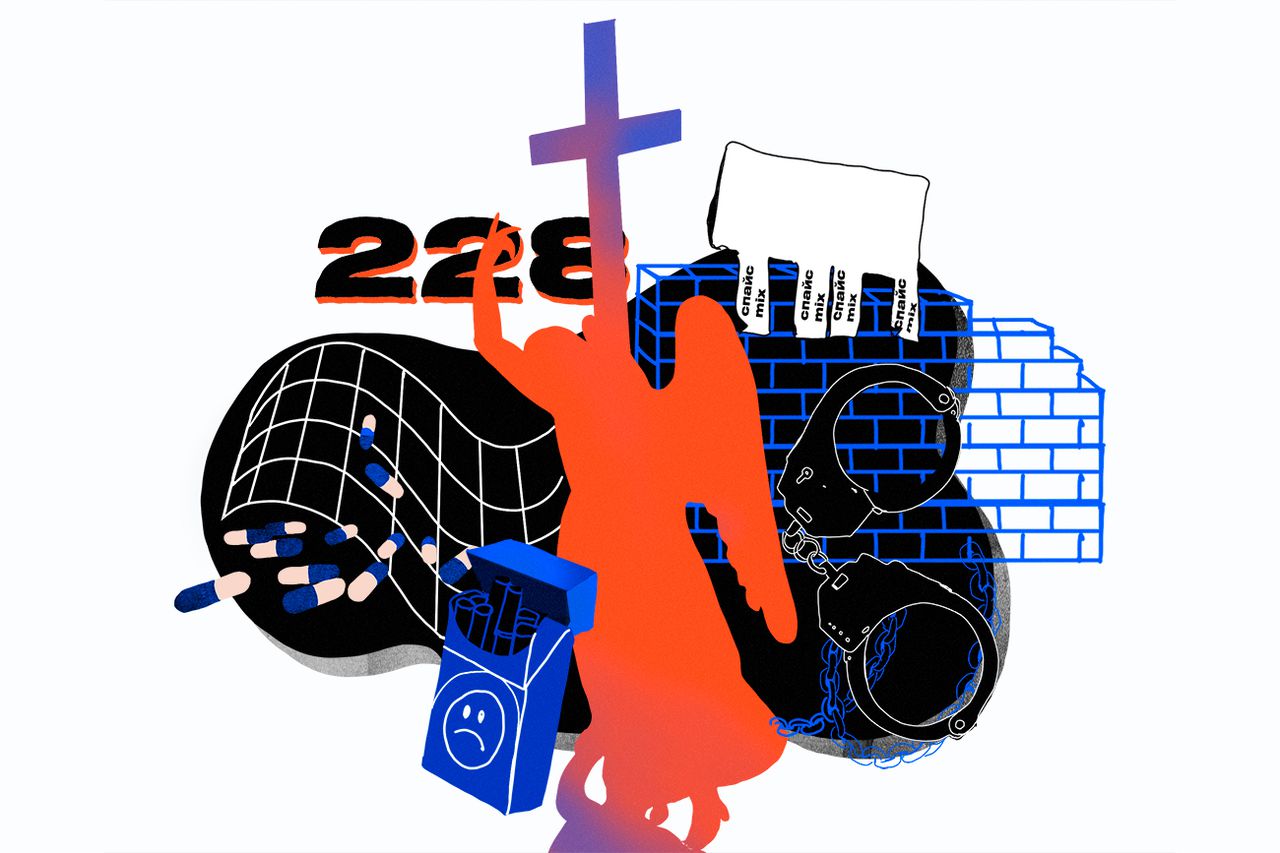
Тогда в 2012 году было предложено понятие «производной» наркотического вещества, незначительно отличающейся по химической структуре от внесённых в перечень наркотиков. Запрещёнными стали не только сами вещества, но и их производные. При этом, как утверждает Левинсон-младший, из-за ввода этого понятия в перечень наркотиков стало сложно определить, какое именно вещество запрещается, «производная» — слишком общее определение. «Мы тогда обратились в ФСКН с просьбой предоставить нам список всех запрещённых производных от одного из первых синтезированных каннабиноидов. Они сказали, что сделать это невозможно, потому что число его производных — с шестнадцатью нулями». Поэтому «запрещённость» устанавливалась постфактум — в зависимости от того, относила ли экспертиза вещество к производным наркотика.
В 2013 году глава ФСКН Виктор Иванов продвигал в Госдуме законопроект , который бы наделил наркополицию возможность предварительно «запрещать» появляющиеся новые производные и вносить их в свой реестр запрещённых наркотиков для дальнейшего изучения. До этого полномочиями по включению в реестры психоактивных веществ обладал лишь Минздрав. В 2015 году закон с поправками был принят, и наркополиция получила право вести свой реестр запрещённых веществ.
«Идея реестра была правильной. Если человека задержали с веществами, которых нет ни в списке, ни в реестре, эти вещества нужно было взять на экспертизу и внести в перечень запрещённых в течение двух лет. За оборот новых потенциально опасных веществ предусматривалась более мягкая ответственность, приобретение и хранение вообще не каралось. Потребитель в таком случае рассматривался как жертва несовершенства законодательства», — объясняет юрист Арсений Левинсон.
Однако с 2015 года ни одного вещества в этот реестр не вошло — всех по-прежнему привлекали за производные наркотических веществ, а не за «новые и потенциально опасные вещества», которые, согласно законопроекту, должны были изучаться — и только тогда вноситься в перечень запрещённых постановлением правительства. Так, многие люди получали сроки за употребление веществ, которые ещё даже не были изучены и внесены в перечень запрещённых. Но сначала ФСКН, а потом МВД, к которому перешли полномочия исследовать новые производные и вносить их, предпочитали использовать старое постановление и относить все неизученные наркотики к производным.
228-я сегодня
В 2012 году антинаркотическое законодательство вновь изменилось. По инициативе ещё живого ФСКН в УК изменились показатели размеров. К крупному и особо крупному добавили значительный, чтобы отделить потребителей и мелких барыг от настоящей наркомафии.
В то же время в Уголовный кодекс ввели возможность пожизненного заключения за сбыт наркотиков. Раньше максимальный срок заключения составлял 20 лет по статье 228.1 УК. Впервые к пожизненному сроку за контрабанду наркотиков в особо крупных размерах приговорили только в 2017 году. По версии следствия, обвиняемые с 2012 по 2015 год ввезли и попытались продать в России 600 килограммов героина.
В начале февраля 2019 года в Госдуме состоялась первая встреча рабочей группы, на которой обсуждались изменения в Уголовный кодекс. Сегодня правозащитники предлагают смягчить наказание за хранение без цели сбыта и перевести вторую часть 228-й статьи из категории тяжких преступлений в категорию преступлений средней тяжести.