Date
Author
Денис Дмитриев, Михаил Зеленский, Иван Колпаков, Дмитрий Карцев
Source

Preserved copy
Translated material
Ivan Golunov is free, but this is not the end
Answers to the main questions about the most resonant case of 2019
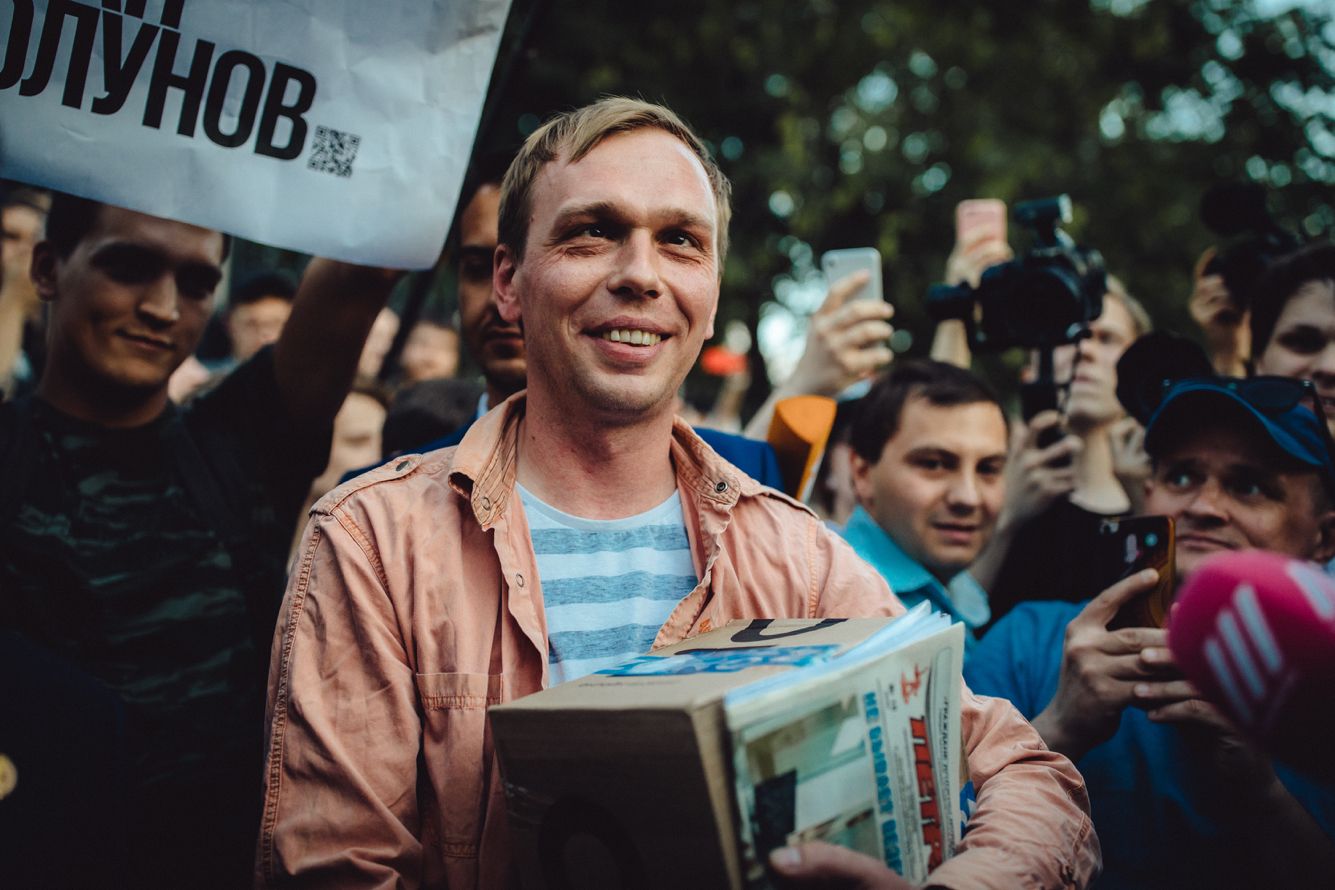
Who is Ivan Golunov? Is he really such a cool investigator?
Ivan Kolunov is a journalist, correspondent of the Medusa investigation department. He used to work in the Afisha (he was one of the authors of the guide to the Moscow Region "Around Moscow"), Slon.ru (now Republic.ru), Forbes, RBC. Golunov was also a special commander of the Siberian Bureau Vedomosti, the editor of the programs “Partenov” and “Sobchak” on the Rain TV channel.
Ivan Golunov is investigating. Its texts are famous for a strong evidence base and the use of open, not anonymous sources. This means that the reader, if desired, himself can go through the path made by Golunov: for example, to check direct and indirect relations between the heroes of publications on the official websites of the companies, the public procurement system or the base of the Unified State Register of Legal Entities.
The main topic of Golunov’s investigations is corruption during public procurement, primarily in Moscow. But this is not limited to his interests. Even before he arrived at Medusa, he wrote about the redistribution of church business under the new Patriarch of the Russian Orthodox Church, about market prerequisites and consequences of riots in Biryulyovo, about Skolkovo sunset , about the neighbors of Vladimir Putin on Valdai, about the case of Denis Svugrobov . The texts of Golunov on Medusa (they can all be found here ) ten times nominated for an independent journalistic Redacleani Prize; Twice he became the laureate of this award. Colleagues call Golunov one of the best investigators in Russia.
What was Ivan Golunov accused of?
Formally, Golunov was accused of attempted drugs-Alfa-PVP (his investigator mistakenly compared with Mephedron) and cocaine. According to investigators, in an unidentified time, in an unidentified place, Golunov bought drugs from an unidentified face, then to resell them. In the journalist’s backpack, five bags with an alpha-PVP weighing 7.16 grams were found, and during a search in an apartment there are three bags with a cocaine weighing 5.39 grams and a bundle with an alpha-PVP weighing 0.37 grams. This is a large size , and in part 4 of Article 228.1 of the Criminal Code, Golunov threatened 10 to 20 years in prison.
But there were informal charges that investigators made on the air of federal television. Andrei Shchirov, head of the drug trafficking department, said that Golunov could carry drugs from Latvia (where the Medusa editorial office is located), then to sell in nightclubs. Investigator Igor Lopatin insisted that Golunov had signs of intoxication, although he himself introduced a certificate from the doctor to the case file, who examined the journalist immediately after the detention and did not find any external signs.
What violations were committed by the police? What are the signs of a fabricated case?
Ivan Golunov was detained on June 6 at 14:40, but acquaintances were told about this only at 3:42 on the night of June 7 - and only then he managed to send a lawyer to him. Formally, Golunov’s detention was also decorated only 13 hours after the handcuffs were put on him. According to Golunov, the police beat him when the journalist refused to go on his own for a medical examination. Subsequently, doctors recorded abrasions and hematoma. The first half a day, Golunov was, in fact, one on one with a system that violated his rights. According to Olga Romanova, director of the Rus Sitting Foundation, all these are signs of pressure and an attempt to achieve confession.
When the police inspected Golunov’s backpack, the drug bag lay on top - as if he had just ended up there. If this package was in a backpack for a long time, then during walking would fall to the bottom. During a search in the apartment of Golunov, the operative first examined the desk, and then went to the closet, behind which he immediately found a package of drugs and scales. For some reason, the bags of sand on the mezzanine were not interested. Golunov told the lawyer that the keys to the apartment were removed from the Internal Affairs Directorate, and when after that he and the investigators drove up to the house, he was left in the car for 20-30 minutes. At this time, police officers moved between the cars and, according to lawyer Dmitry Julia, could go to the apartment.
The police in their testimony in the same formulations claimed that during the detention of the Kolunov he was nervous, behaved inadequately and had all the signs of drug intoxication. After the detention of Golunov, an expert examined, who did not notice any signs of intoxication. Analyzes also showed the lack of drugs. This may mean that three police officers who participated in the detention were simultaneously mistaken; Or - that they specifically stipulated Golunov in their testimony.
All investigative actions in the first hours after the detention were controlled only by witnesses, who, apparently, were familiar with the operatives. One of the police officers, according to Golunov, turned to the understood by Sergey Kuznetsov with the words “Hello, Sergey, you are worthy, or something?”, Noticing a gauze mask on it. Subsequently, “Rain” found Kuznetsov, but he refused to communicate with journalists. The second understood Dmitry Bokarev said that the investigative actions took place correctly - in particular, that they searched the apartment gradually and in detail, even looking at the hood. “All employees have always been in sight,” said Bokarev.
If so many violations, the court could figure it out! Why did you have to raise such a noise?
In the case against Ivan Golunov, there was one court - and he did not understand anything. On June 8, a meeting of the Nikulinsky district court was held, the investigation asked him to arrest Golunov. The lawyers of the journalist pointed out all the violations they found in the case file, which they showed only half an hour before the start of the court.
The materials themselves, as the former employee of the drug control department in an interview with the Mediazona noted , were incomplete: there were no operational data in the case that Golunov sold drugs. Only the fact that these drugs got from his backpack and found in his apartment.
All this did not embarrass the judge Mikhail Maksimov. “Suspicions of Golunov’s involvement in the commission of a crime are confirmed by the criminal case materials provided to the court. <...> The stated arguments of the defense of violations during the detention are objectively not confirmed by anything and are refuted by the presented copies of the case file, ”he said, making a decision on house arrest. Why, contrary to the practice, Judge Maksimov did not send Golunov to the pre -trial detention center is also unknown: explaining the refusal of the investigation, he simply said that Golunov has Moscow registration and work, but there was no criminal record.
Why did you decide that support shares helped Golunov under house arrest, and then let him go? Surely this was done on the command from above
The Russian authorities, of course, influenced the course of the Golunov case. It is known about the meeting at the Moscow City Hall, where, according to the chairman of the Board of Directors of Novaya Gazeta Dmitry Muratov, even before the court’s decision (he is independent of Russian laws from anyone), "it was born that Vanya should be released at least under house arrest." According to the editor -in -chief of Echo of Moscow, Alexei Venediktov, RT editor Margarita Simonyan asked the presidential administration to pay attention to the Golunov case.
But there is no reason to believe that the officials would have taken care of Ivan Golunov at such a speed if Russian journalists, and after them, did not show unprecedented solidarity. From the moment when it became known about the detention (that is, in the morning of June 7), near the building of the Moscow headquarters of the Ministry of Internal Affairs in Moscow on Petrovka, 38, continuous single pickets took place. In the first hours, it seemed that only the opposition supported Golunov, but later artists, journalists and public figures of various views, as well as leading some state television channels joined the defenders of the correspondent. After on Monday, June 10, Kommersant, Vedomosti and RBC left the same first strip “I/we Ivan Golunov”, a flash mob with a demand to free Golunov became truly massive. Even glossy publications (and some reprinted his investigations) about the case of Golunov, which usually do not write about such things.
The real contribution of certain circumstances not described in the procedural norms cannot be evaluated. From a formal point of view, the Moscow police simply studied the case more closely and decided that there was no evidence of Ivan Golunov’s fault. But the Minister of the Interior Vladimir Kolokoltsev personally announced this.
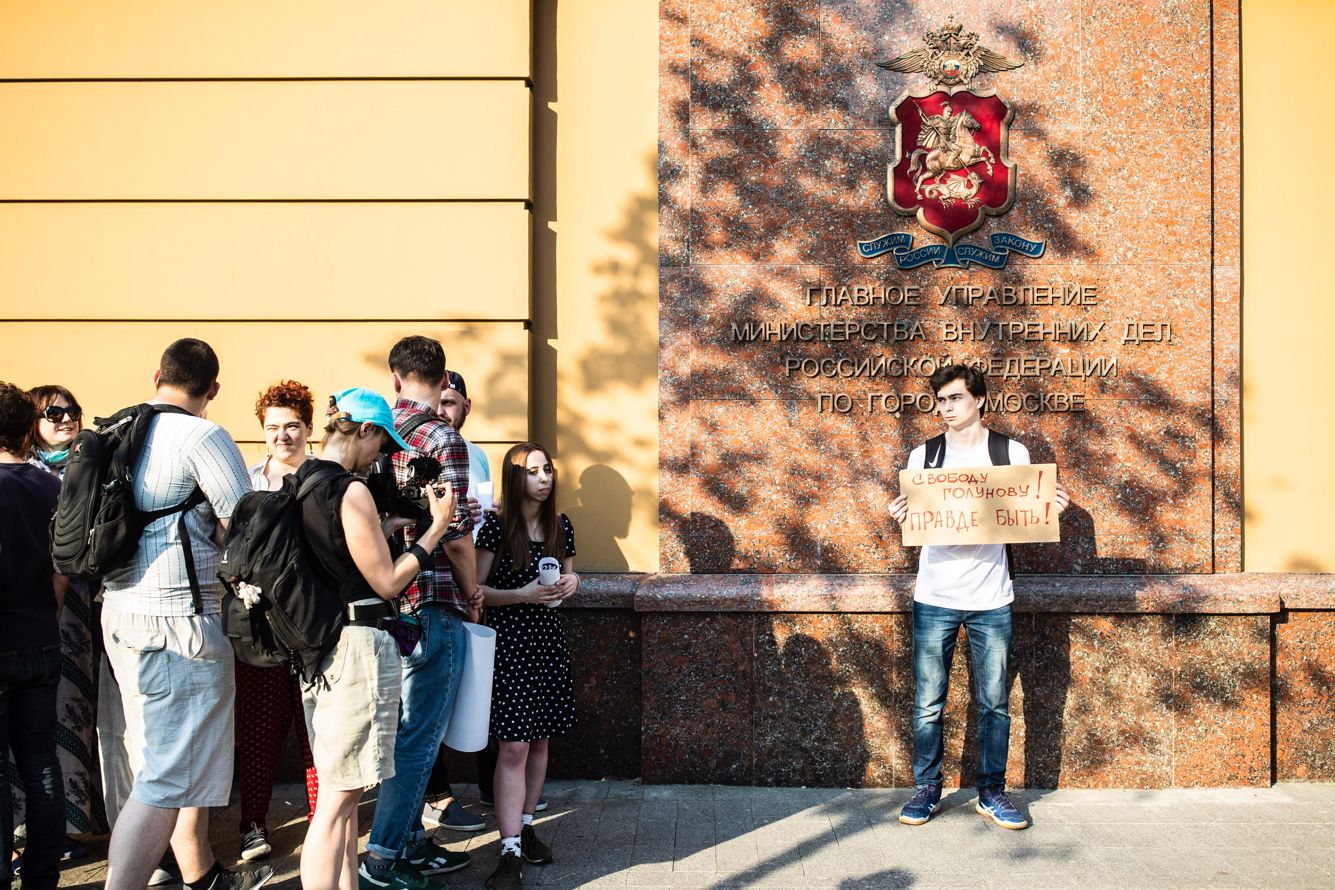
Why did you show such solidarity with Golunov? But what about other journalists who are pursuing - and not only in Russia?
We showed solidarity with Ivan, because we need to intercede for friends.
We often talk about the persecution of other journalists. We wrote about Julian Assange , Kirill Vyshinsky , about the murder of Jan Kutsyak in Slovakia and Daphne Karuana Galicia in Malta. Yes, in these cases, we did not launch special resources like the Kolunov newspaper - but our resources are not unlimited, and of course, we are focused primarily on topics that are especially significant for readers in Russia.
Golunov’s business is also important because the probability of encountering the arbitrariness of the Russian government in these people is much higher than with American, Ukrainian or any other. Russia takes 149th place in the Press Liberty ranking. And although Golunov is free, at least six more journalists in Russia are in custody or are serving deadlines for various charges. One of the main events of 2018 is the murder of three Russian journalists in the Central African Republic, where they tried to investigate the activities of businessman Evgeny Prigozhin close to the Kremlin. Russian legislation on the media is also gradually tightening, primarily on the Internet: regulatory authorities block publications on formal occasions , forcing to remove certain materials (and we, of course, are talking about this).
Why are you only standing up for Golunov, and do not talk about other victims of Article 228?
Ivan is our colleague and friend, so it was really very important for us to achieve his liberation. And only journalistic solidarity allows independent media to at least sometimes protect itself from possible threats. In addition, if any journalist can be imprisoned for his work, then readers will simply have nowhere to take objective information.
Nevertheless, Medusa writes a lot not only about the fate of Golunov, but also about other people who became victims of illegal persecution. We published materials about the cases of Oyub Titiev and Taisiya Osipova , accusations against Sergei Reznikov and Mikhail Savostin - who took place under the same article as Ivan. In prisons under this article, which is called the "people", about 140 thousand people are sitting, according to Olga Romanova. Not all of them are journalists or political activists, and we also talk about them (for example, here and here ).
At the same time, it was precisely on the example of the Golunov case that the law enforcement system worked out this kind of suspicion, which procedural disorders are allowed, if not direct falsifications. And that is why it made so much attention to itself. And almost the first time it became possible to stop the persecution due to suspicions of the forgery. As the same Romanova writes, "even one beaten at the system can become the beginning of the end for her." Many note that Golunov’s case became a symbol of the fight against police arbitrariness (and this happens regardless of what Ivan himself thinks about this business and his life after him).
Ombudsman Tatyana Moskalkova speaks of the need for changes in legislative and law enforcement practice, and the speaker of the Federation Council Valentin Matvienko - of "distrust of the investigating authorities." It appeared that the State Duma is ready to edit the 228th article. The resonance around Ivan’s persecution gives hope for systemic changes in cases of suddenly found narcotic drugs, the number of which exactly corresponds to the criminal case necessary for initiating a criminal case.
That is why we are sure that the matter of Ivan is important not only for Medusa and other journalists, but also for the entire Russian society.
Ivan Golunov is free. What will happen next?
First of all, we plan to complete the investigation that Ivan Kolunov worked on before arrest. This text is the key to understanding who could organize a power operation against the Medusa correspondent. While Ivan was under house arrest, we gathered a group that included more than 10 people out of four Russian publications to finish the article by Golunov. We assume that she will continue to work with Ivan. The investigation will be published in the coming weeks simultaneously in several publications from Russia and other countries. There will be other texts dedicated to people whom we consider likely customers of an illegal force operation against Ivan Golunov.
The resources launched to support Ivan ( telegram channel and the newspaper "Khgunov") will be turned into an indefinite special project "Medusa"-" Golunov. Resistance to the police arbitrariness . " We will talk about those who are faced with illegal persecution - and those who help them. The special project will become a platform for discussing police reform: the Golunov case once again and especially clearly showed that the Russian law enforcement system has been rotten and needs restructuring. Experts of the Institute of Law Problems believe that the pursuit of the Medusa correspondent can be a starting point for such a reform; And openness, that is, the work of public organizations and the media, should become one of the main components of this reform.
Within the framework of the Kolunov project, we will draw attention to the work of human rights organizations and publications that systematically help people who have encountered police arbitrariness. Separately, the Medusa will study the situation with the “folk” article with the 228th article: we had previously published materials on this topic, but we are forced to admit that this was not enough.
As in the case of Golunov’s investigations, we will open access to the texts of the special project for the Creative Commons CC BY License: this means that you can reprint them in your publication, on your website, in your blog on any of the platforms without asking for our permission.
Finally, the Medusa editors will try to do everything that depends on it so that Ivan Golunov could return to reporter and investigation as soon as possible.
Send your ideas and information for the Kolunov project by mail svobodugolunovu@meduza.io .
Mikhail Zelensky, Dmitry Kartsev, Denis Dmitriev, Ivan Kolpakov