
Translated material
As Gref, Usmanov and Chemezov united against Yandex
Sberbank confirmed the intention to buy from Gazprombank his share in Mail.ru Group: without agreeing with Yandex, the State Bank decided to unite with its only direct competitor. The third partner in this alliance will be the state corporation Rostec. They will breed a digital octopus, which will penetrate into all spheres of the life of Russians.
Three partners
The Sberbank deal with Gazprombank will finally draw up an alliance of three heavyweights of the Russian Internet market: German Gref, Alisher Usmanov and Sergey Chemezov. Three partners through MF Technologies will own 100% of Mail.ru Group class A. This package gives 58.89% of the vote, or 5.23% of the economic share in Internet holding. Each class A promotion gives the right to 25 votes, an ordinary action - for one voice. Almost all ordinary Mail.Ru Group shares belong to foreign investors.
A situation of the largest shareholders of Mail.ru Group after a deal with Sberbank will look like this:
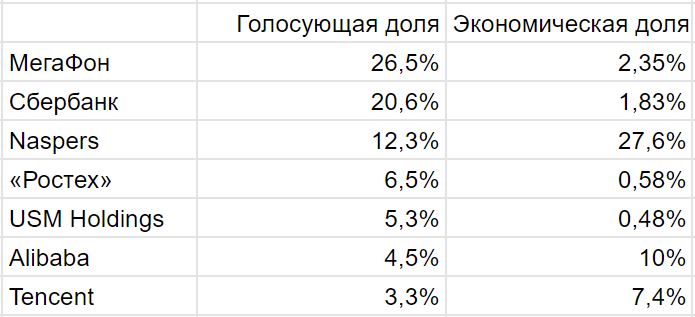
From the ratio of voting and economic shares it is clear: even if Mail.Ru Group paid dividends (the last time that was in 2013), Gref did not come for them.
In fact, each of the three participants in the triumvirate has its own motives:
- Gref consistently turns Sberbank into a national IT giant. This can be considered a state task: Gref acts as the main speaker at all meetings on digitalization with the participation of Vladimir Putin, and in September the president gave him a direct assignment to transfer the technological experience of Sberbank throughout the country. The goal of Gref is to create an ecosystem of services around Sberbank, covering all spheres of the life of Russians. A bank coming from an offline online, for this you need a strong partner on the Internet market. At first, Sberbank considered Yandex in this capacity, but their partnership in the framework of Yandex.Market was not set , and negotiations on the purchase of a large package in the search engine ended in failure and ruined the relationship between Gref and the founder of Yandex Arkady Vologa. After that, Sberbank joined the strategic partnership with Mail.Ru Group, and Yandex began problems with the authorities whose culmination was the emergence of Anton Gorelkin’s bill on the ban on foreign possession of “significant Internet resources”.
- Alisher Usmanov also sequentially follows the path that we described a year ago. In the early 2010s, the businessman earned billions of dollars on Facebook investments and other American Internet companies, but after the next conflict of Russia with the West came out of most foreign assets, took away Megafon from the London Exchange and builds more and more business businesses with the state. A company close to it supplies equipment for SORM, another develops a digital marking system for goods. The position of the state partner for the construction of the national Internet giant fits perfectly into this logic.
- Rostec under the direction of Sergei Chemezov is one of the main contractors and potential beneficiaries of the state -owned digitalization program of the economy. He was instructed to develop the widest range of technologies - from 5G networks and the Internet of things to artificial intelligence. In a recent interview with RBC, Chemezov called the transition to a digital economy the main challenge to the country. Usmanov for Chemezov is an obvious partner: they collaborated in the raw material business , and in the new state -owned businesses Usmanov “Rostec” acts as a minority partner. Chemezov will bring something to partnership, except for his lobbying resource: one of the main areas of work of Rostec is big data.
What will come of it
Although Sberbank will not receive control at Mail.ru Group, the deal brings the bank closer to become the main in the country as an aggregator of data about people who knows almost everything about the behavior of its users.
Thanks to the Sberbank-Online application, the State Bank already knows what 50 million Russians spend money on. A recentpurchase of a large share in Rambler Group opened access to information that Russians are reading (Lenta.ru, Gazeta.ru) and watch (OKKO streaming service) on the Internet. Buying a package at Mail.ru Group makes a Sberbank a co -owner of the second Runet holding, the services of which are used by 44.2 million people. Mail.ru Group includes VKontakte and Odnoklassniki social networks, Delivery Club food delivery service, Citimobil taxi service and many others.

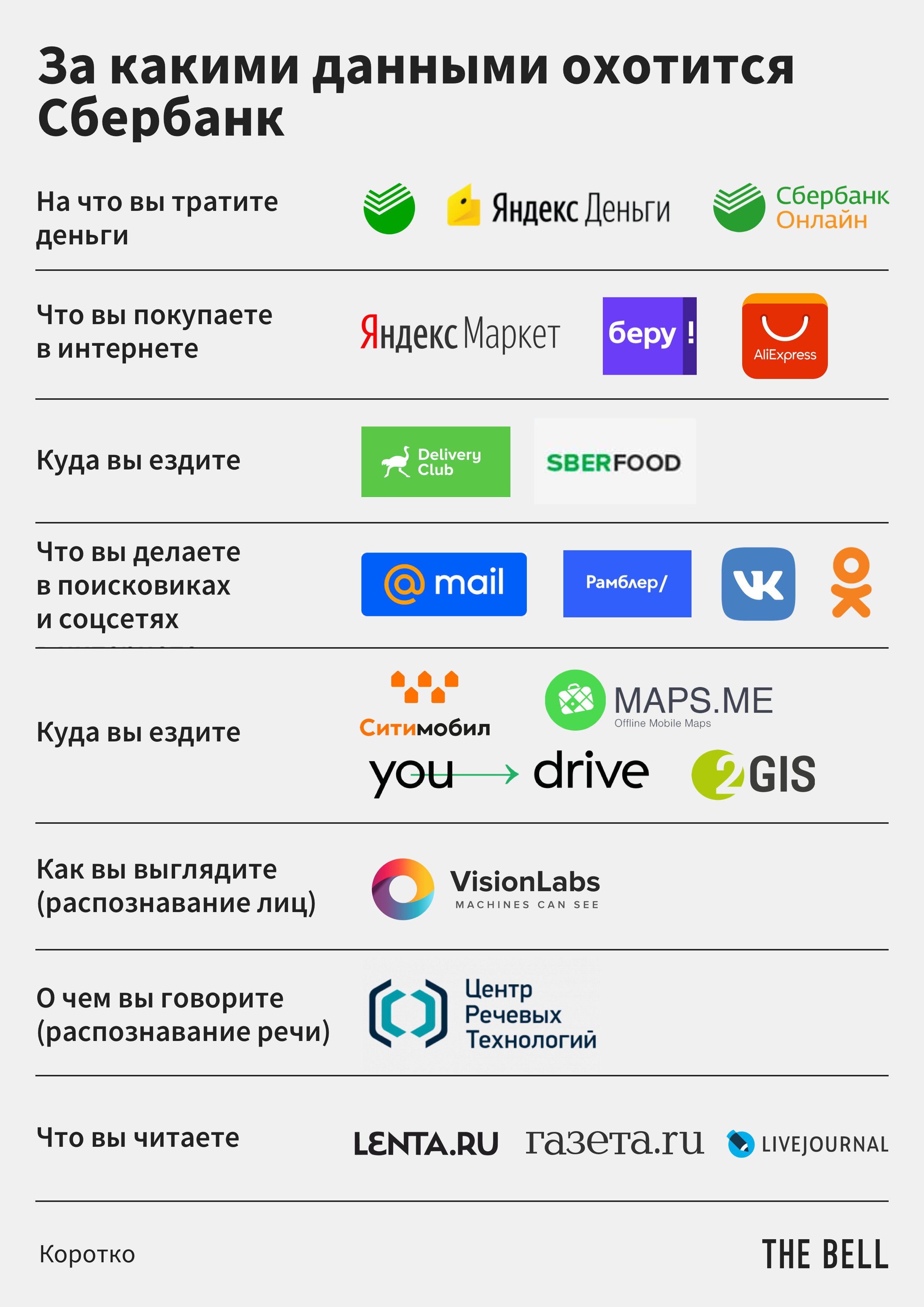
How Sberbank and Mail.ru Group will interact is not yet known, but the analysts surveyed by The Bell have no doubt that their ecosystems will be close.
If there are no conflicts between the partners, the integration will become more and more dense, says Vladimir Bespalov, an analyst with VTB Capital.
“Mail.ru Group builds everything around VKontakte-creates a mini-applications with many services inside the social network. Sberbank - around financial services. But at the same time, it is easily possible that if you order a taxi through VKontakte and through Sber, then the Citimobil will come to you, ”says Raiffeisenbank analyst Sergei Libin.
Lonely "Yandex"
The Alliance of Sberbank, Mail.ru Group and Rostec in Runet only one competitor - Yandex. According to the coincidence, literally the next day after Sberbank and Mail.ru Group announced strategic partnership in July, Yandex facilitated serious problems: deputy Anton Gorekin introduced a bill on the ban on foreign possession of “significant Internet resources” to the State Duma.
- Gorelkin proposes to ban foreigners to own more than 20% of shares in significant Internet companies. The bill did not define the criteria of “significance”. In theory, both Yandex and Mail.ru Group fall under the theory. In practice, even Gorekin himself does not hide that the main goal of his project is Yandex. The deputy recognized this in his Telegram channel
- The relevant State Duma Committee will consider the bill of Gorelkin in November, promised the head of the committee Leonid Levin. Then he will be sent for the first reading. While the struggle continues around the project. In early October, The Bell wrote that the bill in the current form supports and promotes the presidential administration. In mid -October, the government sent its review to the State Duma, in which it proposed to soften the project: to increase the permitted threshold of ownership to 50% minus one promotion and extend the ban only on voting papers.
- Yandex investors understand this well that the news about the bill of Gorekina excites them much more than even reports of Sberbank billion investments in competing companies. After the July news that Sber will invest almost $ 1 billion in Mail.ru Group projects, Yandex shares fell by 4%, but quickly recovered. Yesterday's deal of Sberbank with Mail.ru, they almost did not notice at all. And after the news about the discussion of the Gorelkin project in the Duma and his support in the Presidential Administration, Yandex collapsed by 17% and has not recovered so far.
In what option is the bill will be adopted in the end-it is not clear, but in the fact that in some form it will be approved, neither government officials nor sources of The Bell, familiar with the course of its discussion in the Kremlin, doubt it. One of the latest meetings was held by the deputy head of the presidential administration Sergei Kiriyenko at the end of last week, two interlocutors of The Bell say. The decision was not made, one of them says.