
Translated material
Farewell, 2010: how Russia has exchanged economic growth for stability
2020 completes a strange decade, which for Russia began with hopes for rapid growth, and ends with a deep stagnation. Economists call it a lost decade, when the average growth rate of the Russian economy did not exceed 1.8% of GDP per year. In the absence of growth, the authorities are proud of stability, but they cannot but understand that the protracted stagnation only increases social tension.
Two different decades
“The Russian economy is in a swamp, so it cannot fall from the cliff,” said the project “Russian norms!” Chief Economist EBRR Sergey Guriev. The lack of economic growth is the main difference between the stagnant 2010s and the masters of the 2000s. In the first decade of the 21st century, Russia entered with a tremendous growth rate: 10% - in 2000, 5-8% each in subsequent ones. The second - ends with modest 1.8% (on average).
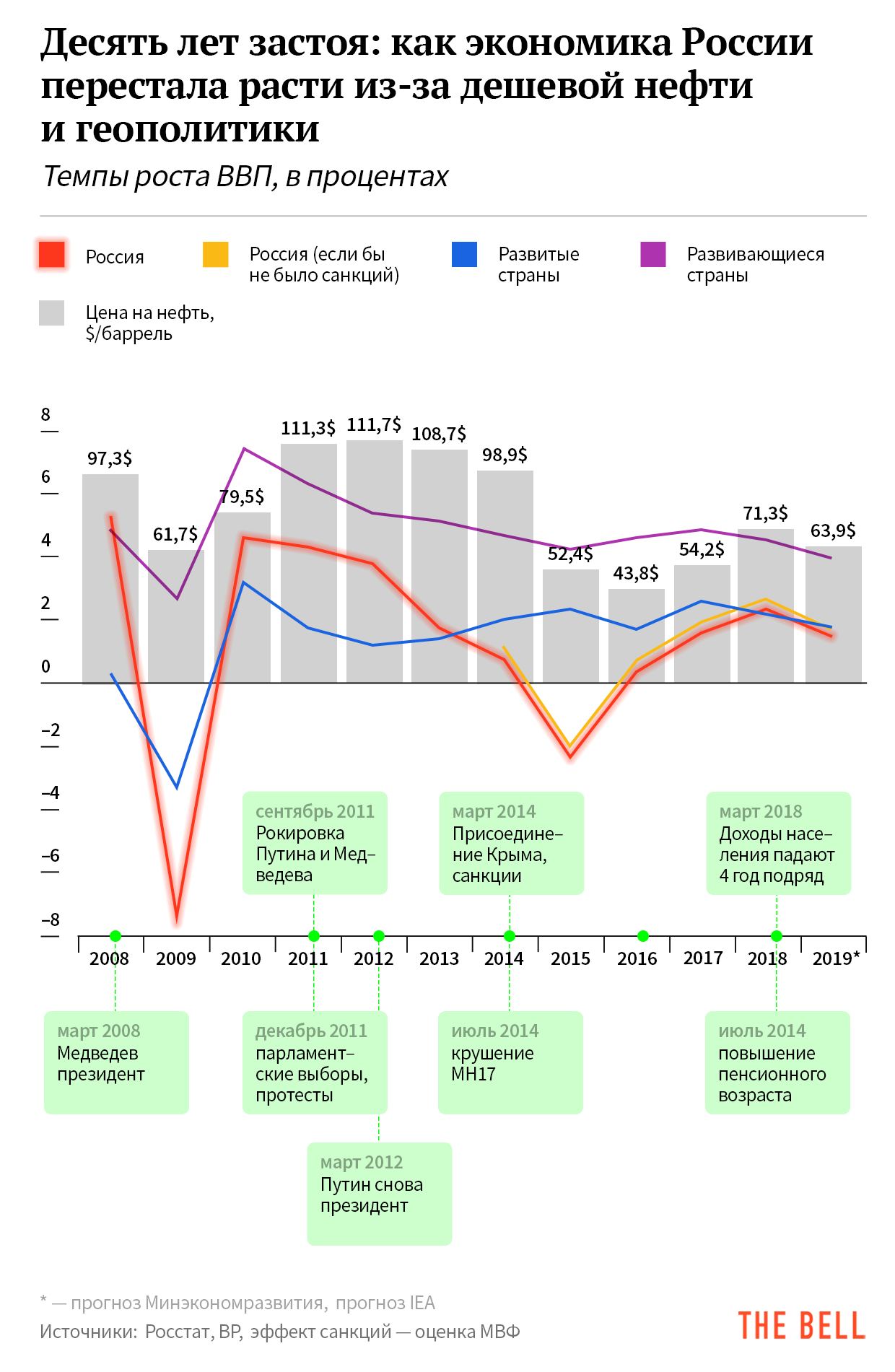
The reasons for the bing of the zero, which Guriev calls the most outstanding period in Russian history after the NEP, are well known. From a third to half the growth of zero is explained by expensive oil. Prices jumped from $ 12 per barrel in the late 1990s to $ 110 by the end of the 2010s. Nefteedollars dripped into the budget and a stab fund, which was prudently created in 2004. This made it possible to increase the expenses of the federal budget and practically pay on public debt-it fell from 92.4% of GDP in 1999 to 7.5% in 2008.
At first, not only expensive oil, but also market reforms helped growth. The progressive tax scale with a maximum rate of 35% replaced flat, the deposit insurance system appeared. Exhausted by the crisis of the 1990s, the Russians finally exhaled. Against the background of market reforms and the first investmentrating in the Russian history of the country, foreign investments flowed into the country. For ten years (until 2008), GDP per capita almost doubled, there were half the poor, unemployment also doubled.
But the more the country received the oilollars, the less the authorities had incentives to continue reforms. After the crisis of 2008-2009, all the concepts of liberal reforms that fell on the table of Vladimir Putin remained on it. The reforms of the previous decade were implemented only for a third. The authorities did not start the most important reform - the reform of public administration, German Gref lamented in 2010.
The state of the state in the economy began to grow sharply. In 2007, state corporations appeared - together with the trend for growing new “national champions” in different industries. The fact that private companies around the world are more effective, no one wanted to hear. “Great privatization”, which Kudrin and Gref spoke about, never happened, over time, was simply forgotten about her.
“We very sharply moved from the paradigm of the rapidly growing economy of the developing market to a stagning European economy with low growth rates. From China, they sharply slipped to Germany, only the income level remained three times lower. ”
Marseille Salikhov, Director of the Economic direction of the Institute of Energy and Finance of the Higher School
The crisis of 2008 and 2009 was a difficult, but not the last test. After the accession of Crimea and the outbreak of war in the east of Ukraine, the Russian market again became toxic for foreigners, and large Russian business realized that international ambitions can be forgotten. The distrust of the business in power, the chronic outflow of capital, the growth of the ineffective public sector in the economy with the weakening of market and legal institutions have become the main problems of the Russian economy, on the assessment of HSE economists. Further, several factors worked one after another: a drop in oil prices, sanctions and strengthening of insulation. In 2015, GDP decreased by 2.3 percentage points, and since then the growth rate has never reached 3%fixed in the next May decree of Vladimir Putin.
Stability as the main achievement
Oil
The continuous increase in oil prices began back in 2001 from $ 29 per barrel. The most dramatic fall was in 2008-and this poisoned the Russian economy in the early 2010s. In the summer of 2008, one of the analysts Morgan Stanley predicted that oil will rise to $ 150 per barrel to the day of independence in the United States. Rainbow forecasts were also built in Russia - Alexei Miller dreamed of the cost of Gazprom in $ 1 trillion, and the capitalization of oil and gas companies beat records. The collapse began in the same summer - after the mortgage crisis that covered the United States. By December, Urals oil cost less than $ 40 per barrel.
As much as at the peak in 2008, oil never cost. The global crisis was not the only threat to the oil market. He was replaced by a slowdown in the Chinese economy and a shale oil boom in the United States. In 2016, to maintain prices, the main exporters from the OPEC countries had to go to unprecedented measures - actually expanding the cartel at the expense of Russia. The creation of OPEC+, an organized decrease in production and extending agreements on this for several years did not allow prices to collapse again - and this can be considered the main achievement of Russian foreign economic diplomacy in this decade.
Nevertheless, the IMF believes that the drop in oil prices in 2014-2018 hit the Russian economy more than sanctions. Fund economists estimate the negative contribution of oil at a 0.6%decrease in the growth rate of Russian GDP, sanctions-at 0.2%, a tough budget and monetary policy-0.3%. And this is the main evidence that the Russian economy has not been able to finally get rid of the resource curse.
“The budget has untied from oil prices, but not the economy as a whole. If the prices are low - $ 30 per barrel - three years, we can handle it. If five years, it will be difficult. No matter how much we talk about diversification, we are sharpened under the defense and raw materials. ”
Alexandra Suslin, head of the Fiscal Policy department of the economic expert group
The budget deficit is now higher than in the early 2000s. The share of the oil and gas sector in its income has not changed since 2008. In addition to oil and gas, there is the extraction of coal and other minerals, primarily ores, says Salikhov from the Higher School.
Inflation
One of the few indisputable achievements of the outgoing decade, which is not doubted, is unambiguous inflation and floating ruble. To come to this, the Russian authorities burned in the top of the crisis of 2008-2009 about 3 trillion rubles.

The crisis laid the end of almost ten years of prosperity. In addition to external reasons - the global financial crisis and the fall of oil prices caused by him - there was also a significant internal one. The authorities underestimated to what extent the economy was tied to loans of Western banks. By 2008, external debt (mainly corporate) Russia exceeded $ 0.5 trillion. The same amount of gold and foreign exchange reserves. The companies could not pay off, it was also re-wrapped in the West: there was no money due to the crisis.
Then the state came to the rescue, allocating only to banks almost trillion rubles. The Central Bank held the ruble exchange rate, but inflation increased sharply. The consequences were catastrophic: enterprises did not pull the sharply rise in price loans and bankrupt one after another, it caused a jump in unemployment (for a year - by 26%) and a decline in production - its fall in Russia in 2008-2009 was the worst among the 20 largest economies in the world.
The victory over traditional double -digit inflation of the Central Bank and the government managed to win only in 2011 - then it amounted to 6.2%, but by 2014 it returned to two -digit numbers. Then it was finally clear that the currency corridor should be abandoned in favor of inflation targeting. At the same time, they cannot be controlled.
“ The Central Bank had two options: target a course or inflation. Depending on this, external shocks would be reflected within the country either through the high volatility of the course, or through bets "
Natalia Orlova, chief economist of Alfa Bank
In the moment, this decision exacerbated the already catastrophic fall of the ruble, but in the end saved the economy. Low inflation is undoubtedly, the main achievement of the stability policy of the end of the 2010s, the economists surveyed by The Bell agree. At the two thousandth average inflation growth rate was 13.6%, in the 2010s it was half as much, 7%.
“From the point of view of a Russian who receives and spends in rubles, it is more profitable to have stable inflation, not a course. For business, everything is ambiguous, a strong ruble is beneficial for importers, and weak exporters are beneficial. In this sense, a floating course is an honest policy, the Central Bank does not give preferences to anyone. What course was established by the market, it will be. ”
Marseille Salikhov, NIU HSE
Today, low inflation is partly the consequence of the weak growth rate. It also helps that monetary and budget policy are coordinated. Without this, it would be impossible to target inflation. There is an experience of Brazil, where the Central Bank tried to target inflation, and the budget policy was soft-nothing happened, explains Orlov from Alfa Bank.
Virgin budget
Another symbol of stability of the late 2010s is the access to the surplus budget (in 2019, the surplus will be 1.4% of GDP). In 2018, his balance was positive for the first time in seven years. The surplus was laid in the budget and three years in advance at the base price of oil $ 42.4 per barrel. This turned out to be possible primarily thanks to the budget rule (when the outerpan from oil automatically goes to the national welfare fund).
“Now, in 2019, we must be aware that our budget is not in the surplus because our economy works well, but because the budget rule and the price of oil is higher than the base. That is, this surplus is partly random. ”
Alexandra Suslin, Economic Expert Group
Since this year, the budget received additional sources of income thanks to an unpopular decision to increase the retirement age and growth of VAT. Salikhov calls the decision to increase VAT by 2 pp. Premature. Because of it, prices rose, as a result-a demand fell, which was one of the few drivers of economic growth.
According to the Ministry of Finance, in 2020 the budget will receive almost 640 billion rubles from VAT, in a total of 2 trillion rubles in a total of the next three years. “The leadership had the idea of national projects that had to find funding for. There is no need to expect an increase in oil prices, there are no other sources either. Why not take money where it is easiest to find? " - explains the logic of the decision to increase the tax load of Suslin: the price of oil does not increase, there are no internal drivers either.
“There are taxes with a mobile tax base - such as income tax, but there are those where the base is not mobile. Here are the taxes on consumption just such - that is, you cannot take and stop “consuming” or bring “consumption” into offshore. Therefore, if the state needs to quickly raise additional funds to the treasury - taxes on consumption, in particular, VAT are the most obvious choice, ”Suslina argues. Pouring reserves for a rainy day is also very important. The authorities did not forget the two past crises, when the money accumulated in the stabyfond saved us, she concludes.
Contrary to Medvedev, which has become a meme that there is no money, now they are - they simply are not spent. 2019 will become a record for the failure of the budget: in nine months, the budget spent 62.9% of the planned. In early December, the head of the Accounts Chamber, Alexei Kudrin, reported Putin that it would not be possible to spend a lot of spending unprecedentedly - up to 1 trillion rubles.
“The problem is that they want to spend on top, but they cannot below. They are afraid that the prosecutor’s office will come, the FSB. The logic is this: we will not spend - the prosecutor's office will not come. The costs of the strategy “do nothing” relatively small. Everyone is tuned to sit smoothly. "
Marseille Salikhov, NIU HSE
The budget of the next year implies a slight increase in expenses compared to 2019, but to what volume they will be able to implement this time - it is incomprehensible. This means that a positive impulse for the growth of the economy will again be weak, Salikhov states.
The price of stability
Ruble
One of the main victims of the geopolitical ambitions of Russia was the national currency. Over the past decade, it has more than doubled to the dollar: we started 2010 with a dollar over 30, and we finish 2019 with a dollar of 64 rubles. The collapse began in the summer of 2014, and by January next year the ruble depreciated by 105%. At first, the Central Bank tried to restrain the market in the framework of the currency corridor, then he released the ruble into free swimming - a little earlier than he was going.
Then, in the collapse of the ruble, many accused the Central Bank, but for devaluation there were also fundamental prerequisites. For the period 2010–2013, retail lending came over. Since 2013, signals began to receive that the course is excessively strong, the money supply grew too quickly, explains Orlov from Alfa Bank. And then triggers worked: March 2014, a drop in oil prices.
“If there were no external shocks, the Central Bank would try to gently leave the foreign exchange market so that the course could reach equilibrium. In early 2014, my models showed a rate of 20-50 rubles per dollar, I waited for devaluation. But, of course, not on such a scale. ”
Natalia Orlova, Alfa-Bank
The sharpest jump happened on Black Tuesday December 16, 2014. On the night, the Central Bank raised a key rate from 10.5% to 17%, and in the morning the euro and the dollar took off to a record values. OPCs were added to the fire to the fire on the preservation of quotas for oil production and an opaquetransaction with Rosneft bonds. More than 80 rubles were given for the dollar, the euro at all reached 100 rubles - the exchangers even had to buy new scoreboards: it simply did not fit into the old new reality. In the evening of the same day, Muscovites rushed to buy household appliances, electronics and furniture. The excitement was understandable: then the weekly inflation was 0.4% - as before in a month, and the iPhone has risen in just a few weeks by 8 thousand rubles.
For many, the fall of the ruble turned into a personal disaster. The currency mortgages of the 2010s became an analogue of the “deceived equity holders” of the 90s. People whose mortgage payments doubled overnight, and the income remained the same,picked up the Central Bank and chained themselves to the doors of the banks. In 2016, the Central Bank counted 25 thousand currency mortgages, every fifth needed help.
For business, the benefits from the weak ruble were not obvious. For exporters, the effects of winning the devaluation will level the budget rule. In addition, it breaks the connection between oil and trade flows and, as a result, with a ruble.
“What is next? There is a positive and negative views. The advantages are that inflation under control, the money supply grows slowly. The increase in consumption is now 20%, the growth of deposits is 6–7%, that is, the money goes to repay loans, they do not flood the economy. Cons are explained by structural factors. If you do not carry out structural reforms, you will have to catch up the price competitiveness of the course. There are also external factors, shocks. New sanctions, a slowdown in China, trade wars. "
Natalia Orlova, Alfa-Bank
Investments in Russia
The risk of investment in Russia after 2014 became “prohibitive,” one of the most successful Investbankers in Russia, Ryr Simonyan.
In absolute terms, now in fixed assets they are invested twice as much as ten years ago. But the growth rate of these investments is very low. In the 2000s, the average growth rate was above 28%, in the 2010s-just below 10%. Twice in recent years, growth rates were generally negative: in the post -crisis in 2009 and 2015.
The volume of direct foreign investment in Russia in 10 years has decreased by 10 times, to $ 8.7 billion, and continues to decline. In 2018, they accounted for 0.5% of GDP, in the previous five years - an average of 1.8% of GDP. The investments into the authorized capital of Russian companies (a hundred times compared to 2008) and the volume of reinvested funds (approximately doubled) collapsed.
This is primarily due to geopolitics: because of possible risks, foreigners are afraid to go into capital. In addition, the economy in Russia is growing slowly, we do not have many projects in which foreigners could invest, explains Oleg Shibanov, Professor of Finance Rash. The volume of direct foreign investment in Russia is relatively small, before the sanctions it could provide several large one -time deals, explains Andrei Movchan from the Moscow Center of Carnegie. There have been no such transactions for a long time and is not expected.
The Central Bank calls another reason: it is likely to return to Russia-despite all the efforts to deoffshorization-less and less funds from abroad. Previously, with a large outflow of capital abroad, there was a comparable tributary to Russia. He was largely explained by transactions through offshore. Now there are fewer of them: the influx of foreign investments fell from offshore zones, primarily with Cyprus. The net outflow of capital there amounted to $ 7.9 billion in 2018. “I will not call you reasons, but specific names and companies: Michael Kalvi, Nginx. Any investment is falling because of such things, ”says Movchan.
Other materials of the “Farewell, 2010s” cycle:
- How citizens of Russia were deprived of participation in political life
- Economist Natalia Orlova - About the fall of the ruble from 30 to 65 per dollar
- “From China, we sharply slipped to Germany”-economist Marcel Salikhov about the results of the 2010s
- How pirate Runet turned into a sovereign
- As a crisis and a quarrel with the West, a venture market was changed