
Translated material
Farewell, 2010: how pirate Runet turned into a sovereign
2020 completes a strange decade, which for Russia began with hopes for stormy growth, but ends with a deep stagnation - but not in Runet. Over 10 years, the Russians moved on the Internet, their national champions appeared in the country, and the digital economy has grown spite all the crises by almost an order of magnitude. But at the end of the decade, the state took up the Internet and is no longer going to leave it.
How Runet has grown over 10 years
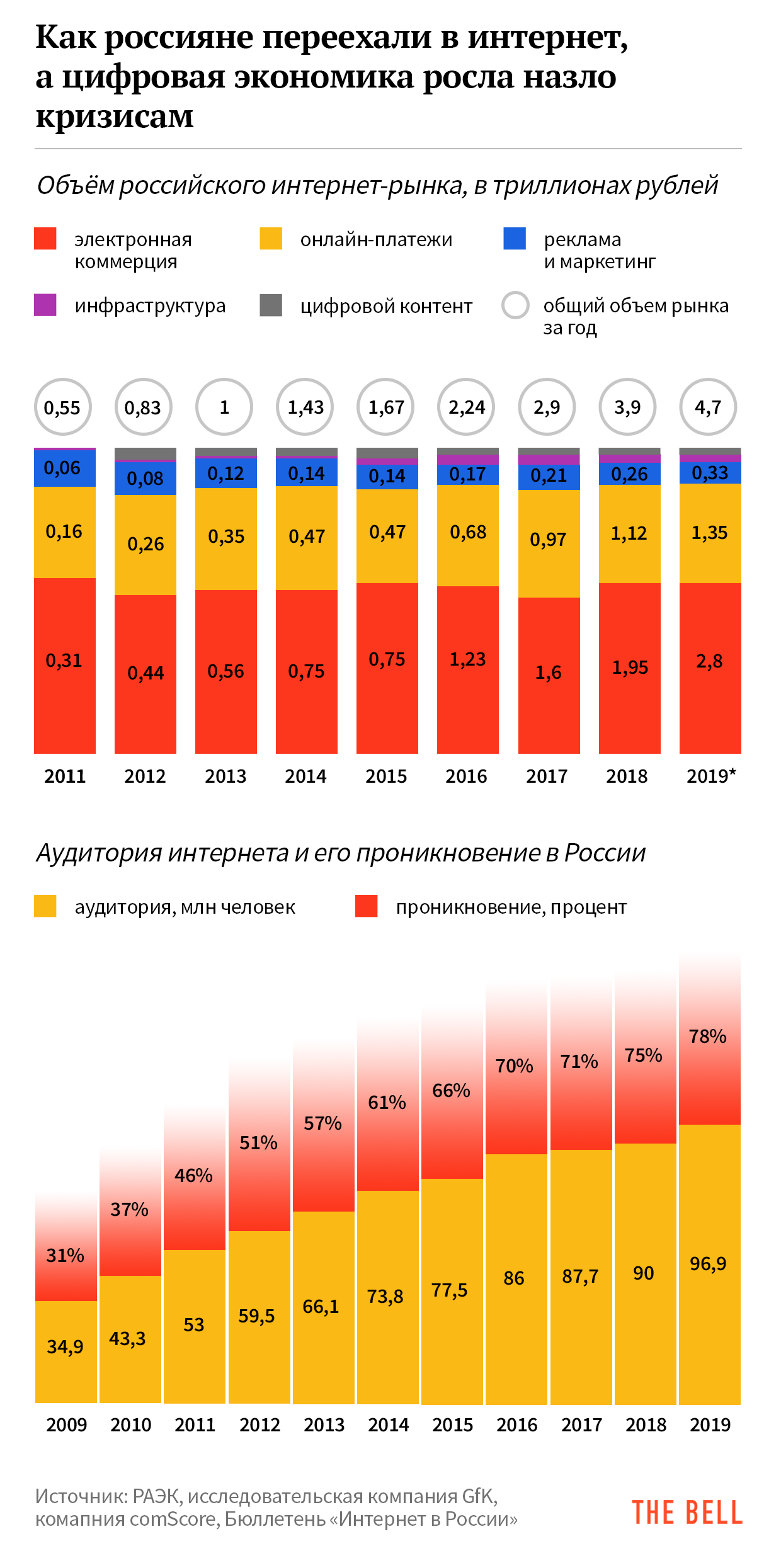
In the early 2010s, Runet was already quite large, but on the scale of the economy of the whole country is still inconspicuous. The Internet in 2009 had less than 35 million people. Only half of them entered the network every day. In the rating of the level of citizens' access to the network, which was the International Union of Electric Communications, Russia took only 48th place.
After 10 years, the Runet audience has 96.9 million people, 85 million of them constantly use the Internet from smartphones. But this is not the limit for growth: the penetration of the Internet in Russia has not yet reached even 80% (in 2009 it was estimated at 31%).
The volume of the Russian Internet market (it has been estimated for nine years by the Russian Association of Electronic Communications-RAEK) from about 500 billion rubles in 2011 to 4.7 trillion rubles in 2019, that is, almost 10 times.
- The revolution in the field of contactless and Internet payments led to a nine-fold increase in e-commerce (2.85 trillion rubles according to the results of 2019) and eight-fold-electronic payments (1.35 trillion rubles).
- Digital content, from films and applications to subscriptions to services and intra -game purchases, estimated at 28.6 billion rubles in 2012, is now sold four times more actively and has reached 115 billion rubles.
Runet also has a growth supply. As the growth rate of penetration is shown, digital expenses grow much faster. Every year, connected Russians are increasingly spending funds on digital substitutes for offline goods and services.
How Runet has changed
Internet companies went offline
In the 2000s, Runet leaders were portals. Yandex, Mail.ru Group and Rambler earned on the digital habits of Russians, helping them look for on the network, read e-mail, create web page and store files.
In the next decade, both a group of leaders and their strategies changed. The one who satisfied won - mainly with the help of mobile devices - offline requests. Yandex in the mass consciousness is already more likely to be associated with a taxi call or food delivery than with a search. Mail.ru Group - with social networks, the same delivery of food (Delivery Club), and also with multi -user games. Telegram Pavel Durov satisfied the mass request for private correspondence.
Runet, in the zero almost completely desktop, is now divided between mobile and payment providers. Almost 50 million people use the Sberbank Online application monthly. The “own” Runet from the subscribers of a large four cellular operators. “Rostelecom” at the infrastructure level captures the home space, providing a set of services that include the symbol of the tenth years: Video Stracing.
Read also the battle of the ecosystems: Yandex and Sberbank entered into the struggle for every Russian
Piracy has become stupid
At the beginning of the decade, piracy seemed invincible. On the computers just collected by acquaintances, they installed a pirate software. The sale of pirate discs flourished. The spreading torrents gave access to any content, and it seemed that this would never change. But only ten years passed - and companies taught us to pay for films, music and books. And even the preserved level of piracy, rather, plays the hands of content manufacturers: while some people are pumping pirate copies and advise friends, others are more willing to pay for the same content.
Such a striking change occurred for four reasons.
- Table computers and laptops began to be sold at prices that were suppressing collectors, and Microsoft successfully transplanted many users to free Windows. Especially lucky for those who bought a PC in the store - this set a habit for years to come.
- Application stores in mobile devices turned out to be much more convenient and easier than relatively complex alternative installation methods for the user.
- Streaming of video and audio content was more convenient than downloading and collecting his own library. As a result, getting a file has become more difficult. Millions of Russians chose to pay 150–450 rubles per month - and not to suffer.
- Games stores appeared (first of all - Steam), which allowed to download digital content on a desktop computer at prices comparable to the cost of pirate copies.
The state became interested in the Internet
On zero, the Internet was perceived as a marginal freemen. Nevertheless, the technology underlying the basis could help build an “electronic government”, which could greatly simplify public administration.
The idea of an electronic government, if not failed, then over the past years has changed beyond recognition.
- Officials still do not like a digital environment so much (the idea of creating a special environment is still being worked out ).
- But the Russians received the “State Services” portal and similar regional portals. All this significantly reduced the number of contacts with bureaucrats and simplified the receipt of documents in standard situations.
- With the growth of the importance of Runet, the authorities became interested in the possibility of its regulation. After the foreign policy crisis of 2014, much more state initiatives concerns control over citizens than to simplify their access to state data. The main online trend of 2019 - an attempt to guarantee, if necessary, the insulation of the Runet from the global network - demonstrates the government course in the field of electronic government.
Read also sovereign Runet: Survival Instructions
The state came to every smartphone
Objective reality: in the rune of the late 2010s there are more and more the state. And it is not only about the law on the “sovereign rune”, with the help of which we can once leave us without access to the global network (unless, of course, they allow technology, so far the “sovereign Runet” tests are unsuccessfully ). Among other things, the state is now going to control which applications will stand in your smartphone after buying.
The state directly or indirectly comes to private companies. These are the changes in the top three of the largest players in the Russian IT market of the late 2000s:
- Rambler sold to Sberbank.
- Mail.ru Group first passed under the control of the structures of Alisher Usmanov, and now she also has become a strategic partner of Sberbank.
- The market leader, Yandex, was forced to come up with the “public interests” fund this year in order to remove the authorities of the company's composition of the company's shareholders and the opportunities to control it on issues that are most exciting state.
Pavel Durov, who preferred to develop his Telegram and cryptocurrency to it outside Russia, stands apart even before the confrontation with Roskomnadzor and the FSB.
Other materials of the “Farewell, 2010s” cycle:
- How citizens of Russia were deprived of participation in political life
- How Russia has exchanged economic growth for stability
- Economist Natalia Orlova - About the fall of the ruble from 30 to 65 per dollar
- “From China, we sharply slipped to Germany”-economist Marcel Salikhov about the results of the 2010s
- How pirate Runet turned into a sovereign
- As a crisis and a quarrel with the West, a venture market was changed