
Translated material
Farewell, 2010s: The results of the decade in the special project The Bell
Farewell, 2010s: The results of the decade in the special project The Bell
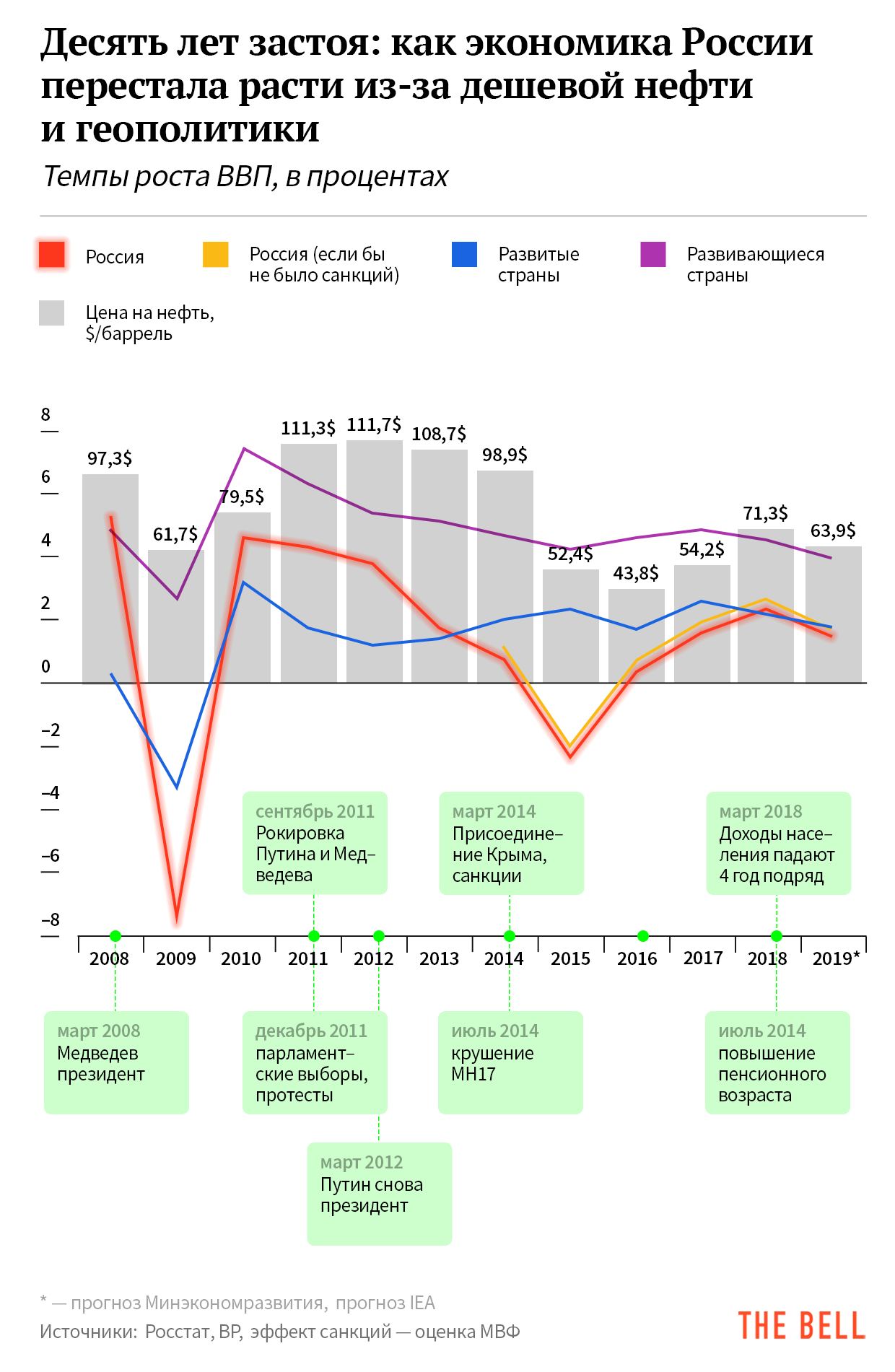
While everyone is summing up the results of the year, we decided to take it wider-look at the 2010s, with which it is also time to say goodbye. 2020 completes a strange decade, which for Russia began with hopes for rapid growth, and ends with a deep stagnation.
How Russia has changed the growth of the economy to stability
Economists call the 2010s a lost decade , when the average growth rate of the Russian economy did not exceed 1.8% of GDP per year. Attempts to reach the mid -Issue growth level were unsuccessful, and stability was the main conquest of the decade. In the conditions of sanctions and international isolation, there really is something to be proud of - the authorities have learned to smooth out external shocks much more effectively, but stability turned out to be their costs.
- About the main conquests and victims of economic stability - we talk in detail here .
- The chronicles of the ruble, which collapsed from 30 to 65 per dollar, was restored by the chief economist of Alfa Bank Natalia Orlova for our special project.
- And about how, from the point of view of the trajectory of economic growth, Russia “sharply slipped from China to Germany,” said Marcel Salikhov, director of the economic direction of the Institute of Energy and Finance of the Higher School of Economics.
The main victim is middle -class income
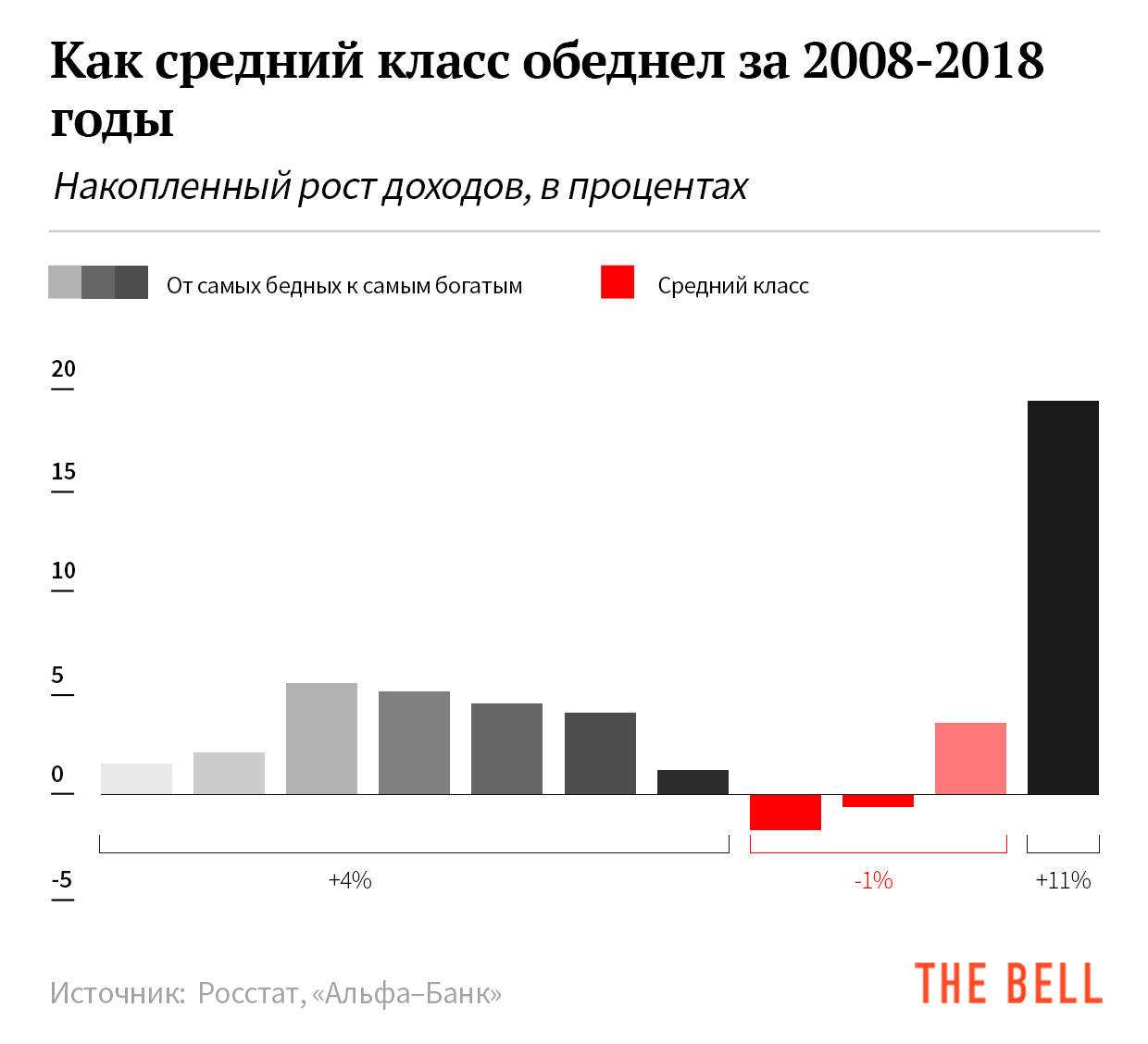
Everyone suffered from the fall of the ruble and slowing down the economy, but the middle class was the main victim of the 2010s-over ten years, Russia lost its almost fifth part of it. In 2014, 37% of Russians could be attributed to it, today-only 30%, the economists of Alfa Bank calculated. Over the same period, the income of the poorest grew by 4%, the richest - by 11%, and the average class income fell.
Business - walking on the spot
In 2012, Vladimir Putin instructed Russia to get up in the Doing Business rating from 120th to 20th place, in 2019 Russia became the 28th. But a comparable jerk in Russia itself in Russia has not happened for this decade, except in some of its areas (the main one is in Runet). According to 2018, the share of small and medium -sized businesses in Russian GDP did not reach 20% against 40-50% in developed countries. Stepping on the spot is clearly visible and if you look at the dollar capitalization of the largest Russian companies from different sectors: since 2014, Sberbank, Rosneft and Yandex played their cost - but only the capital has increased significantly with the latter. Since 2010, Gazprom has almost doubled in dollars in dollars, X5 Retail Group - lost two billion.

The main characters are IT Business and Runet
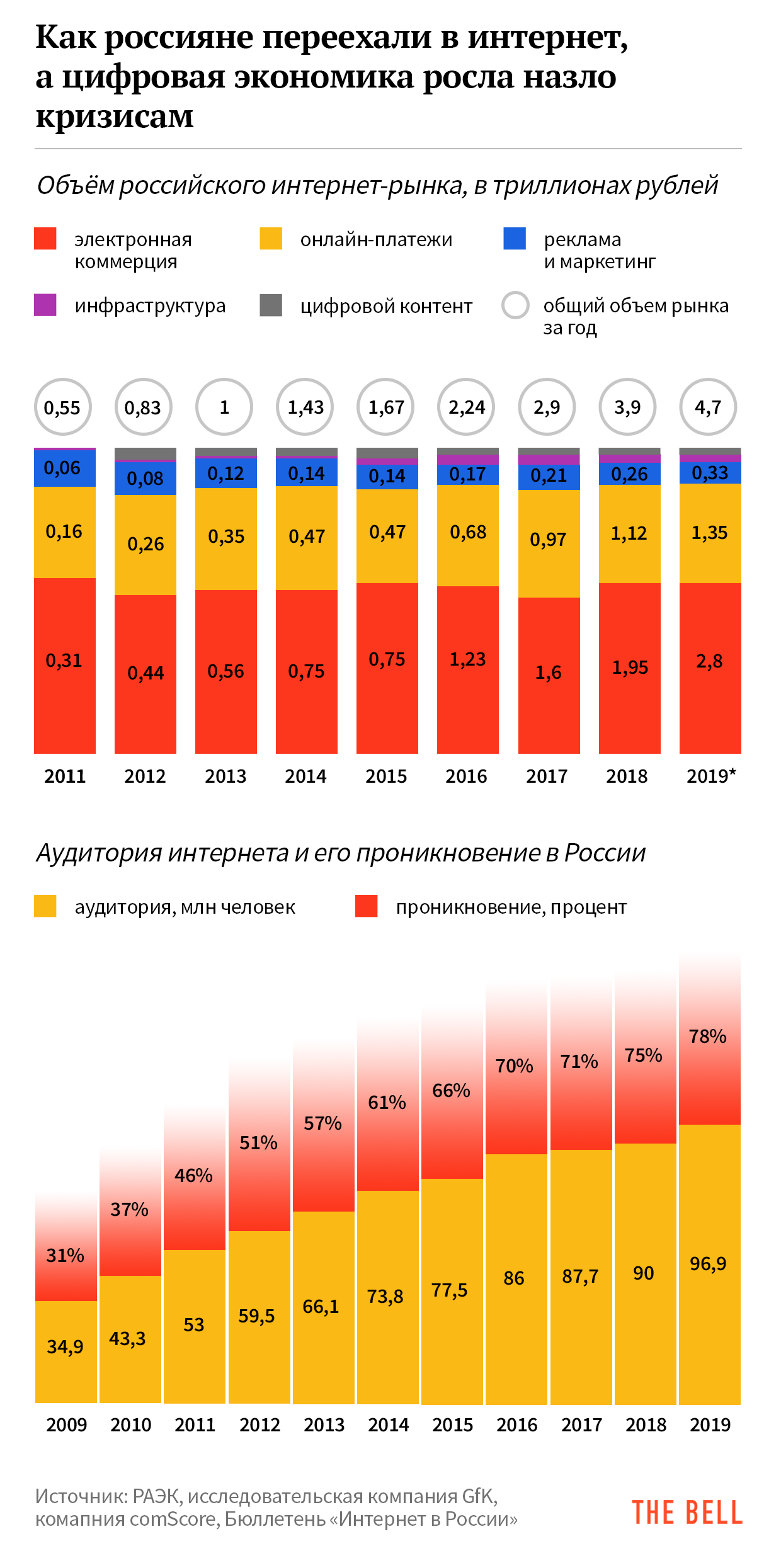
In the early 2010s,Runet was already quite large, but on the scale of the economy of the whole country is still inconspicuous. The Internet in 2009 had less than 35 million people. After 10 years, the Runet audience has 96.9 million people. The volume of the Russian Internet market increased from about 500 billion rubles in 2011 to 4.7 trillion rubles in 2019, that is, almost 10 times. The revolution in the field of contactless and Internet payments also led to a nine-fold increase in e-commerce (2.85 trillion rubles in 2019) and eight-fold-electronic payments (1.35 trillion rubles).
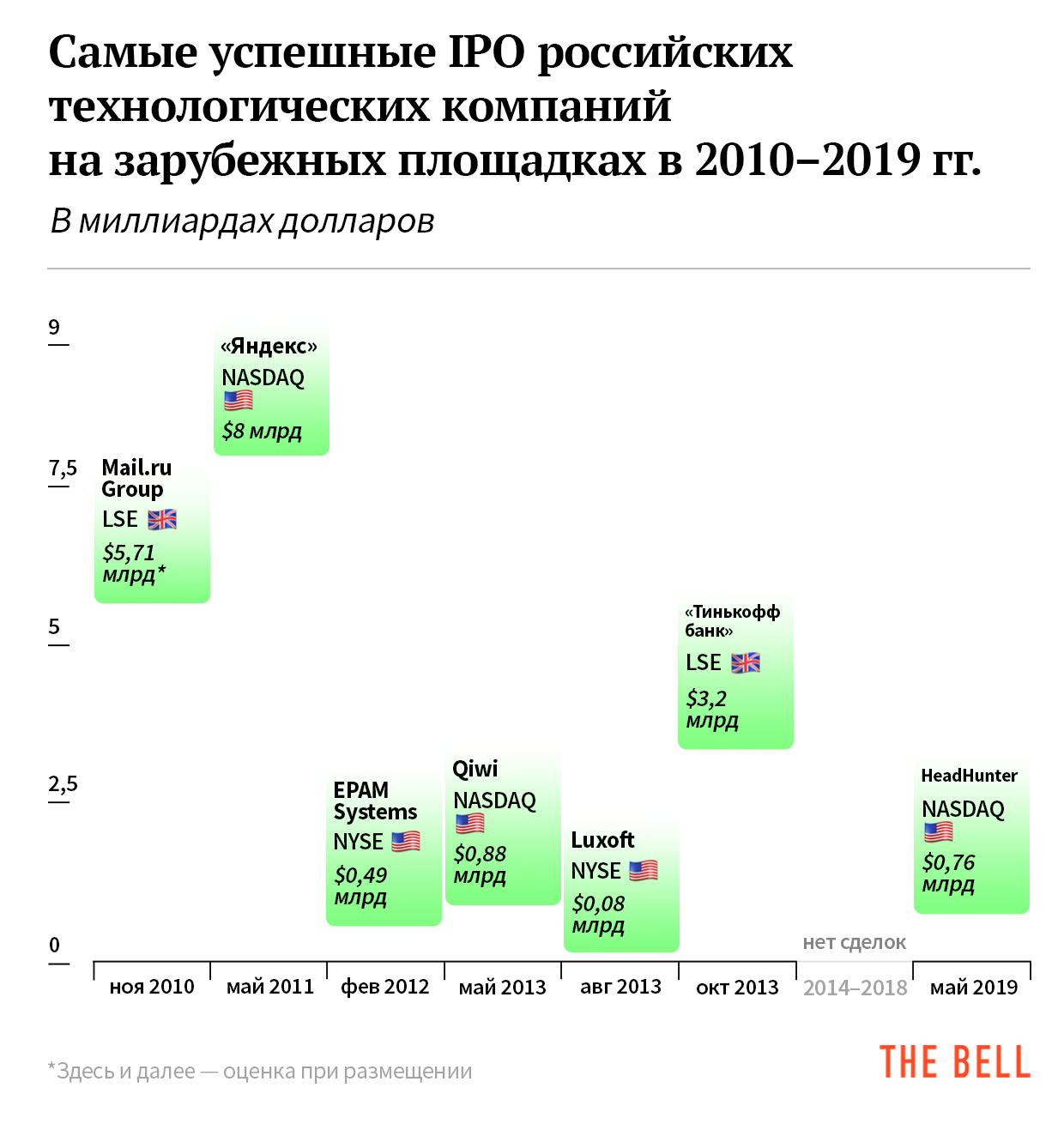
The first years of the decade - the time of the triumphal IPO of Russian technological companies at the main foreign venues, the paper in the fintech is the area in which Russian banks turned out to be better than Western competitors, and the appearance of startups, some of which were lucky to become global companies (which is one Telegram Pavel Durov).
The line of the 2000s and 2010s is the time of the formation of the Russian venture market . In 2012, only private venture funds, according to the Russian Association of Venture Investments, invested $ 376 million in startups. The total volume of transactions, according to EY, exceeded $ 1.2 billion. In Europe, the startups attracted more money in the UK: $ 1.8 billion. But the time of great hope ended in 2014 - simultaneously with the accession of Crimea, falling. oil prices and a new crisis in the economy. The venture market has not been able to recover so far-now this segment, according to Leonid Boguslavsky, is “alive, but hard and is somewhere between the resuscitation and the chamber of intensive therapy.”
Partners The Bell
Network dangers of business
Affective at first glance letters open to the WiFi networks and download their own employees are the most common channels through which cybercriminals can reach your business. In the framework of our special project with the Kaspersky Laboratory, we prepared a cheerful (although somewhat painful for those who have already had to face viruses) a test that will help to figure out which cyber attacks really threaten your company.
Russia and the West - fear and distrust
In relations between Russia and the Western world, probably the most dramatic changes occurred. At the tenth of the tenths, Barack Obama, who had just taken up the post, announced a reboot, Hillary Clinton and Sergey Lavrov pressed the famous Red button, and Dmitry Medvedev dined in Silicon Valley either with Arnold Schwarzenegger, then with Steve Jobs. Now we are under international sanctions, 3-4 million disadvantages have appeared in the country, and the image of Russia in the world is bad than ever.
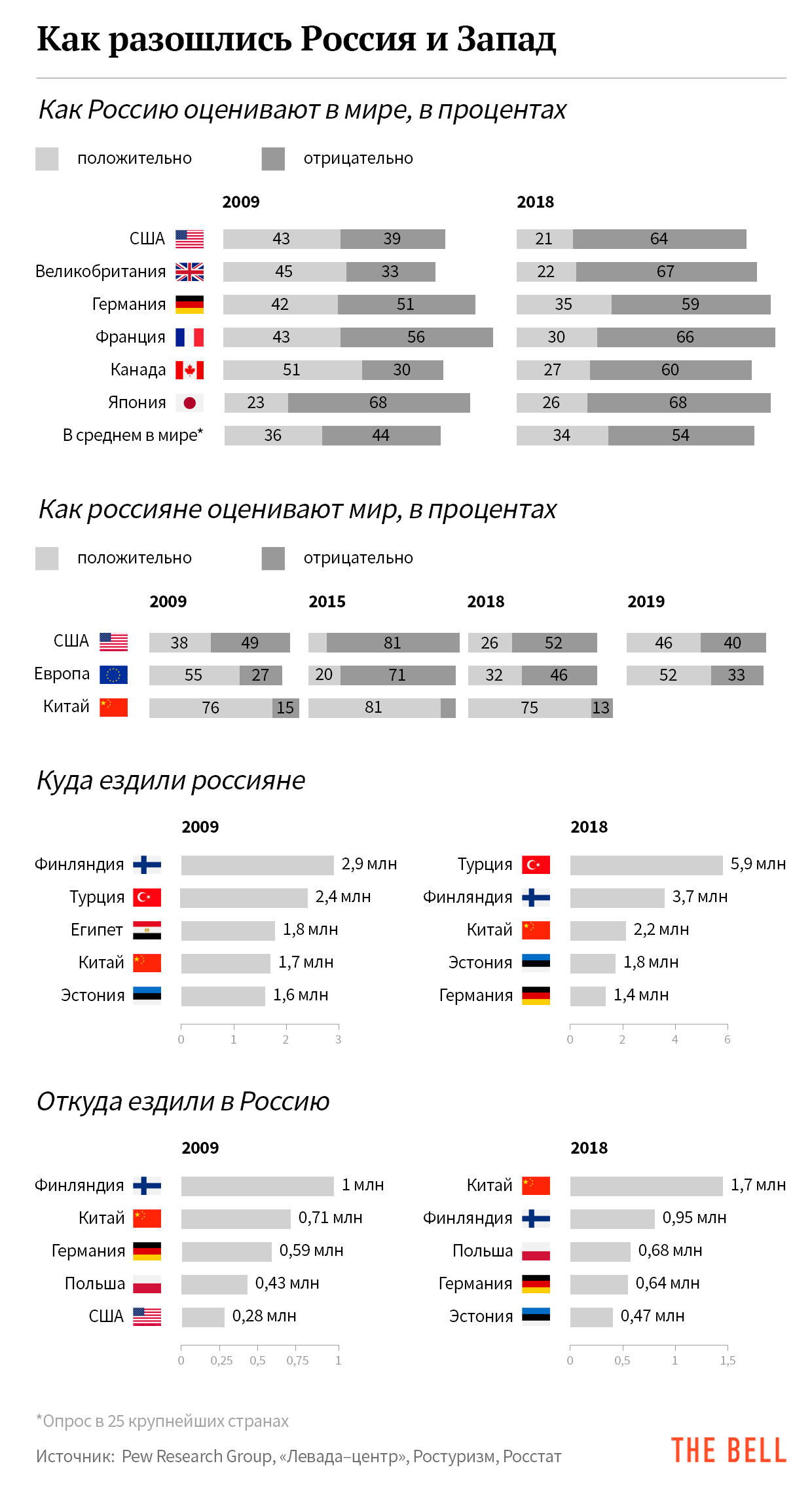
- Partly, Vladimir Putin achieved his own: 48–52% of residents of the largest Western countries believe that the role of Russia in world politics has grown. But the growth of influence does not mean that you are more loved, the sociologists of the PEW Research noted in their review: in 2018, 54% of respondents all over the world announced bad attitude towards Russia (in 2009 it was 44%). In Western countries, this figure fell by dozens of percentage points.
- The Russians turned out to be more “waste”: after the failure in 2014-2015, by 2019, their attitude towards Europe and the United States returned to the pre -crisis -level. Russian public opinion is incredibly adaptive to the television picture, the phenomenon was explained by the phenomenon by political analyst Fedor Lukyanov. Denis Volkov, Deputy Director of Levada Center, says that people are tired of conflicts and hope to discharge with the West. But the answers about the general attitude always depend on what is shown on TV, he warns. For other questions - for example, about the role of the United States in the world - people have been answering negatively for many years: Western countries are afraid, they are not trusted.
Politics - how citizens were expelled from the process
The end of the 2000s met with optimism: the economic crisis is overcome, nothing threatens the stability of the system. But since the beginning of 2011, the schedule of the popularity of Putin, Medvedev and United Russia began to reflect the difficult struggle for ratings. For Russians, she turned into an almost complete ban on participating in the country's political life, not agreed with the authorities.
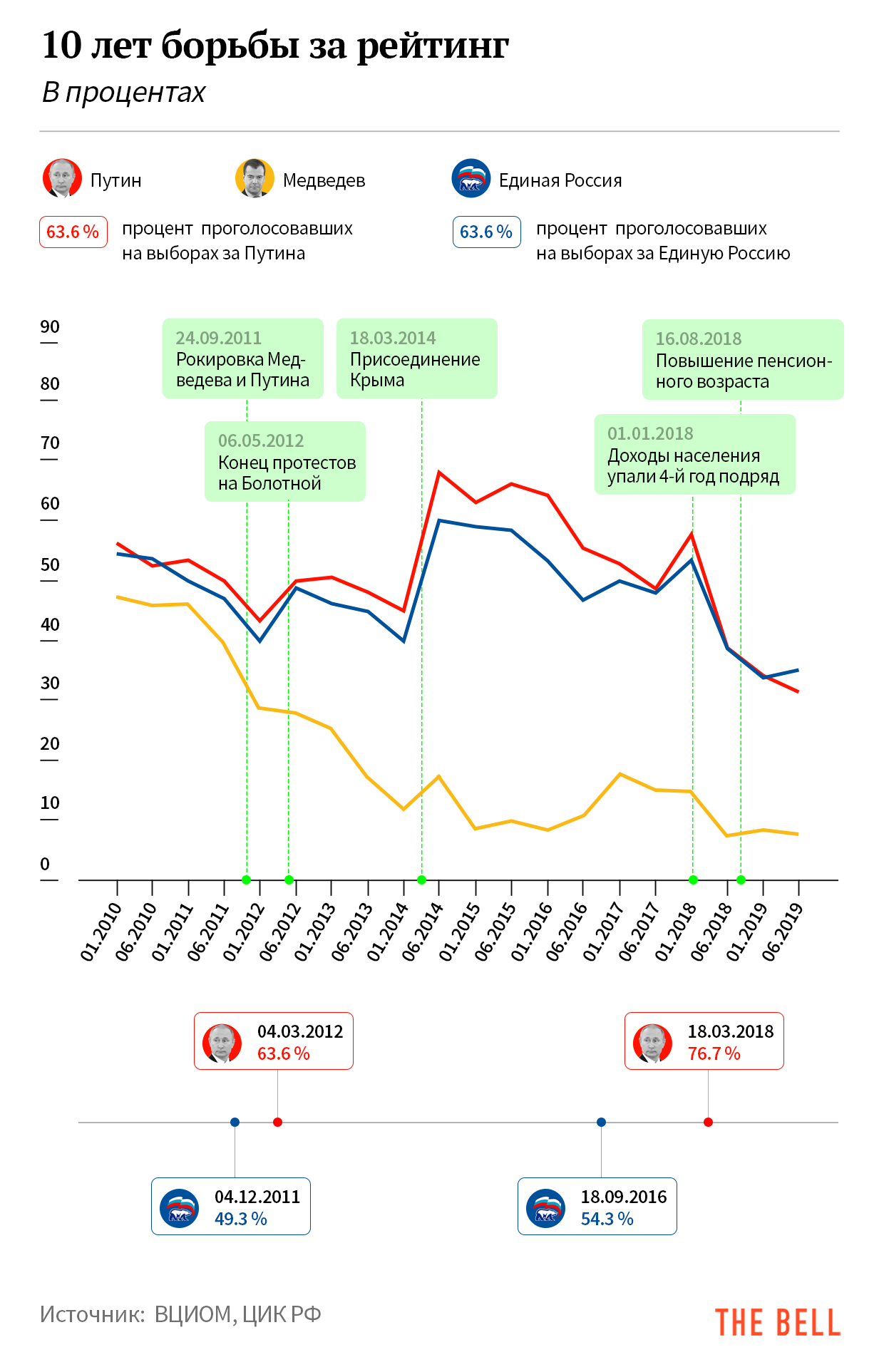
- In the rating of countries in terms of democracy of Economist, Russia finished 2010 in 107th place, 2018- in 144 .
- New legislative prohibitions have spread to almost all political and near political spheres: elections, freedom of assembly, independent press and any criticism of power. The fact that we could not have become in 10 years, we talked in detail here .
- But twisting the nuts allowed to restrain, but not to reduce the protest potential: in 2010, VTsIOM estimated it at 33%, in 2019-at 35%. The 2010s in Russia began with mass protests in Bolotnaya, and end-mass protests against abuses in the elections to the Moscow City Duma and successful public campaigns, thanks to which, for example, Ivan Golunov and Pavel Ustinov were released.
The final weekly newsletter The Bell will come out the next time on January 10. The last daily morning and evening mailings are December 30. Since January 9, we resume work as usual.