
Translated material
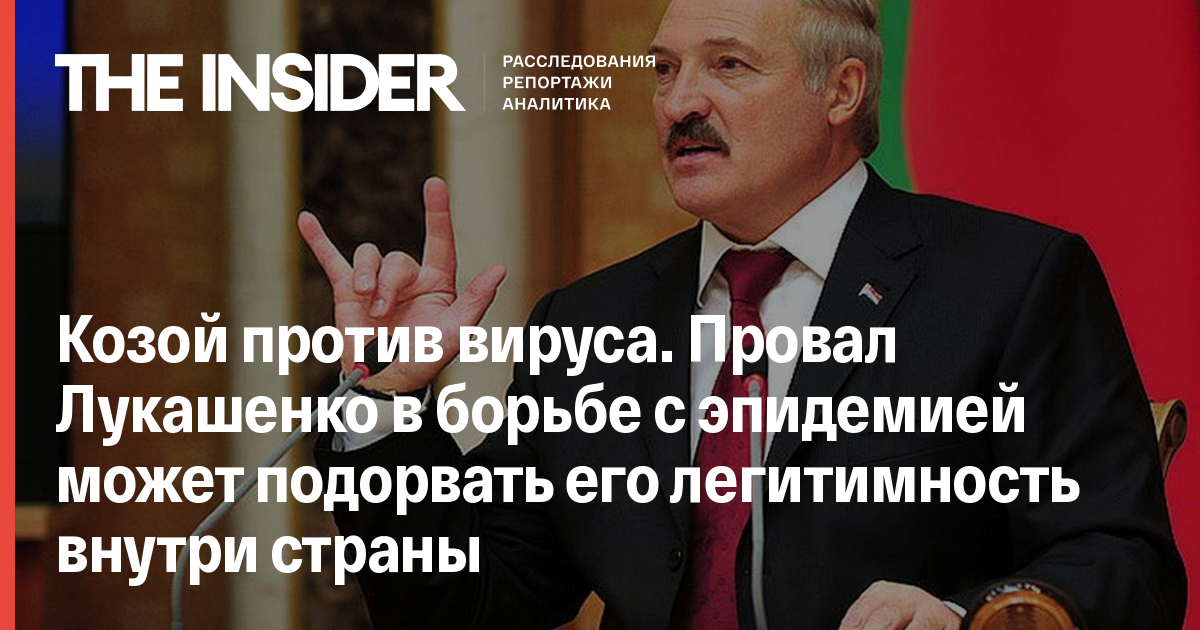
Goat against the virus. Lukashenko’s failure in the fight against the epidemic may undermine his legitimacy within the country
The number of people in Belarus according to official figures on April 21 - 6264 infected and 51 deceased - at the level of the Czech Republic and Ukraine, where, unlike the republic, serious quarantine measures were introduced. Therefore, Belarusian doctors and civil activistsare alarming - they believe that the data is greatly underestimated. Lukashenko created a vicious circle: officials embellish the situation, and the president is convinced of his innocence. The hostages were tens of thousands of people who could die without hard quarantine measures. At the same time, the introduction of quarantine and the refusal of it will seriously hit the economy of Belarus that, together with failure in the fight against the epidemic, can undermine Lukashenko’s legitimacy not only among the wide layers of the population, but also among the ruling class, explains Andrei Eliseev, research director of the East Center.
The Belarusian State Media proudly claim that the republic is not on the way with those crazy countries that introduced “excessive, chaotic, suffocating the already weak world economy of quarantine measures,” and put it on a par with young Korea and Sweden, who chose “reasonable and progressive measures”. But it is impossible to seriously compare the Belarusian strategy for the fight against the epidemic from the South Korean or Swedish. In South Korea, tracking of contacts of infected people is effectively working due to the coordinated work of departments and a high level of trust of people to state bodies, high technologies are massively used, and people regularly inform about the situation with coronavirus. In mid -March, Sweden took systemic measures to reduce contacts between people (and the number of those killed in the country already exceeded 1700). Neither one nor the other in Belarus did.
The recommendation of the Belarusian Ministry of Health to refrain from visiting church services has not been mandatory, so far not all educational institutions have been transferred to remote training, the country's higher national football league continues in the country. The other day, the government adopted a decree on the conduct of a public subbotnik on April 25, and Alexander Lukashenko suddenly stated that there would be no extension of the holidays for schoolchildren and from Monday everything is time for classes. Minsk voluntarily interpreted the conclusions of the WHO mission, which visited Belarus with the inspection on April 8–11. During the final briefing, the head of the Patrick Mission O'Connor said that the current situation in Belarus is concerned: only within three days of the mission in the republic the number of revealed cases of coronavirus infection has doubled. O'Connor urged to abandon mass sports and cultural events, introduce additional social distance measures and warned that the country should be ready for “worst scenarios”.
At WHO, the situation in Belarus caused concern, but Lukashenko did not renew the holidays and called the whole country to the subbotnik
The state media, however, preferred not to notice serious remarks and completely focused on positive passages of the international mission (the work of the epidemic, the presence of laboratories for processing tests, the distinction between patients in medical facilities, as well as the operational organization of local production of protective equipment for health workers). As one of the television channels said, "whoever says and write, WHO fully supports our measures." And this is only one example of that conflicting state policy of lighting the epidemic that can be observed in Belarus. The state media use a whole arsenal of manipulations in order to make fun of “panic”, “psychosis”, “information” around the coronavirus and to lose the danger of the epidemic.
Lukashenko is trying to ignore the epidemic into his PR action, exposing himself to a bold leader, opposing the "universal hysteria." The other day, he said that the farm and small goats could cure any virus: “Yesterday and after the day I went to the farm, I have goats there. Small goats, only the offspring appeared, very small. I open this machine, and there is like snow, all white, small, white-white, like a dressing gown. ” Previously, he already spoke about the tractor, oil, moonshine and the bathhouse as anticoronavirus agents - these statements regularly transmitted state points. There are reports from the matches of the national football championship as “our protest against the pandemic”, and the statements that world leaders have realized their mistake and follow Lukashenko’s example. And the comments of the conspiracy therapists indicating the artificial nature of the virus in the hands of influential external forces as a special operation in order to take possession of Belarusian economic assets. At the same time, they spoke streamlined about external forces, but with a clear hint to the West.
With his installation on the inappropriateness of inflating the danger of the epidemic, Lukashenko set the vector to the entire system of public administration. Officials, apparently, are forced to submit information about the epidemic to the head of state in a softer form, and he, in turn, is even more convinced of the correctness of his line. The Ministry of Health and local authorities, although they have been trying to take additional measures recently in order to slow down the development of the epidemic, but are still not ready to take responsibility entirely. They blame each other, and also emphasize the recommendatory nature of many measures. Officials of the Ministry of Health only shrug the questions of journalists about the form of work or canceling the parade on May 9: they say, these issues are not in our competence. As a result, the system for the most part reproduces Lukashenko’s specified vector and is closed to a very risky both for the healthcare system and the country's population scenario of opposition to the epidemic.
If you believe official statistics, then, despite the fact that social distance measures were introduced unsystematic, late and inefficiently, Belarus today even stands out for the better compared to many countries. If in the same South Korea and Sweden the indicators of mortality (the ratio of the number of deaths to the number of detected cases of coronavirus) today are more than 2% or more than 10%, respectively, in Belarus - supposedly less than 1%. The number of cases of coronavirus in Belarus, proportionate in population with Sweden, is also supposedly almost three times less. In general, out of approximately 150 countries of the world, according to which there are relevant data, no more than 20 mortality rate is less than 1% (Russia has the same wonderful statistics). But even these data (even official, diminished) can significantly worsen in the coming weeks due to unsystematic and belated measures.
Belarus, apparently, is at an earlier stage of the epidemic than other European countries. Recently, an increase in the number of detected cases of coronavirusve of the republic occurs much faster than in many other states, therefore, the consequences of the chosen measures of the fight against the epidemic can be more accurately judged after a few weeks. Minsk is sure that the peak of diseases in any case will occur in late April - early May, and the number of new daily cases will be within 300–400. However, it is possible that this conviction is based more on the good wishes of Lukashenko than on the results of a serious mathematical modeling of the development of the epidemic.
In the Belarusian independent media, there are already many stories about how Belarusians with an established coronavirus infection made a posthumous diagnosis of pneumonia of an unclear typology. Actually, this happened in the very first confirmed case of death from Koronavirus, when the well -known actor Viktor Dashkevich died of Pneumonia of the Unsuality. Lukashenko’s statement that no one died in the country from coronavirus and will not die, responsible for the statistics of a person, obviously, was perceived as a guide to action. State media deleted materials indicating the number of patients with pneumonia in district hospitals. This happened, for example, with the newspaper of the Ushach district (a population of less than 14 thousand people), which on April 16 deleted its note about 53 patients with pneumonia. The heads of medical institutions usually give reporters memorized phrases about the need for appeals for local statistical data either to the ministry or local authorities, and there they prefer not to share such information.
Processing with the introduction of wider and systemic social distance measures can create a situation where the epidemiological situation will get out of control, and Minsk will have to introduce serious quarantine. This is what the Belarusian authorities are so afraid of, because the country has a few economic resources, and the good half of families have no “stoops”. According to the conclusions of the mathematical modeling of the international group of scientists under the auspices of the Imperial College of London, a set of soft measures in the fight against the epidemic can lead to about 30 thousand deaths in Belarus. While the timely implementation of more stringent measures (limiting contacts between people by 75%) is able to reduce the number of deaths to less than two thousand people.
According to the conclusions of mathematical modeling, without strict quarantine measures in Belarus, 30 thousand people can die. With hard - less than 2 thousand
If a poor epidemiological situation is observed in Belarus for a long time, the European Union countries, and Russia and Ukraine can renew the restrictions on entry for citizens of the republic again and again. Then Belarus will be in a conditional blockade ring for an indefinite time. This will hit business and labor migration, which will hit even more on the socio-economic situation in the country. Experts already predict that with the most optimistic scenario in 2020, the country's GDP will decrease by 3.5%, and with worst scenarios-and up to 18%. In addition, if the Kremlin succeeds in successfully cope with the epidemic in the coming weeks, it is possible that he will want to help the “fraternal country”, organizing in that other form a humanitarian mission in unclear prospects for the sovereignty of Belarus. A wave of publications on this occasion on various Russian sites and pro-Kremlin telegrams has already been launched .
A sharp deterioration in the epidemiological situation can critically undermine Lukashenko’s legitimacy not only among the country's population as a whole, but also among the ruling class. Having set the line to undermine the danger of the epidemic, not wanting to limit the conduct of church services and sending the children to school in the midst of the epidemic, he assumed responsibility for all kinds of consequences in the eyes of the electorate and nomenclature. In late August, the next presidential election should be held in Belarus. And although Lukashenko has already publicly rejected the idea of their transfer, the script with the introduction of a state of emergency and their displacement to a later date is still not excluded.