
Translated material
The fourth power in one hand
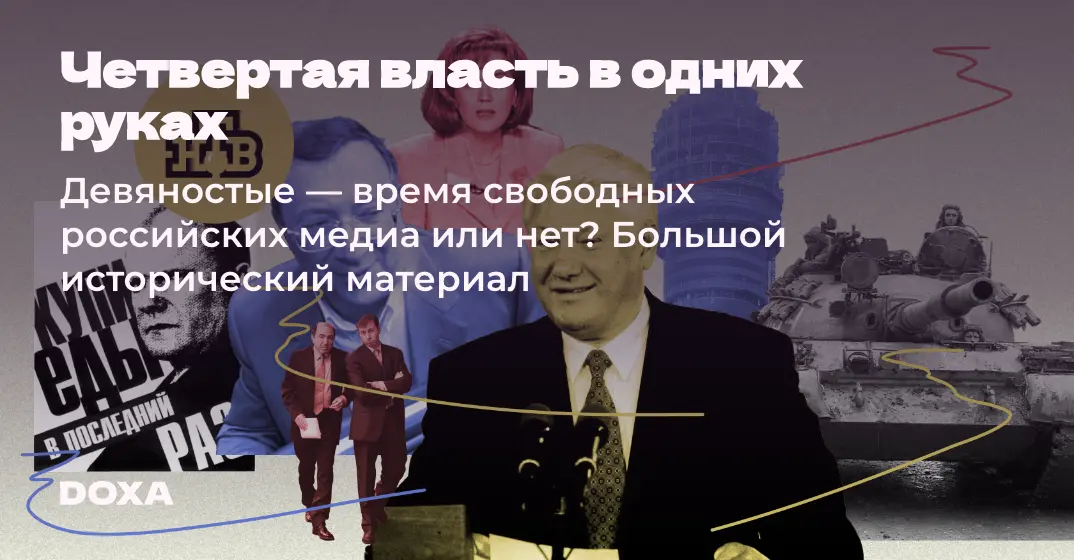
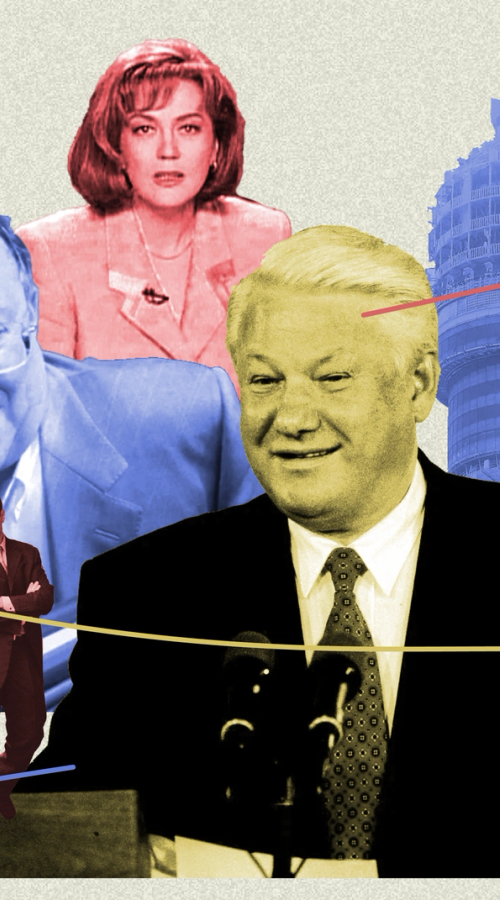
The fourth power in one hand
The nineties - the time of free Russian media or not? Large historical material
On January 25, 2024, Doxa was recognized as an “unwanted organization”.
If you are in Russia or plan to return to it, you can not replace our materials on social networks, refer to them and publish quotes.
Read more about what is possible and impossible, read in the cards .
Russian journalism of the 90s, according to common opinion, existed in conditions of unique freedom. The television channels could criticize the president and issue exposing investigations, the media collaborates received worthy salaries, and officials talked with journalist_ki much more willingly than now. But what if you look at the time at the stage of creating the current information system? Then we will see the origin of those very methods of “managing public opinion”, from which today's state pressure on the media is formed.

Editor
Editor
XX.T.Illustrator
Illustrator
Vitya ErshovPublication
February 2, 2023
The end of the 1980s --1993. The origins of the new media architecture. Manual mode
Device and causes of "publicity"
Back in the Soviet Union, at the turn of the 1980s and 90s, the liberalization of the media began. The press became an ally of Mikhail Gorbachev in the struggle for “publicity” and other reforms. Already during the first broadcasts of the Congress of People's Deputies, “a unique debunking of political power took place on the TV screen [...] people recognized the mechanisms of power that kept secret for so long Rayo Paasilinna wrote, Finnish politician and journalist. PAASILINNA R. Glasnost and Soviet Television, A Study of the Soviet Mass Media and Its Role in Society From 1985-1991. Yle/Tkma Painotuotepalvelu, Ekholmin Kirjapaino // Research Report. 1995 N5, with 148-150 ".
“Reformers - those who wanted changes, and those who believed that they were doing good to their country, rely on the press,” said Gorbachev later.
On June 12, 1990, the Supreme Soviet of the USSR adopted the Law on Press and other media. Its most famous part is the abolition of state censorship. This decision provided Mikhail Gorbachev with great popularity and respect among the opposition public and publications.
The law also established the legal independence of the media. The press turned from a party or trade union unit in an independent actor. Sometimes the owner remained the government, as in the case of the creation of the All -Russian State Television and Radio Broadcasting Company (VGTRK), but in some media the new owners themselves became cooperation, finally embodying the dream of complete freedom from any external instructions. New media were created. For example, in 1990, Vitaly Tretyakov attracted 83 shareholders from the Moscow intelligentsia, who invested a thousand rubles The average salary at that time was about 200 rubles. To create an independent newspaper.
In addition, the development of the media contributed to artificially underestimated prices for all government products, including paper. At the same time, private individuals could sell goods at any price. In the 90th, the newspaper “Arguments and Facts” was introduced into the Guinness Book of Records as a newspaper with the largest circulation in the world (33.5 million copies).

We talk about Russia's military invasion of Ukraine, protests and repression. We believe that now, when dozens of media have closed or ceased to cover the war, access to independent information is more important than ever.
Among the journalist themselves, the popularity of the “fourth power” grew. This concept implies that the media along with state institutions affect politics, and freedom of speech is one of the necessary conditions for building a developed economy. Or, figuratively, the media is “a guard dog, designed to hold the elected officials for their actions This is how the Political Dictionary formulates, but the image of the “Watchdog” (Watchdog) is found in many media materials and academic articles about the media. ".
True, media researcher Ivan Zasursky wrote Zasursky I. Reconstruction of Russia. The media and politics in the 90s. The publishing house of Moscow State University, 2001. P.16 , that in Russia the idea of the “fourth power” received a new reading related to the Soviet heritage: Soviet journalist_ki “saw their task not to inform the public or the formation of a reliable picture of reality, but the education, campaign and organization of the masses in the name of true values and ideals”. Continuing this logic, the liberated media transmitted the values of political and economic liberalism gaining popularity (in fact - neoliberalism). So far thanks to shock therapy Shock therapy is one of the ways to reform the economy. As a rule, it was used in countries with a large public sector (post -Soviet Russia and Poland, Brazil). The main methods of shock therapy: free prices (without government intervention), the privatization of the state of consistency and relief of business. Unemployment, poverty and the number of armed conflicts grew in the country, the press worked on the creation of a dug "common sense".
Thus, the journalist_ki supported power even in unpopular reforms. This partly explains why the new government did not seek to take control of the media. Another reason for relative freedom is the inability of the authorities to work with a news agenda: most of the country's leadership are immigrants from the Soviet system, where state newspapers and radio were the main political media. How to influence formally independent publications, and even more so television, no one knew. And finally, many media outlets worked at a loss, so only successful entrepreneur_nitsy could afford their long content. But in the early years of post -Soviet Russia, the stronger class of ownership, that is, the centers of power that could oppose the central government, had not yet appeared.
Roman Media with power
By 1992, the federal (Moscow) press shared three camps: “Democratic”, who supported Yeltsin (Izvestia, Komsomolskaya Pravda, Moscow Komsomolets), “Opposition” - as a rule, pro -Soviet left (Pravda, Soviet Russia), and new editions (“Independent Gazeta”, Kommersant).
But the economic crisis of the beginning of 1992 hit the media. The cost of newspaper paper increased from 300 rubles to 13,000 per ton. In February 1992, the newspaper Trud and Komsomolskaya Pravda did not go out at all for several days. After that, Yeltsin signed a decree on the supply of paper for some printed publications at a fixed price. The state reimbursed to manufacturers the difference between the established price and the market. Moreover, by the end of the year, some publications received Zagursky I. Reconstruction of Russia. The media and politics in the 90s. Publishing House of Moscow State University, 2001. P.21 from the state direct subsidies to cover expenses. Money gave both the Progeltsin press (“Komsomolskaya Pravda”) and the opposition (“Soviet Russia”).
However, already in 1993, the chairman of the publicity protection fund The Protection Protection Fund is a non-incomplete organization created in 1991 by the Union of Cinematographers of the USSR. “The main goal of the fund is to promote the preservation and development of the legal space in which domestic printed and electronic media work, and through them - promoting the democratization of the information environment, science, politics, education in modern Russia.” Alexey Simonov said:
We live in unnatural time. The press on subsidies, the state has four television channels for its own information. What freedom of printing and information can we talk about? .. From my point of view, there is no real freedom, but there is a fierce struggle of power for the media, for radio and television in the first place
Indeed, in 1993, President Boris Yeltsin was in conflict with Vice President Alexander Rutsky and the Supreme Council, which opposed the sharp market reforms of the new government. When troops were introduced into Moscow in the fall of 1993, and a state of emergency was declared in the city, the authorities recalled the old ways to control the media review. The Ministry of Press and Information banned the publication “Day”, “Glasnity”, “People’s Truth”, “In Russia” and others. The opposition “Pravda” and “Soviet Russia” temporarily suspended work. Referring to a state of emergency, the president introduced preliminary censorship in the media during the conflict. “Independent Gazeta”, “Today”, “Komsomolskaya Pravda”, “Kommersant-Daily” and “Literary Gazeta” published issues with spaces instead of censorship made in protest.
In the arsenal, the authorities were not only prohibitions, but also encouragement for loyalty. At the end of 1993, St. Petersburg Fifth Channel received two million dollars 1 dollar - about 800 rubles. for the purchase of new equipment. During the October political crisis, the channel supported the president and actively criticized the opposition. In particular, the leadership refused to broadcast the program “600 seconds” by Alexander Nevzorov, who was an active and popular critic of Yeltsin.
At a difficult moment for itself, the state was again ready to select freedom of speech. True, already in December 1993 a new constitution was adopted, prohibiting any censorship.
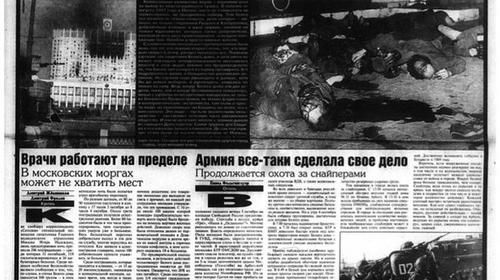
For several years, at the turn of the Soviet and New Russian time, the federal press passed several stages: liberalization, freedom, crisis - and again was with the state on opposite sides of the barricades. But the rules of the game were not yet clear: the opposition publications either received subsidies, then they were forbidden, censorship was, then it was not. The Russian information field was only executed, and the state defended its interests in manual mode.
1994–96. The birth of political technology
Chechnya. From love to hatred
In 1994, the first Chechen war began. The authoritiescalled the bombing of the formidable and suicidal attacks of the Russian troops "an operation to restore the constitutional order and the disarmament of illegal gangs." If the constitutional crisis caused a split among the journalist_k, then the war united even the most ardent rival_z. True, not around the president, but against him. Only state (Russian newspaper, VGTRK) and ultra-patriotic (Limonka) media output for the decision of the authorities
“Democratic” publications would lose their face by supporting Yeltsin. The war was unpopular. In August 1994, 67% of Russians said that they did not need to send troops to Chechnya, 19% did not have a clear opinion and only 14% were for.
The opposition media, mainly left -wing, were not going to forgive the president with a decision that led to another internal war against the backdrop of the economic crisis. In addition, left -wing parties were preparing for parliamentary, and later for the presidential election.
At the same time, large private players appeared in the media. Now the state had to reckon not just with the press - albeit formally independent, but without sustainable income - but with financially protected enterprises. For example, the media holding "bridge" by Vladimir Gusinsky, in particular NTV. Gusinsky conflict with the employees of the presidential administration, but the threats and calls to close the channel did not lead to the support of the president’s policy. On the contrary, thanks to the anti -war NTV, the audience doubled, while the state media tried to at least save the existing one.
In addition, the authorities did not try to work with the opinion of the journalist_k, although some media, even NTV, were ready to compromise. “Unfortunately, from the very beginning they were not established (and this is a rebuke to the federal authorities and those who were engaged in information) professional limiters,” said Oleg Dobroduev, the editor-in-chief of the television channel, “which, probably in these conditions, would be quite legitimate.” This statement can be evaluated in different ways. On the one hand, calls to the ban on the prohibition of NTV sounded in parliament, so it can be assumed that the leadership of the channel tried to reduce stress. On the other hand, it is likely that the journalist_ki were sincerely ready to select the wording so as not to sow panic.
Oleg Poptsov, the head of the VGTRK, wrote in his memoirs that "the most surprise for the president, a kind of revelation was the reaction of the democratic press, which, in its vast majority, took a military action in Chechnya." Perhaps Yeltsin thought that the war would end with a quick victory and therefore would not require an explanation. Or expected that he has a huge loan of the assignment of the press. Moreover, Yeltsin directly accused the journalist_k of contacting the nation:
I know that not without the participation of Chechen money a number of media of Russia are functioning
The lighting of the First Chechen War showed that, on the one hand, in Russia there was a press, ready to defend its right to exist and its own view of events in a difficult situation. But on the other, it turned out that the media - even if the fourth power, was weak or at least not straight. Not a single resignation of the military happened, the policy in relation to Chechnya has not changed. Even with mass support of the world, the state could still continue the military campaign. Only severe defeats, as well as new political problems, could stop it. In 1995, the parliament was occupied by the opposition, and in 1996 the presidential elections were supposed to be held, where Gennady Zyuganov had every chance to win. It turns out that by 1996, Yeltsin had lost the support of the media, the population, and liberals, but still won the elections. How? Because he retained the main thing - direct power.
Presidential elections '96. "Guarantor of Stability"
The presidential election in 1996 is unique. Gennady Zyuganov and Boris Yeltsin were equivalent candidates, the choice took place in two rounds. One of the key reasons for the final victory of Yeltsin was political technology and work with public opinion, including many PR events. For example, a series of concerts “Vote or lose”: the groups “Lube”, “Time Machine” and “Bravo”, Philip Kirkorov, Igor Nikolaev performed throughout the country.
The campaign was carried out by the Effective Policy Fund (FEP) and specialists invited from the United States. The basis was the speech "Not for, but against." The voters had to be convinced, firstly, that Yeltsin is the only alternative to the Communists (although Grigory Yavlinsky participated in the elections), and secondly, that the Communists need to be stopped at all costs. The choice of Zyuganov was served by the Progltsin media as a “step back”, a removal from democracy and a happy life. The press also had the idea that the victory of the Communists would lead to riots or even a civil war, and only Yeltsin can provide real calm.
FEP outlined the support of media as the main method of the campaign: “The society should go to the side of the president before the economic and political prerequisites corresponding to this arise. Before the election day, the president must defeat the mass consciousness. ” Joe Schumat, George Gorton and Richard Dresner began to work out specific steps. For example, they suggested that the president publicly impose guilt for the problem with massive delays in salaries throughout the country on his subordinates, publicly report them, and part of the delays to defiantly repay them.
The main media principle was the extension of references. The election headquarters showed that Boris Nikolaevich could help everyone everywhere. Only for May, Yeltsin visited Volgograd, Yaroslavl, Akhtubinsk, Astrakhan, Krasnoyarsk, Omsk, Arkhangelsk, Vorkuta, Ufa and Perm. All year, Yeltsin was several times overtaken by Zyuganov according to the number of references. InfoPovodes were also created by cultural figures who supported the president: writer Daniil Granin, film director Nikita Mikhalkov, TV presenter Vladimir Pozner. Then there was no habit of huge Putin's lists of “proxies”, so consolidation was stunned. Moreover, many publications had a good reputation for independent press due to the critical lighting of the First Chechen War.
Ideological campaigns also found a place. The Kommersant publishing house produced the newspaper “God forbid”, which gloomily described what would happen after the Communists came to power: “They know why they can abolish privatization and monopoly of foreign trade, which should be done by Glavlit and KGB. They know exactly who was well lived under socialism and what the power of workers are workers in Old Square On the Old Square, in the days of the USSR, the Central Committee of the CPSU was located. "." God forbid "came out of a circulation of 10 million copies.
Why did the media agree to participate in the election campaign of the current president? Firstly, by the middle of the decade, the press had new owners. The most famous of them are Vladimir Gusinsky and Boris Berezovsky. Gusinsky controlled NTV and Echo of Moscow. The main asset of Berezovsky was the shares of ORT, that is, Channel One. Apparently, the authoritiesfound a way to agree with several major players. The business was ready to support the president who guaranteed the stability and protection of property rights. Secondly, many journalists really believed that Yeltsin was better than Zyuganov. In the fact that the candidate from the Communists will respect freedom of speech, there were doubts. Thirdly, television has become more important than the press. The costs of the spread of federal print media grew, regional publications appeared, but television broadcast throughout the country, creating a single and emotionally charged information space. And the TV sector of the media was controlled by prosperous companies.
On July 4, 1996, the CEC summed up the results of the second round of the presidential election: Yeltsin received 53.8% of the vote, Zyuganov - 40.3%. The media and power acted as a united front and reached the desired. More precisely, if in the late 80s-early 90s the press acted as an independent actor, then during the 1996 campaign she became an instrument in the hands of the authorities.
1997–99. The war of everyone is against all
But not only the state noticed that it was possible to manipulate public opinion. Entrepreneurs and officials after the elections also decided to use new technologies, and the era of information wars began. But technologies are now not exhausted by censorship and direct attacks on opponents. Compromant, investigations, hints and semi -German are also used.
At the federal level, by the end of the 90s, four major players in the political media market were formed: Media-Most Holding Vladimir Gusinsky (NTV, TNT, Radio Echo of Moscow), Boris Berezovsky Media (49% of ORT shares, Kommersant Publishing House, Independent Gazeta), Media close to Yuri Luzhkov, Moscow mayor (TV-Center, Radio "Speak Moscow", the newspaper "Moskovskaya Pravda"), as well as state (51% ORT, Rossiyskaya Gazeta, RTR, ITAR-TASS).
“Most-Media”, first of all, NTV, as a rule, was held by “democratic” positions and emphasized its professionalism. Of the politicians, it sympathized mainly with the right: for example, Boris Nemtsov and the Soyuz of the Right Forces, although in the 1999 parliamentary elections, supported Evgeny Primakov and his Blok “Fatherland-All of Russia”, that is, conservative-“sovereign” leftists.
The sympathies of Berezovsky changed every time he concluded a new political alliance. In 1997, during the auction on the privatization of the Svyazinvest holding A large holding that owned shares of several telephone enterprises. ", Berezovsky united with his direct competitor to Gusinsky, but Vladimir Potanin was able to lobby for the sale of the holding for himself. Then the newspaper" Today ", ORT," Echo of Moscow "released many materials with criticism of the Holden himself, as well as the officials who decided to sell the holding. In response to this, state and Potaninsky media (Komsomolskaya Pravda, also accused RSR) Gusinsky and Berezovsky, the confrontation subsided only after the first vice-prime minister Boris Nemtsov said that the results of the auction were not revised. Protection of the property of the oligarchs and their political interests.
Only the media of Luzhkov possessed a steady political position: it predicted not only the support of the mayor, but also the moderate approval of the federal center, conservatism and sovereign. Researcher Media Ivan Zasursky wrote Zasursky I. Reconstruction of Russia. The media and politics in the 90s. The publishing house of Moscow State University, 2001. P.111 that the broadcasts of the TV Center led "to the conclusion that Orthodoxy is the state religion of the great state of the Russian."
The state media did not have a clear political position, except for the approval of state policy. But politics quickly changed: six prime ministers in four years, each has their own methods of work.
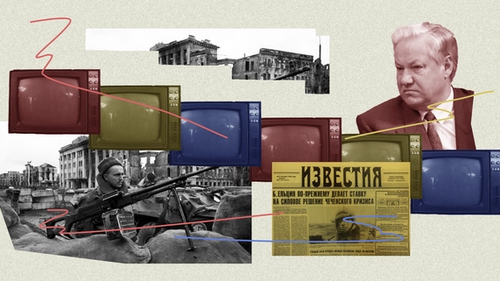
In 1999, Putin became the prime minister, and Gosmedia's agenda acquired familiar outlines. This is especially noticeable in the coverage of the Second Chechen War. When the militants invaded neighboring Dagestan and the Russian state decided to deliver a response, then
The authorities took into account the media -epiacts of the previous war and created the "sanitary cordon" around Chechnya.
One of the tasks was to minimize the presence of journalists. The Ministry of Press also introduced partial censorship. In addition, after terrorist attacks in Russian cities, the state immediately stated that they were arranged by Chechens. There was no evidence, but this did not stop creating a simple and understandable image of the enemy: on TV they showed generalized photobots of the suspects, emphasizing their ethnicity.
“Chechens want only one independence-from the Code of Criminal Procedure,” said Mikhail Leontyev, journalist ORT
During the First Chechen War, the state skillfully only prohibit and rely on the love of journalists. Now, in access, there were not only resources, but also skills. The 1996 elections showed how to create an image of an enemy, in which ordinary citizens and journalists will believe. Indeed, it turned out to be easier for many Russians to support the federal government, the more strong than the “Chechen fighters”.
1999 - Nast. BP. Love that ended in marriage. What did the Russian authorities learn
Already at the very beginning of the Putin’s presidency of four centers of forces - Gusinsky, Berezovsky, Luzhkov and the state - only the latter remained. Boris Berezovsky was in opposition to Vladimir Putin, lost assets and left Russia. Vladimir Gusinsky was arrested, spent three days in Butyrskaya prison, and a month later transferred his business to the state: Gazprom-Media holding received shares in NTV, as well as key stakes in TNT, Echo of Moscow and other media belonging to the “bridge”. The political block “Fatherland - the whole of Russia”, which included Yuri Luzhkov, lost the party in power, and Luzhkov’s personal political ambitions were locked within Moscow.
But the current president did not break what was built before him, but appropriated it.
The approach to working with the media and Putin’s public image-learned lessons of the 90s:
Firstly, you need to control even those journalists who are allowed to official events. For example, when Putin decided to meet with the families of the military who died on the Kursk submarine, the record was prohibited .
Secondly, you need to maintain media and work with mention. So, in 2003, Putin federal channels were mentioned 926 times, and the premiere of Mikhail Kasyanov, who took second place, only 217.
Thirdly, create an understandable image of an external enemy. At first these were a terrorist_ki, then the “fifth column” and the collective West, then the Georgian and Ukrainian_ki.
The attempt was worse to become a charismatic public politician, similar to Yeltsin, who performed on stage with popular musicians and talked with a “ordinary people”. Putin was enough only on phrases like the famous "we will pursue terrorists everywhere <...> and in the toilet we will eventually soak them." In return, an image of a macho appeared, who loves to show himself in business. For example, a week before the election of 2000, the future president flew to Chechnya on the Su-27 military fighter.
But most importantly, Putin was able to combine the agenda of all opponents. Luzhkov talks about sovereign? Putin - about strong Russia, sovereignty and protecting the interests of Russians abroad. Zyuganov criticizes the oligarchy? Putin takes away the assets from the oligarchs, and puts some in prison. Obzini from the liberal camp talk about a free economy? Vladimir Putin conducts market reforms and introduces a flat taxation scale Unlike the progressive scale, with flat, everyone pays the same income tax regardless of earnings. A flat scale is one of the elements of a neoliberal economy. . The leader should like everyone.
In the period from perestroika before Vladimir Putin, the media outlets visited the temporary allies of Mikhail Gorbachev, and independent political players, opponents of war and power, and their defenders. But the main thing is that a new era inherited from the 90s is a steady belief that public opinion does not exist. With the help of press, television and administrative resource, it can be created and destroyed in a few weeks. Relations with state power turned out to be more important for the media than the support of readers or income. The media really became the “fourth power” - adjusted for the fact that one person controls the other three.
When I was just starting to work in journalism, then living in Moscow, then often during educational events and informal communication I came across the memories of senior colleagues about a more free, meaningful and worthy paid work in Moscow editions in the 1990s. Often these memories were even nostalgic.
In this material, we, on the contrary, wanted to question the “unique freedom” of the media of that decade. But at the same time, in many respects remained inside the “federal” history, although even according to fragmentary information about republican and regional publications, it is clear that resistance to the regime on their pages and in their air could be brighter or more acute. In addition, we did not touch Samizdat in any languages.
If you want to tell about the story - the agenda, strategies, victories and defeats - media in places that we have not touched or touched superficially, please write to me: [email protected] .
Other materials
What do you need to know about Russian fakes?
The collaboration of DOXA magazine and verified. Media
Will the regulation of the hat will destroy freedom of speech?
We understand the cards

"White snow lies a little audibly, no one is to blame for anything."
Review of the film Russia 1985–1999: Traumazone


8 most important DOXA materials for 2022
Author Doxa about the war, resistance and work on complex topics

"Russian regime is the eruption of global neoliberal world order"
Post -colonial researcher Madina Tlostanova - about decolonization, past and future of Russia
