
Translated material
Cooling recession
PMEF officials send a signal to the Kremlin: either war or economy. Resources for its growth are becoming less. And the Russians are facing poverty
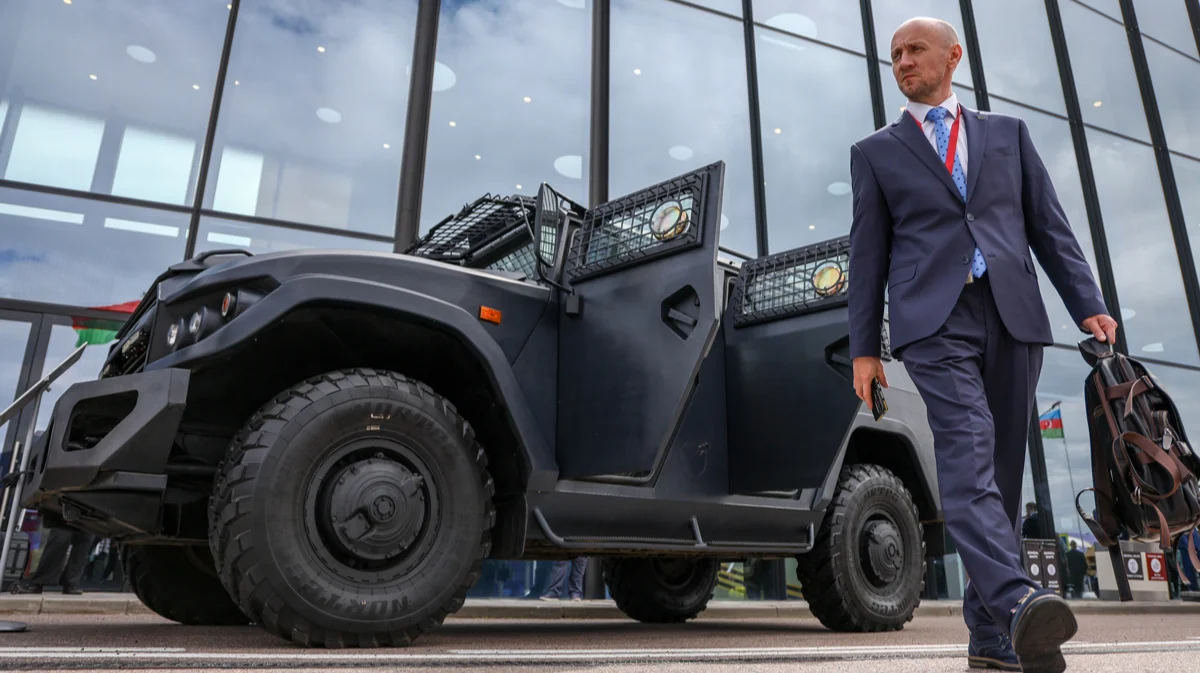
Photo: Artyom Pryakhin / Roscongress
Higher Russian officials at the St. Petersburg Economic Forum with an ezopian language said that it was time to choose: either war or economy. What the country threatens the country and Russians, the new newspaper Europe understands.
The Putin’s curators of the economy are literate enough to understand what threatens it (why they still in power-“New Evrop” explained in detail). On Thursday, at the St. Petersburg Economic Forum, Minister of Economics Maxim Reshetnikov warned: "In general, it seems, on the verge of transition to a recession." The official was safe: this is not his examination, but the conclusion "on the current business sensations." Strictly speaking, recessions (that is, the fall of GDP during two consistent quarters) in Russia is not yet, but there is a very modest growth. But, the minister scares, we are "on the verge, then everything depends on our decisions."
The decisions, in his opinion, should be fundamentally and lead to the "change of long -term trends." So far, such a trend is close to what is called stagflation : lack of growth at roller prices. And how can you change them, if, the head of the Central Bank Elvira Nabiullina complains , the resources are exhausted and it is time to think about the “some new growth model”. And only the head of the Ministry of Finance Anton Siluanov is full of contagious optimism: "We have planned cooling." But, he said, the "model works" itself.
Of course, Putin’s officials will never directly say what the root of the trouble is, but the encrypted messages that they transfer to the Kremlin mean: if for four years to continue bloody battles in the spirit of the first and Second World Wars, then we will not last long.
Thus, three economists think with whom the New Evropa spoke.
“Such voices will sound louder and louder: they say, choose one thing-either war, or economy. They will speak the ezopov language that the costs are no longer pulling, the FNB (the National Welfare Fund) ends (we explained this in more detail here ), there is nowhere to replenish it again, and all these are more or less arithmetic things, ”the head of one of the Russian expert centers told us.
Rotten whales
The current economic model of Russia is mainly on four whales. These are huge budget expenses that mainly go to the needs of the military-industrial complex. This is revenue from exports, first of all - oil and gas. This is a powerful fiscal consolidation: everything that can be seized from the economy should be seized. Finally, this is a “support on its own forces” - the rejection of large -scale foreign investment and technology and import substitution at any cost with the help of China.
In the fourth year of the war, each of these supports began to distinctly rot. The budget expenditures (on the military -industrial complex per year are spent four times more than before the war, we wrote in detail about this here ) dispersed inflation, which at the end of 2024 was at a peak level of 9.5%, and by mid -June in annual terms - 9.6%. True, this indicator decreases with every week, the efforts of the Central Bank, which holds a high key rate at the level of 20%, which suppresses economic growth.
2025 showed to what extent the support of oil and gas revenues is unreliable: they fell, instantly responding to new sanctions against exporters and the “shadow fleet”, as well as the drop in oil prices due to Donald Trump's trade wars. Over the five months of the year, the revenue of Russia from the export of raw materials decreased by 14%, and in May it even collapsed by April. In June, however, there was a chance to catch up, because due to the military operation of Israel against Iran, prices rose. But it is not known how long growth will continue. But it is known that the possible new sanctions against the shadow fleet, as well as a reduction in the price ceiling on Russian oil (so far, are the problems due to the opposition of Trump, but the discussion continues) will potentially reduce budget revenues in the second half of the year.
The fiscal greed of the authorities who need to replenish the budget paralyzes economic growth, and where there is no damage from sanctions. The New Gazeta Europe recently wrote that the duties for export of wheat from Russia became the main reason for the rise in price of bread. As well as the fact that in Russia it became unprofitable to grow grain, which is in demand on the world market and there are no trade restrictions on it.
Finally, import substitution and abandonment of global partnerships either leave the economy without goods and services (they have not learned to build their planes), or sharply increase their cost (the best example - cars that have gone aside as many). The benefits of China are reduced only to the fact that he increased the purchase of Russian oil. But Moscow did not wait for large investments from the East, as well as the alternative to the West of the payment system, which Beijing is not eager to participate in the creation of.
“The hope that China will give us at least second -level technologies is not justified. All technological chains are torn, starting from agriculture, ending with electronics. As a result, for example, rising prices for vegetables such that I do not remember at all in our whole story.
The country in practice has successfully proved that there is no technological sovereignty in the modern era. The proof was expensive and will cost even more, ”the Russian economist told us.
What the ministers are talking about
What really needs to be done so that new sources of growth appear in return for those that are exhausted - for the participants in the discussion themselves on the forum, it is obvious, our interlocutors say. Firstly, the locomotive of the economy should not be a state, but a private sector, recalls an economist in a global bank. Instead, right now, the authorities are selecting private assets to distribute them to loyal businessmen; The last example is the confiscation of the Domodedovo airport.
Secondly, a sharp reduction in government departments is necessary. Thirdly - the restoration of normal relations with the outside world. But for all this happened, the case is small: just to stop the war and withdraw troops from Ukraine, namely, Putin is not going to do. From what he said on Wednesday at a meeting with the heads of world news agencies, it follows that he will not stop until Kiev accepts its conditions for surrender.
As a result, as our interlocutors say, there are no signs that the situation in the Russian economy will not deteriorate in the very near future.
Economists are waiting for the budget they will not reduce, but will increase along with the share of military expenses in it - and this will inevitably be inflated by inflation even more. This means that the Central Bank will hold a high rate and the business will complain: such a policy suppresses growth.
For Russians, this will mean growth in poverty : prices will rise, income - no, they will increase their possibilities to increase. Particularly growing prices will be beaten at the least wealthy, because inflation is a “tax for the poor” (“New Evrop” explained in detail why). And for the whole economy, the main trouble will remain that “the country has deprived itself of the possibility of scientific and technological progress, because our traditional partners left not only from us, but also forward,” said our interlocutor-economist.