
Translated material
The war economy has fallen ill with the Dutch disease: rising oil prices and economic income lead to “reverse import substitution”

The additional revenues that fell on the Kremlin due to the sharp rise in oil prices and the easing of sanctions did not lead to a revival of the Russian economy. On the contrary, the influx of currency contributes to the further strengthening of the ruble, the exchange rate of which has returned to pre-war values. As a result, the revival of domestic demand is covered by expanding imports. The Russian military economy is faced with a classic Dutch disease: the economy is experiencing “reverse import substitution”, and additional income from the export of Russian energy resources turns into a gain for Chinese commodity producers. The main increase in imports in the first quarter of 2026 will come from vehicles, machinery and equipment from China.
April industrial data, like those for the first quarter, showed continued growth almost exclusively in war-related industries, such as drones, electronics or pharmaceuticals, while civilian manufacturing has contracted output in recent months. The vectors of total industrial output and civilian output, calculated by expert centers, are diverging further and further.
However, Rosstat data so far only obscures the picture, due to the department’s transition to a new base year in calculating industry indices. Such a transition in this case turns out to be by no means a technical event. The new base year, 2023, was a year of dramatic economic restructuring and investment in the military sector. Now the militarized structure of the economy will become the norm, the weight of the military sectors will increase. This will help the Russian authorities to camouflage the reduction in the civilian sector of industry and obtain better aggregate indicators for industry and the economy as a whole, while the imbalance in production will increase. In conditions of high commodity incomes, this gap will be balanced by an increase in imports, and if they decrease, it will lead to increased inflation associated with a lack of supply.
Reverse import substitution
While Ukrainian strikes on a local plant literally rained oil on Tuapse, a metaphorical oil rain has rained down the Russian economy for the third month in a row thanks to the ongoing crisis in the Strait of Hormuz. Russia has become one of the main beneficiaries of the US and Israeli war against Iran, but a significant share of the gains from the rise in oil prices provoked by the crisis will go not to Russian, but to Chinese producers. This effect is known in economics as Dutch disease.
According to the Ministry of Economic Development, the price of Russian Urals oil for taxation was $94.9 per barrel in April - after $77 in March, $44.6 in February and $41 in January. According to the May review of the International Energy Agency (IEA) , Russia's revenues from the export of oil and petroleum products in March-April jumped by 85% compared to January-February - to $38.3 billion versus $20.6 billion. However, compared to March-April 2025, they also increased by 40%, and even compared to the same period in 2024 - by 7%. Despite the fact that in physical volume they practically did not change compared to the beginning of the year and turned out to be lower than supplies in 2025 and 2024 (by 5 and 9%, respectively).
Chart 1. Russian exports of oil and petroleum products in physical and monetary terms, 2024–2026
A concomitant effect of the growth in export earnings, however, was the further strengthening of the ruble. Over the past year, it has already become heavier by almost 25%, dropping from 102 to 79 rubles per dollar (→ Re: Russia: Victim of disinflation, sanctions and “sinicization” of trade ), and by the end of May this year, the dollar exchange rate set by the Central Bank dropped to 71 rubles. In fact, thus, the rate returned to the pre-war era (71–75 rubles per dollar in the second half of 2021). According to Bloomberg , for the second year in a row, the ruble beats analysts' forecasts of devaluation, becoming the world's best currency against the dollar.
The strengthening of the ruble increasingly looks like an integral feature of the modern Russian economy. This is facilitated, according to the Central Bank and economic analysts, by a positive trade balance, the absence of capital outflow, the suspension of currency purchases by the Ministry of Finance according to the budget rule, the expansion of foreign trade bypassing the dollar (cryptocurrency, ruble offsets, as a result of which the share of the ruble in payment for imports reached almost 60%, according to the Central Bank ) and even the high rate of the Central Bank, which has a restraining effect on consumption and the interest of enterprises in investment imports.
At the same time, a significant strengthening of the national currency naturally leads to an increase in demand for imports from consumers, whose purchasing power is increasing. Higher quality imported goods are becoming more affordable in ruble equivalent. This effect clearly manifested itself in the first quarter of 2026: after two years of stagnation in 2024–2025 (a small cumulative reduction of 2.2%), imports in January–March, according to fragmentary data from the Federal Customs Service, increased by 6% compared to the first quarter of last year (from $62.9 billion to $66.9 billion). The main increase came from “machinery, equipment and vehicles” - $3.5 billion, or 12%, as well as food - $0.7 billion (7%) and chemical industry - $0.7 billion (5%). The strengthening of the ruble thus leads to “reverse import substitution”.
Table 1. Structure and dynamics of imports of goods in the first quarter of 2025 and 2026, billion dollars
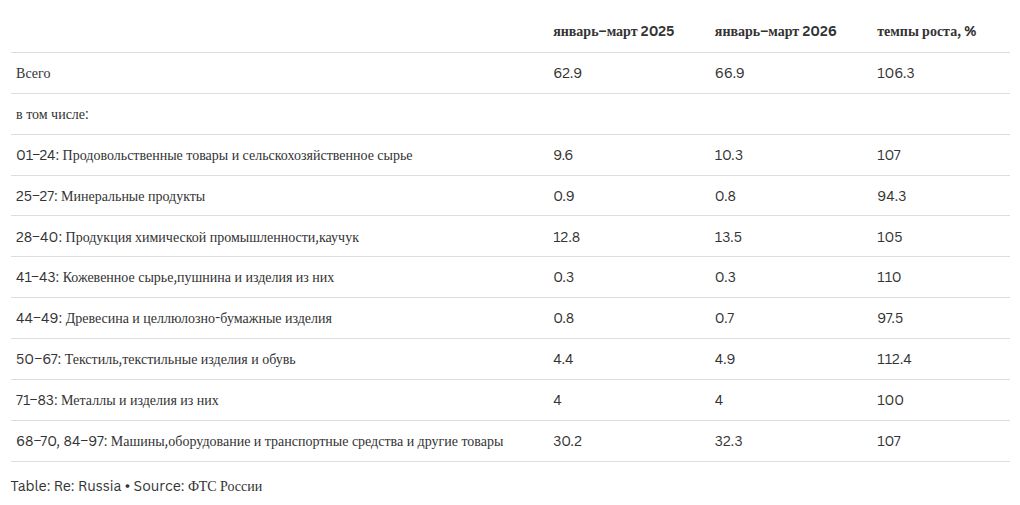
The Russian Customs Service (FCS) does not disclose data for individual countries, but from the materials of the Chinese Customs Committee it follows that the main growth in Russian imports is ensured by this country. In January–March 2026, supplies to Russia increased by almost 22%, from $22.7 billion to $27.7 billion (and by the end of April - to $38 billion). Thus, Chinese supplies at the end of the quarter increased by $5 billion, while the total increase in imports amounted to $4 billion. Accordingly, China’s share in Russian imports increased from 36 to 42% both due to the increase and due to the displacement of other importing countries.
The growth of Chinese supplies is primarily in the engineering sector and high-tech products. After the break with the West, China became an almost exclusive source of technological equipment for the Russian economy. Imports of Chinese vehicles increased by $1.07 billion (+41% compared to January–March 2025, from $2.62 billion to $3.69 billion), electric vehicles and electrical equipment - by $0.86 billion (+26%, from $3.2 billion to $4.04 billion). The Federal Customs Service records in the first quarter of 2026 an increase in imports in the category “machinery, equipment, vehicles and other goods” by $3.5 billion (from $28.8 billion to $32.3 billion), which, as we see, more than 50% comes from China.
In addition, a noticeable jump occurred in the supply of Chinese goods not classified by type (group XXII): in the first quarter, their exports almost quadrupled, from $480 million to $1.78 billion. For the most part, these are goods for personal use, cleared under simplified customs procedures, explained Andrei Gnidchenko, an expert at the Center for Macroeconomic Analysis and Short-Term Forecasting (CMAP) , and the growth in this category of imports is associated with the introduction a trial visa-free regime between Russia and China from September 15, 2025, which led to the emergence of the so-called new shuttles. Probably, through this channel and through marketplaces, the replacement of “other imports” from other countries with Chinese ones took place.
However, China may be the largest, but not the only beneficiary of the growth in income of the Russian economy, which translates into an increase in imports. Oddly enough, part of the gain also falls on Europe, which is due to an increase in the supply of pharmaceutical products ( still not subject to sanctions ), as follows from the mirror data of Eurostat . Its supplies to Russia in January-February (data for March have not yet been published) increased by 11%, from $4.97 billion to $5.5 billion, with a total increase of more than $500 million coming from medicines (from $1.47 billion to $2.15 billion).
Demand is not growing
Throughout 2025, the growth rate of consumer demand slowed significantly. The growth rate of retail trade, for example, slowed from 8 to 4%. However, already in March 2026, a new surge is observed - +6.2% by March 2025, Rosstat records . At the same time, food products continue to slow down, and growth is redistributed in favor of non-food products: in March, the growth of these two categories compared to last year was 3.1 and 9.1%, respectively. However, the acceleration in demand does not translate into gains for manufacturing industries, as manufacturers had hoped.
In annual terms, industrial production, according to Rosstat , grew by 1.9% in April. By March, growth with calendar and seasonal factors removed in Rosstat's calculations showed a modest increase of 0.4%, while production decreased by 0.5%, and processing increased by 0.7%. As before, however, growth in processing is concentrated in military and paramilitary industries: production of finished metal products (+23% in annual terms), production of other vehicles (+57.4%), as well as medicines and materials (+15.4%). The split of output in manufacturing into military and civilian shows a reduction in the civilian sector (manufacturing without military industries). According to CMAKP calculations, the decline occurred in the first three months, and in April output stagnated, and according to calculations by the National Research University Higher School of Economics (Bessonov), the reduction occurs precisely in April, as follows from the brief April review of CMAKP (Graph 2). Both calculations lead to the same conclusion: despite the recovery in demand in March, the data does not indicate a reciprocal recovery in civilian production.
Chart 2. Dynamics of industrial production in general and “civil” industries, 2021–2026, seasonality eliminated, 100 = monthly average for 2021
Military-normalization
However, since the beginning of 2026, experts have questioned the correctness of Rosstat’s figures for industrial production, implying that the extent of the decline may be deeper. The department switched to a new base year in calculating the production index (2023 instead of 2018), but the old and new series are not consistent with each other, as stated in the review of the dynamics of industrial production by the Center for Industrial Production . Thus, according to the initial data, the index of industrial production increased by 2.3% compared to the corresponding period last year in March, while the chain index with the elimination of seasonal and calendar factors gives an increase of 4.6%. In April, the discrepancies remained: TsMAKP believes that the annual growth in industry was no more than 1.5%, and not at all 1.9%, as Rosstat reports. TsMAKP experts note that Rosstat, after the transition to a new base (2023), does not harmonize chain indices (month to month) and indices for the corresponding period of the previous year.
However, this is not the only consequence of the “technical” transition to a new base year. The transition also results in a change in assessments of the structure of Russian industry: the weights of sub-sectors and industries in the industrial structure are calculated based on the base year. The previous transition took place in 2018, shortly after the 2015–2016 crisis against the backdrop of a relatively neutral price environment. However, 2023 was a year of very significant structural changes in the economy. After the impact of sanctions, the government massively supported the economy with budgetary funds and investments from the National Welfare Fund, which were directed toward the rapid expansion of military production, emergency import substitution, and the creation of new infrastructure to redirect trade flows. Accordingly, the share of added value that was created in the relevant sectors and industries increased. And now, when assessing the contribution of their output, they will receive greater weight in the aggregate indicator of industry and the economy as a whole.
Quite predictably, when the base year changed, the shares of military and paramilitary production and the corresponding industries and sub-sectors increased significantly. This means that their continued growth due to budget injections will have a greater impact on aggregate industry indicators. And this, in turn, will help the Russian government hide the reduction in civilian production through the contribution of the military. In the new basis, the weight of mineral extraction decreased slightly (from 38.9 to 38.3% of the industrial production index), where stagnation or reduction in oil production is expected. The manufacturing sector, on the contrary, increased its weight, in particular due to such positions as the production of fabricated metal products (from 5 to almost 7%), which includes the production of heavy military equipment and has been one of the main drivers of processing since the second half of 2022, the production of computers, electronic and optical products (from 3.8 to 5%), which also saw rapid growth driven by military needs. The share of production of medicines and materials used for medical purposes has also increased significantly (increase from 1.5 to 2.2%), which are showing stable growth, obviously related to the number of wounded returning from war.
Thus, the transition to a new base year in Rosstat’s calculations contributes to the normalization of the militarized economy and the concealment of negative dynamics in the sector of production whose products are consumed on the domestic market. Improving aggregate indicators will help mask accumulating structural imbalances. In conditions of high incomes, these imbalances will be balanced by imports, and in conditions of unfavorable external conditions, they will contribute to a shortage of goods for domestic consumption, provoking a rise in prices.