
Translated material
Pitching: How to offer the topic of media?

How to enroll the idea for media, and what to do when journalists do not respond to letters? How to interest a journalist and build constructive cooperation? This was announced on May 25 at the webinar by Alisa Kustikova , a journalist for Novaya Gazeta, a correspondent of the investigation department.
This was the second webinar of the mini-course of the greenhouse about communication with reporters. We offer to see the record, read the abstract. And if you want to join the closed part of the course on May 28, then submit an application for participation in the pitching of your topic. We talk more about the format at the end of the material.
What is pitching
Pitching (from the English pitch - throw, feed) is a brief structured presentation of the project to a journalist or editorial office.
Pitching formats for media:
- A short letter.
- A call with a proposal of history.
- informal conversation.
Where does the misunderstanding arise between NPOs and the media?
- The editors did not indicate NPO as the source of information.
- The journalist confuses the terms on the topics of NPOs.
- Non -compliance with the agreement on the time of publication.
- Media did not agree on quotes before leaving.
- The journalist uses the language of enmity.
Roots
- The editorial office is important, not the result.
- It is important for a journalist to show the story from several sides.
- The journalist is trying to simplify the language, make a story affordable.
- The editors have high working speed standards.
What can be done?
A universal answer is to say everything on the shore.
How to prepare for a pitching
“The first step is to decide on the format of history,” says Alisa Kustikova. - For this, the media uses a system of journalistic genres. It would seem, why should NPO delve into such subtleties of a media kitchen? The answer is simple - the more precisely you will learn to understand the rules of packaging history, the faster you will understand which editorial office you go and to which journalist. ”
Step 1: Select the format
Find a question that corresponds to the topic.
- News: is there efficiency?
- History: Do I have a bright hero who is open to communication?
- Report: Can I look at the problem?
- Expert type of content: Do I need to explain the audience what is happening?
- Analytical article: Is there a complexity and collision of the parties in history?
- Investigation: Do you know about the maliciousness that led to a violation of rights or law? Do you have a hypothesis?
- Documentary: Is my hero in a state of transformation right now, is he ready to tell about this?
- Special projects: Does your idea go beyond the standard editorial formats-tests, games, multimedia longings, podcasts, VR projects?
- Figures, statistics: can numbers tell about my story better than words?
“There are a lot of genres, but most often they write news, stories and reports about NPOs. If you first get confused, it doesn’t matter. A journalist will help to finalize the story if you have already taken the first step. Write simply: “We have a hero for human history”, “I think this story has investigative potential.” Alisa Kustikova
Step 2: We understand who to write
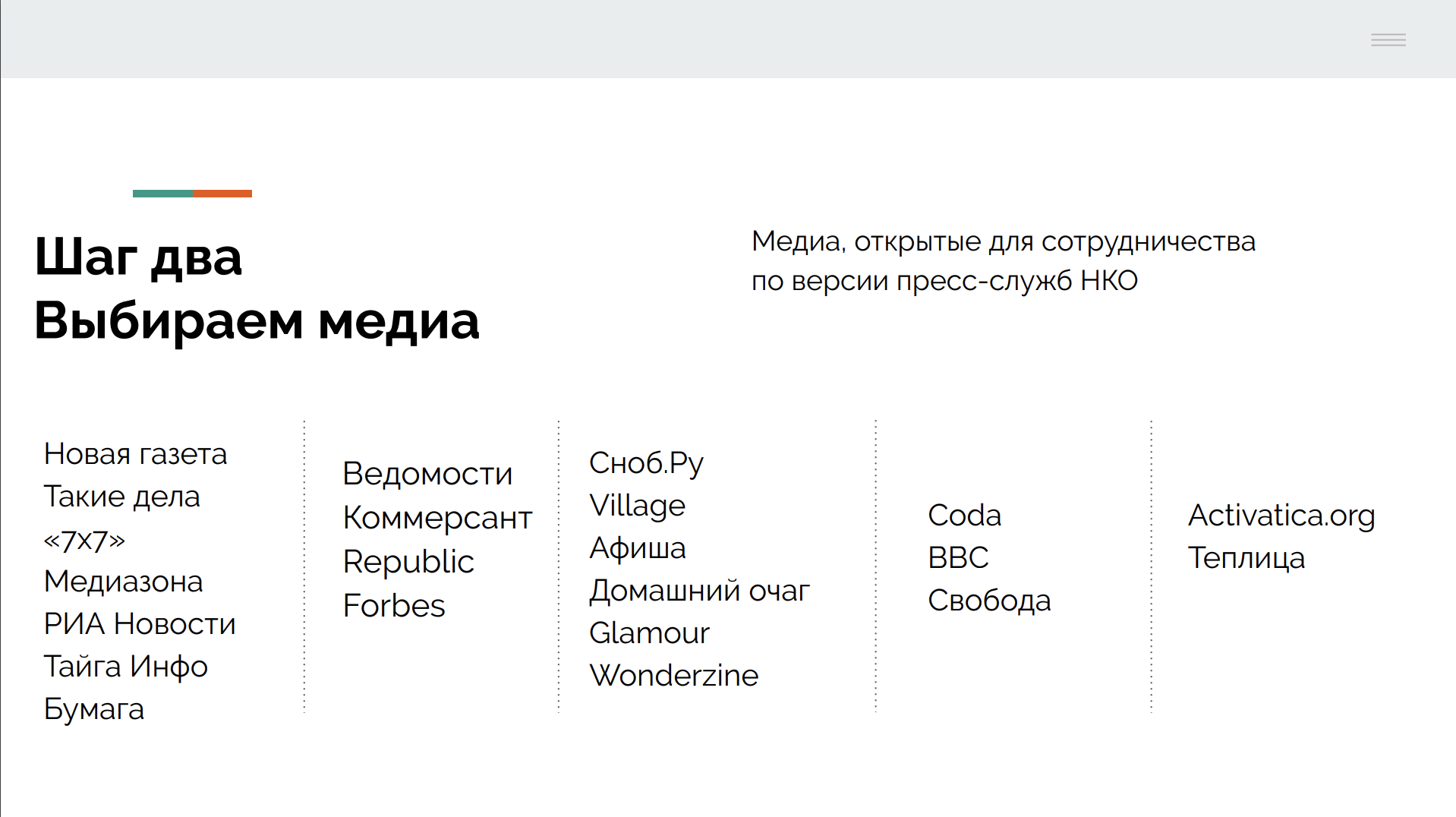
Media is:
- socio-political;
- business;
- lifstail;
- foreign media who write about the situation in Russia;
- Specialized media.
Now we choose a journalist. But, before, it is worth knowing how the editors are arranged:
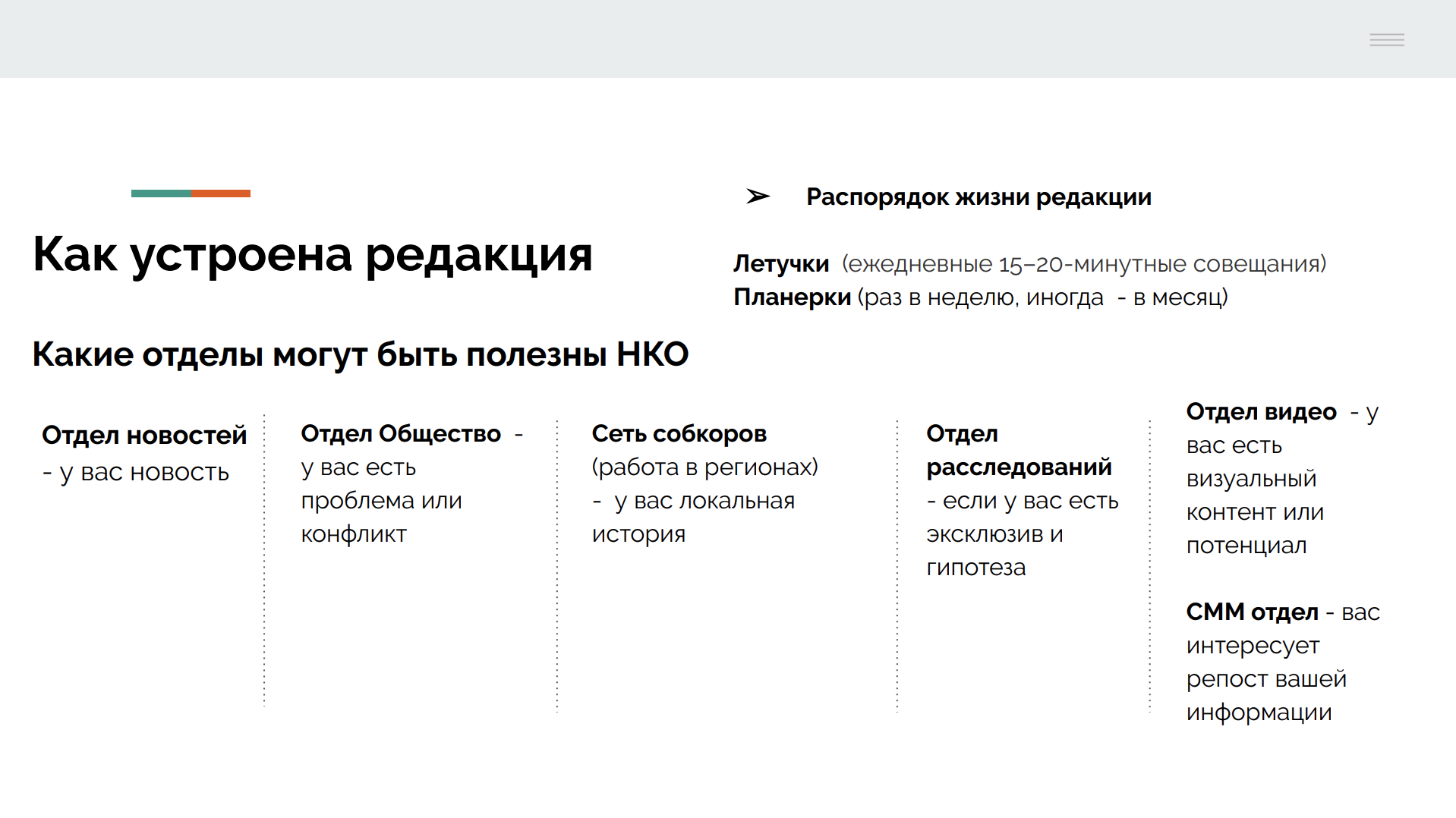
- News Department - you have news;
- Department of Society - you have a problem and conflict;
- a network of sobs - you have a local story that requires deep immersion, business trips);
- Investigation department - you have an exclusive in the hypothesis;
- video department - you have visual content and potential;
- SMM department-you need information support, repost.
“It is clear that in regional editions not such an extensive structure of division into departments. If you are a regional fund, probably in your notebook and so there are contacts of the main editions. But if you want to reach the federal media, then the knowledge of the structure will come in handy. ” Alisa Kustikova
Examples of cooperation between Novaya Gazeta and non -profit organizations:
- Foundation "In Defense of the Rights of Prisoners" and the Center for Social Assistance "Luna" ;
- Greenpeace whale prison ;
- Blood sisters - Advita ;
- Civil compensation .
How open are you for media? Ask yourself:
- Are contacts established with news services (separate channel or newsletter)?
- Do you have the contacts of journalists who work on the topic? Do you work with them targeted or send a fan newsletter?
- Does your site help write media about you? Are there information about the project and the team, work results, contacts, photographs that the media can quickly publish?
- Do you have a person who communicates with media (goes to meetings, tracks publications, meets personally)?
“The NPO website is a platform to increase awareness, including the media. If there is no information on the site, an alternative is a Google document with a more detailed story about the problem that the NGO is dealing with, to which you throw a link to the journalist. ” Alisa Kustikova
How to build a network of journalists on your topic
- Personal contacts and dating work.
- Write on the platform where the journalist is more active.
- To increase the level of cooperation gradually (it is important not impressive plans, but a real result of cooperation).
- Several journalists in one media are a potential conflict.
- Continue to send information, even if for a specific time cooperation did not work out.
- Update the base (transition of journalists from one media to another, a change in the profession).
- Reference to past publications, talk about the consequences of the publication.
- The business approach works, crushing for pity is not the best strategy.
- Offer formats on the specialization of a journalist (do not send news to those who write reports or columns).
- Contact of the media editor - your ace in the sleeve, do not use too often (special projects, investigations, reports).
Three principles of media work
- Systematization of the base and lists help to develop work on contacts.
- Diversification : Do not waste all your efforts on one site or journalist. A variety of your list.
- Personification often makes sense to follow the authors, not the editorial offices, they will continue to write on your topic and in another media.
Alice Kustikova recommends to store a list of contacts of journalists on the topic indicating the editorial office and contacts. Use the following formats:
- Excel table with graphs: name, editors, communication channel, notes - genre, links to past publications);
- Media map can be designated in red publications with which cooperation has not yet developed.
Step Three: Prelating the topic, preparing a pitch
“So, the time has come for Pitching. How to tune in? Colleagues from NPOs say that the best way to write a pitch is to try on the role of a journalist. “I forget that the press secretary, I recall that I am a journalist”, “I have a very presented topic,” the NPO employees describe the process who had experience in journalism, ”says Alisa Kustikova.
The first letter
- Appeal to a journalist by name.
- Who are you? What is your name and explain your attitude to NGOs.
- Link to previous publications. Tell us that you were impressed by how they covered a similar story, explain why you think that he/she is the best intermediary for history.
- Tell us briefly about the organization. Turn on the wording of the NGO mission. It is easier to have a ready -made brief (a paragraph of text about a mission).
Element NTA
- The title (theme of the letter) is bright, short.
- The first paragraph is a description of the situation (what, where, when, why).
- The main part is the alignment of forces: what the fund has, what is needed from the editor (the most personified part).
- The story of the hero and his contact (if the problem is typical, it is better not to give contacts of the same hero, but experts can).
- List of experts (two or three, better from another NPO).
- Actual contact for additional questions.
Optionally
- Release for officials (at what level of the catch, this will help the journalist understand who to send requests).
- Where and how you can look at the situation in live (people's contacts on the spot) - this will help the journalist write a report.
Strategies: How to get into the media
- Actualization for the information water. Revision of history on the news agenda.
- Attract the name. Perhaps your fund is supported by a person with a loud name. This approach works well when it comes to glossy publications, you can get into the media through the heroes of the art or secular chronicle.
- We speak to an excellent degree. Are there a story among your NPOs, to which epithets are applicable - the first, the largest, smallest, oldest?
- Raise the bets. Conflict or dispute is news. The battle between the parties creates drama and emotions, turning the problem into a fascinating story.
- Become part of the solution. Perhaps your fund is looking for a solution to the problem that Media writes about.
- Find a bright hero. Find the hero whose story reflects the problem, the solution of which is engaged in NPOs.
- Regional history: Journalists may interest a local view of national news or trend.
- The figure of the trustee or founders can draw attention to the subject of the fund. The result of cooperation may be the publication of the case of your NGOs.
- Unit to get into the field of vision of the media . Perhaps the solution is engaged in friendly funds with which you can act as a united front.
- Regional news bursts into the federal agenda. If the region stands out against the background of others in the approach to the problem, this is an occasion to go to the federal media.
Alternative ways
- Advertising agencies . You can try yourself in social advertising - for this you need to learn to write briffs and understand what the interest of agencies is.
- Banner stories with the media . Sometimes it’s easier to agree on a banner than on the publication in the media.
- Cooperation with bloggers.
- Promotions and offline events always work, the attention of media is attracted, the trend of recent times-art projects, documentaries.
View the presentation from the performance of Alice Kustikova (PDF).
I want to participate in Pitching that on May 28, how to do it?
We invite everyone to participate in a pitching ideas on May 28 at 11:00. The presentation will be closed, we invite only those who will represent their ideas to it.
Everyone who will participate in Pitching will receive an electronic certificate about the passage of a mini-course.
For this you need:
- View the first webinar from our course: download useful additional materials: a press release and instructions on how to write stories;
- study second -year material;
- To study a memo that will help you prepare for a pitching;
- Fill out an application for participation until 14.00 on May 27.
- Enter the closed chat in Telegram and ask questions about preparing for pitching, if they are (the link to the chat will be in the form of registration).
More on the topic
- 10 ideas, how to tell about the project in the crisis: recording a webinar with the chief of the greenhouse Natalya Baranova
- "We heard you": how to communicate with the audience during the pandemic and not panic
- 5 questions about SMM: how are social networks WWF and Greenpeace Russia