
Translated material
New Facebook Strategy, the right to anonymity and rallies on March 10
The topic of release is Facebook reversal at 180 °
Facebook founder Mark Zuckerberg published a software article for almost 20 thousand signs. In it, he promises to move the focus of Facebook development towards the protection of private life. The Bell retold the main provisions of the article, but everyone should try to read it on his own, especially since the focus on protecting private life can lead to a Facebook conflict with the authorities. Three things that should be kept in mind:
Facebook loses users in developed countries. Millions of American users left the social network, the newly published data from Edison Research said . Now Facebook uses 15 million less Americans than in 2017. Most of all, leaching of the audience affected the key age group from 12 to 34 years.
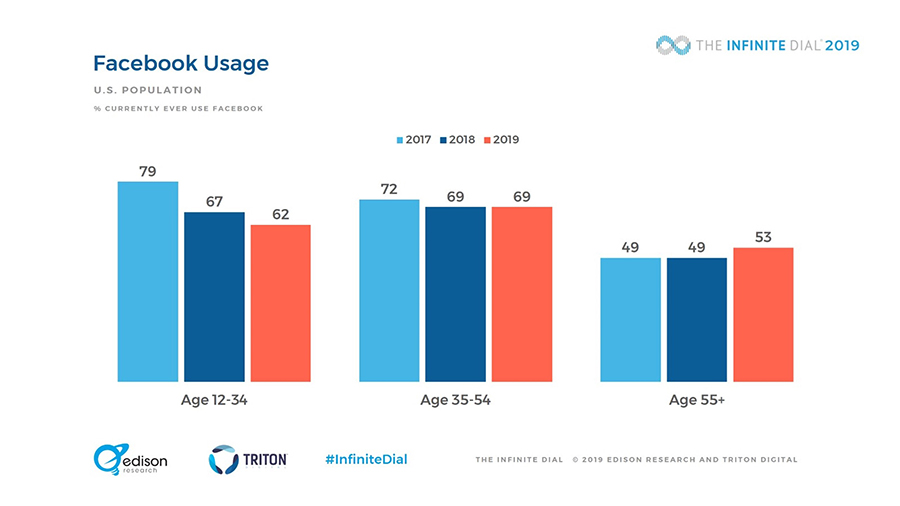
Using Facebook in the USA. Data Edison Research and Triton Digital.
Facebook's right hand does not always know what the left is doing. For example, Facebook promotes the idea of two -factor authentication, offering to use a phone number for this. However, by entering the phone number, you guarantee that anyone can find you by this number. You cannot refuse to be found. In addition, Facebook uses these numbers taken from the user to ensure security, for advertising .
A new strategy may imply Facebook from Russia. Zuckerberg correctly writes that there is a big difference between the provision of services in the country and storage of user data there. According to the new strategy, in countries where the freedom of statements or human rights is violated, data centers for storing personal data will not be built. Russian legislation requires storing such data in the country.
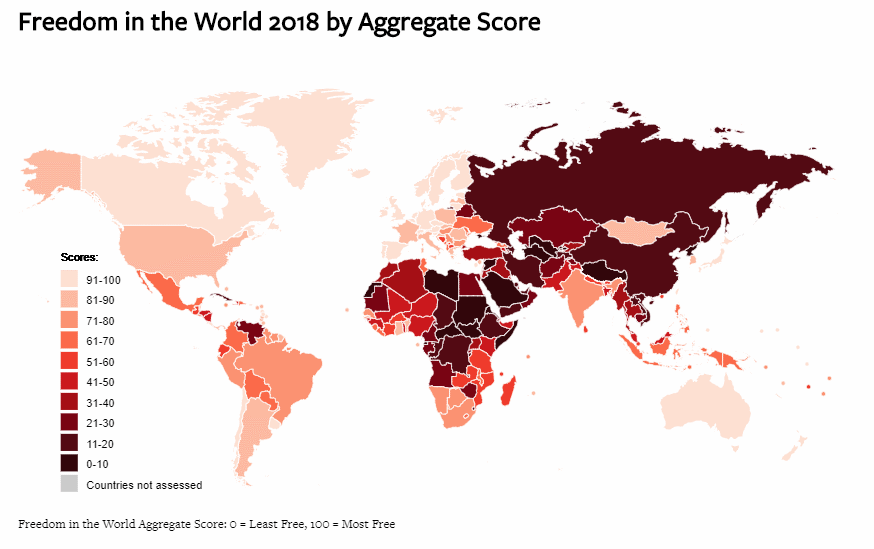
Freedom in the world on Freedom House.
If Tsuckerberg speaks seriously, he will have to measure freedom, and most likely he will take existing methods. For example, Freedom in the World 2018 rating, compiled by Freedom House. According to him , Russia is a non-free country, its non-freedom rating is 6.5 out of 7, and the Freedom of Expression, which is guided by Zuckerberg, is estimated at 3 points out of 16. If the data centers in the country are not placed, Facebook will not be able to work in Russia.
+3 to anonymity
- An article explaining that people confuse anonymity with privacy, and gives some tips on both.
- Three years ago, an article explaining how to be anonymous: not to use a real mailing address, create a new person, make payments carefully, etc. - Not at all obsolete.
- A huge list of services, programs, as well as operating systems to ensure privacy.
Meet Later
On Wednesday, millions of Russian Telegram users were called up on March 10 to participate in the Moscow rally at Sakharov (SIC!).
Quote: “For more than 10 months, Roskomnadzor has been blocking thousands of IP addresses daily, trying to prevent the work of Telegram in Russia. While Telegram wins in this struggle, but on any day everything can change - the state has huge resources taken from the population. ”
The official Telegram account is not the first to become a coordinating center of rallies. However, for the first time we are talking about supporting a truly politicized event. The previous performance on Sakharov Avenue passed on April 30, it was a protest against Telegram blocking and the freedom of the Internet as a whole.
4 things you need to know about rallies on March 10
It is assumed that on March 10, thousands of ruins will pass along Sakharov Avenue. All of them are against the bill on isolation of the Russian segment of the Internet adopted in the first reading (on March 13, the second is scheduled). The last protest against Telegram gathered about 7,500 people. If in April 2018 it was about the resistance of what is, now what will happen.
This time the idea itself is much wider and concerns not so much Telegram. The rally was organized by the Libertarian party and the Internet protection society , it was supported by the Pirate Party , Roskomvobod , the Digital Defense campaign.
Rallies will be held in several cities. Now it is known about Moscow, Khabarovsk and Voronezh. The first two are agreed. For the authorities, this is once again the indicator of the “popular vote” against an important set of repressive amendments.
The organizers are not limited to technological slogans or a discussion of a draft of chiti isolation. The Libertarian Party in the Anons post reminds potential participants about the shortcomings of Putin’s policy, including grocery sanctions, freezing pension savings and introducing new taxes.
How "sustainable Internet" works
In December, The Bell wrote about what is generally proposed in the bill. Since then, many details have appeared, but in general, the document “On the Sustainable Internet” (in the media is better known as “On the Sovereign Internet” and “On the Internal Distress”) gives the government five key megagnes.
- Get control over provider channels. Providers who will put the control systems (the so -called “technical means of counteract threats”) are exempted from liability for insolving sites. This can be done by the authorized body - most likely Roskomnadzor.
- Maintain a full register of cross -border channels. The connection of Runet with the outside world cannot be blocked overnight, like in some countries. But taking into account such channels - part of the practice of centralizing communication networks, which leads to a decrease in the stability of the national segment of the scheme and more depending on large providers. For example , growing Rostelecom.
- Monitor and control a single communication network. The Unified Monitoring and Management Center should be created by July 1. It will allow you to block any channel, including cross -border. So it will be possible to block not only Russian, but also any foreign services.
- Introduce a national domain name system. It is still unclear whether this idea will remain in the final version of the bill, but even if it is crossed out, it is only because something similar already exists and is under the state control.
- Conduct "exercises". A lot of space is devoted to this in the bill, their meaning is reduced to the use of certain systems of insulation “to test”. A recent article at Bloomberg suggests that the capabilities of the system can be used to counteract the protest movement, as it was in Ingushetia in October 2018. Then the authorities turned off their mobile communications in places of excitement, but they had to act through providers, and not directly.
What will this lead to
All this, according to the experts of the ANO “Digital Economy”, which was established by the government itself and the largest Russian companies, including Sberbank and Yandex, will create a critical vulnerability for Runet:
- The load will increase on the network infrastructure;
- The lack of planned modernization of equipment will slow down the development of networks;
- A critical point will appear in Runet, due to which the entire system can fail (now there is no such point);
- Experts estimated additional budget expenditures at tens of billions of rubles; Potential losses of the Internet business from infrastructure deterioration are not amenable to the assessment.
Alexander Ambzin