
Translated material
The dynamics of anti -excess law enforcement before and after February 24
During the time past from February 24, the number of political repression in Russia has grown markedly. First of all, this concerns anti -war performances - but not only. Where is the state tended to see the manifestations of extremism today and how does it fight with them? How politically or ideologically motivated actions that the government considers illegal? The head of the SOVA research center Alexander Verkhovsky and expert of the Center Natalia Yudina shared data on this subject with T-Invariant.
Crimes of hatred and opposition to them
Pursuit of extremist statements
Administrative law enforcement *
Criminal prosecution of extremist and terrorist organizations and groups
What is this article about
In the past two years, sufficiently massive political repressions have unfolded, primarily against anti-war performances (the most systematically illuminates the OVD-info ). However, it makes sense to place them in a wider context of all repression for actions that the state considers as politically or ideologically motivated and at the same time considers it illegal. So it is better to understand the development of the repressive policy of the state, which does not at all come down to repression against anti -war performances: the state sees different threats and uses repression in different directions.
The repressive policy of Russia is diverse, but it is important to focus on a sphere that approximately [1] is covered by anti -extremist law . The law enforcement here remains directed against the most diverse groups in the political sense: from the extreme right to the extreme left, from jihadists to militant atheists, from those who call for the overthrow of the government to those who do not speak about it at all. This law enforcement, as everyone now knows, provides many examples of persecution of politically motivated, contradicting constitutional norms and even the letter of the law. But this enforcement is not always anticipated, since often we are talking about acts and even statements that could become the subject of persecution in a democratic legal state. (On the legitimacy of sentences or individual anti -extremist norms can be read on the Owls website.)
Our task is to evaluate the dynamics of anti -extremist law enforcement in recent years before February 24, 2022 and after this date. To do this, we will divide this law enforcement into three main parts:
1) regarding the ideologically motivated ordinary crimes (the so -called crimes of hatred) against the personality and property;
2) regarding public statements;
3) regarding participation in communities understood by the state as extremist or terrorist.
Reference
The Owl information center is a group of researchers, whose sphere of interests includes the problems of nationalism and xenophobia , the relationship of religion and society , the formation and implementation of anti -extremist policy in Russia. The Center in its current form began its work in August 2023-after the liquidation of the Owl, the information and analytical center existing since 2002. For what exactly the organization was closed, you can read here .
Crimes of hatred and opposition to them
An important part of the anti -extremist norms is the additional criminalization of hatred crimes, that is, ordinary criminal offenses, but committed by the motive of hatred (racial, religious, political, gender, etc.). Basically, these are violent crimes and attacks on material objects (vandalism). In Russia, there is no official statistics either for such crimes or to persecute for them. Therefore, here we rely only on the data of the "owl" . They are significantly incomplete, but the technique is stable, so we can talk about trends.
The average duration of the investigation for ideologically motivated crimes against the personality, according to our calculations, is about a year, so you can assess the number of initiating cases by the number of sentences issued for the next year (for simplicity of calculations, we did not include here for compulsory treatment). This allows you to build comparable graphs of ideologically motivated violence and reaction to it. But for 2023, we had to calculate only the new cases we knew, and, most likely, according to the sentences of 2024, the number of suspects in 2023 will be more.
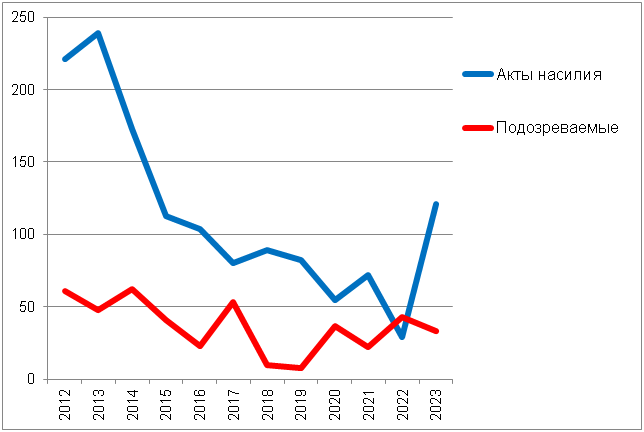
Schedule 1. Violent crimes and persecution for them. Data Center "Owl"
As you can see from this schedule, the dynamics of violence is uneven, but decreased. And in 2022 there was a sharp decline. How can it be explained? Perhaps the point is in shock in connection with the outbreak of war, in which it turned out that the ultra -right ones were along with the entire Russian society.
But in 2023, the number of attacks began to grow rapidly and exceeded 120. That is, last year he overtook the previous eight at once. And the beginning of 2024 does not promise improvements.
But the activation of the persecution for violence was in 2014 (30% compared to the previous year), 2017 (more than double), 2020 (4.5 times) and 2022 (almost doubled). These were the years when violence was reduced, but the persecution of “extremist statements” grew significantly (with the exception of 2017, see the schedule below). And in 2023 there was no such activation, and despite the fact that violence has grown sharply, the reaction to it was clearly insufficient. Perhaps this is due to the fact that the share of murders remains an order of magnitude lower than until 2020, when this share was about 10%.
The main part of those who commit such crimes and are persecuted for them are participants in neo -Nazi groups. Veterans of the neo -Nazi movement for long -standing crimes were also arrested and tried. Since 2021, part of the affairs was rhetorically linked with influence from Ukraine, especially a series of cases of M.K.U. But real acts and their qualifications were quite common for Russian ultra -right.
As for the ideologically motivated attacks on material objects, such cases are investigated much faster than violence: usually from four to six months. Therefore, here, to build a similar schedule, it is more correct to assume that cases are exciting in the same year when sentences are sentenced. We believed the acts of vandalism, taking into account the data of both the Owls and the OVD-Info (excluding episodes that are more correct to understand as acts of sabotage).
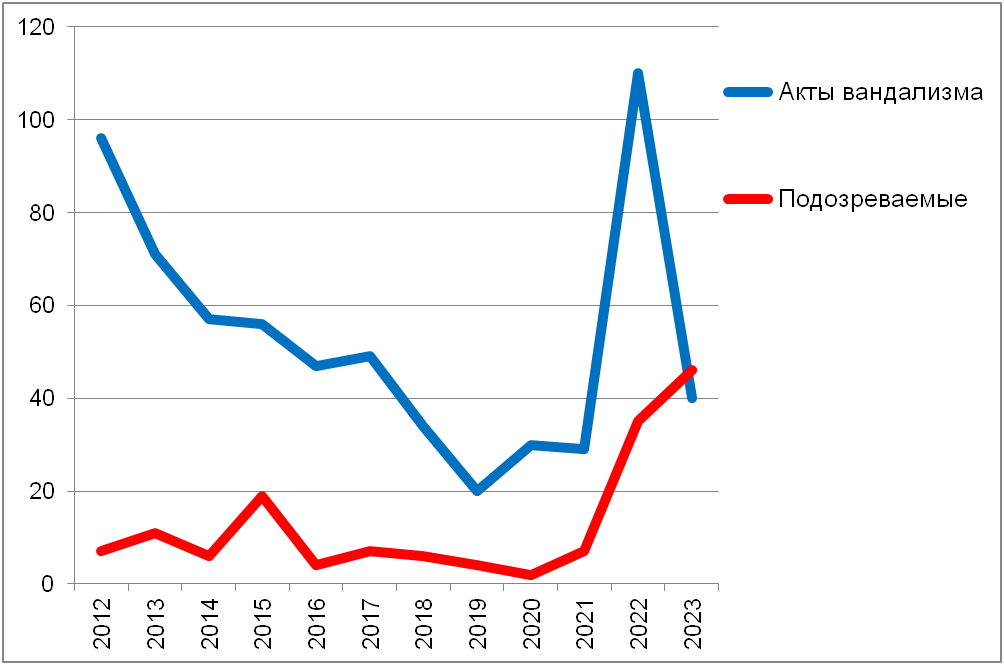
Schedule 2. Vandalism and persecution for it. Data Center "Owl"
Until 2022, the ideologically motivated vandalism was dominated by shares of the ultra -right (although, of course, others occurred). In 2022, in 80% of cases, these were anti-war shares. In 2023, the activity of this kind fell and this kindaroused less . But this decrease was not up to the pre -war level, and anti -war shares were still 55%. True, it should be noted that xenophobic shares with very insignificant material damage, we took into account only in cases where sentences were sentenced to them, and then not always - and this clearly increases the share of anti -war shares in this statistics.
In 2022, the number of such sentences increased the fifth, and in 2023-by another third. The share of verdicts related to war has also increased: from 46% to 54%.
Pursuit of extremist statements
a) criminal law enforcement
Public statements of an ideological nature are covered by an extensive and constantly replenished list of articles of the Criminal Code [2] . The approximate time from the initiation of the case to the entry into force of the sentence is about one year, and we can evaluate the dynamics of the establishment of cases according to the sentences issued a year later. Here we are forced to repeat that it is not only about prisoners of conscience. But Russian courts often greatly exaggerate the public danger of incriminated aggressive statements, for example, according to the most popular article in the last two years on calls for terrorism or justification of one.
The official statistics of the Supreme Court gives data on articles and even parts of articles on the main and additional charges. But at the same time, it does not allow us to understand how different articles of the accusations are combined in sentences and how often (both for statements and on accusations of a different type, which is far from uncommon). That is, from official statistics it is impossible to identify the total number of convicts per year for utterances. Therefore, we analyzed such intersections of the accusations on Owls (they cover approximately half of cases) and extorted the obtained proportions for the entire array. This schedule shows our assessment of the number of suspects of public statements.
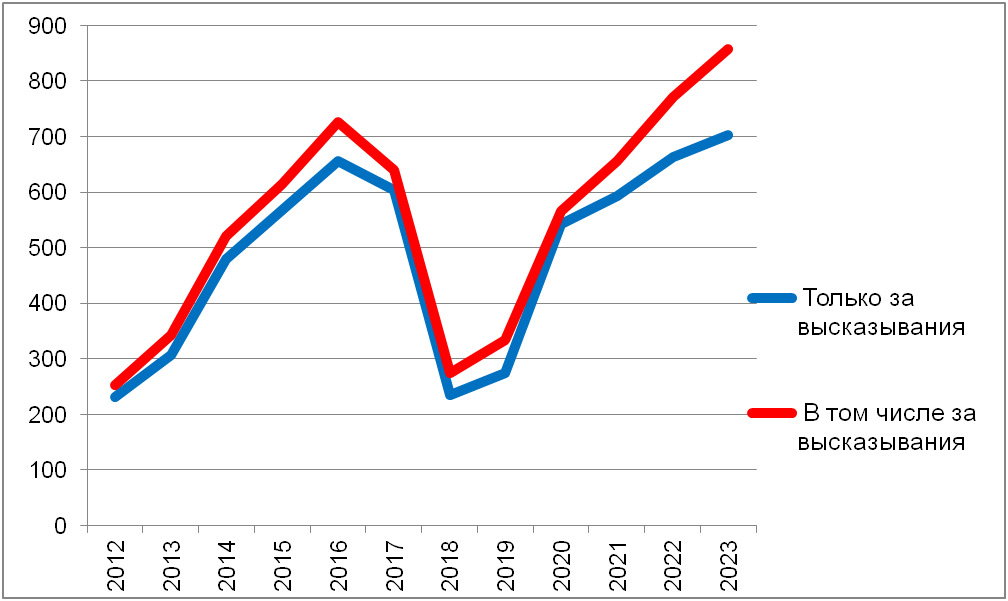
Schedule 3. Suspects on public statements. Assessment based on the official data and data of the Center "SOVA"
We see on this schedule a sharp fall in 2018 (in connection with the reform of the article on arousing hatred) and a sharp increase in 2020. It was in 2020 that the fastest increase in the number of cases for the utterance for the entire period of our observations was recorded-about 70%: apparently, this is a reaction to violent opposition rallies and, we believe, also-the result of the “constitutional reform” that changed the type of political regime.
Judging by the sentences issued in 2023, the first military year did not give a significant increase in cases of statements. About 770 people passed along them, that is, an increase of less than 18%. And if you evaluate the number of cases only for statements, the increase is even less: about 12%.
In the second half of 2023, the traditional increase in the number of sentences in relation to the first was not observed. In general, this means that the process of initiating cases of statements in the last months of 2022 has slowed down (and, perhaps, the average investigation period has become about a month shorter). At the same time, in cases of “fakes” and “re -discrediting the army”, widely known to the public, in the second half of the last year, there were just many more sentences: 2.5 times compared to the first half of the year. But in fact, these articles became the most massive articles.
Since 2022, the most common was the charge of propaganda or justification of terrorism. It put forward more often than a previously leading charge of calls to extremism.
A heavier terrorist article was used in 2022 in almost half the affairs, and in 2023, probably less, but still retained a leading position. And in these two articles in the second half of the year, the growth in relation to the first was more modest than average: only 5-7%.
It was more difficult to build this schedule for 2023. We will tell you briefly how it was done. To assess the number of new cases of 2023, we have less data, since for obvious reasons there is still no data on sentences of 2024. And this creates two problems.
The first is an assessment of the intersection of different articles of the Criminal Code in business. The fact is that articles are often added along the investigation, therefore, information about the verdicts of the intersections of the articles is noticeably more than in information about the initiated matters. Until now, we have rely on the knowledge of the “Owls” about the intersection of articles precisely in sentences, and it is precisely this knowledge that has not yet been about new affairs last year. According to our data, the share of “one-feathers” (not counting the articles of the Criminal Code, not about statements), was almost always higher than 80%, and in 2022-23 was 83 and 82%, respectively. But according to our data on the initiated matters of 2023, it seems that this share has grown to 90%again. But, comparing with the same calculation on the cases of 2022, we understand that by the time of sentences for these cases, the indicator will decrease to about the same 82%. We will come from this.
The second problem is the incomplete and uneven awareness of the “owl” regarding the articles of the Criminal Code. We have the appropriate “Owls' awareness coefficients”, calculated for previous years. The problem, however, is that these coefficients for different articles were stable in time in time and could change last year. At least in the affairs of 2022, they clearly deviated from the usual ones, which is not surprising: practice has changed noticeably. It is impossible to eliminate this uncertainty, but you can try to minimize it. On different articles of the Criminal Code, we considered different grades:
- preservation of last year's indicators;
-Appendix of last year's awareness of the known amounts of affairs per year (in some places this coefficient is almost equal to one);
- extrapolation of the already known “owls” of sentences for the beginning of 2024 to the sentences known to us, issued a year earlier.
Discarding extreme and unlikely values, we received the permissible range of the amount under the articles of the Criminal Code.
Applying the intersection of articles 0.82 to this range, we received the final range from about 770 to 890 cases. If, as a year earlier, add from the OVD-Info not taken into account the “owl” of the “fakes” without a “extremist” motive, the range moved from 795 to 920 cases. Unfortunately, we do not have a way to make a choice in this range, so we have to stop at an average value - 860 cases. What does an increase in the number of cases by 2022 mean by 11% plus or minus 8%.
What proportion of statements that caused these cases had to do with the war? It is impossible to find out exactly. But for those cases when the content of the statements was at least approximately known “Iv.”, we can say that in 2023 there were almost exactly half of such cases. And in 2022, the proportion of such cases was definitely slightly more.
And what is the share of new articles of the Criminal Code entered from the beginning of the war? According to the ATS-Info, the most famous-about the "fakes about the army"-gave 162 cases in 2022, and in 2023-81 cases. That is, it began to be used twice as much. But the article about the “re -discrediting of the army”, respectively, 55 and 85 cases - on the contrary, much more often. It should also be borne in mind that another new article - about the re -demonstration of prohibited symbols - is increasingly applied against AUE *. In general, the “New Articles” were used both years in a quarter of affairs.
b) administrative law enforcement
Administrative persecution for ideological and political statements [3] grew until 2023 very quickly in comparison with the criminal (for the latter we used our assessment, see above).
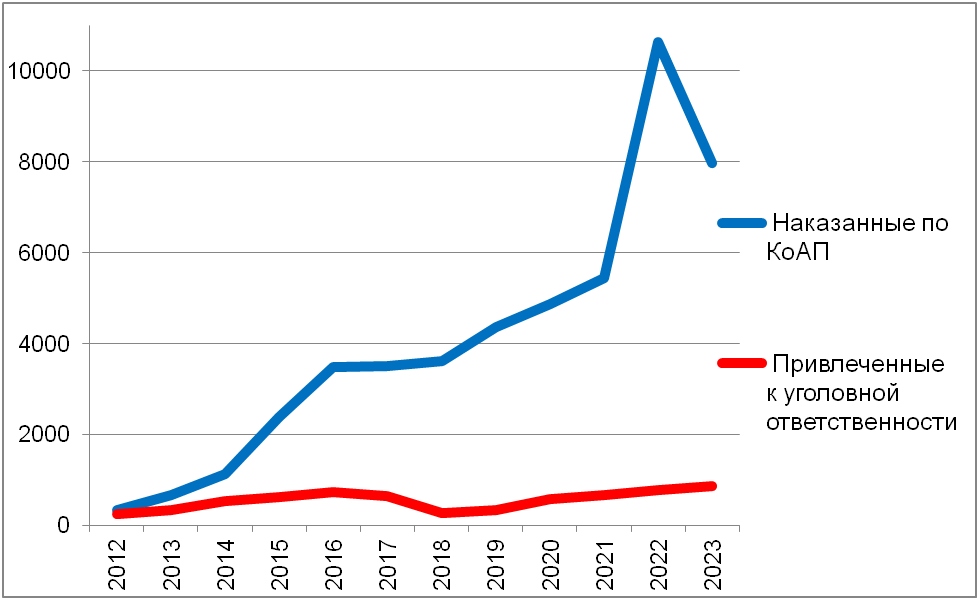
Schedule 4. Administrative prosecution for statements in comparison with criminal. Official data on the Code of Administrative Offenses, evaluation
From this graph it can be seen that the changes in connection with the outbreak of the war were very serious. To delve into them better, let's look at the data on the most “popular” in this area of the Code of Administrative Offenses. Here we rely on the data of the Supreme Court of the Russian Federation, as well as on the data of the Parser of the OTD-Info that are very close to them, since since 2022 official statistics for some reason united two pairs of Code of Administrative Offenses of interest to us, but the Parter allows them to be quite accurately divided.
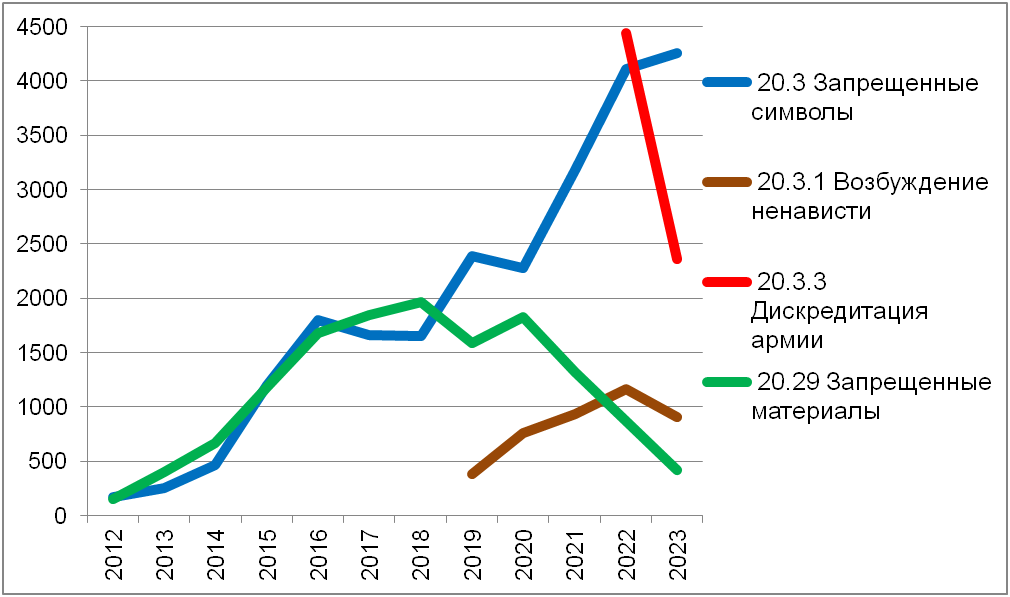
Schedule 5. The use of individual articles of the Code of Administrative Offenses. Official data and assessment of the owl center
In March 2022, an article was introduced on the discrediting of the army and immediately set an absolute record: about 4440 punished before the end of the year. But other articles were used widely: about symbolism - about 4100 times, about the excitation of enmity - at least 1150 times, about extremist materials - more than 850 times.
Together with more rare articles, about 10850 people were punished, that is, almost twice as much as a year earlier.
In 2023, the persecution of “discrediting” and for prohibited materials halved. About 900 people were punished for the excitement of hatred, that is, 250 less and below the pre -war level. But according to the article on the symbolism of affairs - about 150 more. In all together - more than 8100 people. This cannot be called a rollback to the pre -war level, when it was about 5550, but still this is a very significant decrease.
We tried to evaluate the “share of war” in this law enforcement. There are a lot of cases, so the calculations were made selectively and only for 2023. According to our conclusions, in 2023, about 40% of administrative penalties were connected with the war, and in 2022 there were clearly more than half of these: then there were twice as many things under the article on the “discrediting of the army”, the application of which applies to the war.
Criminal prosecution of extremist and terrorist organizations and groups
In this chapter, it will not work to conduct the same quantitative analysis as for persecution for public statements: the degree of awareness of the “owl” greatly fluctuates according to the articles of the Criminal Code [4] , organizations and years.
The average duration of the investigation in cases of this type clearly exceeds one year and clearly varies depending on the articles and even on specific organizations and groups. This complicates the construction of a schedule for the initiation of new cases on the basis of sentences issued by years and articles of the Criminal Code. But quite indicative is the schedule of the number of convicts in total according to the articles of the Criminal Code of this type (the used calculation method according to the Supreme Court is inaccurate, but the inaccuracy is very small). For 2023, we limited ourselves to a conservative assessment based on the doubling of data in the first half of the year (judging by the dynamics of new cases of the last two years, which is mentioned below, the usual exceeding the number of sentences in the second half of the year could not happen). But the forecast of the number of sentences of 2024, it seems, is impossible and we will refrain from it.
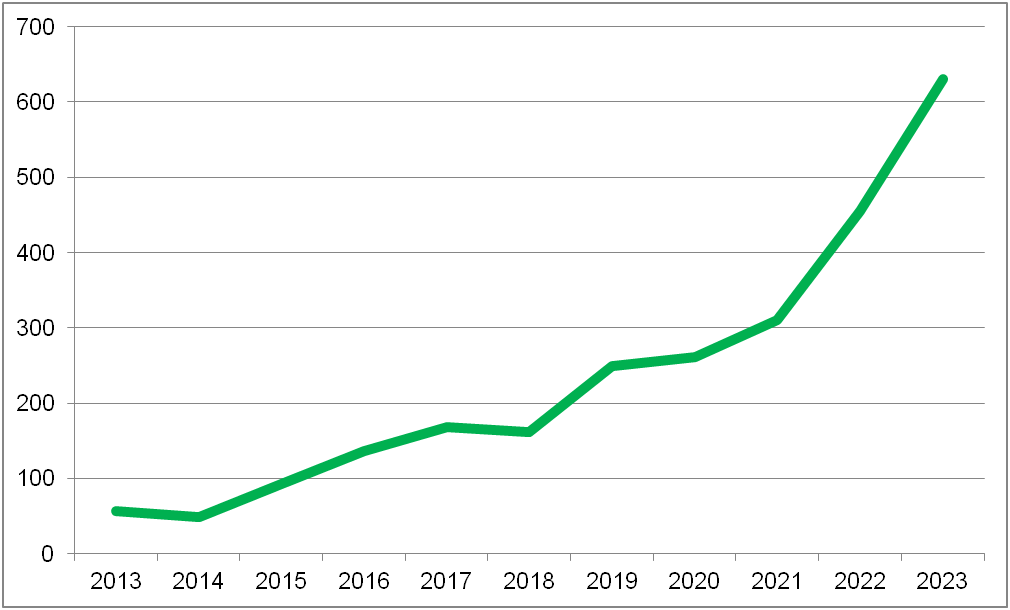
Schedule 6. convicts for participation in associations regarded as terrorist and extremist. Official data in the processing of the owl center
Наблюдаемый на графике резкий рост числа приговоров в 2022-2023 годах — в основном результат дел, возбуждённых ещё до войны. Но в рамках этого материала нереально даже попытаться проанализировать график в целом: правоприменение в этой сфере крайне неоднородно в зависимости от объекта. К тому же у «Совы» есть более или менее систематические данные о преследовании за участие в уже запрещённых организациях и гораздо меньше данных за преследование в экстремистских или террористических группах, спектр которых очень широк: от сообщества сторонников Навального до боевых неонацистских или джихадистских группировок.
Поэтому здесь мы покажем данные только по преследованию за участие в запрещённых организациях, и именно в тех, которые сейчас лидируют по количеству уголовных дел за участие в них. График ниже отображает количество известных «Сове» возбуждённых дел по организациям или группам организаций за военные и последние предвоенные годы (именно по этим организациям мы знаем почти все дела).
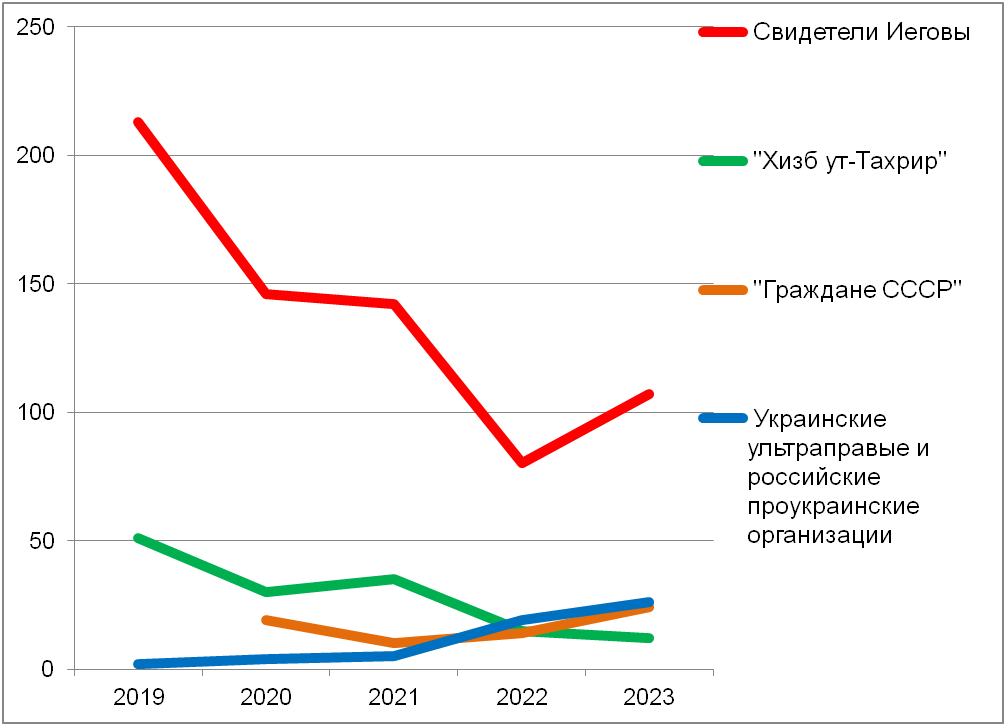
График 7. Приговоры за участие в некоторых запрещенных организациях. Данные Центра «Сова»
Крупнейшая кампания преследований этого типа — против Свидетелей Иеговы* — достигла своего пика в 2019 году: 213 дел. Далее мы видим два резких снижения в 2020 и 2022 годах — то есть в год самого резкого прироста числа уголовных дел о высказываниях и в первый год войны. Правда, в 2023-м спад был хотя бы частично скомпенсирован.
Еще более впечатляющая картина с исламистской партией «Хизб ут-Тахрир» *: мы видим те же два снижения в те же годы, но снижение 2022 года — резче. Более того, в 2023 году мы знаем вообще только о 12 новых подозреваемых.
Первый запрет одной из организаций «Граждан СССР» * в 2019 году повлёк в 2020-м всплеск дел. Потом их стало поменьше, но рост числа дел возобновился, и в 2023 году мы знаем уже 24 новых дела.
Наконец, с 2022 года ожидаемо выросло количество дел в отношении людей, обвинённых в сотрудничестве с запрещенными в России украинскими националистическими организациями. С 2023 года добавились обвинения в сотрудничестве с запрещенными Легионом «Свобода России»* и РДК * (дела на уже воюющих на стороне Украины участников этих групп мы не учитывали, а дела о высказываниях, как-то связанных с этими организациями, учтены в другой главе), и суммарное количество дел оказалось не менее 26. Но, скорее всего, их больше. Дело в том, что по статье об участии в террористических организациях в 2023 году было вынесено необычно много приговоров, и мы об огромной их части ничего на этот раз не знаем. В том числе, видимо, и о быстро расследованных делах, касающихся намерения вступить в упомянутый легион. Судя по всему, эта линия на графике будет идти вверх и в 2024 году.
Conclusions
Что мы увидели
Просто перечислим вкратце основные наши наблюдения.
- Динамика борьбы с насильственными преступлениями явно не совпадает с динамикой самих этих преступлений, а от чего она зависит, непонятно. Возможно, в значительной степени эта часть правоприменения следует общему антиэкстремистскому тренду, а не является собственно реакцией на насилие.
- Всплеск идейного вандализма в 2022 году произошёл за счет антивоенных акций. Количество таких акций затем резко пошло вниз, а вот активность правоприменения продолжила рост.
- Применение административной статьи о «дискредитации армии» дало основную массу «антивоенных» дел. Сокращение её применения более или менее следовало за спадающей активностью самих антивоенных протестов. А вот уголовные дела за «повторную дискредитацию», хотя и сравнительно редки, но быстро множатся, то есть в глазах граждан риск серьёзного преследования наглядно повышается.
- Зато, поскольку административное преследование понимается властями как профилактическая мера, по основной антиэкстремистской статье КоАП — о запретной символике — показатели в 2023 году даже немного возросли.
- Уголовные преследования за высказывания в 2022 году возросли, но далеко не так значительно, как могло показаться по освещению темы репрессий в независимых СМИ. (Вероятно, потому что обычно оценивают не весь политический спектр репрессий, с одной стороны, а с другой — к делам «за слова» добавляют дела за различные милитантные действия.) Прирост числа новых дел оказался немного меньше 18%, а только «за слова» — 12%. И применялись в основном не скандальные новые, а старые, проверенные статьи УК. Это несравнимо с рекордными в этом смысле годами, как 2020-й, когда прирост в сравнении с предыдущим годом составил 70%, или 2014-й — более 50%, и лишь чуть больше прироста 2021 года. Но, конечно, надо помнить, что мы говорим именно о приросте, и с 2020-го каждый следующий год начинает с всё более высокой базы. Так что в абсолютных цифрах был поставлен рекорд за все время правоприменения (обойдя пиковый 2016 год). А активное освещение в медиа усиливало эффект, оказываемый репрессиями на общество.
- В 2023 году прирост по этому параметру тоже наблюдался, но, похоже, менее значительный: оценивая его от 3% до 19%, лучше ориентироваться на среднее — 11%, и тогда только «за слова» — 6%. Зато явно строже стали приговоры. Доли разных наказаний точно посчитать невозможно, но если по данным Верховного суда суммировать наказания по статьям УК о высказываниях только по основному обвинению, то при сравнении 2022 и 2023 годов мы увидим, что доля приговоров к реальному лишению свободы выросла с 26% до 36%, а к условному — упала с 42% до 26%. Сроки лишения свободы тоже выросли: если считать осужденных только за высказывания по данным «Совы» и исключить особо мягкие или особо строгие приговоры, доля приговорённых к срокам от года до трёх упала с 59% до 42%, а доли осужденных к срокам от трех до пяти лет и от пяти до десяти лет выросли соответственно с 9% до 12% и с 22% до 36%.
- Преследование за участие в различных сообществах дает противоречивую картину. Похоже, такие дела с 24 февраля 2022 года появляются чаще, чем ранее. Но не всегда можно увязать динамику возбуждаемых дел с тем, имеет ли то или иное преследуемое сообщество какое-то отношение к войне. Например, «экстремистские» обвинения все активнее применяются и к тем, кто связан (реально или предположительно) с украинскими организациями, и к уголовным деятелям на основе запрета АУЕ*. Зато можно определённо сказать, что сократилось применение статей УК из этой группы по отношению к религиозным и религиозно-политическим объединениям. Все новые организации запрещаются как экстремистские или террористические , но это тоже не всегда имеет отношение к Украине.
- Даже в 2022 году весьма значительная часть антиэкстремистского правоприменения в целом не имела отношения к теме войны. В 2023 году это стало ещё более заметно.
How to understand it
Главная задача антиэкстремистского и антитеррористического правоприменения — предотвратить потенциальные угрозы безопасности и политической стабильности. Разумеется, здесь имеются в виду те представления о стабильности и угрозах (а главное, о мерах необходимой предосторожности), которые существуют у политического руководства страны, а не у правовых или политических экспертов.
Правоприменение имеет и другие цели. Конкретные исполнители сверху донизу заинтересованы в том, чтобы показывать хорошую отчётность, подлаживаясь к гибким и переменчивым требованиям к этой отчётности. А политическое руководство явно использует репрессии в целях пропаганды и, шире, в идеологических целях. Наиболее очевидно это применительно к таким нормам как «реабилитация нацизма» и «оскорбление религиозных чувств».
Наконец, как бы ни было много произвола в правоприменительной системе, она всё же ориентируется на юридические нормы. А эти нормы, в том числе, в интересующей нас сфере, имеют свою логику развития, пусть и причудливую.
В последние пять лет внутренняя логика властей, будь то политическая, бюрократическая или юридическая (или квазиюридическая), подталкивает к расширению репрессий. И естественно, этот импульс усиливается, когда государство находится в состоянии войны.
Но у репрессий есть и свои ограничители. Главный из них — ресурсный. Нам ничего не известно об увеличении штатов управления МВД по противодействию экстремизму или службы ФСБ по защите конституционного строя и борьбе с терроризмом. А ведь их силы теперь в гораздо большей степени, чем раньше, уходят на противоборство со спецслужбами Украины и на борьбу с реальными милитантными действиями: это и умножающиеся преступления ненависти, и разнообразные диверсии.
Штаты можно было бы существенно расширить. Но нам кажется, что советская традиция подсказывает политическому руководству не слишком усиливать аппарат политической полиции. Даже если само политическое руководство в значительной степени из неё вышло. Или как раз именно поэтому.
В антивоенно настроенной части общества весной 2022 года было очень широко распространено представление о том, что теперь наступит «новый 37-й». Эти мрачные ожидания не оправдались, хотя ситуация, конечно, существенно ухудшилась во многих отношениях.
Власти с тех пор ввели новые сугубо политические нормы в УК и КоАП, они практикуют весьма агрессивную внутриполитическую риторику.
Но репрессии они стараются дозировать в соответствии со своими представлениями о масштабе внутренней угрозы.
Конечно, количество «экстремистских» дел не определяется прямо по количеству протестующих на улице или по иному подобному параметру, но всё же нельзя не заметить, что масштаб оппозиционной активности накануне введения ковидных ограничений был явно больше масштаба антивоенных митингов в 2022 году. Поэтому неудивительно, что прирост числа уголовных дел в 2020 году (к тому же — году «конституционной реформы») был настолько больше, чем в 2022-м.
Повторим, что репрессии определяются не только реакцией на волны протестов: есть же и постоянно действующие угрозы. По-прежнему активны боевые неонацисты, джихадисты и иные группы, воспринимаемые властями как опасные (пусть иногда явно напрасно), вплоть до Свидетелей Иеговы* или людей, ассоциируемых с АУЕ*. Мы здесь не говорим о степени правомерности всего этого правоприменения, но нельзя не заметить, что представление о том, какого рода угрозы заслуживают более жёстких мер сдерживания, в том числе антиэкстремистских, постоянно расширяется, дойдя, например, до ЛГБТ*.
При этом власти, помимо упомянутых ресурсных ограничений, вряд ли вообще стремятся к «новому 37-му»: масштабный террор — это всегда непредсказуемость, а ослабление управляемости явно считается при нынешнем политическом режиме одной из главных угроз.
2023 год в целом был спокойнее предыдущего: разные типы репрессий показывали разнонаправленную динамику, а новых репрессивных норм принималось сравнительно немного. Но ситуация войны с её потребностью в идеологической мобилизации подталкивает к расширению репрессий, даже если власти не видят роста угроз для себя. Поэтому, скорее всего, 2024 год станет не годом полной стабилизации репрессивной политики, а годом её расширения. Хотя при отсутствии серьёзных триггеров бурным этот процесс всё же не будет.
* Запрещённые в РФ организации (как реально существующие, так и вымышленные), входящие в списки террористических и экстремистских
[1] Примерно — потому что эта сфера очерчена нечётко. Некоторые уголовные составы (например, «реабилитация нацизма» или «оправдание терроризма») формально в него не входят, но по сути они очень близки. При этом мы не включаем в рассмотрение все многообразие «преступлений террористического характера»: по ним есть своя динамика, очень сложная, в самом общем виде представленная недавно в Re:Russia . Здесь, следует признать, возникает элемент непоследовательности: некоторые насильственные преступления — и в России, и на Западе — относят к экстремистским, а некоторые — к террористическим. Не углубляясь в эту дискуссию, просто скажем, что в нашей статье преступления против личности и собственности, которые обычно квалифицировались бы как экстремистские (так называемые преступления ненависти), будут по сложившейся традиции рассматриваться, а как террористические — нет.
[2] Это следующие статьи Уголовного кодекса РФ:
— 148, части 1 и 2 (Публичные действия, выражающие явное неуважение к обществу и совершенные в целях оскорбления религиозных чувств верующих);
— 205.2 (Публичные призывы к осуществлению террористической деятельности, публичное оправдание терроризма или пропаганда терроризма);
— 207.3 (Публичное распространение заведомо ложной информации об использовании Вооруженных Сил Российской Федерации, исполнении государственными органами Российской Федерации своих полномочий, оказании добровольческими формированиями, организациями или лицами содействия в выполнении задач, возложенных на Вооруженные Силы Российской Федерации);
— 212 ч.3 (Призывы к массовым беспорядкам … или к участию в них, а равно призывы к насилию над гражданами);
— 280 (Публичные призывы к осуществлению экстремистской деятельности);
— 280.1 (Публичные призывы к осуществлению действий, направленных на нарушение территориальной целостности Российской Федерации; если в интернете или СМИ или если уже был наказан за это по КоАП);
— 280.3 (Публичные действия, направленные на дискредитацию использования Вооруженных Сил Российской Федерации в целях защиты интересов Российской Федерации и ее граждан, поддержания международного мира и безопасности, исполнения государственными органами Российской Федерации своих полномочий, оказания добровольческими формированиями, организациями или лицами содействия в выполнении задач, возложенных на Вооруженные Силы Российской Федерации или войска национальной гвардии Российской Федерации; если наступили тяжкие последствия или если уже был наказан за это по КоАП);
— 280.4 (Публичные призывы к осуществлению деятельности, направленной против безопасности Российской Федерации);
— 282 (Возбуждение ненависти либо вражды, а равно унижение человеческого достоинства; если с применением насилия, или использование служебного положения, или группой или если уже был наказан за это по КоАП);
— 282.4 (Неоднократные пропаганда либо публичное демонстрирование нацистской атрибутики или символики, либо атрибутики или символики экстремистских организаций, либо иных атрибутики или символики, пропаганда либо публичное демонстрирование которых запрещены федеральными законами; если уже был наказан за это по КоАП);
— 284.2 (Призывы к введению мер ограничительного характера в отношении Российской Федерации, граждан Российской Федерации или российских юридических лиц; если уже был наказан за это по КоАП).
Также в некоторых случаях публичные высказывания квалифицировались по статьям:
— 213 (Хулиганство);
— 354.1 (Реабилитация нацизма).
[3] Здесь речь идёт о следующих статьях Кодекса об административных правонарушениях РФ:
— 20.3 (Пропаганда либо публичное демонстрирование нацистской атрибутики или символики, либо атрибутики или символики экстремистских организаций, либо иных атрибутики или символики, пропаганда либо публичное демонстрирование которых запрещены федеральными законами);
— 20.3.1. (Возбуждение ненависти либо вражды, а равно унижение человеческого достоинства);
— 20.3.2. (Публичные призывы к осуществлению действий, направленных на нарушение территориальной целостности Российской Федерации);
— 20.3.3 (Публичные действия, направленные на дискредитацию использования Вооруженных Сил Российской Федерации в целях защиты интересов Российской Федерации и ее граждан, поддержания международного мира и безопасности или исполнения государственными органами Российской Федерации своих полномочий в указанных целях, оказания добровольческими формированиями, организациями или лицами содействия в выполнении задач, возложенных на Вооруженные Силы Российской Федерации или войска национальной гвардии Российской Федерации);
— 20.29 (Производство и распространение экстремистских материалов);
А также ещё о трёх, которые не учитывались в графике в этом материале:
— 13.48 (Нарушение установленного федеральным законом запрета публичного отождествления целей, решений и действий руководства СССР, командования и военнослужащих СССР с целями, решениями и действиями руководства нацистской Германии, командования и военнослужащих нацистской Германии и европейских стран оси в ходе Второй мировой войны, а также отрицания решающей роли советского народа в разгроме нацистской Германии и гуманитарной миссии СССР при освобождении стран Европы.);
— 20.1 (Мелкое хулиганство), части 3-5 (Распространение в информационно-телекоммуникационных сетях, в том числе в сети «Интернет», информации, выражающей в неприличной форме, которая оскорбляет человеческое достоинство и общественную нравственность, явное неуважение к обществу, государству, официальным государственным символам Российской Федерации, Конституции Российской Федерации или органам, осуществляющим государственную власть в Российской Федерации) и те же действия с отягчающими обстоятельствами;
— 20.3.4. (Призывы к введению мер ограничительного характера в отношении Российской Федерации, граждан Российской Федерации или российских юридических лиц).
[4] Здесь имеются в виду следующие статьи Уголовного кодекса РФ:
205.4 (Организация террористического сообщества и участие в нем);
205.5 (Организация деятельности террористической организации и участие в деятельности такой организации);
239 (Создание некоммерческой организации, посягающей на личность и права граждан);
282.1 (Создание экстремистского сообщества);
282.2 (Организация деятельности экстремистской организации);
282.3 (Финансирование экстремистской деятельности).
Sources
- Верховский А. Юдина Н. По законам военного времени: как в России борются с экстремизмом после 24 февраля 2022 года // T-Invariant. 2024. 12 мая.