
Translated material
The Insider found more than 6,000 exporters trading with sanctioned Russian firms and military-industrial complex suppliers, 4,000 of them from China
Manufacturing of electronic components in China
Investigations Andrey Zayakin March 11, 2026 The Insider has identified more than 6,000 firms that directly violate restrictive measures by trading with sanctioned Russian enterprises and military-industrial complex suppliers and thereby profiting from the war in Ukraine. About 4,000 of them are Chinese companies, many of the rest are Turkish and Emirati firms. Among their Russian counterparties there are many who are already included in the US, UK and EU sanctions lists, but continue to purchase the goods they need abroad as if nothing had happened.
Content
China is the largest supplier
Türkiye is the supplier of the most important
Why Mass Sanctions Can Work
China is the largest supplier
The Insider analyzed foreign trade data of Russian companies for 2024–2025, considering shipments over $10 thousand, and identified more than 6,000 foreign exporting firms that supplied goods to companies authorized at the beginning of the corresponding year, contractors of the military-industrial complex and directly to the military-industrial complex (this is not a complete list, and only those companies that we were able to identify based on fragmentary data). The infographic below shows the largest of them in terms of export volume.
Among the Russian importing companies that worked with them, The Insider identified several hundred of those that, having already fallen under sanctions from the United States, Europe or Great Britain, continued to buy goods abroad, ignoring the risk of “framing” their foreign partners (and the partners, in turn, ignored the risk of blocking by banks, which usually do not welcome transactions with “tainted” companies).
The Insider also identified Russian firms that were not yet on the sanctions lists, but, according to data on trade within Russia obtained by The Insider, provided goods and services to military-industrial complex enterprises within Russia. They resold other people's goods and supplied their own products based on purchased imported devices. The Insider has found out the names of all the foreign firms that traded with them and is publishing a list of them for the first time.
Strapping, drawing, punching, mandrel drawing, bending, stacking and cutting.
A device for removing workpieces from the oven.
Companies whose primary export items were medical equipment and consumer electronic communications equipment (smartphones, laptops) were excluded from the published list.
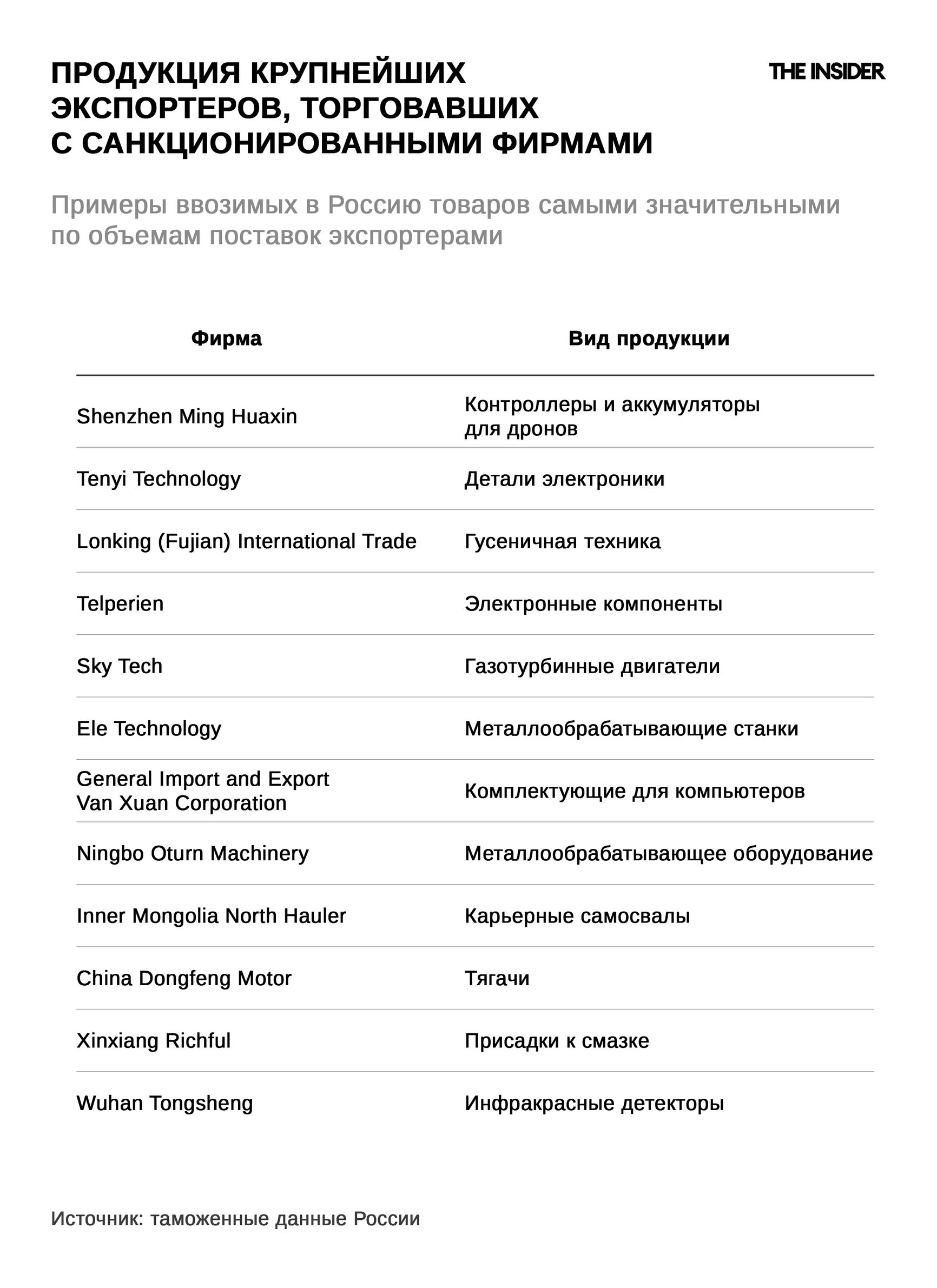
The full list of companies can be found here.
The main countries of origin of exporting firms are China (with Hong Kong), Türkiye, India and the UAE. Together, they provide 2/3 of trade with sanctioned firms and military-industrial complex counterparties.
Strapping, drawing, punching, mandrel drawing, bending, stacking and cutting.
A device for removing workpieces from the oven.
Companies whose primary export items were medical equipment and consumer electronic communications equipment (smartphones, laptops) were excluded from the published list.
Among these companies there were about 4,000 Chinese and Hong Kong, about 300 Turkish, about 120 from the Emirates and 60 Indian.
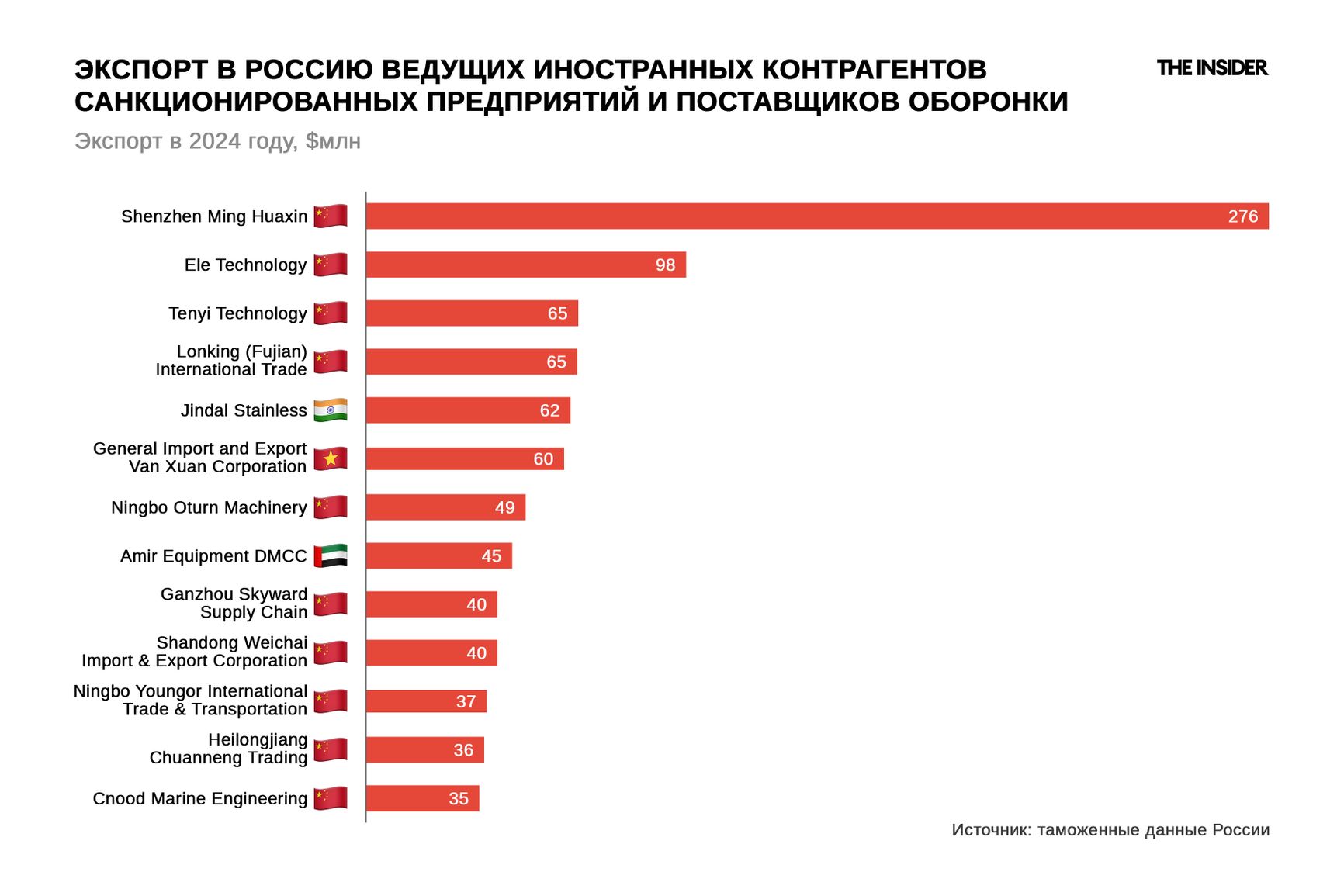
Examples of goods that the largest exporters in terms of supply volumes imported into Russia for sanctioned firms and firms supplying the military-industrial complex are given in the table.
Strapping, drawing, punching, mandrel drawing, bending, stacking and cutting.
A device for removing workpieces from the oven.
Companies whose primary export items were medical equipment and consumer electronic communications equipment (smartphones, laptops) were excluded from the published list.
For example, the Chinese company Henan New Silk Road International Co., Ltd. imported more than a hundred turbojet engines worth about $3 million. A non-existent company was indicated as the manufacturer of the goods. The thrust of such engines is 80 kg, which allows them to be used on large military UAVs (for comparison, on Geraniums/Shaheds the thrust is about 40 kg). The recipient was the Russian Chipdevice LLC, which was included in the sanctions list, but the Chinese seller itself is not yet under sanctions.
The Iset Forging and Mechanical Plant, which produces titanium products, has increased its production 7–8 times since the beginning of the full-scale war. So we can safely assume that production works almost entirely for the military sphere. The company purchased a hydraulic rapid forging press complete with two forging manipulators and a carving machine .
This technique is used for titanium alloy forging and other operations . Seller: Shanghai Yanghuang Trading Co. Ltd. - not under sanctions. Forging titanium is a rather difficult technology due to the poor thermal conductivity of this material. In this way, for example, armor parts for armored vehicles and personal protection are made.
Türkiye is the supplier of the most important
Both in terms of the number of exporting firms and gross imports of goods, China continues to be the leader in trade with sanctioned and military enterprises.
However, Türkiye is the leader among large sanctioned firms and trading partners of the Russian military-industrial complex in terms of the quality of imported goods. 68% of its supplies in the sector of the most high-tech goods (metalworking, non-consumer electronics, optics, equipment for metallurgy and energy, non-household measuring instruments) are high-end equipment made in Europe, Japan and Korea.
For example, for Mobula LLC, which sells machines to military factories, the Turks supplied a vertical milling machine - a five-axis machining center with numerical control manufactured by Leadwell CNC Machines. Such machines are used , for example, by the Kalashnikov concern, which produces small arms and ZALA drones.
The military-industrial complex supplier Soyuz Engineering purchased from Turkey a new five-axis high-performance vertical milling processing center R5A.6 from the Raffaello line from the Italian company Rema Control SRL.
Another military-industrial complex supplier, Sovtest ATE LLC, purchases Italian Seica PCB automatic testing systems (model PILOT V8) through Turkey.
Strapping, drawing, punching, mandrel drawing, bending, stacking and cutting.
A device for removing workpieces from the oven.
Companies whose primary export items were medical equipment and consumer electronic communications equipment (smartphones, laptops) were excluded from the published list.
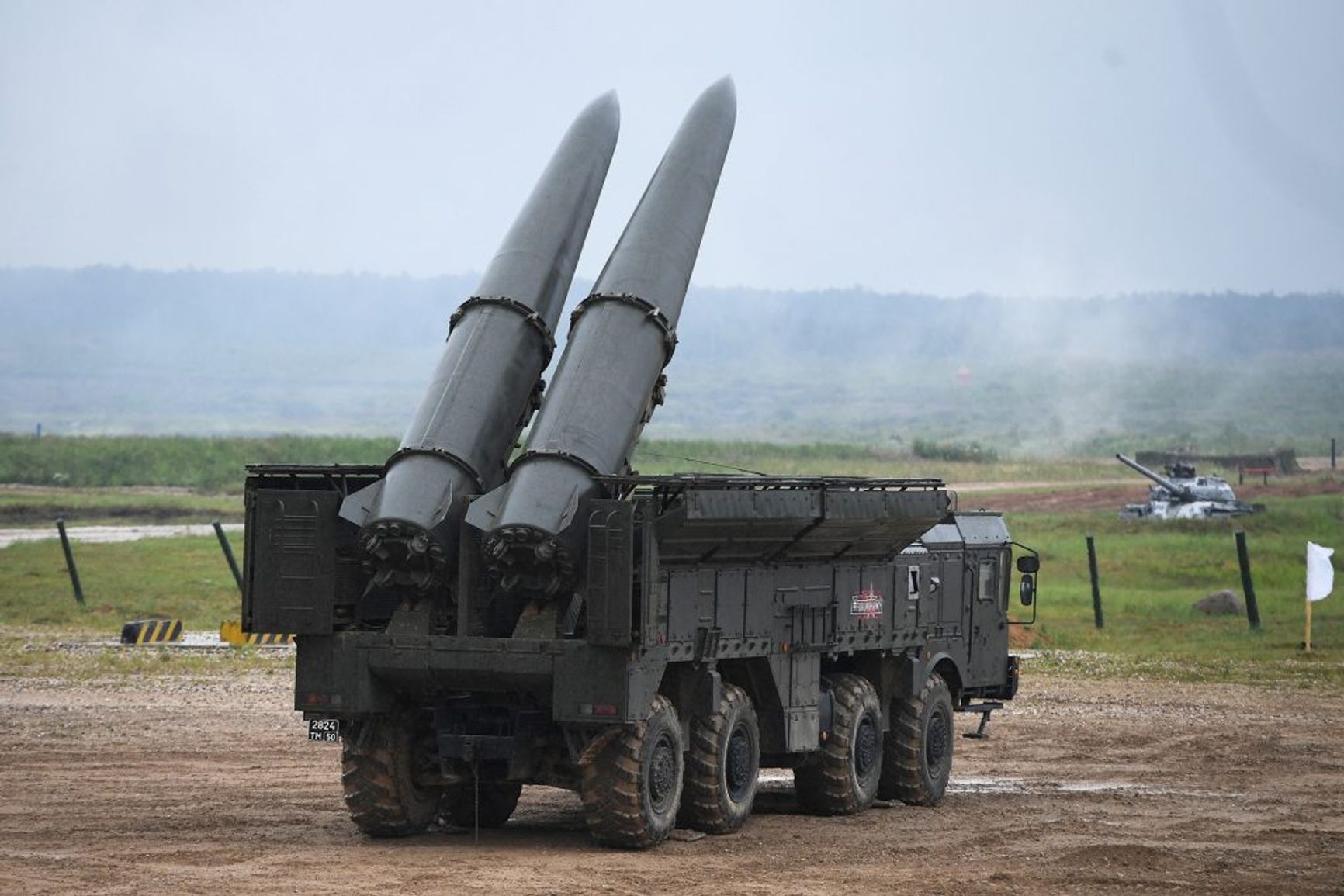
Iskander complex
JSC Ruspolimet purchased through Turkey a used vertical lathe with numerical control with two supports and a turret head (model TITAN SC 43) produced by the Romanian plant Umaro. Ruspolimet is a permanent supplier of titanium and steel rings for the Votkinsk plant in Udmurtia. This plant produces, in particular, Iskander missiles, which use metal rings.
Thus, Türkiye firmly specializes in the resale of high-quality Western equipment to Russia. Chinese supplies are distinguished by large gross volumes, but the quality of products is gradually increasing.
Why Mass Sanctions Can Work
Targeted inclusion of individual reseller companies in the sanctions lists cannot produce much effect and only leads to a switching of exports from one player to another. Many of them are created as shell companies for trade with Russia, so their closure will not be a big problem. If the authorities of Western countries decide to simultaneously include several thousand suppliers of the Russian military-industrial complex on the sanctions list, then this tactic could indeed cause very serious damage to military production for several reasons at once.
Firstly, with such a massive approach, sanctions will inevitably hit not only fly-by-night gaskets, but also those companies that have vital interests in the United States and Europe.
Secondly, such large-scale restrictions can have a serious impact on the only player in this market that knows how and often wants (when it believes it is profitable for him) to stop transactions between Russia and its suppliers - Chinese and Turkish banks. In assessing their risks, banks may decide that dealing with suspicious clients trading with Russia is not worth the risk of sanctions themselves.
Third, even if the majority of sellers are small-scale intermediaries, the mass approach to sanctions will be a big problem for supplies if the adoption of a new sanctions list occurs faster than supply chains can be restructured. Even when using fly-by-night companies, reorienting supplies to other legal entities takes time - it is necessary to register the companies themselves, open bank accounts for them, enter into new contracts, clear goods at customs, etc.
Not in all cases, suppliers of the Russian military-industrial complex are ready to change intermediaries every few months. This means that Western sanctions authorities have all the conditions to get ahead of them in their mobility and “strangle” the flow of prohibited imports.
Strapping, drawing, punching, mandrel drawing, bending, stacking and cutting.
A device for removing workpieces from the oven.
Companies whose primary export items were medical equipment and consumer electronic communications equipment (smartphones, laptops) were excluded from the published list.
ARTICLES ON THE TOPIC
Hiding traces of receipt. Russian customs began to hide data on the import of sanctioned goods
Foreign reagents. The Russian military-industrial complex is critically dependent on the import of chemical products, including Western ones, The Insider found out
Some people are not allowed, others go through customs. The Insider has identified the main brokers of sanctioned imports to Russia
Take it by the bottleneck: 9 vulnerable spots where Russian industry is critically dependent on imports
We really need your help
Sign up for regular donations