
Translated material
"For me all this is a game"
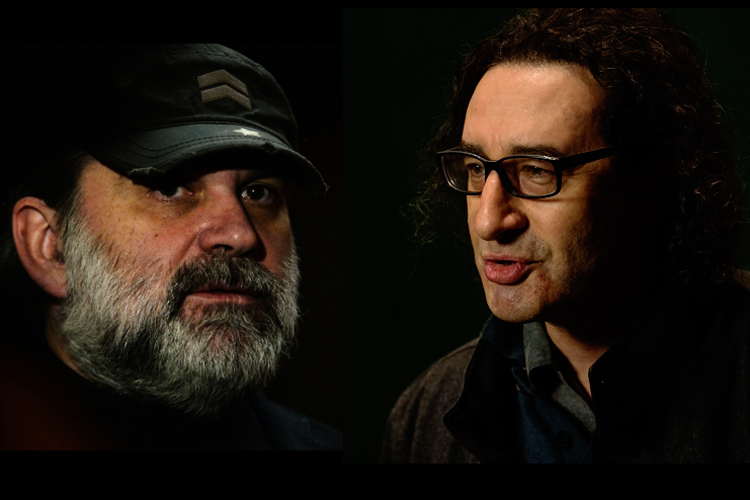
Next week it will turn three years since the director Andrei Molchy led the St. Petersburg BDT, and a new stage has come in the life of the famous theater named after George Tovstonogov. Today we offer the attention of readers COLTA.ru to decipher the conversation of Andrei Mogeli with the artist “Stanislavsky” by Boris Yukhananov, held in early March as part of the project of the Electric Theater “The School of the Modern Spectator and Student” (together with the Institute of Theater and the Festival “Golden Mask”) is a remarkable human document that portraits the head of a large drama hard Better his numerous interviews.
Boris Yukhananov: I am very close to the fate and work of Andrei. Your leadership position in art, a merciless attitude towards yourself - this is a rare quality of directors of our generation. Your risky entry into the structure of the [repertoire theater], an amazing story with Alexandrinka, a new scene that you conceived with Fokin, your festival [“Theatrical Space of Andrei Mogeliy”] - which you make open, frankly and in no way, giving him your name, working on the creation of a cultural context ... and finally, that you headed the PLD: that you headed the HAR This is a huge risk and huge work. How do you build your theater today? What real problems exist in the BDT now?
Andrei Mogly: Remembering now about how I entered the profession, how a formal theater arose, how we ended up in Europe with all our performances, and thinking about how the BDT arose in my life, I thought that the mechanism was the same everywhere: everything always happened besides all logic, and the conflict was always not inside a particular event, but between the event and life. When I agreed to enter the BDT in a rather short time, for me it was a kind of artistic act: it was not in the career perspective, but in the perspective of a new artistic task that was interesting to me as an artist. I even approached the director of choosing as a casting - forming a team as if preparing to work on a new performance.
Therefore, the repertoire policy was largely built from the point of view of the significance or quality of individual performances, but based on the contextual movement. For example, it was very important for me that the first premiere released on the historical scene of the BDT would be the play “What to do?” - And then we would have already figured out what, in fact, to do with this name, with this book. I understood that the first step in the project, which we ourselves called the “BDT Return,” should be sharp enough. It was important to do something intuitive, contrary to logic-for example, the [artist Alexander] Shishkin put the amphitheater from aluminum farms in the place of the stall, which in a large dramatic seemed completely impossible. It was a boring novel, a strange staging - in general, a lot was done in the movement of negation.
Yesterday, one of the journalists asked me, they say, you are engaged in the BDT classic-although I did not put a single classic work in this theater in this theater. "What to do?" - This is a play by Petersburgers Alexander Artemov and Dmitry Ushkov, “drunk” - it is clear that modern drama, “Alice” was composed from scratch at all ... But this year I really move to classical texts - to “Thunderstorms”, to “Dead Souls” - in a space that had already saturated in the BDT of the explosion. Somehow I feel this logic: now we are experiencing such a period when the material chosen by the theater should not blow up the situation-it must balance it. I feel that way.
Yukhananov: It is clear that in the management of such a large ship as the BDT, there is a lot of necessary passive tolerance, without which, probably, it is impossible. But where you realize your strategy, tolerance does not work - there are other, sometimes merciless, criteria. In this sense, I was interested in your phrase about returning - what do you mean, what do you want to return to? To bright relations with the society that this theater had once had?
Mighty: The BDT in this sense is a completely special theater: the name of Tovstonogov is unusually powerfully present in it, despite the fact that Georgy Alexandrovich himself was terribly afraid of the canonization and literal repetition of what he did. But this is exactly what, in my opinion, happened. Having crossed the BDT threshold, it was logical to forget this name as quickly as possible - such a powerful weight of Tovstonogov’s authority does not allow the joints to work, your own energy is suppressed instantly. But it was this path that seemed false to me. And our team, on the contrary, began to be very attentive to the past BDT - it seemed to us that the most avant -garde, most radical move would make maximum efforts in order to make the name of Tovstonovov fashion again. And at the same time, to understand what the meaning of his reforms was, if they were, what was the meaningful meaning of that era - and what, in fact, Tovstonogov did for the theater.
Yukhananov: Will it not be so that the more precisely we will open the essence of the past, the faster we will part with it?
Mighty: we devote really a lot of time to study the first ten years of Tovstonogov in the BDT-since 1956 and later: these were the most powerful, explosive years when he made his best performances. They were charged with the same problems that I exist today - the human position continues to be relevant. It is clear that the theater is about "here and now", that purely aesthetically all a thousand times has managed to change. But, oddly enough, when I talked with people who worked with the Tovstonogov, it seemed to me that from a purely professional point of view, his method is quite relevant for itself. He was a person who is scary in himself - which seems to me a dignity for an artist who was looking for authenticity in the present. All this on the fundamental, on the methodological level remains very important - take at least the idea that the classics cannot be set as a classic, that the performance is doomed to failure, if the classic is not put as a modern play. Or, for example, when Tovstonogov says that there are no restrictions in art: he thought that it was impossible to play a classic work in modern costumes, but he looked at the performance of Peter Brook in Paris - and only in the thirtieth minute he realized that the costumes were by no means historical. Brooke killed a stereotype in it.
It is terrible to be irrelevant.
Yukhananov: The personality wins with history, and the method always loses - over time it turns out that the ideology is not hidden in the personality, but in the method. The method is always ideological - and this is a rather serious problem with education: what will we transmit, personality? It is impossible to convey it. Transferring the method means subordinating a person to his own ideology. Is it possible then to talk about education today, especially about the director's? How do you see him?
Mighty: You and I were recently at the master class of your teacher [Anatoly] Vasiliev-I listened admiringly and immediately went to use: why, in fact, not try? We are all collectors, scoring from different sources, borrowing something from each other, digesting all this-and in this way they create their own personal method of individual directing. I think that no teacher can name his own students, but everyone can call their teacher. My son recently graduated from the Faculty of VGIK, and I decided to give him my favorite book in aiterly-a very rare brochure, Andrei Tarkovsky's lectures on directing. Give me, I think, I’ll spill it in the end-and she is all out of my notes. I have not opened it for thirty years - and suddenly I realized that all this time I spoke Tarkovsky’s texts: my ideas were not even mine at all. After all, there is such a feature of the theater profession - parasitization and appropriating.
Yukhananov: In communication with you, it becomes obvious that you are a person by no means a totalitarian property. Does this complicate your life in the BDT? Are they expecting totalitarianism from you?
Mighty: I think that love is omnipotent .
Yukhananov: Doesn't it seem to you that the modern theater has completely fucked up? What did people find in a situation of incredible dependence on their own position of modern directors? Do you want to blow up all this and do something completely different than expected brothers by profession and a small bunch of lovers of contemporary art in general and the theater in particular?
Mighty: it is very scary to be irrelevant. The digital era, when everyone is a writer, photographer, artist, makes a particularly acute issue of criteria. As the head of the latest movements of the Russian Museum, Alexander Davidovich Borovsky, once told me, seeing the work of some performanists, "I have not yet appointed them to artists." So it is in the theater: what is prescribed by art, then art begins to be. Of course, it is difficult to put up with this - even to us postmodernists. Returning to the question - yes, today we live in the era of fucked art. Although the theater has its own distinctive feature-this is a negative art: the audience comes to the hall, buying a ticket, it is not clear what, not knowing what she sees, sits in the hall for a long time, from where it is not easy to take and go out-all these certain criteria still retains.
Yukhananov: Is the commercial theater possible today-professional, cool, but completely dependent on the box office? And is a non -profit theater possible in Russia? And if neither one nor the other is impossible, then what happens here at all - what do we deal with the theater?
Mighty: I want to quote the Sesapes in response, the person’s very respected person writes: “It is cool when the theater is higher than criticism, above the festivals, above all this party. When the main thing is the tickets sold for performances in which there is a genuine meaning. This is a rack. "
Yukhananov: Sovetskaya vocabulary. I think that the words about the genuine meaning are intolerable for the theater and are generally extremely dangerous: someone assigns the truth to himself-and this leads to fascism. The box office does not make the theater fascist, it makes it democratic, but the reasoning about the genuine meaning put the theater on the path of ideology.
Mighty: I think that when you put the performance, you are appointing this meaning yourself.
Yuhananov: No, I can avoid the point and with the help of this to make a performance. This is a technique. So is it possible, in your opinion, to engage in a commercial theater in Russia?
Mighty: It seems to me that yes. And at the same time he can remain semantic ...
Yukhananov: ... given the box office?
Mighty: Yes, and this is almost the most important task for me today: if you want it, but 780 seats in the BDT need to be sold every day. When the Ministry of Culture tells us that the subsidies will directly depend on the cash desk, that is, on the number of spectators, we can argue very much with this, which we do, but still we have to live in such a system of coordinates. Despite the fact that making money is not so difficult: two or three tricks-and the hall is full, we all know that. But for a great dramatic, such a way seems wrong to me.
The artist in my head still prevails over the manager.
Yukhananov: Where there is an enlightened democratic power of the box office, at the same time there is no repertoire theater as a class. He simply cannot exist in a casting power situation over the actor. You have to start work on each performance with a casting, and then in front of you the sea is poured with capabilities, an actor in front of you on a string, you can choose anyone-and then you can do, as you put it, a meaningful performance, at the same time satisfying the thirst for the box office. If you are dealing with a repertoire and if it’s too late for you to trade its former glory and fading stars, then what kind of tools do you use to cope with the box office? Especially if you are included in the infrastructure that serves today quite primitive moods - both propaganda and vital, which is filled with the present time.
Mighty: The audience of the theater is incomparably small compared to the audience of television. But I am firmly sure that any project can find its buyer - although this, of course, is always the risk and problem of lazy administrators. But if the project is understood by analysts, brought to the stage of goods, it can be sold - in this logic and it is necessary to exist.
Yukhananov: But for this, it is necessary to increase the culture of producing and marketing the theater, to admit that the theater is located on the marketing territory, to understand that an integral part of the producing the theater is an enlightened active marketing ... I’ll ask about another. You say that your creative self-awareness has not changed over time-you are aware of integrity, developing, but still the same artistic body as in the late 1980s.
Mighty: movements were different, but the motivation is always alone, yes.
Yukhananov: Once upon a time, certain figures seemed absolutely great to us-Grotovsky, Brooke, Arto, Craig ... Did you have a configuration of this starry sky, did other guidelines in the theater, dramaturgy, and cinema appeared? Has the picture of the world expressed in personalities changed?
Mighty: did not change, but supplemented: Vasiliev, Nyakroshus, Lupa, Persianal, Mitchell ...
Question from the audience: What educational programs exist in the BDT and what are they needed for?
Mighty: We took several steps in this direction. On the one hand, they held a pedagogical laboratory in the calculation of secondary schools - teachers came to the BDT, with whom Boris Pavlovich was engaged in: the theater as instruments of teaching and the theater as an object of attention - how to watch performances, how to evaluate them. On the other hand, there are social projects with the center “Anton here is nearby”, with the wards of which the same Boris Pavlovich made the play “Bird Language”. We implemented the program “New People” based on the motives, of course, Chernyshevsky - schoolchildren under the leadership of the playwright wrote essays about what a new person is today. And, of course, discussions after "What to do?" - topics that we did not have time to comprehend in the play were discussed already in a situation of open dialogue. In general, the desire to talk with each other is enormous-therefore, performances built in the form of a dialogue are more interesting today and are in demand by a box office. As for all our projects and programs, they are inextricably linked with the repertoire: the main generator of the meanings and ideology of the theater is a large scene.
Yukhananov: How many projects are planned for your year on the historical scene, have any statistics?
Mighty: no statistics.
Yukhananov: But how can the Bolshoi Theater not plan its activities a year ahead?
Mighty: striking, but maybe. I said at the beginning that all this is a perfect game for me. Artistic game. Honestly, I will tell you: I do not always know what my next move will be - intuition is more important to me. Even this season, the planned names changed several times along the way. I create a complex system of supports, which allows planning to be very flexible and fast. My genuine dream is to come to long-term planning, but the artist in my head still prevails over the manager. At today's stage, this seems more important to me. The repertoire policy, the theater strategy should sprout, they must be natural, artistically grown - and only after that recorded in specific plans. This situation requires, of course, additional resources, primarily human, work on wear, possibly the change of personnel. Another question is that in the future I want to make an attempt to reform the forms of the existence of the repertoire theater - leaving it repertoire. But we will talk about this somehow another time.