
Translated material
Against Hitler and against Superman
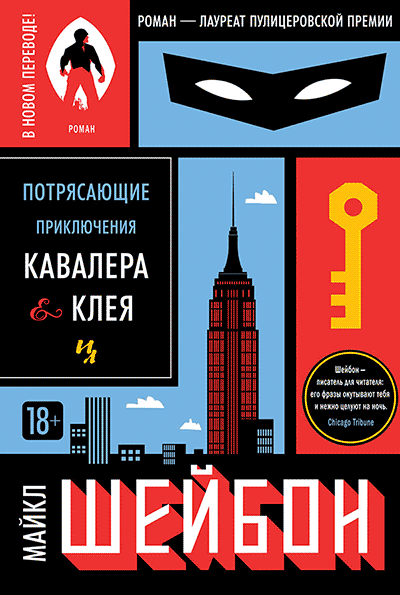
Bloggers read the Foreign List of Yasnaya Polyana: Michael Sheibon "Stunning Adventures of the Cavalier & glue"
Michael Sheibon. Stunning adventures of a gentleman & glue. M.: ABC-Atticus, 2018. Translation by A. Gryzunova
Vera Kotenko , Telegram channel of the book about books
After the well -known statement of the Minister of Culture Vladimir Medinsky on the Internet, the flash mob #sloopers continues, which means that it is time to talk about our cavalier and Klee Michael Sheibon, who was on the Yasnaya Polyana list thanks to the nominee Yegor Mikhailov.
Schaybon got the “idiotic” love of comics by inheritance from his father - he also loved them, as the son of Sheibon himself now loves. It is not surprising that it was the book about the comics that became the bestseller of the New York Times, brought the writer the Pulitzer Prize in 2001, and the below of Ellis called it one of the three greatest books of his generation. “Stunning Adventures” - a book about the so -called gold age of comics. The book itself is also a comic book: its superheroes and supervillains, super conflict, a little mysticism, Jewish jokes and the history of the United States, which as a result gives an explosive mixture, a crazy book, to the same extent as a great one. Sheibon is the walls from literature. But he is not very lucky with film adaptations: the “Union of Jewish Polisen” tried several times to shoot, but the projects failed (even the Cohen brothers, as a result, were rumored to be rumored). The same thing with “amazing adventures”: they were going to make a movie several times (even Juda Low was almost persuaded), but did not work out, and continues not to fold every time. Not in vain Shibon with frank irritation speaks of Hollywood, be it wrong.
The heroes of the heibon are fighting with evil as they know how they can create heroes who, in the drawings, are tapping on the head of a bad black mass of enemies coming from somewhere in the east. However, it is one thing to draw murders, another thing to do them yourself, that is, to step over this drawn border and even erase it.
Actually, the novel itself about “amazing adventures” seems nothing more than a belated, but peculiar crusade against such cultural ministers - the sheibon also had a reason, who was called Frederick Vertam. Vertam is an American psychologist and face of the "anti -partic" movement. Once he remarked: "Compared to the comics industry, Hitler is nothing more than a beginner." The result of all his efforts was the creation of a comic book code, according to which violence in the comics was completely prohibited, and the good was always obliged to win the bad.
In principle, the advantages of such events are obvious - “amazing adventures” are written. There must be at least some benefit from Vertam.
Assessment: 8/10
Victoria Gorbenko , Telegram channel of the bookviki
“The Stunning Adventures of the Cavalier & glue” is a great novel about how a large art grows in the ten -center dream market. The main characters are Jewish boys Joseph Cavalier and Samuel Kleiman, who managed to bite off a healthy piece from a nicknamed pie at the very dawn of the comic book. One of them is an amazing draftsman, the other is a talented writer, together they created an escapist, a hero-liberator of all oppressed, capable of being rebuffed by Hitler's figure to the world evil.
Schibon deftly combines fantasy with reality, giving the creations of a gentleman and glue recognizable features of real graphic novels and introducing real characters into the plot - from Salvador Dali to Stan Lee. At the same time, the main narrative is periodically interrupted by inserts with the adventures of the escapist, and the novel begins with the mystical history of the salvation of Joseph from occupied Czechoslovakia. The fact is that he manages to escape, hiding in a coffin with Prague Golem, clay giant, defender of the Jewish people. Sheibon draws a bright and convex portrait of New York, in which the echoes of the Second World War are heard in the noise of crazy katezh, and the Holocaust time coincided with the golden age of comics.
Schibon subtly captures the essence of the comic book as the art of the weak, in which broken outsiders gain great power. The characters of the gentleman and glue broadcast the languor of the whole generation of "weaklings, an amateur and scapegoat." Since the late 1930s, nothing has changed in this sense, and superheroes still draw power from injuries and a sense of their otherness.
As the plot develops, the prejudices about the comic book as a low genre intended exclusively for children and idiots are also crumbling. The cavalier and glue first invent motivation, which should provide the characters with psychological reliability, and then, inspired by the “citizen Kane” Wells, realize that the power of the comic book as art is consisted with the conjugation of the narrative and the visual series, in the original combinations of which there are a lot of opportunities for creative self -realization. No type of art is no worse than another a priori - a matter is always exclusively in the genius of the Creator.
To whom to read: Vladimir Medinsky and in general, to everyone who still thinks that comics are for morons. Those who know that this is not so, to read all the more and without fail.
Assessment: 8/10
Evgenia Lisitsyn , telegram channel GreenlampBooks
In the novel “Atonement” by Ian Mcueen, the main character converts artistic fiction into a kind of currency. She does harm to people with almost literary sciences, and then in the same way she tries to atone for his guilt in the form of literature and come up with a beautiful and elegant fate to the victims. In the “Adventures of the Cavalier and glue” something similar happens, but with the help of art, the heroes fight not so much with their own conscience as with the imperfection of the world. Well, what, everyone has their own weapons. It would be stupid to wield with fists and shoot from a rifle if you have the strength like a sparrow, and accuracy like the attack aircraft from Star Wars. Everyone fights the way he can.
The art in the novel is comics. If the “gentleman and glue” was written about sculptors or musicians, the idea of art-boring also rolled, but there would be less convex. Comics, bright, exaggerated, often say something right in the forehead, and they are just good, because they can instantly react to all the topical and exciting large masses of the people. While you still sculpt the sculpture there, in which Apollo or Athena is trampled by the feet of a gypsum Hitler. But you can draw muzzle quickly - and it will see the people much more.
 Of course, Michael Sheibon’s novel is not only about the fight against problems at different living standards. To start listing the problems means to get bogged down for the whole evening in the wording of topics for school works. This is not required. It is much more important to mention that a real strong American novel (the great, of course, multi-page) for most consists of the realities of a particular country, but at the same time still manages to leak out a little to a larger level, if not world, then at least psychological-for certain personalities. For American -centric prose, this is a rarity that needs to be protected and distinguished so that they do not close there in the very small town literature.
I am sure that in a hundred years it was this novel by Schiibon that will be studied with a magnifying glass and write multi -page monographs that occupy much more pages than the text of the work itself. But this is then, and now we can afford to enjoy a magnificent novel without unnecessary pees and tests. If you do not find for yourself in the novel at least something consonant among the variety of lines, characters and problems, then, by golly, you are some kind of alien, not a person.
I wish everyone to read, even those who are afraid of comics like fire. Perhaps you will change your opinion.
Assessment: 10/10
Vladimir Pankratov , Telegram channel "Stonener"
The novel about the two artists of the cavalier and Klee, who came up with their comic-hero, in contrast to Superman, managed to make him popular and thereby make an obvious historical contribution to the development of the comic industry (it must be remembered that neither glue nor a gentleman never existed), he himself was written as an exciting comic book in which the pictures were suddenly replaced by letters. The text here, on the one hand, like a script for the film, on the other hand, you need to peer into dense paragraphs as in detailed scenes, otherwise you can just miss half of what has been said. It seems, with its long, whirling sentences, Shibon seems to seek to convey that passionate dynamics that was on the covers drawn by Joseph Cavalier. For the same reason, with this text you can choke and, tormenting, throw it somewhere in half; However, the very idea of writing about the creators of comics in a swift, torn manner characteristic of the comics themselves causes only respect.
Actually, the “adventures” are called so because it is not just a Bayopic about the two guys who found their own business, but the adventures of heroes who half live in reality themselves. Sheibon’s novel is generally a text located on the border of several worlds. This is a very American story about Self-Made Men from dysfunctional families that have been patience, plowed like donkeys and were rewarded for this. This is the story that miracles are not only in books, and the weak worlds are heroic not only in their own dreams. Of course, this is the story of the American 30-40s, where the creators of the comics could converge at one party (which many are still laughing at) and Salvador Dali-and about the same time in Europe, when people were ready to part with their children, just to save them from the advancing fascism. The story is so multifaceted that you don’t even know who to advise it. Medinsky, probably, excuse me for the truism.
Assessment: 7/10
General assessment: 8/10
* * *
Here you can read about other books from the long list of the Yasnaya Polyana prize in the nomination "Foreign Literature":
Paul Oster "4 3 2 1" - 8.75/10
Jonathan COU "Middle England" - 8.5/10
Dan Simmons "Terror" - 8.25/10
Richard Russo Empire Falls - 8.25/10
Oygen Ruga "Days of Decreasing Light" - 8.2/10
Viet Tan Nguyen "Sympathetic" - 8/10
John Boyn "History of Loneliness" - 7.75/10
Ali Smith "Autumn" - 7.75/10
Syuw "Skugga-Baldur" -7.6/10
Kolm Toybin "House of Names" - 7.5/10
Ernan Rivera Letelier “The Art of Resurrection” - 7.5/10
Julian Barnes “One History” - 7.4/10
Tibor Fisher “How to rule the world” - 7.25/10
George Saunders "Lincoln in Bardo" - 7.25/10
Evelyio Rosero "War" - 7.25/10
Robert Menassa "Capital" - 7.25/10
Celeste ING "And fires smolder everywhere" - 7/10
Olga Tokarchuk "Runners" - 7/10
Milenko Ergovich "Gloria in Excelsis" - 7/10
Neil Mukerji "Status of Freedom" - 7/10
Eka Kournian "Beauty is Woe" - 6.6/10
Maya Lunde "History of bees" - 6.25/10
Bi Fayyu "Chinese massage" - 6/10
Marius Wilk "Through the Wild Goose" - 6/10
Masachiko Simada “Canon, sounding forever” - 5.75/10
Whether the son of the "secret life of plants" - 5.4/10
Anne Patettt "Belcanto" - 5.4/10
Kristina Dalcher "Voice" - 4.25/10